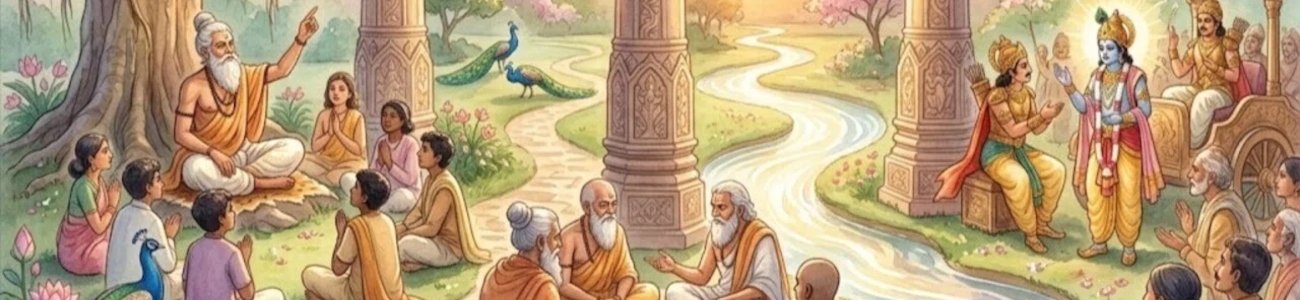
AKA Vedanta Sutras or Shariraka Sutras
Author: Sage Badarayana
The Brahma Sutras are a foundational text of Hindu philosophy, specifically the Vedanta tradition. Written by the sage Badarayana (often associated with Vyasa) around 400–450 CE (with older origins), the text consists of 555 concise aphorisms (sutras) organized into four chapters.Their primary purpose is to systematize and harmonize the teachings of the Upanishads, which can often seem contradictory at first glance.
The Three Pillars of Vedanta
The Brahma Sutras make up the first of the Prasthanatrayi ("three starting points") which form the basis of all Vedanta philosophy. The other two pillars are:
The Upanishads (The foundational revelations)
The Bhagavad Gita (The practical application of philosophy)
Chapter 6: 2.2
2.2
Verse #1
Vaisesika Objection Refuted |
oṃ mahaddīrghavaddhā hrasvaparimaṇḍalābhyām oṃ 2.2.11.. ||
Vaisesika Objection Refuted |
o mahaddirghavaddha hrasvaparimanalabhyam o 2.2.11.. ||
Sw. Krishnananda
(The world may originate from Brahman) as the great and the long originate from the short and the atomic.
Verse #2
oṃ antyāvasthiteścobhayanityatvādaviśeṣat oṃ ||
o antyavasthitescobhayanityatvadavisesat o ||
Sw. Krishnananda
And on account of the permanency of the final (size of the soul on release) and the resulting permanency of the two (preceding sizes), there is no difference (of size of the soul, at any time).
Verse #3
Samkhya View Refuted (Impossibility of Design) |
oṃ racanānupapatteśca nānumānam oṃ 2.2.1.. ||
Samkhya View Refuted (Impossibility of Design) |
o racananupapattesca nanumanam o 2.2.1.. ||
Sw. Krishnananda
That which is inferred, (by the Sankhyas, viz., the Pradhana) cannot be the cause (of the world) because (in that case it is) not possible (to account for the) design or orderly arrangement (found in the creation).
Verse #4
oṃ pravṛtteśca oṃ ||
o pravttesca o ||
Sw. Krishnananda
And on account of the (impossibility of) activity.
Verse #5
oṃ payo'mbuvaccettatrāpi oṃ ||
o payo'mbuvaccettatrapi o ||
Sw. Krishnananda
If it be said (that the Pradhana moves or spontaneously modifies herself into the various products) like milk or water (without the guidance of any intelligence), (we reply that) there also (it is due to intelligence).
Verse #6
oṃ vyatirekānavasthiteścānapekṣatvāt oṃ ||
o vyatirekanavasthitescanapeksatvat o ||
Sw. Krishnananda
And because (the Pradhana) is not dependent (on anything), there being no external agent besides it (it cannot be active).
Verse #7
oṃ anyatrābhāvācca na tṛṇādivat oṃ ||
o anyatrabhavacca na tnadivat o ||
Sw. Krishnananda
And (it can) not (be said that the Pradhana modifies itself spontaneously) like grass, etc., (which turn into milk), because of its absence elsewhere (than in the female animals).
Verse #8
oṃ abhyupagame'pyarthābhāvāt oṃ ||
o abhyupagame'pyarthabhavat o ||
Sw. Krishnananda
Even if we admit (the Sankhya position with regard to the spontaneous modification of the Pradhana, it cannot be the cause of the universe) because of the absence of any purpose.
Verse #9
oṃ puruṣāśmavaditicettathāpi oṃ ||
o purusasmavaditicettathapi o ||
Sw. Krishnananda
If it be said (that the Purusha or Soul can direct or move the Pradhana) as the (lame) man can direct a blind man, or as the magnet (moves the iron), even then (the difficulty cannot be overcome).
Verse #10
oṃ aṅgitvānupapatteḥ oṃ ||
o angitvanupapatte o ||
Sw. Krishnananda
And again (the Pradhana cannot be active) because the relation of principal (and subordinate matter) is impossible (between the three Gunas).
Verse #11
oṃ anyathānumitau ca jñaśaktiviyogāt oṃ ||
o anyathanumitau ca jnasaktiviyogat o ||
Sw. Krishnananda
Even if it be inferred otherwise on account of the Pradhana being devoid of the power of intelligence (the other objections to the Pradhana being the cause of the universe remain in force).
Verse #12
oṃ vipratiṣedhāccāsamañjasam oṃ ||
o vipratisedhaccasamanjasam o ||
Sw. Krishnananda
And moreover (the Sankhya doctrine) is objectionable on account of its contradictions.
Verse #13
Atoms Not the Cause of Universe |
oṃ ubhayathāpi na karmātastadabhāvaḥ oṃ 2.2.12.. ||
Atoms Not the Cause of Universe |
o ubhayathapi na karmatastadabhava o 2.2.12.. ||
Sw. Krishnananda
In both cases also (in the cases of the Adrishta, the unseen principle inhering either in the atoms or the soul) the activity (of the atoms) is not possible; hence negation of that (viz., creation through the union of the atoms).
Verse #14
oṃ samavāyābhyupagamācca sāmyādanavasthiteḥ oṃ ||
o samavayabhyupagamacca samyadanavasthite o ||
Sw. Krishnananda
And because in consequence of Samavaya being admitted, a regresssus ad infinitum results on similar reasoning (hence the Vaiseshika theory is untenable).
Verse #15
oṃ nityameva ca bhāvāt oṃ ||
o nityameva ca bhavat o ||
Sw. Krishnananda
And on account of the permanent existence (of activity or non-activity, the atomic theory is not admissible).
Verse #16
oṃ rūpādimattvācca viparyayo darśanāt oṃ ||
o rupadimattvacca viparyayo darsanat o ||
Sw. Krishnananda
And on account of the atoms possessing colour, etc., the opposite (of which the Vaiseshikas hold would take place), because it is seen or observed.
Verse #17
oṃ ubhayathā ca doṣāt oṃ ||
o ubhayatha ca dosat o ||
Sw. Krishnananda
And because of defects in both cases (the atomic theory cannot be accepted).
Verse #18
oṃ aparigrahāccātyantamanapekṣā oṃ ||
o aparigrahaccatyantamanapeksa o ||
Sw. Krishnananda
And because (the atomic theory) is not accepted (by authoritative sages like Manu and others) it is to be totally rejected.
Verse #19
Refutation of Buddhist Realists |
oṃ samudāyobhayahetuke'pi tadaprāptiḥ oṃ 2.2.18.. ||
Refutation of Buddhist Realists |
o samudayobhayahetuke'pi tadaprapti o 2.2.18.. ||
Sw. Krishnananda
Even if the (two kinds of) aggregates proceed from their two causes, there would take place non-establishment (of the two aggregates).
Verse #20
oṃ itaretarapratyayatvāditi cennautpattimātranimittatvāt oṃ ||
o itaretarapratyayatvaditi cennautpattimatranimittatvat o ||
Sw. Krishnananda
If it be said that (the formation of aggregates may be explained) through (nescience) standing in the relation of mutual causality, we say 'no'; they merely are the efficient cause of the origin (of the immediately subsequent links and not of the aggregation).
Verse #21
oṃ uttarotpāde ca pūrvanirodhāt oṃ ||
o uttarotpade ca purvanirodhat o ||
Sw. Krishnananda
(Nor can there be a causal relation between nescience, etc.) because on the origination of the subsequent thing the preceding one ceases to be.
Verse #22
oṃ asati pratijñoparodho yaugapadyamanyathā oṃ ||
o asati pratijnoparodho yaugapadyamanyatha o ||
Sw. Krishnananda
If non-existence (of cause) be assumed, (while yet the effect takes place), there results contradiction of the admitted principle or proposition. Otherwise there would result simultaneity (of cause and effect).
Verse #23
oṃ pratisaṅkhyāpratisaṅkhyānirodhāprāptiḥ avicchedāt oṃ ||
o pratisankhyapratisankhyanirodhaprapti avicchedat o ||
Sw. Krishnananda
Conscious and unconscious destruction would be impossible on account of non-interruption.
Verse #24
oṃ ubhayathā ca doṣāt oṃ ||
o ubhayatha ca dosat o ||
Sw. Krishnananda
And on account of the objections presenting themselves in either case.
Verse #25
oṃ ākāśe cāviśeṣāt oṃ ||
o akase cavisesat o ||
Sw. Krishnananda
The cause of Akasa (ether) also not being different (from the two other kinds of destruction it also cannot be a non-entity.)
Verse #26
oṃ anusmṛteśca oṃ ||
o anusmtesca o ||
Sw. Krishnananda
And on account of memory the things are not momentary.
Verse #27
oṃ nāsato'dṛṣṭatvāt oṃ ||
o nasato'dstatvat o ||
Sw. Krishnananda
(Existence or entity does) not (spring) from non-existence or non-entity, because it is not seen.
Verse #28
oṃ udāsīnānāmapi caivaṃ siddhiḥ oṃ ||
o udasinanamapi caiva siddhi o ||
Sw. Krishnananda
And thus (if existence should spring from non-existence, there would result) the attainment of the goal by the indifferent and non-active people also.
Verse #29
Buddhist Idealism Refuted |
oṃ nābhāva upalabdheḥ oṃ 2.2.28.. ||
Buddhist Idealism Refuted |
o nabhava upalabdhe o 2.2.28.. ||
Sw. Krishnananda
The non-existence (of eternal things) cannot be maintained; on account of (our) consciousness (of them).
Verse #30
oṃ vaidharmyācca na svapnādivat oṃ ||
o vaidharmyacca na svapnadivat o ||
Sw. Krishnananda
And on account of the difference in nature (in consciousness between the waking and the dreaming state, the experience of the waking state) is not like dreams, etc., etc.
Verse #31
oṃ na bhāvo'nupalabdheḥ oṃ ||
o na bhavo'nupalabdhe o ||
Sw. Krishnananda
The existence (of Samskaras or mental impressions) is not possible (according to the Bauddhas), on account of the absence of perception (of external things).
Verse #32
oṃ kṣaṇikatvācca oṃ ||
o ksanikatvacca o ||
Sw. Krishnananda
And on account of the momentariness (of the Alayavijnana or ego-consciousness it cannot be the abode of the Samskaras or mental impressions).
Verse #33
oṃ sarvathānupapatteśca oṃ ||
o sarvathanupapattesca o ||
Sw. Krishnananda
And (as the Bauddha system is) illogical in every way (it cannot be accepted).
Verse #34
Jaina View Refuted |
oṃ naikasminnasambhavāt oṃ 2.2.33.. ||
Jaina View Refuted |
o naikasminnasambhavat o 2.2.33.. ||
Sw. Krishnananda
On account of the impossibility (of contradictory attributes) in one and the same thing at the same time (the Jaina doctrine is) not (to be accepted).
Verse #35
oṃ evaṃ cātmākārtsnyam oṃ ||
o eva catmakartsnyam o ||
Sw. Krishnananda
And in the same way (there results from the Jaina doctrine) the non-universality of the soul.
Verse #36
oṃ na ca paryāyādapyavirodhaḥ vikārādibhyaḥ oṃ ||
o na ca paryayadapyavirodha vikaradibhya o ||
Sw. Krishnananda
Nor is non-contradiction to be derived from the succession (of parts according to and departing from the soul to such different bodies) on account of the change, etc., (of the soul).
Verse #37
God Is Not a Mere Superintendent |
oṃ patyurasāmañjasyāt oṃ 2.2.37.. ||
God Is Not a Mere Superintendent |
o patyurasamanjasyat o 2.2.37.. ||
Sw. Krishnananda
The Lord (cannot be the efficient or the operative cause of the world) on account of the inconsistency (of that doctrine).
Verse #38
oṃ saṃbandhānupapatteśca oṃ ||
o sabandhanupapattesca o ||
Sw. Krishnananda
And because relation (between the Lord and the Pradhana or the souls) is not possible.
Verse #39
oṃ adhiṣṭhānānupapatteśca oṃ ||
o adhisthananupapattesca o ||
Sw. Krishnananda
And on account of the impossibility of rulership (on the part of the Lord).
Verse #40
oṃ karaṇavaccenna bhogādibhyaḥ oṃ ||
o karanavaccenna bhogadibhya o ||
Sw. Krishnananda
If it be said (that the Lord rules the Pradhana etc.,) just as (the Jiva rules) the senses (which are also not perceived), (we say) no, because of the enjoyment, etc.
Verse #41
oṃ antavattvamasarvajñatā vā oṃ ||
o antavattvamasarvajnata va o ||
Sw. Krishnananda
(There would follow from their doctrine the Lord's) being subject to destruction or His non-omniscience.
Verse #42
Bhagavata View Refuted |
oṃ utpattyasambhavāt oṃ 2.2.42.. ||
Bhagavata View Refuted |
o utpattyasambhavat o 2.2.42.. ||
Sw. Krishnananda
On account of the impossibility of the origination (of the individual soul from the Highest Lord), (the doctrine of the Bhagavatas or the Pancharatra doctrine cannot be accepted).
Verse #43
oṃ na ca kartuḥ karaṇam oṃ ||
o na ca kartu karanam o ||
Sw. Krishnananda
And (it is) not (observed that) the instrument (is produced) from the agent.
Verse #44
oṃ vijñānādibhāve vā tadapratiṣedhaḥ oṃ ||
o vijnanadibhave va tadapratisedha o ||
Sw. Krishnananda
Or if the (four Vyuhas are said to) possess infinite knowledge, etc., yet there is no denial of that (viz., the objection raised in Sutra 42).
Verse #45
oṃ vipratiṣedhācca oṃ ||
o vipratisedhacca o ||
Sw. Krishnananda
And because of contradictions (the Pancharatra doctrine is untenable).