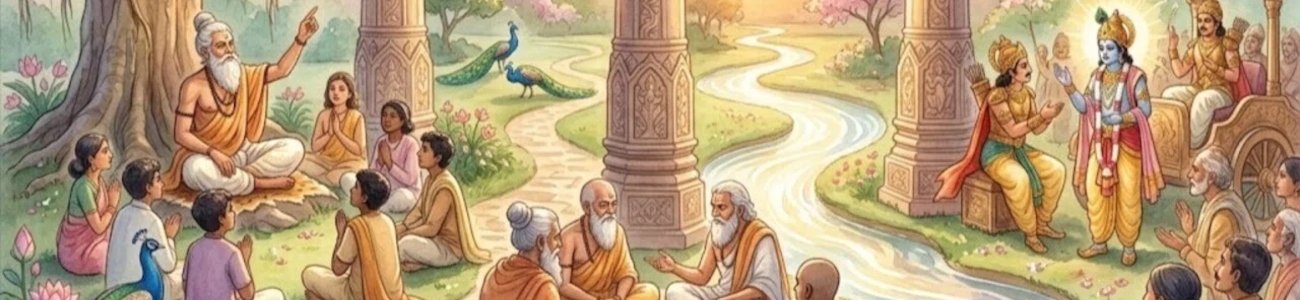
AKA Vedanta Sutras or Shariraka Sutras
Author: Sage Badarayana
The Brahma Sutras are a foundational text of Hindu philosophy, specifically the Vedanta tradition. Written by the sage Badarayana (often associated with Vyasa) around 400–450 CE (with older origins), the text consists of 555 concise aphorisms (sutras) organized into four chapters.Their primary purpose is to systematize and harmonize the teachings of the Upanishads, which can often seem contradictory at first glance.
The Three Pillars of Vedanta
The Brahma Sutras make up the first of the Prasthanatrayi ("three starting points") which form the basis of all Vedanta philosophy. The other two pillars are:
The Upanishads (The foundational revelations)
The Bhagavad Gita (The practical application of philosophy)
Chapter 10: 3.2
3.2
Verse #1
Topic -1: The Soul in the dream state |
oṃ sandhye sṛṣṭirāha hi oṃ 3.2.1.. ||
Topic -1: The Soul in the dream state |
o sandhye sstiraha hi o 3.2.1.. ||
Sw. Krishnananda
In the intermediate stage (between waking and deep sleep) there is (a real) creation; because (the Sruti) says so.
Verse #2
oṃ nirmātāraṃ caike putrādayaśca oṃ ||
o nirmatara caike putradayasca o ||
Sw. Krishnananda
And some (the followers of one Sakha, namely, the Kathakas) (state that the Supreme Lord is the) Creator; sons, etc., (being the lovely things which He creates).
Verse #3
oṃ māyāmātraṃ tu kārtsnyenānabhivyaktasvarūpatvāt oṃ ||
o mayamatra tu kartsnyenanabhivyaktasvarupatvat o ||
Sw. Krishnananda
But it (viz., the dream world) is mere illusion on account of its nature not manifesting itself with the totality (of the attributes of reality).
Verse #4
oṃ sūcakaśca hi śruteḥ ācakṣate ca tadvidaḥ oṃ ||
o sucakasca hi srute acaksate ca tadvida o ||
Sw. Krishnananda
But (though the dream world is an illusion), yet it is indicative (of the future), for (so we find) in the Sruti, the dream experts also declare this.
Verse #5
oṃ parābhidhyānāttu tirohitaṃ tato hyasya bandhaviparyayau oṃ ||
o parabhidhyanattu tirohita tato hyasya bandhaviparyayau o ||
Sw. Krishnananda
But by the meditation on the Supreme Lord, that which is hidden (by ignorance, viz., the equality of the Lord and the soul becomes manifest), because from him (the Lord) are its (the soul's) bondage and freedom.
Verse #6
oṃ dehayogādvāso'pi oṃ ||
o dehayogadvaso'pi o ||
Sw. Krishnananda
And that (viz., the concealment of the soul's rulership) also (results) from its connection with the body.
Verse #7
Topic -2: The Soul in dreamless sleep. |
oṃ tadabhāvo nāḍīṣu tacchruteḥ ātmani ca oṃ 3.2.7.. ||
Topic -2: The Soul in dreamless sleep. |
o tadabhavo naisu tacchrute atmani ca o 3.2.7.. ||
Sw. Krishnananda
The absence of that (i.e., of dreams, i.e., dreamless sleep) takes place in the nerves (Nadis or psychic currents) and in the self, as it is known from the Sruti or scriptural statement.
Verse #8
oṃ ataḥ prabodho'smāt oṃ ||
o ata prabodho'smat o ||
Sw. Krishnananda
Hence the waking from that (viz., Brahman).
Verse #9
Topic -3: The same Soul returns from deep sleep |
oṃ sa eva tu karmānusmṛtiśabdavidhibhyaḥ oṃ 3.2.9.. ||
Topic -3: The same Soul returns from deep sleep |
o sa eva tu karmanusmtisabdavidhibhya o 3.2.9.. ||
Sw. Krishnananda
But the same (soul returns from Brahman after deep sleep) on account of work, remembrance, scriptural text and precept.
Verse #10
Topic -4: The nature of swoon |
oṃ mugdhe'rthasampattirpariśeṣāt oṃ 3.2.10.. ||
Topic -4: The nature of swoon |
o mugdhe'rthasampattirparisesat o 3.2.10.. ||
Sw. Krishnananda
In a swoon (in him who is senseless) there is half union on account of this remaining (as the only alternative left, as the only possible hypothesis).
Verse #11
Topic -5: The nature of Brahman |
oṃ na sthānato'pi parasyobhayaliṅgaṃ sarvatra hi oṃ 3.2.11.. ||
Topic -5: The nature of Brahman |
o na sthanato'pi parasyobhayalinga sarvatra hi o 3.2.11.. ||
Sw. Krishnananda
Not on account of (difference of) place also two-fold characteristics can belong to the Highest; for everywhere (scripture teaches It to be without any difference).
Verse #12
oṃ na bhedāditi cenna pratyekamatadvacanāt oṃ ||
o na bhedaditi cenna pratyekamatadvacanat o ||
Sw. Krishnananda
If it be said that it is not so on account of difference (being taught in the scriptures), we reply that it is not so, because with reference to each (such form), the Sruti declares the opposite of that.
Verse #13
oṃ api caivameke oṃ ||
o api caivameke o ||
Sw. Krishnananda
Moreover some (teach) thus.
Verse #14
oṃ arūpavadeva hi tatpradhānatvāt oṃ ||
o arupavadeva hi tatpradhanatvat o ||
Sw. Krishnananda
Verily Brahman is only formless on account of that being the main purport (of all texts about Brahman).
Verse #15
oṃ prakāśavaccāvaiyarthyam oṃ ||
o prakasavaccavaiyarthyam o ||
Sw. Krishnananda
And as light (assumes forms as it were by its contact with things possessing form, so does Brahman take form in connection with Upadhis or limiting adjuncts), because (texts which ascribe form to Brahman) are not meaningless.
Verse #16
oṃ āha ca tanmātram oṃ ||
o aha ca tanmatram o ||
Sw. Krishnananda
And (the Sruti) declares (that Brahman is) that (i.e., intelligence) only.
Verse #17
oṃ darśayati cātho'pi smaryate oṃ ||
o darsayati catho'pi smaryate o ||
Sw. Krishnananda
(The scripture) also shows (this and) it is likewise stated in Smriti.
Verse #18
oṃ ata eva copamā sūryakādivat oṃ ||
o ata eva copama suryakadivat o ||
Sw. Krishnananda
For this very reason (we have with respect to Brahman) comparisons like the images of the sun and the like.
Verse #19
oṃ ambuvadagrahaṇāttu na tathātvam oṃ ||
o ambuvadagrahanattu na tathatvam o ||
Sw. Krishnananda
But there is no similarity (of the two things compared since) (in the case of Brahman any second thing) is not apprehended or experienced like water.
Verse #20
oṃ vṛddhihrāsabhāktvamantarbhāvāt ubhayasāmañjasyādevam oṃ ||
o vddhihrasabhaktvamantarbhavat ubhayasamanjasyadevam o ||
Sw. Krishnananda
As (the highest Brahman) is inside (its limiting adjuncts) It participates in their increase and decrease; owing to the appropriateness (thus resulting) of the two (things compared), it is thus, (i.e., the comparison holds good).
Verse #21
oṃ darśanācca oṃ ||
o darsanacca o ||
Sw. Krishnananda
And on account of the declaration of scripture.
Verse #22
Topic -6: The Neti-neti text explained |
oṃ prakṛtaitāvattvaṃ hi pratiṣedhati tato bravīti ca bhūyaḥ oṃ 3.2.22.. ||
Topic -6: The Neti-neti text explained |
o praktaitavattva hi pratisedhati tato braviti ca bhuya o 3.2.22.. ||
Sw. Krishnananda
What has been mentioned up to this is denied (by the words "not this, not this" and the Sruti) says something more than that (afterwards).
Verse #23
oṃ tadavyaktamāha hi oṃ ||
o tadavyaktamaha hi o ||
Sw. Krishnananda
That (Brahman) is not manifest, for (so the scripture) says.
Verse #24
oṃ api saṃrādhane pratyakṣānumānābhyām oṃ ||
o api saradhane pratyaksanumanabhyam o ||
Sw. Krishnananda
And moreover (Brahman is experienced) in devout meditation (as we know) from the Sruti and Smriti.
Verse #25
oṃ prakāśavaccāvaiśeṣyaṃ oṃ ||
o prakasavaccavaisesya o ||
Sw. Krishnananda
And as in the case of (physical) light and the like, there is no difference, so also between Brahman and Its manifestation in activity; on account of the repeated instruction (of the Sruti to that effect).
Verse #26
oṃ ato'nantena tathā hi liṅgam oṃ ||
o ato'nantena tatha hi lingam o ||
Sw. Krishnananda
Therefore (the individual soul becomes one) with the Infinite; for thus the (scripture) indicates.
Verse #27
oṃ ubhayavyapadeśāttu ahikuṇḍalavat oṃ ||
o ubhayavyapadesattu ahikunalavat o ||
Sw. Krishnananda
But on account of both (i.e., difference and non-difference) being taught (by the Sruti), (the relation of the highest Brahman to the individual soul has to be viewed) like that of the snake to its coils.
Verse #28
oṃ prakāśāśrayavadvā tejastvāt oṃ ||
o prakasasrayavadva tejastvat o ||
Sw. Krishnananda
Or like (the relation of) light and its substratum, on account of both being luminous.
Verse #29
oṃ pūrvavadvā oṃ ||
o purvavadva o ||
Sw. Krishnananda
Or (the relation between the two, i.e., Jiva and Brahman is) as (given) before.
Verse #30
oṃ pratiṣedhācca oṃ ||
o pratisedhacca o ||
Sw. Krishnananda
And on account of the denial.
Verse #31
Topic -7: Brahman is one without a second |
oṃ paramatah setūnmānasaṃbandha bhedavyapadeśebhyaḥ oṃ 3.2.31.. ||
Topic -7: Brahman is one without a second |
o paramatah setunmanasabandha bhedavyapadesebhya o 3.2.31.. ||
Sw. Krishnananda
(There is something) Superior to this (Brahman) on account of terms denoting a bank, measure, connection and difference (used with respect to It).
Verse #32
oṃ darśanāt oṃ ||
o darsanat o ||
Sw. Krishnananda
But (Brahman is called a bank etc.) on account of similarity.
Verse #33
oṃ buddhyarthaḥ pādavat oṃ ||
o buddhyartha padavat o ||
Sw. Krishnananda
(The statement as to Brahman having size) is for the sake of easy comprehension (i.e., Upasana or devout meditation); just like (four) feet.
Verse #34
oṃ sthānaviśeṣātprakāśādivat oṃ ||
o sthanavisesatprakasadivat o ||
Sw. Krishnananda
(The statements concerning connection and difference with respect to Brahman) are due to special places: as in the case of light and the like.
Verse #35
oṃ upapatteśca oṃ ||
o upapattesca o ||
Sw. Krishnananda
And it is reasonable.
Verse #36
oṃ tathā'nyapratiṣedhāt oṃ ||
o tatha'nyapratisedhat o ||
Sw. Krishnananda
Similarly on account of the express denial of all other things (there is nothing but Brahman).
Verse #37
oṃ anena sarvagata oṃ ||
o anena sarvagata o ||
Sw. Krishnananda
By this the Omnipresence (of Brahman is established) in accordance with the scriptural statements regarding (Brahman's) extent.
Verse #38
Topic -8: The Lord is the giver of the fruits of actions |
oṃ phalamata upapatteḥ oṃ 3.2.38.. ||
Topic -8: The Lord is the giver of the fruits of actions |
o phalamata upapatte o 3.2.38.. ||
Sw. Krishnananda
From Him (the Lord) are the fruits of actions, for that is reasonable.
Verse #39
oṃ śrutatvācca oṃ ||
o srutatvacca o ||
Sw. Krishnananda
And because the Sruti so teaches.
Verse #40
oṃ dharmaṃ jaiminiḥ ata eva oṃ ||
o dharma jaimini ata eva o ||
Sw. Krishnananda
Jaimini thinks for the same reasons (viz., scriptural authority and reasoning, on the same ground as stated in Sutras 38 and 39) that religious merit (is what brings about the fruits of actions).
Verse #41
oṃ pūrvaṃ tu bādarāyaṇo hetuvyapadeśāt oṃ |
brahmasūtreṣu ||
o purva tu badarayano hetuvyapadesat o |
brahmasutresu ||
Sw. Krishnananda
But Baadarayana thinks the former (i.e., the Lord to be the cause of the fruits of action) on account of His being declared to be the cause (of the actions themselves).