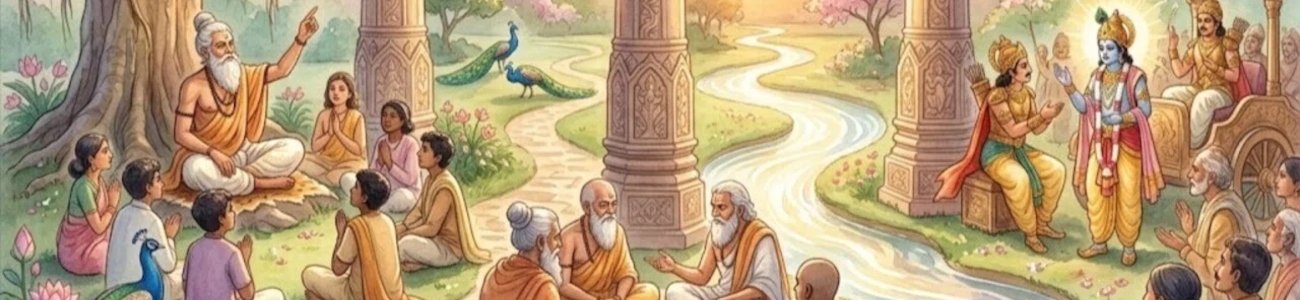
AKA Vedanta Sutras or Shariraka Sutras
Author: Sage Badarayana
The Brahma Sutras are a foundational text of Hindu philosophy, specifically the Vedanta tradition. Written by the sage Badarayana (often associated with Vyasa) around 400–450 CE (with older origins), the text consists of 555 concise aphorisms (sutras) organized into four chapters.Their primary purpose is to systematize and harmonize the teachings of the Upanishads, which can often seem contradictory at first glance.
The Three Pillars of Vedanta
The Brahma Sutras make up the first of the Prasthanatrayi ("three starting points") which form the basis of all Vedanta philosophy. The other two pillars are:
The Upanishads (The foundational revelations)
The Bhagavad Gita (The practical application of philosophy)
Chapter 16: 4.4
4.4
Verse #1
Nature of Freedom |
oṃ sampadyāvihāya svenaśabdāt oṃ 4.4.1.. ||
Nature of Freedom |
o sampadyavihaya svenasabdat o 4.4.1.. ||
Sw. Krishnananda
(When the Jiva or the individual soul) has attained (the highest light) there is manifestation (of its own real nature) as we infer from the word 'own'.
Verse #2
oṃ muktaḥ pratijñānāt oṃ ||
o mukta pratijnanat o ||
Sw. Krishnananda
(The self whose true nature has manifested itself is) released; according to the promise (made by scripture).
Verse #3
oṃ ātmā prakaraṇāt oṃ ||
o atma prakaranat o ||
Sw. Krishnananda
(The light into which the individual soul enters is) the Supreme Self; owing to the subject matter of the chapter.
Verse #4
Liberated Soul Inseparable from Brahman |
oṃ avibhāgena dṛṣṭatvāt oṃ 4.4.4.. ||
Liberated Soul Inseparable from Brahman |
o avibhagena dstatvat o 4.4.4.. ||
Sw. Krishnananda
(The Jiva in the state of release exists) as inseparable (from Brahman), because it is so seen from the scriptures.
Verse #5
Characteristics of the Liberated Soul |
oṃ brāhmeṇa jaiminirupanyāsādibhyaḥ oṃ 4.4.5.. ||
Characteristics of the Liberated Soul |
o brahmena jaiminirupanyasadibhya o 4.4.5.. ||
Sw. Krishnananda
(The released soul exists) as possessed of (the attributes of) Brahman; (thus) Jaimini (opines) on account of the reference etc.
Verse #6
oṃ citimātreṇa tadātmakatvādityauḍulomiḥ oṃ ||
o citimatrena tadatmakatvadityauulomi o ||
Sw. Krishnananda
(The released soul exists) solely as pure consciousness or Intelligence, that being its true nature or essence; thus Audulomi (thinks).
Verse #7
oṃ evamapyupanyāsātpūrvabhāvādavirodhaṃ bādarāyaṇaḥ oṃ ||
o evamapyupanyasatpurvabhavadavirodha badarayana o ||
Sw. Krishnananda
Thus also, on account of the existence of the former qualities admitted owing to reference and so on, there is no contradiction (between the two); (so thinks) Baadarayana.
Verse #8
Fulfilment of Desire through Will |
oṃ saṅkalpādeva ca tacchruteḥ oṃ 4.4.8.. ||
Fulfilment of Desire through Will |
o sankalpadeva ca tacchrute o 4.4.8.. ||
Sw. Krishnananda
But by mere will (the liberated souls attain their purpose), because scriptures say so.
Verse #9
oṃ ata eva cānanyādhipatiḥ oṃ ||
o ata eva cananyadhipati o ||
Sw. Krishnananda
And for this very same reason (the released soul is) without another Lord.
Verse #10
Body after Reaching Brahma-loka |
oṃ abhāvaṃ bādarirāha hyevam oṃ 4.4.10.. ||
Body after Reaching Brahma-loka |
o abhava badariraha hyevam o 4.4.10.. ||
Sw. Krishnananda
There is absence (of body and organs, in the case of the liberated souls) (asserts) Baadari, for thus scripture says.
Verse #11
oṃ bhāvaṃ jaiminirvikalpāmnānāt oṃ ||
o bhava jaiminirvikalpamnanat o ||
Sw. Krishnananda
Jaimini (asserts that the liberated soul) possesses (a body and the organs) because the scriptures declare (the capacity on the part of such a soul to assume) various forms.
Verse #12
oṃ dvādaśāhavadubhayavidhaṃ bādarāyaṇo'taḥ oṃ ||
o dvadasahavadubhayavidha badarayano'ta o ||
Sw. Krishnananda
For this reason Baadarayana opines that the released person is of both kinds as in the case of the twelve days' sacrifice.
Verse #13
oṃ tanvabhāve sandhyavadupapatteḥ oṃ ||
o tanvabhave sandhyavadupapatte o ||
Sw. Krishnananda
In the absence of a body (the fulfilment of desires is possible) as in dreams, as this is reasonable.
Verse #14
oṃ bhāve jāgradvat oṃ ||
o bhave jagradvat o ||
Sw. Krishnananda
When the body exists (the fulfilment of desires is) as in the waking state.
Verse #15
Entry into many Bodies |
oṃ pradīpavadāveśaḥ tathā hi darśayati oṃ 4.4.15.. ||
Entry into many Bodies |
o pradipavadavesa tatha hi darsayati o 4.4.15.. ||
Sw. Krishnananda
The entering (of the released soul into several bodies) like (the multiplication of) the flame of a lamp because thus the scripture declares.
Verse #16
oṃ svāpyayasampattyoranyatarāpekṣamāviṣkṛtaṃ hi oṃ ||
o svapyayasampattyoranyatarapeksamaviskta hi o ||
Sw. Krishnananda
(The declaration of absence of all cognition is made) having in view either of the two states, viz., deep sleep and absolute union (with Brahman), for this is made clear (by the scriptures).
Verse #17
Acquisition of Divine Powers |
oṃ jagadvyāpāravarjam oṃ .. ||
Acquisition of Divine Powers |
o jagadvyaparavarjam o .. ||
Sw. Krishnananda
(The liberated soul attains all lordly powers) except the power of creation, etc., on account of (the Lord being) the subject matter (of all texts where creation, etc., are referred to) and (the liberated souls) not being mentioned (in that connection).
Verse #18
oṃ pratyakṣopadeśāditi cennādhikārikamaṇḍalasthokteḥ oṃ oṃ ||
o pratyaksopadesaditi cennadhikarikamanalasthokte o o ||
Sw. Krishnananda
If it be said that the liberated soul attains absolute powers on account of direct teaching of the scriptures, we say no; because the scriptures declare that the liberated soul attains Him who entrusts the sun, etc., with their offices and abides in those spheres.
Verse #19
oṃ vikārāvarti ca tathā hi darśayati oṃ ||
o vikaravarti ca tatha hi darsayati o ||
Sw. Krishnananda
And (there is a form of the Supreme Lord) which is beyond all created things (because, so the scripture declares) (His) existence (in a two-fold form unmanifest and manifest).
Verse #20
oṃ sthitimāha darśayataścaivaṃ pratyakṣānumāne oṃ ||
o sthitimaha darsayatascaiva pratyaksanumane o ||
Sw. Krishnananda
And thus perception and inference show.
Verse #21
oṃ bhogamātrasāmyaliṅgācca oṃ ||
o bhogamatrasamyalingacca o ||
Sw. Krishnananda
And because of the indications (in the scriptures) of equality (of the liberated soul with the Lord) only with respect to enjoyment.
Verse #22
oṃ anāvṛttiḥ śabdādanāvṛttiḥ śabdāt oṃ ||
o anavtti sabdadanavtti sabdat o ||
Sw. Krishnananda
(There is) no return (for these liberated souls), on account of the scriptural statement (to that effect).