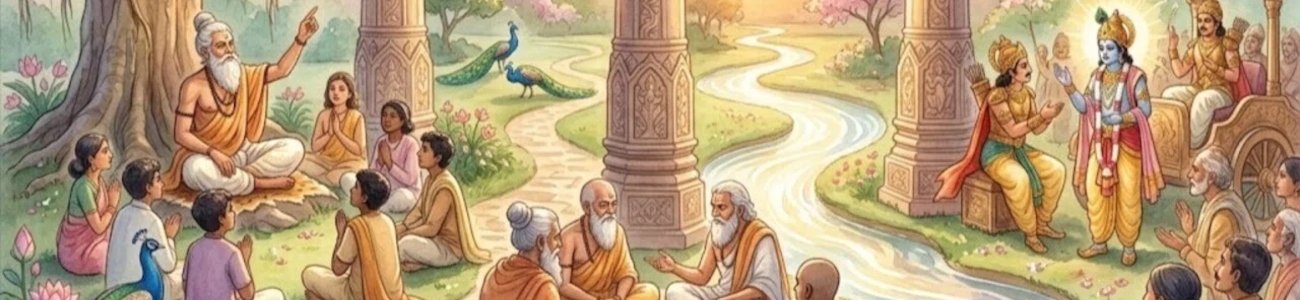
AKA Vedanta Sutras or Shariraka Sutras
Author: Sage Badarayana
The Brahma Sutras are a foundational text of Hindu philosophy, specifically the Vedanta tradition. Written by the sage Badarayana (often associated with Vyasa) around 400–450 CE (with older origins), the text consists of 555 concise aphorisms (sutras) organized into four chapters.Their primary purpose is to systematize and harmonize the teachings of the Upanishads, which can often seem contradictory at first glance.
The Three Pillars of Vedanta
The Brahma Sutras make up the first of the Prasthanatrayi ("three starting points") which form the basis of all Vedanta philosophy. The other two pillars are:
The Upanishads (The foundational revelations)
The Bhagavad Gita (The practical application of philosophy)
Chapter 11: 3.3
3.3
Verse #1
Sameness of Vidyas |
oṃ sarvavedāntapratyayaṃ codanādyaviśeṣāt oṃ 3.3.1.. ||
Sameness of Vidyas |
o sarvavedantapratyaya codanadyavisesat o 3.3.1.. ||
Sw. Krishnananda
(The Vidyas or the Upasanas) described in the various Vedanta texts (are not different, are identical) on account of the non-difference of injunction, etc., (i.e., connection, form and name).
Verse #2
oṃ bhedānneti cedekasyāmapi oṃ ||
o bhedanneti cedekasyamapi o ||
Sw. Krishnananda
If it be said that the Vidyas are separate on account of difference (in minor points), we deny that, since even in the same Vidyas (there may be such minor differences).
Verse #3
oṃ svādhyāyasya tathātvena hi samācāre'dhikārācca oṃ ||
o svadhyayasya tathatvena hi samacare'dhikaracca o ||
Sw. Krishnananda
(The rite of carrying fire on the head is connected) with the study of the Veda (of the Atharvanikas), because in the Samachara (it is mentioned) as being such. And (this also follows) from its being a qualification (for the students of the Atharva Veda) as in the case with the (seven) oblations (viz., Saurya etc.).
Verse #4
oṃ darśayati ca oṃ ||
o darsayati ca o ||
Sw. Krishnananda
(The scripture) also instructs (thus).
Verse #5
Combination of Traits |
oṃ upasaṃhāro'rthābhedādvidhiśeṣavatsamāne ca oṃ 3.3.5.. ||
Combination of Traits |
o upasaharo'rthabhedadvidhisesavatsamane ca o 3.3.5.. ||
Sw. Krishnananda
And in the Upasanas of the same class (mentioned in different Sakhas) a combination (of all the particulars mentioned in all Sakhas is to be made) as there is no difference in the object of meditation, just as (a combination of) all subsidiary rites of a main sacrifice (mentioned in different Sakhas is made).
Verse #6
Difference of Meditations |
oṃ anyathātvaṃ ca śabdāditi cennāviśeṣāt oṃ 3.3.6.. ||
Difference of Meditations |
o anyathatva ca sabdaditi cennavisesat o 3.3.6.. ||
Sw. Krishnananda
If it be said (that the Udgitha Vidya of the Brihadaranyaka Upanishad and that of the Chhandogya Upanishad) are different on account of (difference in) texts; we deny this on the ground of their non-difference (as regards essentials).
Verse #7
oṃ na vā prakaraṇabhedātparovarīyastvādivat oṃ ||
o na va prakaranabhedatparovariyastvadivat o ||
Sw. Krishnananda
Or rather there is no (unity of the Vidyas) owing to the difference of subject matter even as (the meditation on the Udgitha) as the highest and greatest (i.e., Brahman) (is different from the meditation on the Udgitha as abiding in the eye etc.).
Verse #8
oṃ saṃjñātaścettaduktamasti tu tadapi oṃ ||
o sajnatascettaduktamasti tu tadapi o ||
Sw. Krishnananda
If it be said (that the Vidyas are one) on account of (the identity of) name; (we reply that) that is explained (already); moreover that (identity of name) is (found in the case of admittedly separate Vidyas).
Verse #9
Specifications of Om |
oṃ vyāpteśca samañjasam oṃ 3.3.9.. ||
Specifications of Om |
o vyaptesca samanjasam o 3.3.9.. ||
Sw. Krishnananda
And because (OM) extends (over the whole of the Vedas), (to specialise it by the term 'Udgitha') is appropriate.
Verse #10
Sameness of the Meditation on Prana |
oṃ sarvābhedādanyatreme oṃ 3.3.10.. ||
Sameness of the Meditation on Prana |
o sarvabhedadanyatreme o 3.3.10.. ||
Sw. Krishnananda
On account of the non-difference (of the Vidya) everywhere (i.e., in all the texts of the different Sakhas where the Prana-Vidya occurs) these qualities (mentioned in two of them are to be inserted) in the other places (e.g., the Kaushitaki Upanishad).
Verse #11
Combination and Non-combination of Attributes of Brahman |
oṃ ānandādayaḥ pradhānasya oṃ 3.3.11.. ||
Combination and Non-combination of Attributes of Brahman |
o anandadaya pradhanasya o 3.3.11.. ||
Sw. Krishnananda
Bliss and other attributes (which depict the true nature) of the Principal or the Supreme Self, i.e., Brahman (have to be combined from all places in the meditation on Brahman).
Verse #12
oṃ priyaśirastvādyaprāptirupacayāpacayau hi bhede oṃ ||
o priyasirastvadyapraptirupacayapacayau hi bhede o ||
Sw. Krishnananda
(Qualities like) joy being His head, etc., are not to be taken everywhere, (being subject to) increase and decrease (are possible only) if there is difference (and not in Brahman in which there is non-difference).
Verse #13
oṃ itare tvarthasāmānyāt oṃ ||
o itare tvarthasamanyat o ||
Sw. Krishnananda
But other attributes (like Bliss, etc., are to be combined) on account of identity of purport.
Verse #14
Purusha as the Highest in Katha |
oṃ ādhyānāya prayojanābhāvāt oṃ 3.3.14.. ||
Purusha as the Highest in Katha |
o adhyanaya prayojanabhavat o 3.3.14.. ||
Sw. Krishnananda
(The passage in Katha Upanishad I.3.10 tells about the Self only as the highest) for the sake of pious meditation, as there is no use (of the knowledge of the objects being higher than the senses and so on).
Verse #15
oṃ ātmaśabdācca oṃ ||
o atmasabdacca o ||
Sw. Krishnananda
And on account of the word Atman.
Verse #16
The Supreme Self in Aitareya |
oṃ ātmagṛhītiritaravaduttarāt oṃ 3.3.16.. ||
The Supreme Self in Aitareya |
o atmaghitiritaravaduttarat o 3.3.16.. ||
Sw. Krishnananda
(In the Aitareya Upanishad I.1.) the Supreme Self is meant, as in other texts (dealing with creation) because of the subsequent qualification.
Verse #17
oṃ anvayāditi cetsyādavadhāraṇāt oṃ ||
o anvayaditi cetsyadavadharanat o ||
Sw. Krishnananda
If it be said that because of the context (the Supreme Self is not meant) (we reply that) it is so (i.e., the Supreme Self is meant) on account of the definite statement (that the Atman alone existed in the beginning).
Verse #18
Acamana and Meditation on Prana |
oṃ kāryākhyānādapūrvam oṃ 3.3.18.. ||
Acamana and Meditation on Prana |
o karyakhyanadapurvam o 3.3.18.. ||
Sw. Krishnananda
On account of (the rinsing of the mouth with water referred to in the Prana Vidya) being a reiteration of an act (already ordained by the Smriti), what has not been so ordained elsewhere (is here enjoined by the Sruti).
Verse #19
Same Meditation in the Same Branch |
oṃ samāna evañcābhedāt oṃ 3.3.19.. ||
Same Meditation in the Same Branch |
o samana evancabhedat o 3.3.19.. ||
Sw. Krishnananda
In the same (Sakha also) it is thus (i.e., there is unity of Vidya,) owing to non-difference (of the object of meditation).
Verse #20
No Combination in Meditation on Satya-Brahman |
oṃ saṃbandhādevamanyatrāpi oṃ 3.3.20.. ||
No Combination in Meditation on Satya-Brahman |
o sabandhadevamanyatrapi o 3.3.20.. ||
Sw. Krishnananda
Thus in other cases also, on account of the connection (of particulars with one and the same Vidya).
Verse #21
oṃ na vā viśeṣāt oṃ ||
o na va visesat o ||
Sw. Krishnananda
Rather not (so) on account of the difference (of place).
Verse #22
oṃ darśayati ca oṃ ||
o darsayati ca o ||
Sw. Krishnananda
(The scripture) also declares (that).
Verse #23
Attributes of Brahman in Ranayaniya not to be combined elsewhere |
oṃ sambhṛtidyuvyāptyapi cātaḥ oṃ 3.3.23.. ||
Attributes of Brahman in Ranayaniya not to be combined elsewhere |
o sambhtidyuvyaptyapi cata o 3.3.23.. ||
Sw. Krishnananda
For the same reason (as in the previous Sutra) the supporting (of the world) and pervading the sky (attributed to Brahman in the Ranayaniya Khila) also (are not to be included in other Vidyas or Upasanas of Brahman).
Verse #24
Purusha-Vidya in Chandogya and Taittiriya |
oṃ puruṣavidyāyāmiva cetareṣāmanāmnānāt oṃ 3.3.24.. ||
Purusha-Vidya in Chandogya and Taittiriya |
o purusavidyayamiva cetaresamanamnanat o 3.3.24.. ||
Sw. Krishnananda
And (as the qualities) as (mentioned) in the Purusha-Vidya (of the Chhandogya) are not mentioned (in that) of the others (i.e., in the Taittiriya) (the two Purusha-Vidyas are not one; are not to be combined).
Verse #25
Non-combination of Disparate Traits |
oṃ vedhādyarthabhedāt oṃ 3.3.25.. ||
Non-combination of Disparate Traits |
o vedhadyarthabhedat o 3.3.25.. ||
Sw. Krishnananda
Because the matter (of certain Mantras) such as piercing and so on is different (from the matter of the approximate Vidyas), (the former are not to be combined with the latter).
Verse #26
Rejection and Reception of Merit |
oṃ hānau tūpāyanaśabdaśeṣāt kuśācchandasstutyupagānavat taduktam oṃ 3.3.26.. ||
Rejection and Reception of Merit |
o hanau tupayanasabdasesat kusacchandasstutyupaganavat taduktam o 3.3.26.. ||
Sw. Krishnananda
But where only the getting rid (of the good and evil) is mentioned (the obtaining of this good and evil by others has to be added) because the statement about acceptance is supplementary (to the statement about the getting rid of) as in the case of the Kusas, metres, praise and hymns or recitations. This (i.e., the reason for this) has been stated (by Jaimini in Purvamimamsa).
Verse #27
Discarding Virtue and Vice at Death |
oṃ sāmparāye tartavyābhāvāt tathā hyanye oṃ 3.3.27.. ||
Discarding Virtue and Vice at Death |
o samparaye tartavyabhavat tatha hyanye o 3.3.27.. ||
Sw. Krishnananda
(He who attains knowledge gets rid of his good and evil deeds) at the time of death, there being nothing to be attained (by him on the way to Brahmaloka through those works); for thus others (declare in their sacred texts).
Verse #28
oṃ chandata ubhayāvirodhāt oṃ ||
o chandata ubhayavirodhat o ||
Sw. Krishnananda
(The interpretation that the individual soul practising Yama-Niyama) according to his liking (discards good and evil works while living is reasonable) on account of there being harmony in that case between the two (viz., cause and effect, as well as between the Chhandogya and another Sruti).
Verse #29
Paths of Those Who Know Or Do Not Know the |
oṃ gaterarthavattvamubhayathā'nyathā hi virodhaḥ oṃ 3.3.29.. ||
Paths of Those Who Know Or Do Not Know the |
o gaterarthavattvamubhayatha'nyatha hi virodha o 3.3.29.. ||
Sw. Krishnananda
(The soul's) journey (along the path of the gods, Devayana) is applicable in a two-fold manner, otherwise there would be contradiction (of scripture).
Verse #30
oṃ upapannastallakṣaṇārthopalabdheḥ lokavat oṃ ||
o upapannastallaksanarthopalabdhe lokavat o ||
Sw. Krishnananda
(The two-fold view taken above) is justified because we observe a purpose characterised thereby (i.e., a purpose of the going) as in ordinary life.
Verse #31
The Path of Gods Is for All Worshippers of |
oṃ aniyamaḥ sarveṣāmavirodhaśśabdānumānābhyām oṃ 3.3.31.. ||
The Path of Gods Is for All Worshippers of |
o aniyama sarvesamavirodhassabdanumanabhyam o 3.3.31.. ||
Sw. Krishnananda
There is no restriction (as to the going on the path of the gods for any Vidya). There is no contradiction as is seen from the Sruti and Smriti.
Verse #32
People with a Mission |
oṃ yāvadadhikāramavasthitirādhikārikāṇām oṃ 3.3.32.. ||
People with a Mission |
o yavadadhikaramavasthitiradhikarikanam o 3.3.32.. ||
Sw. Krishnananda
Of those who have a mission to fulfil (there is corporeal) existence, so long as the mission is not fulfilled.
Verse #33
Conception of the Immutable |
oṃ akṣaradhiyāṃ tvavirodhaḥ sāmānyatadbhāvābhyāmaupasadavattaduktam oṃ .. taduktam oṃ ||
Conception of the Immutable |
o aksaradhiya tvavirodha samanyatadbhavabhyamaupasadavattaduktam o .. taduktam o ||
Sw. Krishnananda
But the conceptions of the (negative) attributes of the Imperishable (Brahman) are to be combined (from different texts where the Imperishable Brahman is dealt with, as they form one Vidya), because of the similarity (of defining the Imperishable Brahman through denials) and the object (the Imperishable Brahman) being the same, as in the case of the Upasad (offerings). This has been explained (by Jaimini in the Purvamimamsa).
Verse #34
Same Conception in Mundaka and Katha |
oṃ iyadāmananāt oṃ 3.3.34.. ||
Same Conception in Mundaka and Katha |
o iyadamananat o 3.3.34.. ||
Sw. Krishnananda
Because (the same thing) is described as such and such.
Verse #35
The Inmost Self in Brihadaranyaka |
oṃ antarā bhūtagrāmavaditi cet taduktam oṃ 3.3.35.. ||
The Inmost Self in Brihadaranyaka |
o antara bhutagramavaditi cet taduktam o 3.3.35.. ||
Sw. Krishnananda
As the Self is within all, as in the case of the aggregate of the elements, (there is oneness of Vidya).
Verse #36
oṃ anyathā bhedānupapattiriticennopadeśavat oṃ ||
o anyatha bhedanupapattiriticennopadesavat o ||
Sw. Krishnananda
If it be said (that the two Vidyas are separate, for) otherwise the repetition cannot be accounted for, we reply not so; (it is) like (the repetition) in another instruction (in the Chhandogya).
Verse #37
Reciprocity of Conceptions |
oṃ vyatihāro viśiṃṣanti hītaravrat oṃ 3.3.37.. ||
Reciprocity of Conceptions |
o vyatiharo visisanti hitaravrat o 3.3.37.. ||
Sw. Krishnananda
There is exchange (of meditation), because the texts distinguish (two meditations); as in other cases.
Verse #38
Satya-Brahman in Brihadaranyaka |
oṃ saiva hi satyādayaḥ oṃ 3.3.38.. ||
Satya-Brahman in Brihadaranyaka |
o saiva hi satyadaya o 3.3.38.. ||
Sw. Krishnananda
The same (Satya Vidya is taught in both places), because (attributes like) Satya etc., (are seen in both places).
Verse #39
Combination of Traits in Brihadaranyaka and Chandogya |
oṃ kāmāditaratra tatra ca āyatanādibhyaḥ oṃ 3.3.39.. ||
Combination of Traits in Brihadaranyaka and Chandogya |
o kamaditaratra tatra ca ayatanadibhya o 3.3.39.. ||
Sw. Krishnananda
(Qualities like true) desire etc., (mentioned in the Chhandogya Upanishad are to be inserted) in the other (i.e., in the Brihadaranyaka) and (those mentioned) in the other (i.e., in the Brihadaranyaka are also to be inserted in the Chhandogya) on account of the abode, etc., (being the same in both).
Verse #40
Agnihotra to Prana |
oṃ ādārādalopaḥ oṃ 3.3.40.. ||
Agnihotra to Prana |
o adaradalopa o 3.3.40.. ||
Sw. Krishnananda
On account of the respect shown (to the Pranagnihotra by the Sruti) there can be no omission (of this act) (even when the eating of food is omitted).
Verse #41
oṃ upasthitestadvacanāt oṃ ||
o upasthitestadvacanat o ||
Sw. Krishnananda
When eating is taking place (the Pranagnihotra has to be performed) from that (i.e., the food first eaten), for so (the Sruti) declares.
Verse #42
Meditations Connected with Rites Are Not Obligatory |
oṃ tannirdhāraṇārthaniyamastaddṛṣṭerpṛthagdhyapratibandhaḥ phalam oṃ 3.3.42.. ||
Meditations Connected with Rites Are Not Obligatory |
o tannirdharanarthaniyamastaddsterpthagdhyapratibandha phalam o 3.3.42.. ||
Sw. Krishnananda
There is no rule about the inviolability of that (i.e., Upasanas connected with certain sacrifices) that is seen (from the Sruti itself); for a separate fruit (belongs to the Upasanas), viz., non-obstruction (of the results of the sacrifice).
Verse #43
Meditations on Prana and Vayu |
oṃ pradānavadeva hi taduktam oṃ 3.3.43.. ||
Meditations on Prana and Vayu |
o pradanavadeva hi taduktam o 3.3.43.. ||
Sw. Krishnananda
As in the case of the offerings (Vayu and Prana must be held apart). This has been explained (in the Purvamimamsa Sutra).
Verse #44
Fires in Agni-Rahasya Not Parts of Sacrifice |
oṃ liṅgabhūyastvāttaddhi balīyastadapi oṃ 3.3.44.. ||
Fires in Agni-Rahasya Not Parts of Sacrifice |
o lingabhuyastvattaddhi baliyastadapi o 3.3.44.. ||
Sw. Krishnananda
On account of the majority of indicatory marks (the fires of the mind, speech, etc., in the Agnirahasya of the Vajasaneyins do not form part of the sacrifice), for it (the indicatory mark) is stronger (than the context or the general subject matter). This also (has been explained in the Purvamimamsa Sutras by Jaimini).
Verse #45
oṃ pūrvavikalpaḥ prakaraṇātsyātkriyāmānasavat oṃ ||
o purvavikalpa prakaranatsyatkriyamanasavat o ||
Sw. Krishnananda
(The fires spoken of in the previous Sutra are) alternative forms of the one mentioned first, (i.e., the actual sacrificial fire) on account of the context; (they) ought to be part of the sacrifice like the imaginary drink or the Manasa-cup.
Verse #46
oṃ atideśācca oṃ ||
o atidesacca o ||
Sw. Krishnananda
And on account of the extension (of the attributes of the actual fire to these imaginary fires).
Verse #47
oṃ vidyaiva tu nirdhāraṇāt oṃ ||
o vidyaiva tu nirdharanat o ||
Sw. Krishnananda
But (the fires) rather constitute the Vidya, because (the Sruti) asserts it.
Verse #48
oṃ darśanācca oṃ ||
o darsanacca o ||
Sw. Krishnananda
And because (in the text indicatory marks of that are) seen.
Verse #49
oṃ śrutyādibalīyastvācca na bādhaḥ oṃ ||
o srutyadibaliyastvacca na badha o ||
Sw. Krishnananda
(The view that the Agnis or fires constitute an independent Vidya) cannot be refuted, owing to the greater force of the Sruti etc.
Verse #50
oṃ Anubandhadibhyah prajnantaraprithaktvavat drishtascha taduktam ||
o Anubandhadibhyah prajnantaraprithaktvavat drishtascha taduktam ||
Sw. Krishnananda
On account of the connection and so on (the fires built of mind, etc., form an independent Vidya), in the same way as other Vidyas (like Sandilya Vidya) are separate; and it is seen (that in spite of the context a sacrifice is treated as independent). This has been explained (in the Purvamimamsa Sutras by Jaimini).
Verse #51
oṃ na sāmānyādapyupalabdhermṛtyuvannahi lokāpattiḥ oṃ .. oṃ ||
o na samanyadapyupalabdhermtyuvannahi lokapatti o .. o ||
Sw. Krishnananda
In spite of the resemblance (of the fires to the imaginary drink, they do) not (constitute part of the sacrificial act) because it is seen (from the reasons given, and on the ground of Sruti that they form an independent Vidya) as in the case of death; for the world does not become (fire, because it resembles fire in some points).
Verse #52
oṃ pareṇa ca śabdasya tādvidhyaṃ bhūyastvāttvanubandhaḥ oṃ oṃ ||
o parena ca sabdasya tadvidhya bhuyastvattvanubandha o o ||
Sw. Krishnananda
And from the subsequent (Brahmana) the fact of the text (under discussion) being such (i.e., enjoining an independent Vidya) (is known). But the connection (of the fanciful Agnis or imaginary fires with the actual fire is) on account of the abundance (of the attributes of the latter that are imagined in these fires).
Verse #53
The Self Distinct from Body |
oṃ eka ātmanaḥ śarīre bhāvāt oṃ 3.3.53.. ||
The Self Distinct from Body |
o eka atmana sarire bhavat o 3.3.53.. ||
Sw. Krishnananda
Some (maintain the non-existence) of a separate self (besides the body) on account of the existence (of the self) where a body is (only).
Verse #54
oṃ vyatirekastadbhāvabhāvitvānna tūpalabdhivat oṃ oṃ ||
o vyatirekastadbhavabhavitvanna tupalabdhivat o o ||
Sw. Krishnananda
But not (so); a self or soul separate (from the body does exist), because (Consciousness) does not exist even when there is the body (after death), as in the case of cognition or perceptive consciousness.
Verse #55
Meditations Connected with Accessories of Rites |
oṃ aṅgāvabaddhāstu na śākhāsu hi prativedam oṃ 3.3.55.. ||
Meditations Connected with Accessories of Rites |
o angavabaddhastu na sakhasu hi prativedam o 3.3.55.. ||
Sw. Krishnananda
But (the Upasanas or meditations connected with parts) (of sacrificial acts are) not (restricted) to (particular) Sakhas, according to the Veda (to which they belong), (but to all its Sakhas because the same Upasana is described in all).
Verse #56
oṃ mantrādivadvā'virodhaḥ oṃ ||
o mantradivadva'virodha o ||
Sw. Krishnananda
Or else, there is no contradiction (here), as in the case of Mantras and the like.
Verse #57
Meditation on Vaisvanara as a Whole |
oṃ bhūmnaḥ kratuvajjyāyastvaṃ tathā ca darśayati oṃ 3.3.57.. ||
Meditation on Vaisvanara as a Whole |
o bhumna kratuvajjyayastva tatha ca darsayati o 3.3.57.. ||
Sw. Krishnananda
Importance (is given to the meditation) on the entire form (of Vaisvanara) as in the case of sacrifice; for thus (the Sruti) shows.
Verse #58
When Meditations Differ |
oṃ nānāśabdādibhedāt oṃ 3.3.58.. ||
When Meditations Differ |
o nanasabdadibhedat o 3.3.58.. ||
Sw. Krishnananda
(The Vidyas are) separate, on account of the difference of words and the like.
Verse #59
Alternative Meditations |
oṃ vikalpo viśiṣṭaphalatvāt oṃ 3.3.59.. ||
Alternative Meditations |
o vikalpo visistaphalatvat o 3.3.59.. ||
Sw. Krishnananda
There is option (with respect to the several Vidyas), because the result (of all the Vidyas) is the same.
Verse #60
Meditations Yielding Worldly Results |
oṃ kāmyāstu yathākāmaṃ samuccīyeranna vā pūrvahetvabhāvāt oṃ 3.3.60.. ||
Meditations Yielding Worldly Results |
o kamyastu yathakama samucciyeranna va purvahetvabhavat o 3.3.60.. ||
Sw. Krishnananda
But Vidyas for particular desires may be combined or not according to one's desires on account of the absence of the previous reason (mentioned in the previous Sutra).
Verse #61
Meditations Based on Subsidiaries |
oṃ aṅgeṣu yathāśrayabhāvaḥ oṃ 3.3.61.. ||
Meditations Based on Subsidiaries |
o angesu yathasrayabhava o 3.3.61.. ||
Sw. Krishnananda
With regard (to meditations) connected with members (of sacrificial acts) it is as with (the members) with which they are connected.
Verse #62
oṃ śiṣṭeśca oṃ ||
o sistesca o ||
Sw. Krishnananda
And from the injunction of the Sruti.
Verse #63
oṃ samāhārāt oṃ ||
o samaharat o ||
Sw. Krishnananda
On account of the rectification.
Verse #64
oṃ guṇasādhāraṇyaśruteśca oṃ ||
o gunasadharanyasrutesca o ||
Sw. Krishnananda
And from the Sruti declaring 'OM' which is a common feature (of the Udgitha Vidya) to be common to all the Vedas.
Verse #65
oṃ na vā tatsahabhāvaśruteḥ oṃ ||
o na va tatsahabhavasrute o ||
Sw. Krishnananda
(The meditations connected with members of the sacrificial acts are) rather not (to be combined) as the Sruti does not state their going together.
Verse #66
oṃ darśanācca oṃ |
brahmasūtreṣu ||
o darsanacca o |
brahmasutresu ||
Sw. Krishnananda
And because the Sruti (scripture) says so (shows it).