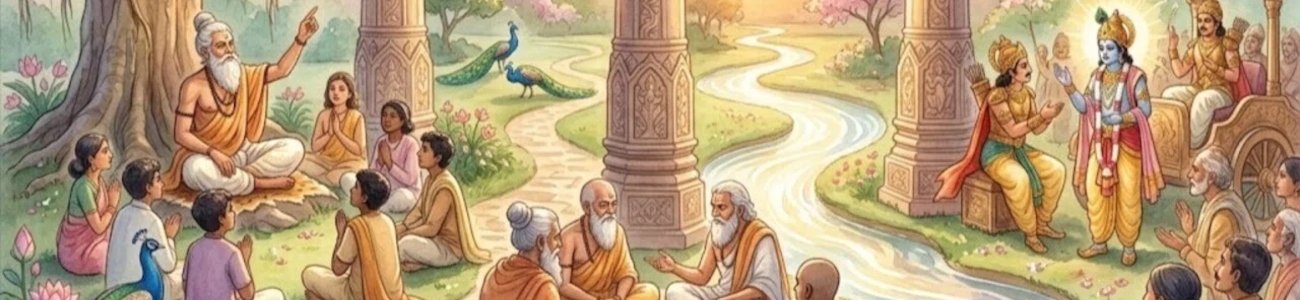
AKA Vedanta Sutras or Shariraka Sutras
Author: Sage Badarayana
The Brahma Sutras are a foundational text of Hindu philosophy, specifically the Vedanta tradition. Written by the sage Badarayana (often associated with Vyasa) around 400–450 CE (with older origins), the text consists of 555 concise aphorisms (sutras) organized into four chapters.Their primary purpose is to systematize and harmonize the teachings of the Upanishads, which can often seem contradictory at first glance.
The Three Pillars of Vedanta
The Brahma Sutras make up the first of the Prasthanatrayi ("three starting points") which form the basis of all Vedanta philosophy. The other two pillars are:
The Upanishads (The foundational revelations)
The Bhagavad Gita (The practical application of philosophy)
Chapter 1: 1.1
1.1
Verse #1
Deliberation on Brahman |
śrī brahmasūtrāṇi.. atha iti oṃ athāto brahmajijñāsā oṃ 1.1.1.. ||
Deliberation on Brahman |
sri brahmasutrani.. atha iti o athato brahmajijnasa o 1.1.1.. ||
Sw. Krishnananda
Now, therefore, the enquiry into Brahman.
Verse #2
Origin etc., of the Universe |
oṃ janmādyasya yataḥ oṃ 1.1.2.. ||
Origin etc., of the Universe |
o janmadyasya yata o 1.1.2.. ||
Sw. Krishnananda
(Brahman is that) from which the origin etc., (i.e. the origin, sustenance and dissolution) of this (world proceed).
Verse #3
Scripture as Source of Knowledge of Brahman |
oṃ śāstrayonitvāt oṃ 1.1.3.. ||
Scripture as Source of Knowledge of Brahman |
o sastrayonitvat o 1.1.3.. ||
Sw. Krishnananda
The scripture being the source of right knowledge.
Verse #4
Upanishads Reveal Brahman |
oṃ tattusamanvayāt oṃ 1.1.4.. ||
Upanishads Reveal Brahman |
o tattusamanvayat o 1.1.4.. ||
Sw. Krishnananda
But that (Brahman is to be known only from the Scriptures and not independently by any other means is established), because it is the main purpose (of all Vedantic texts).
Verse #5
The first Cause Possessed of Consciousness |
oṃ īkṣaternāśabdam oṃ 1.1.5.. ||
The first Cause Possessed of Consciousness |
o iksaternasabdam o 1.1.5.. ||
Sw. Krishnananda
On account of seeing (i.e. thinking being attributed in the Upanishads to the First Cause, the Pradhana) is not (the first cause indicated by the Upanishads; for) it (Pradhana) is not based on the scriptures.
Verse #6
oṃ gauṇaścennātmaśabdāt oṃ ||
o gaunascennatmasabdat o ||
Sw. Krishnananda
If it be said that (the word 'seeing' or thinking) is used in a secondary sense, (we say) not so, because of the word Atman being applied to the cause of the world.
Verse #7
oṃ tanniṣṭhasya mokṣopadeśāt oṃ ||
o tannisthasya moksopadesat o ||
Sw. Krishnananda
(The Pradhana cannot be designated by the term Self) because Salvation is declared to one who is devoted to that Sat.
Verse #8
oṃ heyatvāvacanācca oṃ ||
o heyatvavacanacca o ||
Sw. Krishnananda
And (the Pradhana cannot be denoted by the word 'Self'), because it is not stated (by the scriptures) that It (Sat) has to be discarded.
Verse #9
oṃ svāpyayāt oṃ ||
o svapyayat o ||
Sw. Krishnananda
On account of (the individual) merging in its own Self (the Self cannot be the Pradhana).
Verse #10
oṃ gatisāmānyāt oṃ ||
o gatisamanyat o ||
Sw. Krishnananda
On account of the uniformity of view (of the Vedanta texts, Brahman is to be taken as that cause).
Verse #11
oṃ śrutatvācca oṃ ||
o srutatvacca o ||
Sw. Krishnananda
And because it is directly stated in the Sruti (therefore the all-knowing Brahman alone is the cause of the universe).
Verse #12
The Blissful One |
oṃ ānandamayo'bhyāsāt oṃ 1.1.12.. ||
The Blissful One |
o anandamayo'bhyasat o 1.1.12.. ||
Sw. Krishnananda
Anandamaya means Para Brahman on account of the repetition (of the word 'bliss' as denoting the Highest Self).
Verse #13
oṃ vikāraśabdānneticenna prācuryāt oṃ ||
o vikarasabdanneticenna pracuryat o ||
Sw. Krishnananda
If (it be objected that the term Anandamaya consisting of bliss can) not (denote the supreme Self) because of its being a word denoting a modification or transformation or product (we say that the objection is) not (valid) on account of abundance, (which is denoted by the suffix 'maya').
Verse #14
oṃ taddhetuvyapadeśācca oṃ ||
o taddhetuvyapadesacca o ||
Sw. Krishnananda
And because he is declared to be the cause of it (i.e. of bliss; therefore 'maya' denotes abundance or fulness).
Verse #15
oṃ māntravarṇikameva ca gīyate oṃ ||
o mantravarnikameva ca giyate o ||
Sw. Krishnananda
Moreover that very Brahman which has been re-referred to in the Mantra portion is sung (i.e. proclaimed in the Brahmana passage as the Anandamaya).
Verse #16
oṃ netaro'nupapatteḥ oṃ ||
o netaro'nupapatte o ||
Sw. Krishnananda
(Brahman and) not the other (i.e. the individual soul is meant here) on account of the impossibility (of the latter assumption).
Verse #17
oṃ bhedavyapadeśācca oṃ ||
o bhedavyapadesacca o ||
Sw. Krishnananda
And on account of the declaration of the difference (between the two i.e. the one referred to in the passage 'The Self consisting of bliss' etc. and the individual soul, the latter cannot be the one referred to in the passage).
Verse #18
oṃ kāmācca nānumānāpekṣā oṃ ||
o kamacca nanumanapeksa o ||
Sw. Krishnananda
Because of wishing or willing in the scriptural passage we cannot say even inferentially that Anandamaya means Pradhana.
Verse #19
oṃ asminnasya ca tadyogaṃ śāsti oṃ ||
o asminnasya ca tadyoga sasti o ||
Sw. Krishnananda
And moreover it, i e., the scripture, teaches the joining of this, i.e., the individual soul, with that, i.e., consisting of bliss (Anandamaya) when knowledge is attained.
Verse #20
The Being Inside |
oṃ antastaddharmopadeśāt oṃ 1.1.20.. ||
The Being Inside |
o antastaddharmopadesat o 1.1.20.. ||
Sw. Krishnananda
The being within (the Sun and the eye) is Brahman, because His attributes are taught therein.
Verse #21
oṃ bhedavyapadeśāccānyaḥ oṃ ||
o bhedavyapadesaccanya o ||
Sw. Krishnananda
And there is another one (i.e. the Lord who is different from the individual souls animating the Sun etc.) on account of the declaration of distinction.
Verse #22
Space |
oṃ ākāśastalliṅgāt oṃ 1.1.22.. ||
Space |
o akasastallingat o 1.1.22.. ||
Sw. Krishnananda
The word Akasa i.e., ether here is Brahman on account of characteristic marks (of that i.e. Brahman being mentioned).
Verse #23
Prana |
oṃ ata eva prāṇaḥ oṃ 1.1.23.. ||
Prana |
o ata eva prana o 1.1.23.. ||
Sw. Krishnananda
For the same reason the breath also refers to Brahman.
Verse #24
Light |
oṃ jyotiścaraṇābhidhānāt oṃ 1.1.24.. ||
Light |
o jyotiscaranabhidhanat o 1.1.24.. ||
Sw. Krishnananda
The 'light' is Brahman, on account of the mention of feet in a passage which is connected with the passage about the light.
Verse #25
oṃ chando'bhidhānānneticenna tathāceto'rpaṇanigadāttathā hi darśanam oṃ ||
o chando'bhidhananneticenna tathaceto'rpananigadattatha hi darsanam o ||
Sw. Krishnananda
If it be said that Brahman is not denoted on account of the metre Gayatri being denoted, we reply not so, because thus i.e. by means of the metre the application of the mind on Brahman is declared; because thus it is seen (in other passages also).
Verse #26
oṃ bhūtādipādavyapadeśopapatteścaivam oṃ ||
o bhutadipadavyapadesopapattescaivam o ||
Sw. Krishnananda
And thus also (we must conclude, viz., that Brahman is the subject or topic of the previous passage, where Gayatri occurs) because (thus only) the declaration as to the beings etc. being the feet is possible.
Verse #27
oṃ upadeśabhedānneti cennobhayasminnapyavirodhāt oṃ ||
o upadesabhedanneti cennobhayasminnapyavirodhat o ||
Sw. Krishnananda
If it be said (that Brahman of the Gayatri passage cannot be recognised in the passage treating of 'light') on account of the difference of designation or the specification (we reply) no, because in either (designation) there is nothing contrary (to the recognition).
Verse #28
Pratardana |
oṃ prāṇastathānugamāt oṃ 1.1.28.. ||
Pratardana |
o pranastathanugamat o 1.1.28.. ||
Sw. Krishnananda
Prana is Brahman, that being so understood from a connected consideration (of the passage referring to Prana).
Verse #29
oṃ navakturātmopadeśāditi cedadhyātmasaṃbandhabhūmā hyasmin oṃ ||
o navakturatmopadesaditi cedadhyatmasabandhabhuma hyasmin o ||
Sw. Krishnananda
If it be said that (Brahman is) not (denoted or referred in these passages on account of) the speaker's instruction about himself, we reply not so, because there is abundance of reference to the Inner Self in this (chapter or Upanishad).
Verse #30
oṃ śāstradṛṣṭyā tūpadeśo vāmadevavat oṃ ||
o sastradstya tupadeso vamadevavat o ||
Sw. Krishnananda
The declaration (made by Indra about himself, viz., that he is and with Brahman) is possible through intuition as attested by Sruti, as in the case of Vamadeva.
Verse #31
oṃ jīvamukhyaprāṇaliṅgānneti cennopāsatraividyādāśritatvādiha tadyogāt oṃ |
brahmasūtreṣu caturthādhyāyasya ||
o jivamukhyapranalinganneti cennopasatraividyadasritatvadiha tadyogat o |
brahmasutresu caturthadhyayasya ||
Sw. Krishnananda
If it be said that (Brahman is) not (meant) on account of characteristic marks of the individual soul and the chief vital air (being mentioned); we say no, because (such an interpretation) would enjoin threefold meditation (Upasana), because Prana has been accepted (elsewhere in the Sruti in the sense of Brahman) and because here also (words denoting Brahman) are mentioned with reference to Prana.