Author: Sri Swami Shivananda
Dedicated to Bhagavan Vyasa and Lord Krishna Avatara of Lord Vishnu Flute-Bearer of Vrindavana Joy of Devaki, Beloved of Radho Redeemer of the Fallen
Chapter 8: INTRODUCTION
Verse #1
GLORY of The Gita ||
GLORY of The Gita ||
GLORY of The Gita ||
The Bhagavad Gita is a dialogue between Lord Krishna and Arjuna, narrated in the Bhishma-Parva of the Mahabharata. It comprises eighteen chapters of a total of 700 Sanskrit verses. Considerable matter has been condensed and compressed within these verses. On the battlefield of Kurukshetra, Lord Krishna, during the course of His most interesting and instructive talk with Arjuna, revealed the profound, sublime and soul-stirring spiritual truths, and expounded to him the rare secrets of Yoga, Vedanta, Bhakti and Karma. All the teachings of Lord Krishna were subsequently recorded as the Song Celestial or the Bhagavad Gita by Sri Bhagavan Vyasa for the benefit of humanity at large. The world is under a great debt of gratitude to Sri Vyasa who has presented this Celestial Song to humanity for their daily conduct in life, spiritual uplift and Self-realisation. Only those who are self-controlled and are endowed with faith can reap the full benefit
of the Gita, which is the Science of the Soul.
The Gita Jayanti day or the birthday of the Bhagavad Gita is celebrated throughout India by all the admirers and lovers of this unique book on the 110 day (Ekadasi) of the bright half of the Margasirsha month according to the Hindu almanac. It was the day on which this scripture was revealed to the world by Sanjaya.
In the whole world-literature there is no book so elevating and so inspiring as the Gita. The Gita expounds very lucidly the cardinal principles or the fundamentals of the Hindu religion and the Hindu Dharma. It is the source of all wisdom. It is your great guide. It is your supreme teacher. It is an inexhaustible spiritual treasure. It is a fountain of bliss. It is an ocean of knowledge. It is full of divine splendour and grandeur.
The Gita is the cream of the Vedas. It is the essence of the Upanishads. It is the universal scripture for all people of all temperaments and for all times. It is a wonderful book with sublime thoughts and practical instructions on Yoga, devotion, Vedanta and action. It is a marvellous book, profound in thoughts and sublime in heights of vision. It gives peace and solace to the souls who are afflicted by the three fires (Taapas) of this mortal world (Samsara), viz., Adhyatmika (afflictions caused by one's own body), Adhibhautika (those caused by beings around one), and Adhidaivika (those caused by the gods).
The Bhagavad Gita contains the divine nectar. It is the Chintamani, Kalpataru and Kamadhenu (wish-fulfilling gem, tree and cow respectively). You can milk out anything from it. It is a book of eternity. It is not a catch-penny book which has a life like that of a mushroom. The Gita has been my constant companion of life. It is a vade mecum for all. Peace, Bliss, Ananda, Happiness, Wisdom, Atman, Brahman, Purusha, Dhama, Nirvana, Param Padam, Gita are all only synonymous terms.
The Gita is a boundless ocean of nectar. It is an immortal celestial fruit of the tree of the Upanishads. In this unique book, you will find an unbiased exposition of the philosophy of action, devotion and knowledge, and a wonderful synthesis. The Bhagavad Gita is a rare and splendid flower that wafts its sweet aroma throughout the world. All the Upanishads represent the cows. Sri Krishna is the milker of the Upanishad-cows; Partha (Arjuna) is te calf who first tasted that milk of wisdom of the Self, which was milked by the Divine Cowherd, Sri Krishna, for the benefit or Arjuna and all humanity, as the Bhagavad Gita. It helps to solve not only Arjuna’s problems and doubts, but also the world problems and the problems and doubts of every individual. Glory to Lord Krishna, the friend of the cowherds of Gokula, the Joy of Devaki! He who drinks the nectar of the Gita through purification of the heart and meditation, attains immortality, eternal bliss, everlasting peace and perennial joy.
Just as the dark, unfathomed depths of the ocean contain most precious pearls, so also the Gita contains spiritual gems of incalculable value. You will have to dive deep into the depths of the ocean of the Gita with sincere attitude of reverence and faith. Only then will you be able to collect the spiritual pearls of the Gita. Only then will you be able to comprehend the profound and subtle teachings of the Gita.
-The Gita is a unique book for all ages. It is a book that comes under the category of Prasthanatraya, the authoritative books of the Hindu religion. The Gita is the Immortal Song of the Soul, which bespeaks of the glory of life. The instructions that are inculcated by Lord Krishna are for the whole world. It is a standard book on Yoga for all. The language is as simple as it could be. Even a man who has an elementary knowledge of Sanskrit can go through the book. It deals with the four Yogas, viz., Karma Yoga, Bhakti Yoga, Raja Yoga and Jnana Yoga.
There are countless commentaries on the Gita at the present day. A volume can be written on each verse. A busy man with Karmic tendencies will be benefited by the commentary of Sri Bala Gangadhara Tilak (Gita Rahasya), a man of devotion by studying Sridhara's commentary, and a man of reason by Sri Sankara's commentary.
There are now hundreds of commentaries on this wonderful book. The Gita is like an ocean. Sri Sankara, Sri Ramanuja and Sri Madhva have given their own interpretations of the Gita and established their own philosophy. Anyone can dive deep into this ocean of the Gita, bring out the most precious pearls of divine knowledge and give his own interpretation. Glory to the Gita! Glory to the Lord of the Gita!
The teachings of the Gita are broad, universal and sublime. Jts teachings do not belong to any cult, sect, creed, particular age, place or country. They are meant for the people of the whole world at large. The teachings are based on the Upanishads, the ancient wisdom of the seers (Rishis) and sages. It teaches a method which is within the reach of all. It has a message for the solace, peace, freedom, salvation and perfection of all human beings.
The Gita is like the lake Manasasarovara for the Paramahamsas (monks and renunciates) and thirsting aspirants to sport in. It is the ocean of bliss in which the seekers of Truth swim with joy and ecstasy. If the philusopher's stone touches a piece of iron even at one point, the whole of it is transformed into gold. Even so, if you live in the spirit of even one verse, you will doubtless be transmuted into divinity.
Study of the Gita alone is sufficient for the purpose of daily Svadhyaya (scriptural study). You will find a solution here for all your doubts. The more you study with devotion and faith, the more you will get deeper knowledge, penetrative insight and clear right thinking. Even if you live in the spirit of one verse of the Gita, all your miseries will come to an end and you will attain the goal of life—Immortality and Eternal Peace.
The Gita is a gospel for the whole world. It is meant for the generality of mankind. It was given over five thousand years ago on the battlefield of Kurukshetra, by Lord Krishna to Arjuna.
None but the Lord can bring out such an unprecedented and marvellous book which gives peace to the readers, which helps and guides them in the attainment of Supreme Bliss, which has survived up to this time. This itself proves clearly that God exists, that God is an embodiment of knowledge and that one can attain perfection or liberation by realising God alone.
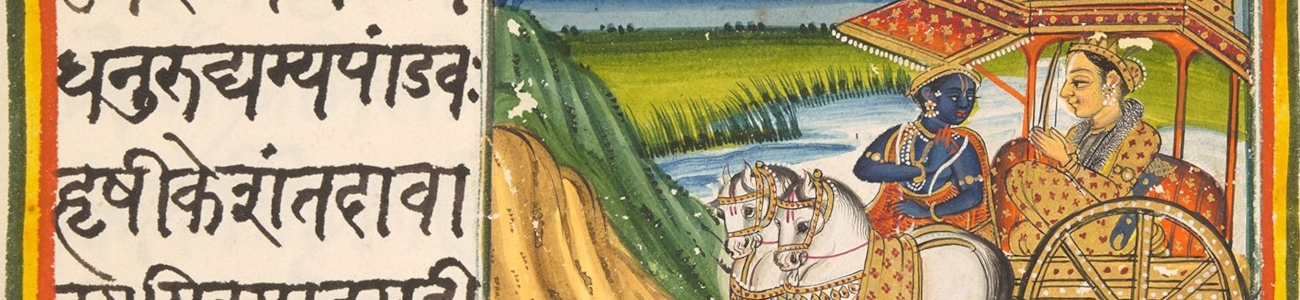
The whole world is a big battlefield. The real Kurukshetra is within you. The battle of Mahabharata is still raging within you. Ignorance (Avidya) is Dhritarashtra. The individual soul is Arjuna. The Indweller Who dwells in your heart is Lord Krishna, the charioteer. The body is your chariot. The senses (Indriyas) are the horses. The mind, egoism, senses, Samskaras (mental impressions), Vasanas (latent tendencies), cravings, Raga-Dvesha (likes and dislikes), lust, jealousy, greed, pride and hypocrisy are your dire enemies.
of the Gita, which is the Science of the Soul.
The Gita Jayanti day or the birthday of the Bhagavad Gita is celebrated throughout India by all the admirers and lovers of this unique book on the 110 day (Ekadasi) of the bright half of the Margasirsha month according to the Hindu almanac. It was the day on which this scripture was revealed to the world by Sanjaya.
In the whole world-literature there is no book so elevating and so inspiring as the Gita. The Gita expounds very lucidly the cardinal principles or the fundamentals of the Hindu religion and the Hindu Dharma. It is the source of all wisdom. It is your great guide. It is your supreme teacher. It is an inexhaustible spiritual treasure. It is a fountain of bliss. It is an ocean of knowledge. It is full of divine splendour and grandeur.
The Gita is the cream of the Vedas. It is the essence of the Upanishads. It is the universal scripture for all people of all temperaments and for all times. It is a wonderful book with sublime thoughts and practical instructions on Yoga, devotion, Vedanta and action. It is a marvellous book, profound in thoughts and sublime in heights of vision. It gives peace and solace to the souls who are afflicted by the three fires (Taapas) of this mortal world (Samsara), viz., Adhyatmika (afflictions caused by one's own body), Adhibhautika (those caused by beings around one), and Adhidaivika (those caused by the gods).
The Bhagavad Gita contains the divine nectar. It is the Chintamani, Kalpataru and Kamadhenu (wish-fulfilling gem, tree and cow respectively). You can milk out anything from it. It is a book of eternity. It is not a catch-penny book which has a life like that of a mushroom. The Gita has been my constant companion of life. It is a vade mecum for all. Peace, Bliss, Ananda, Happiness, Wisdom, Atman, Brahman, Purusha, Dhama, Nirvana, Param Padam, Gita are all only synonymous terms.
The Gita is a boundless ocean of nectar. It is an immortal celestial fruit of the tree of the Upanishads. In this unique book, you will find an unbiased exposition of the philosophy of action, devotion and knowledge, and a wonderful synthesis. The Bhagavad Gita is a rare and splendid flower that wafts its sweet aroma throughout the world. All the Upanishads represent the cows. Sri Krishna is the milker of the Upanishad-cows; Partha (Arjuna) is te calf who first tasted that milk of wisdom of the Self, which was milked by the Divine Cowherd, Sri Krishna, for the benefit or Arjuna and all humanity, as the Bhagavad Gita. It helps to solve not only Arjuna’s problems and doubts, but also the world problems and the problems and doubts of every individual. Glory to Lord Krishna, the friend of the cowherds of Gokula, the Joy of Devaki! He who drinks the nectar of the Gita through purification of the heart and meditation, attains immortality, eternal bliss, everlasting peace and perennial joy.
Just as the dark, unfathomed depths of the ocean contain most precious pearls, so also the Gita contains spiritual gems of incalculable value. You will have to dive deep into the depths of the ocean of the Gita with sincere attitude of reverence and faith. Only then will you be able to collect the spiritual pearls of the Gita. Only then will you be able to comprehend the profound and subtle teachings of the Gita.
-The Gita is a unique book for all ages. It is a book that comes under the category of Prasthanatraya, the authoritative books of the Hindu religion. The Gita is the Immortal Song of the Soul, which bespeaks of the glory of life. The instructions that are inculcated by Lord Krishna are for the whole world. It is a standard book on Yoga for all. The language is as simple as it could be. Even a man who has an elementary knowledge of Sanskrit can go through the book. It deals with the four Yogas, viz., Karma Yoga, Bhakti Yoga, Raja Yoga and Jnana Yoga.
There are countless commentaries on the Gita at the present day. A volume can be written on each verse. A busy man with Karmic tendencies will be benefited by the commentary of Sri Bala Gangadhara Tilak (Gita Rahasya), a man of devotion by studying Sridhara's commentary, and a man of reason by Sri Sankara's commentary.
There are now hundreds of commentaries on this wonderful book. The Gita is like an ocean. Sri Sankara, Sri Ramanuja and Sri Madhva have given their own interpretations of the Gita and established their own philosophy. Anyone can dive deep into this ocean of the Gita, bring out the most precious pearls of divine knowledge and give his own interpretation. Glory to the Gita! Glory to the Lord of the Gita!
The teachings of the Gita are broad, universal and sublime. Jts teachings do not belong to any cult, sect, creed, particular age, place or country. They are meant for the people of the whole world at large. The teachings are based on the Upanishads, the ancient wisdom of the seers (Rishis) and sages. It teaches a method which is within the reach of all. It has a message for the solace, peace, freedom, salvation and perfection of all human beings.
The Gita is like the lake Manasasarovara for the Paramahamsas (monks and renunciates) and thirsting aspirants to sport in. It is the ocean of bliss in which the seekers of Truth swim with joy and ecstasy. If the philusopher's stone touches a piece of iron even at one point, the whole of it is transformed into gold. Even so, if you live in the spirit of even one verse, you will doubtless be transmuted into divinity.
Study of the Gita alone is sufficient for the purpose of daily Svadhyaya (scriptural study). You will find a solution here for all your doubts. The more you study with devotion and faith, the more you will get deeper knowledge, penetrative insight and clear right thinking. Even if you live in the spirit of one verse of the Gita, all your miseries will come to an end and you will attain the goal of life—Immortality and Eternal Peace.
The Gita is a gospel for the whole world. It is meant for the generality of mankind. It was given over five thousand years ago on the battlefield of Kurukshetra, by Lord Krishna to Arjuna.
None but the Lord can bring out such an unprecedented and marvellous book which gives peace to the readers, which helps and guides them in the attainment of Supreme Bliss, which has survived up to this time. This itself proves clearly that God exists, that God is an embodiment of knowledge and that one can attain perfection or liberation by realising God alone.
The whole world is a big battlefield. The real Kurukshetra is within you. The battle of Mahabharata is still raging within you. Ignorance (Avidya) is Dhritarashtra. The individual soul is Arjuna. The Indweller Who dwells in your heart is Lord Krishna, the charioteer. The body is your chariot. The senses (Indriyas) are the horses. The mind, egoism, senses, Samskaras (mental impressions), Vasanas (latent tendencies), cravings, Raga-Dvesha (likes and dislikes), lust, jealousy, greed, pride and hypocrisy are your dire enemies.
Verse #2
GUIDE for STUDY ||
GUIDE for STUDY ||
GUIDE for STUDY ||
As the Gita contains subtle and profound teachings, you should study the Gita under a qualified teacher—a Brahma-Nishtha Guru (a preceptor who is established in the Absolute), with great and intense faith, single-minded devotion and purity. Only then will the truths of the Gita be revealed unto you like the fruit on the palm of your hand. Good commentaries like those of Swami Madhusudana Sarasvati, Swami Sankarananda, and Sri Sankara, written by sages of Self-realisation, will be of immense help to you.
Worldly-minded people, however intellectual they may be, cannot grasp the essential teachings of the Gita. They will enter into unnecessary discussions and useless debates. They will cavil and carp at the teachings. Ignorant people only say: “There is no intimate connection between the verses. They are thrown together in a disorderly manner. There is a great deal of repetition." If they study the Gita with reverence and faith under a qualified teacher, all their doubts will vanish. They will realise that there is a close connection between the verses in all the chapters. Repetitions in the Gita and the Upanishads are useful repetitions. They are calculated to create a deep and indelible impression on the minds of the aspirants.
Lord Krishna speaks from different levels of consciousness. In the Gita, the term “Avyakta” sometimes refers to Mulaprakriti (primordial Nature), sometimes also to Para Brahman (the Absolute). Therefore, the help of a teacher is necessary if you wish to know the right significance of the verses. In the Kathopanishad, the term ‘brick’ is used to denote the Devata (god). In Hatha Yoga it is said: *At the junction of the rivers Ganga and Yamuna, there is a young virgin.” The esoteric meaning is: “There is the SushumnaNadi between the Ida and the Pingala.” You cannot understand the real meaning of these terms without the help of a Master. Even so, you cannot rightly comprehend the meaning of the verses of the Gita without the help of a teacher. Otherwise, you will be like the man who brought a horse before one who asked for “Saindhava”, when he was taking his food. “Saindhava” means “salt” as well as "horse"!
Worldly-minded people, however intellectual they may be, cannot grasp the essential teachings of the Gita. They will enter into unnecessary discussions and useless debates. They will cavil and carp at the teachings. Ignorant people only say: “There is no intimate connection between the verses. They are thrown together in a disorderly manner. There is a great deal of repetition." If they study the Gita with reverence and faith under a qualified teacher, all their doubts will vanish. They will realise that there is a close connection between the verses in all the chapters. Repetitions in the Gita and the Upanishads are useful repetitions. They are calculated to create a deep and indelible impression on the minds of the aspirants.
Lord Krishna speaks from different levels of consciousness. In the Gita, the term “Avyakta” sometimes refers to Mulaprakriti (primordial Nature), sometimes also to Para Brahman (the Absolute). Therefore, the help of a teacher is necessary if you wish to know the right significance of the verses. In the Kathopanishad, the term ‘brick’ is used to denote the Devata (god). In Hatha Yoga it is said: *At the junction of the rivers Ganga and Yamuna, there is a young virgin.” The esoteric meaning is: “There is the SushumnaNadi between the Ida and the Pingala.” You cannot understand the real meaning of these terms without the help of a Master. Even so, you cannot rightly comprehend the meaning of the verses of the Gita without the help of a teacher. Otherwise, you will be like the man who brought a horse before one who asked for “Saindhava”, when he was taking his food. “Saindhava” means “salt” as well as "horse"!
Verse #3
HARMONY in The Gita ||
HARMONY in The Gita ||
HARMONY in The Gita ||
Man is a composite of three fundamental factors, viz., cognition, feeling and will. There are people with three kinds of temperaments, viz. the active temperament, the emotional temperament and the rational temperament. So, there are the three Yogas, viz., Jnana Yoga for the man of enquiry and self-analysis or rational temperament, Bhakti Yoga for the man of emotional temperament, and Karma Yoga for the man of active temperament. One Yoga is as efficacious as the other.
The Gita formulates the theory of the three Margas (paths), viz., the Jnana Marga, the Bhakti Marga and the Karma Marga. According to the teaching of the Gita, there is no conflict among the three. The Gita harmonises wonderfully the philosophy of action, devotion and knowledge. All the three must be harmoniously blended if you wish to attain perfection. You should have the head of Sri Sankara, the heart of Lord Buddha and the hand of Raja Janaka. The three horses of this body-chariot—action, emotion and intellect—should work in perfect harmony. Only then will this body-chariot move smoothly and you can reach the destination safely and quickly. Only then can you rejoice in the Self within. Only then can you sing the song of Soham (I am He).
Only then can you be in tune with the Infinite. Only then can you hear the soundless voice of the soul and enjoy the sweet internal music of the Self.
The central teaching of the Gita is the attainment of the final beatitude of life or perfection or freedom (Moksha) by doing the duties of life or one's Svadharma. The Lord says to Arjuna: "Therefore without attachment, do thou always perform action which should be done; for by performing action without attachment man reaches the Supreme."
The Gita is divided into three sections, illustrative of the three terms of the Mahavakya or the Great Sentence of the Sama Veda, Tat-Tvam-Asi, (That thou art). In accordance with this view, the first six chapters deal with the path of action or Karma Yoga and the nature of "thou" or the Tvam-Pada. The next six chapters explain the path of devotion or Bhakti Yoga and the nature of "That", Tat-Pada. The last six chapters treat of the path of knowledge or Jnana Yoga and the nature of the term “art” or Asi-Pada which establishes the identity of the individual and the Supreme Soul, Jiva-Brahma-Aikya.
The eighteen chapters of the Gita are nov woven in a disconnecied or discordant manner. There is an intimate relationship or vital connection between one chapter and another. Arjuna became very despondent and the teachings of the second chapter which bespeak of the immortality of the Soul, opened his eyes and gave him strength and courage. Arjuna then understood the technique of Karma Yoga and renunciation of the fruits of actions. Then he learnt the methods to control the senses and the mind and to practise concentration and meditation. Then Lord Krishna gave a description of His various Vibhutis (manifestations) in order to prepare him for the vision of the Cosmic Form or Visvarupa-Darsana. Then Arjuna: experienced the magnificent Cosmic Vision. Then he understood the nature of a Jivanmukta or Bhagavata. Then he had knowledge of the field and the knower of the three Gunas and the Purushottama. Then he had knowledge of the divine attributes and the three kinds of faith, and the essence of Sannyasa Yoga in the end. Just as a student is coached up in the university, so also Arjuna was coached up by Lord Krishna for the attainment of knowledge of the Self in the Adhyatmic (spiritual) University. Arjuna had various kinds of doubts. Lord Krishna cleared his doubts one by one. He pushed Arjuna up the ladder of Yoga from one rung to another. Ultimately Arjuna placed his foot on the highest rung of the ladder, attained knowledge of the Self, and then exclaimed in joy: “O my Lord! My delusion has been destroyed. I have attained knowledge through Thy Grace. I am firm now. My doubts have now vanished in toto. I will act according to Thy word."
You can become a Jivanmukta by annihilating the ego, and the two currents of Raga (likes) and Dvesha (dislikes). You can become a liberated sage by annihilating the desires and cravings and by destroying the residual potencies (Samskaras) and Sankalpas (desireful thoughts). You can thus rest in your own Satchidananda-Svarupa (essential nature as Existence-KnowledgeBliss Absolute) and still you can be active in the affairs of the world like Raja Janaka. You will not be bound by Karmas. You will not be tainted by the actions, because the idea of doership has been destroyed by the attainment of knowledge of the Self or Brahma-Jnana. This is the keynote of the Gita.
The Gita formulates the theory of the three Margas (paths), viz., the Jnana Marga, the Bhakti Marga and the Karma Marga. According to the teaching of the Gita, there is no conflict among the three. The Gita harmonises wonderfully the philosophy of action, devotion and knowledge. All the three must be harmoniously blended if you wish to attain perfection. You should have the head of Sri Sankara, the heart of Lord Buddha and the hand of Raja Janaka. The three horses of this body-chariot—action, emotion and intellect—should work in perfect harmony. Only then will this body-chariot move smoothly and you can reach the destination safely and quickly. Only then can you rejoice in the Self within. Only then can you sing the song of Soham (I am He).
Only then can you be in tune with the Infinite. Only then can you hear the soundless voice of the soul and enjoy the sweet internal music of the Self.
The central teaching of the Gita is the attainment of the final beatitude of life or perfection or freedom (Moksha) by doing the duties of life or one's Svadharma. The Lord says to Arjuna: "Therefore without attachment, do thou always perform action which should be done; for by performing action without attachment man reaches the Supreme."
The Gita is divided into three sections, illustrative of the three terms of the Mahavakya or the Great Sentence of the Sama Veda, Tat-Tvam-Asi, (That thou art). In accordance with this view, the first six chapters deal with the path of action or Karma Yoga and the nature of "thou" or the Tvam-Pada. The next six chapters explain the path of devotion or Bhakti Yoga and the nature of "That", Tat-Pada. The last six chapters treat of the path of knowledge or Jnana Yoga and the nature of the term “art” or Asi-Pada which establishes the identity of the individual and the Supreme Soul, Jiva-Brahma-Aikya.
The eighteen chapters of the Gita are nov woven in a disconnecied or discordant manner. There is an intimate relationship or vital connection between one chapter and another. Arjuna became very despondent and the teachings of the second chapter which bespeak of the immortality of the Soul, opened his eyes and gave him strength and courage. Arjuna then understood the technique of Karma Yoga and renunciation of the fruits of actions. Then he learnt the methods to control the senses and the mind and to practise concentration and meditation. Then Lord Krishna gave a description of His various Vibhutis (manifestations) in order to prepare him for the vision of the Cosmic Form or Visvarupa-Darsana. Then Arjuna: experienced the magnificent Cosmic Vision. Then he understood the nature of a Jivanmukta or Bhagavata. Then he had knowledge of the field and the knower of the three Gunas and the Purushottama. Then he had knowledge of the divine attributes and the three kinds of faith, and the essence of Sannyasa Yoga in the end. Just as a student is coached up in the university, so also Arjuna was coached up by Lord Krishna for the attainment of knowledge of the Self in the Adhyatmic (spiritual) University. Arjuna had various kinds of doubts. Lord Krishna cleared his doubts one by one. He pushed Arjuna up the ladder of Yoga from one rung to another. Ultimately Arjuna placed his foot on the highest rung of the ladder, attained knowledge of the Self, and then exclaimed in joy: “O my Lord! My delusion has been destroyed. I have attained knowledge through Thy Grace. I am firm now. My doubts have now vanished in toto. I will act according to Thy word."
You can become a Jivanmukta by annihilating the ego, and the two currents of Raga (likes) and Dvesha (dislikes). You can become a liberated sage by annihilating the desires and cravings and by destroying the residual potencies (Samskaras) and Sankalpas (desireful thoughts). You can thus rest in your own Satchidananda-Svarupa (essential nature as Existence-KnowledgeBliss Absolute) and still you can be active in the affairs of the world like Raja Janaka. You will not be bound by Karmas. You will not be tainted by the actions, because the idea of doership has been destroyed by the attainment of knowledge of the Self or Brahma-Jnana. This is the keynote of the Gita.
Verse #4
The TWO WAYS ||
The TWO WAYS ||
The TWO WAYS ||
The seers of the Upanishads emphatically declare that the real man is the-all-pervading, immortal Soul which is the substratum of this body, mind and world, which is behind the five sheaths, viz., the food sheath, the vital sheath, the mental sheath, the intellectual sheath and the blissful sheath. |
The goal of life is the direct cognition or realisation of this self-Iuminous Self which is hidden in this body like fire in wood, and butter in milk. This Self (Atman) is the inner ruler or Antaryamin. He is the unseen governor or hidden proprietor of this house, the body.
Real religion is the attainment of this transcendental, supreme, undying, undecaying Tattva or principle through constant and profound meditation. Real life is life in the eternal Atman or Soul. True life is identification with this Supreme Soul which exists in the past, present and future, which has neither beginning, middle nor end, which has neither parts nor limbs, which is neither subtle nor gross.
The Rishis of yore attained this mysterious and marvelous Atman through the eye of intuition or the divine inner third eye (Jnanachakshus) and then explained things of this world in the light of their knowledge of the Self. This is the direct method of Self-realisation.
You can ascend the summit of the hill of knowledge of the Self through science, art, Nature, music, etc. This is the indirect method. From the effect you go to the cause and ultimately reach the causeless Cause or Para Brahman or the ultimate, transcendental Truth. Our Western scientists will be groping in utter darkness if their purpose is only to invent some things for our physical comforts or convenient living. The goal of science is to find out the one ultimate Truth which is the substratum of the atoms, molecules, electrons, energy, motion and all physical and mental phenomena and all the laws of Nature through enquiry, observation, analysis, investigation and study of the laws of Nature. A real scientist is only a Vedantin. His mode of approach to the Truth only is different. The scientist who was saying previously: “There is nothing beyond this world”, proclaims now: “The more I know of the phenomena, the more I am puzzled. Intellect is finite and cold. Behind these changing phenomena, there is the unchanging Noumenon. Behind the rotating dynamic electrons, there is the static, motionless something: or something beyond the intellect and the world.” The Brahman of the Upanishads is the Atman of the Vedantins, Who is the Lord of these laws of Nature. “My method of approach is a posteriori method, from the effect to the cause. The Vedantins’ method is the a priori method, from the cause to the effect. The goal is the same.”
The goal of life is the direct cognition or realisation of this self-Iuminous Self which is hidden in this body like fire in wood, and butter in milk. This Self (Atman) is the inner ruler or Antaryamin. He is the unseen governor or hidden proprietor of this house, the body.
Real religion is the attainment of this transcendental, supreme, undying, undecaying Tattva or principle through constant and profound meditation. Real life is life in the eternal Atman or Soul. True life is identification with this Supreme Soul which exists in the past, present and future, which has neither beginning, middle nor end, which has neither parts nor limbs, which is neither subtle nor gross.
The Rishis of yore attained this mysterious and marvelous Atman through the eye of intuition or the divine inner third eye (Jnanachakshus) and then explained things of this world in the light of their knowledge of the Self. This is the direct method of Self-realisation.
You can ascend the summit of the hill of knowledge of the Self through science, art, Nature, music, etc. This is the indirect method. From the effect you go to the cause and ultimately reach the causeless Cause or Para Brahman or the ultimate, transcendental Truth. Our Western scientists will be groping in utter darkness if their purpose is only to invent some things for our physical comforts or convenient living. The goal of science is to find out the one ultimate Truth which is the substratum of the atoms, molecules, electrons, energy, motion and all physical and mental phenomena and all the laws of Nature through enquiry, observation, analysis, investigation and study of the laws of Nature. A real scientist is only a Vedantin. His mode of approach to the Truth only is different. The scientist who was saying previously: “There is nothing beyond this world”, proclaims now: “The more I know of the phenomena, the more I am puzzled. Intellect is finite and cold. Behind these changing phenomena, there is the unchanging Noumenon. Behind the rotating dynamic electrons, there is the static, motionless something: or something beyond the intellect and the world.” The Brahman of the Upanishads is the Atman of the Vedantins, Who is the Lord of these laws of Nature. “My method of approach is a posteriori method, from the effect to the cause. The Vedantins’ method is the a priori method, from the cause to the effect. The goal is the same.”
Verse #5
RECONCILIATION of The PATHS ||
RECONCILIATION of The PATHS ||
RECONCILIATION of The PATHS ||
In the Vishnu Purana, Bhagavan Vishnu is highly eulogised and a secondary place is given to Lord Siva. In the Siva Purana, Lord Siva is immensely praised and a secondary place is given to Lord Hari. In Devi Bhagavatam, Devi is highly praised and a secondary place is given to Lord Siva and Lord Hari. This is done in order to create intense and unswerving faith in the aspirant for his Ishta Devata or a ourite deity. Siva, Hari and Devi are one. They are different aspects of the Lord. It is simply absurd if you believe that Siva is inferior to Hari or Hari is inferior to Siva.
Even so, in one place Lord Krishna praises Karma Yoga.
"Karmasannyasat karmayogo visishyate—Yoga of action is verily better than renunciation of action." (Chapter V. 2). In another place He praises Yoga. “The Yogi is greater than the ascetic; he is thought to be even greater than the wise; the Yogi is greater than the man of action; therefore, become thou a Yogi, O Arjuna." (Chapter VI. 46). In another place, the Lord praises Bhakti Yoga. "He, the Highest Spirit, O Partha, may be reached by unswerving devotion to Him alone." (Chapter VIII. 22). In another place, He praises Jnana Yoga. *Noble are all these, but I hold the wise as verily Myself; he, self-united, is fixed on Me, the highest path." (Chapter VII. 18)
A neophyte will be confused when he comes across these verses. But there is no room for any confusion if you think deeply. Lord Krishna has praised each Yoga in order to create interest in the aspirant in his particular Marga or path. You must remember that the Gita is a book for the people of the world at large. It was not meant for Arjuna alone. Each Yoga is as efficacious and potent as the other.
Even so, in one place Lord Krishna praises Karma Yoga.
"Karmasannyasat karmayogo visishyate—Yoga of action is verily better than renunciation of action." (Chapter V. 2). In another place He praises Yoga. “The Yogi is greater than the ascetic; he is thought to be even greater than the wise; the Yogi is greater than the man of action; therefore, become thou a Yogi, O Arjuna." (Chapter VI. 46). In another place, the Lord praises Bhakti Yoga. "He, the Highest Spirit, O Partha, may be reached by unswerving devotion to Him alone." (Chapter VIII. 22). In another place, He praises Jnana Yoga. *Noble are all these, but I hold the wise as verily Myself; he, self-united, is fixed on Me, the highest path." (Chapter VII. 18)
A neophyte will be confused when he comes across these verses. But there is no room for any confusion if you think deeply. Lord Krishna has praised each Yoga in order to create interest in the aspirant in his particular Marga or path. You must remember that the Gita is a book for the people of the world at large. It was not meant for Arjuna alone. Each Yoga is as efficacious and potent as the other.
Verse #6
ESSENCE of The Gita ||
ESSENCE of The Gita ||
ESSENCE of The Gita ||
The Gita emphasises again and again that one should cultivate an attitude of non-attachment or detachment. It urges repeatedly that one should live in the world like the lotus-leaf, which is unaffected by water. He who acts placing all actions in the Eternal,
abandoning attachment, is as unaffected by sin as a lotus-leaf by water—Padmapatramivambhasa. (Chapter V. 10)
Attachment is due to Moha. Attachment is the offspring of the quality of Rajas. Non-attachment is born of Sattva. Attachment is an Asuri-Sampat, demoniacal quality. Non-attachment is a Daivi-Sampat, divine attribute. Attachment is born of ignorance, selfishness and passion. Attachment brings death. Non-attachment is wisdom. Non-attachment brings freedom. Practice of detachment is a rigorous discipline indeed. You will have to practise it again and again. You may tumble down like a baby who is just learning to walk, but you will have to rise up again with a smile and a cheerful heart. Failures are not stumbling blocks, but steppingstones to success. Try to dwell always in your own Self. Abide in your own Self. Abide in your centre. Think of the Self constantly. All attachments will die automatically. Attachment to God or Atman is a potent antidote to annihilate all worldly attachments. He who has no attachment can really love others. He has pure love or divine Prema. Therefore, without attachment, constantly perform action which is duty, for, by performing actions without attachment, man verily reacheth the Supreme. (Chapter III. 19)
The thirteenth, fourteenth and fifteenth discourses deal with Jnana Yoga. He who has knowledge of Prakriti and. Purusha (Nature and God), the three Gunas (qualities of Nature) and their operation, and of the wonderful tree of Maya (illusory power) or the Samsara-Vriksha, can transcend the Prakriti and the Gunas, and cut this marvellous, deep-rooted tree with the sword of wisdom of the Self or the axe of dispassion, 'and attain Atma-Sakshatkara or direct Self-realisation which releases him from the round of births and deaths. The fifteenth discourse is a soul-elevating one. It contains the essence of Vedanta. He who rightly understands this discourse will soon attain Moksha or the imperishable Seat of Brahman. Get by heart the twenty verses and repeat them before you take your food. All Sannyasins repeat them before they take food.
The eighteenth chapter must be studied again and again. It contains the quintessence of the whole Gita Sastra. It is the supreme pinnacle on the magnificent hill of the knowledge of the Gita. It is the crowning jewel in the priceless necklace and in it is condensed the substance of those teachings found in the first seventeen chapters.
Constant remembrance and practice of the teachings of verses 19, 20, 23, and 24 of chapter II will confer on you Immortality and will remove fear and Dehadhyasa (identification of the Self with the body).
Constant remembrance and practice of the teachings of verse 22 of chapter V: Ye hi samsparsaja bhogah......., verse 8 of chapter XIII: Indriyartheshu vairagyam...... and verse 38 of chapter XVIII: Vishayendriya samyogat...... will induce dispassion (Vairagya).
Life in the spirit of verses II. 71, and IV. 39, will give you supreme peace. Verses V. 27, 28, VI. 11 to 14, and 26, VIII. 8, 12, 13 and 14, IX. 34, XII. 8 to 10, XVIII. 51 to 53, deal with Yoga Sadhana or spiritual practice for Self-realisation. The philosophy of the Gita begins from verse II. 11. Verse XVIII. 66 is the most important one in the Gita: “Abandoning all duties, come unto Me alone for shelter; sorrow not; I will liberate thee from all sins." Arjuna asks Lord Krishna: “My heart is overpowered by the taint of pity; my mind is confused as to duty. I ask Thee: tell me decisively what is good for me. I am Thy disciple. Instruct me who has taken refuge in Thee.” (Chapter II. 17) Lord Krishna gives His answer to this question of Arjuna in verse XVIII. 66. The essence of the whole Gita is contained in verses 65 and 66 of chapter XVIII.
Verse 65 of chapter XVIII contains the essence of Navavidha-Bhakti or the nine modes of devotion. Here is the Sadhana for perfect control of thoughts. By fixing the mind again and again on the. Lord, all worldly thoughts die by themselves. Bhakti Yoga can hardly be separated from Raja Yoga. There is a blending of these two Yogas. Patanjali Maharshi says that Samadhi can be attained through devotion unto the Lord: /svarapranidhanadva, or by self-surrender to the Lord. Self-surrender to the Lord is an important item in the Kriya Yoga and Niyama of Raja Yoga. Manmana Bhava is merging the mind. It is a Raja Yoga Sadhana. It is difficult to say where Bhakti Yoga ends and where Raja Yoga begins. Raja Yoga is the fulfilment of Bhakti Yoga. There is no hard and fast rule or line of demarcation between Bhakti Yoga and Raja Yoga. A Raja Yogi is also a Bhakta. A devotee is also a Raja Yogi. There is difference only in name. Lord Krishna gives His word of assurance to Arjuna to encourage him as he is in a despondent and confused state of mind by saying: “Thou shalt come even to Me. I pledge thee My Truth (word); thou art dear to Me." Follow these instructions. He who has practised these four vital instructions will be able to effect unconditioned, unreserved self-surrender.
The next verse contains the essence of self-surrender. The Advaita Vedantin explains the verse thus: “Give up the notion that you are an individual soul. You will attain liberation. You will become a Jivanmukta (a sage liberated while living)." An Acharya (teacher) of the Bhakti cult explains it thus: "Surrender the fruits of all actions and the actions themselves at the Feet of the Lord. The Lord will give you liberation." Dharma here cannot signify the Dharma of the senses, because even a Jivanmukta sees, hears, tastes, and so forth; but, he stands as a witness; he does not identify himself with the actions of the senses. In this verse, Lord Krishna gives His definite answer to the query of Arjuna contained in the verse: “My heart is overpowered by the taint of pity; my mind is confused as to duty. I ask Thee: tell me decisively what is good for me. I am Thy disciple. Instruct me who has taken refuge in Thee."
You need not study many books on Yoga and Vedanta. If you can live in the true spirit of those two verses, you will attain the summum bonum of existence, i.e., immortality, eternal bliss and knowledge of the Self.
“Work without egoism, without expectation of fruits. Surrender the actions and their fruits as offerings unto the Lord. Divinise your life by melting the mind and the ego in the Lord. Spiritualise your life by dedicating your mind and intellect to the Lord (Macchitta, Yukta, Matparah). Fix the mind on the Lord. Be devoted to Him. Be intent on the welfare of all beings, sarvabhutahite ratah. Sacrifice everything unto the Lord. Then, you will enter into His Being.” This is the note ringing throughout the Gita.
Sadhana in the Gita is explained in the following verses:
Karma Yoga: II. 48, IV. 20 to 22 and 24.
Bhakti Yoga: IX. 27, 34, XII. 8, XVIII. 52 to 54.
Japa Yoga: VIII. 14.
Abhyasa Yoga: XII. 9.
Hatha Yoga: VIII. 10, 12.
Raja Yoga: VI. 25, 26.
Jnana Yoga: III. 28, V. 8, 9.
IN DEFENCE
Some people study the Gita in order to find out loopholes in it and criticise the teachings contained in it. The teachings of the Gita can only be understood if you approach it with a reverential attitude of mind and with intense faith.
Someone in a newspaper gave vent to the criticism thus: “The Gita is not a sacred book at all. It teaches violence. Lord Krishna has asked Arjuna to kill even his dear relations and preceptors." It seems that this critic has obviously no real knowledge of the Gita. He is like Virochana who received spiritual instructions from Prajapati and took the body for the Self on account of his perverted intellect. He is obviously a follower of the philosophy of the flesh.
He cannot comprehend the depths of the Gita philosophy as his mind is callous and impervious to the reception of Truth. He has read the Gita not for gaining spiritual knowledge, but for attacking it! If he really understood the right significance of the three verses, viz., "He who regardeth this as a slayer, and he who thinketh he is slain, both of them are ignorant. He slayeth not, nor is He slain." (Chapter II. 19). "Therefore, stand up. By Me they have already been overcome. Be thou the outward cause." (Chapter XI. 33). "He who is free from the egoistic notion, whose intellect is not affected, though he slays these people, he slayeth not, nor is he bound." (Chapter XVIII. 17)—he would not have made this vain criticism. The Universal Being transcends all parochial values.
Just as coloured water penetrates a piece of cloth freely and nicely when it is pure white, so also the instructions of a sage can penetrate and settle down in the hearts of aspirants only when their minds are calm, when there are no desires for enjoyments and when the impurities of their minds are destroyed. That is the reason why an aspirant is expected to possess the qualifications of Viveka (discrimination), Vairagya (dispassion), Sama (control of the mind), Dama (control of the senses), Uparati (turning away from worldly attractions), before he could practise the threefold Sadhana of hearing of the scriptures, reflection, and meditation on them. Discipline and purification of the mind and the senses are the prerequisites in the aspirants on the path of Truth and God-realisation.
Even when the nature of God is explained, those who have not been purged of their faults and impurities, either disbelieve or misbelieve it, as was the case with Indra and Virochana. Therefore, knowledge as inculcated arises only in him who has purified himself by Tapas (austerity), etc., performed either in this or in a previous birth. The Sruti (Upanishad) says: “To that high-souled man whose devotion to his preceptor is as great as that to the Lord, these secrets explained here become illumined.”
Some people catch fish in the river Ganga for satisfying their palate and quote the Gita to support their evil action: “Weapons cleave him not, nor fire burneth him.” (Chap. II. 23). Wonderful philosophy indeed! Devils also can quote scriptures. These people are also followers of the Virochana school. They are the evil-doing, the deluded and the vilest of men. They cannot understand the teachings of the Gita as their wisdom has been destroyed by illusion and as they have embraced the nature of demons. May the Lord grant them subtle and pure intellect, inner spiritual strength and right understanding to comprehend the teachings of the Gita in their proper light and live in the spirit of the teachings.
Some ignorant people say: “Krishna is not God. He is not an . Avatara (incarnation). He was a passionate cow-herd who lustfully played with the Gopis." What was the age of Lord Krishna at that time? Was He not a boy of seven? Could there have been a tinge of passion in Him? Who can understand the secret of Rasa Lila and Madhurya Bhava (the lover-beloved relationship between the devotee and God), the culmination of highest Bhakti, Amanivedana or total surrender to the Lord. It is only Narada, Suka Deva, Chaitanya, Mira, Hafiz, Ramananda, the Sakhis or the Gopis that could understand the secret of Rasa Lila. The Sakhis only are qualified for this. Did He not perform miracles when He was a. boy? Did He not show that He was the Avatara of Lord Hari? Did He not show His Cosmic Form to His mother when He was a baby? Did He not subdue the Kaliya-serpent by standing on its hood? Did He not multiply Himself as countless Krishnas? Who were the Gopis? Were they not God-intoxicated beings who saw Krishna alone everywhere, who saw themselves also as Krishna? The sound of the Murali could throw them in a state of divine ecstasy or holy communion. They were above body-consciousness.
What is the fate of such people who cavil and carp against the Lord? Just listen. “Those devoid of reason think of Me, the unmanifested, as having manifestation, knowing not My supreme nature, imperishable, most excellent." (Chapter VII. 24) “The foolish disregard Me, when clad in human semblance, ignorant of My supreme nature, the great Lord of beings. Empty of hope, empty of deeds, empty of wisdom, senseless, partaking of the deceitful, brutal and demoniacal nature (chapter IX. 11, 12), they, enwrapped in darkness, think wrong to be right, and see things in a perverted light. These demoniacal men know neither action nor renunciation, neither purity nor right conduct, neither truth nor uprightness. They do not know what ought to be done and what ought not to be done. I ever throw them into demoniacal wombs. Deluded birth after birth, not attaining Me, they sink into the lowest depths.” (Chapter XVI. 19, 20)
Some thoughtless people begin to entertain a doubt and say: . *How could the Gita have been taught to Arjuna on the battlefield in such a short time? It could not." This is wrong. It was all a revelation to Arjuna. Lord Krishna gave Arjuna the divine eye of intuition. The omniscient, omnipotent Lord can do anything. His Grace can make the dumb man eloquent and the cripple a climber of mountains.
abandoning attachment, is as unaffected by sin as a lotus-leaf by water—Padmapatramivambhasa. (Chapter V. 10)
Attachment is due to Moha. Attachment is the offspring of the quality of Rajas. Non-attachment is born of Sattva. Attachment is an Asuri-Sampat, demoniacal quality. Non-attachment is a Daivi-Sampat, divine attribute. Attachment is born of ignorance, selfishness and passion. Attachment brings death. Non-attachment is wisdom. Non-attachment brings freedom. Practice of detachment is a rigorous discipline indeed. You will have to practise it again and again. You may tumble down like a baby who is just learning to walk, but you will have to rise up again with a smile and a cheerful heart. Failures are not stumbling blocks, but steppingstones to success. Try to dwell always in your own Self. Abide in your own Self. Abide in your centre. Think of the Self constantly. All attachments will die automatically. Attachment to God or Atman is a potent antidote to annihilate all worldly attachments. He who has no attachment can really love others. He has pure love or divine Prema. Therefore, without attachment, constantly perform action which is duty, for, by performing actions without attachment, man verily reacheth the Supreme. (Chapter III. 19)
The thirteenth, fourteenth and fifteenth discourses deal with Jnana Yoga. He who has knowledge of Prakriti and. Purusha (Nature and God), the three Gunas (qualities of Nature) and their operation, and of the wonderful tree of Maya (illusory power) or the Samsara-Vriksha, can transcend the Prakriti and the Gunas, and cut this marvellous, deep-rooted tree with the sword of wisdom of the Self or the axe of dispassion, 'and attain Atma-Sakshatkara or direct Self-realisation which releases him from the round of births and deaths. The fifteenth discourse is a soul-elevating one. It contains the essence of Vedanta. He who rightly understands this discourse will soon attain Moksha or the imperishable Seat of Brahman. Get by heart the twenty verses and repeat them before you take your food. All Sannyasins repeat them before they take food.
The eighteenth chapter must be studied again and again. It contains the quintessence of the whole Gita Sastra. It is the supreme pinnacle on the magnificent hill of the knowledge of the Gita. It is the crowning jewel in the priceless necklace and in it is condensed the substance of those teachings found in the first seventeen chapters.
Constant remembrance and practice of the teachings of verses 19, 20, 23, and 24 of chapter II will confer on you Immortality and will remove fear and Dehadhyasa (identification of the Self with the body).
Constant remembrance and practice of the teachings of verse 22 of chapter V: Ye hi samsparsaja bhogah......., verse 8 of chapter XIII: Indriyartheshu vairagyam...... and verse 38 of chapter XVIII: Vishayendriya samyogat...... will induce dispassion (Vairagya).
Life in the spirit of verses II. 71, and IV. 39, will give you supreme peace. Verses V. 27, 28, VI. 11 to 14, and 26, VIII. 8, 12, 13 and 14, IX. 34, XII. 8 to 10, XVIII. 51 to 53, deal with Yoga Sadhana or spiritual practice for Self-realisation. The philosophy of the Gita begins from verse II. 11. Verse XVIII. 66 is the most important one in the Gita: “Abandoning all duties, come unto Me alone for shelter; sorrow not; I will liberate thee from all sins." Arjuna asks Lord Krishna: “My heart is overpowered by the taint of pity; my mind is confused as to duty. I ask Thee: tell me decisively what is good for me. I am Thy disciple. Instruct me who has taken refuge in Thee.” (Chapter II. 17) Lord Krishna gives His answer to this question of Arjuna in verse XVIII. 66. The essence of the whole Gita is contained in verses 65 and 66 of chapter XVIII.
Verse 65 of chapter XVIII contains the essence of Navavidha-Bhakti or the nine modes of devotion. Here is the Sadhana for perfect control of thoughts. By fixing the mind again and again on the. Lord, all worldly thoughts die by themselves. Bhakti Yoga can hardly be separated from Raja Yoga. There is a blending of these two Yogas. Patanjali Maharshi says that Samadhi can be attained through devotion unto the Lord: /svarapranidhanadva, or by self-surrender to the Lord. Self-surrender to the Lord is an important item in the Kriya Yoga and Niyama of Raja Yoga. Manmana Bhava is merging the mind. It is a Raja Yoga Sadhana. It is difficult to say where Bhakti Yoga ends and where Raja Yoga begins. Raja Yoga is the fulfilment of Bhakti Yoga. There is no hard and fast rule or line of demarcation between Bhakti Yoga and Raja Yoga. A Raja Yogi is also a Bhakta. A devotee is also a Raja Yogi. There is difference only in name. Lord Krishna gives His word of assurance to Arjuna to encourage him as he is in a despondent and confused state of mind by saying: “Thou shalt come even to Me. I pledge thee My Truth (word); thou art dear to Me." Follow these instructions. He who has practised these four vital instructions will be able to effect unconditioned, unreserved self-surrender.
The next verse contains the essence of self-surrender. The Advaita Vedantin explains the verse thus: “Give up the notion that you are an individual soul. You will attain liberation. You will become a Jivanmukta (a sage liberated while living)." An Acharya (teacher) of the Bhakti cult explains it thus: "Surrender the fruits of all actions and the actions themselves at the Feet of the Lord. The Lord will give you liberation." Dharma here cannot signify the Dharma of the senses, because even a Jivanmukta sees, hears, tastes, and so forth; but, he stands as a witness; he does not identify himself with the actions of the senses. In this verse, Lord Krishna gives His definite answer to the query of Arjuna contained in the verse: “My heart is overpowered by the taint of pity; my mind is confused as to duty. I ask Thee: tell me decisively what is good for me. I am Thy disciple. Instruct me who has taken refuge in Thee."
You need not study many books on Yoga and Vedanta. If you can live in the true spirit of those two verses, you will attain the summum bonum of existence, i.e., immortality, eternal bliss and knowledge of the Self.
“Work without egoism, without expectation of fruits. Surrender the actions and their fruits as offerings unto the Lord. Divinise your life by melting the mind and the ego in the Lord. Spiritualise your life by dedicating your mind and intellect to the Lord (Macchitta, Yukta, Matparah). Fix the mind on the Lord. Be devoted to Him. Be intent on the welfare of all beings, sarvabhutahite ratah. Sacrifice everything unto the Lord. Then, you will enter into His Being.” This is the note ringing throughout the Gita.
Sadhana in the Gita is explained in the following verses:
Karma Yoga: II. 48, IV. 20 to 22 and 24.
Bhakti Yoga: IX. 27, 34, XII. 8, XVIII. 52 to 54.
Japa Yoga: VIII. 14.
Abhyasa Yoga: XII. 9.
Hatha Yoga: VIII. 10, 12.
Raja Yoga: VI. 25, 26.
Jnana Yoga: III. 28, V. 8, 9.
IN DEFENCE
Some people study the Gita in order to find out loopholes in it and criticise the teachings contained in it. The teachings of the Gita can only be understood if you approach it with a reverential attitude of mind and with intense faith.
Someone in a newspaper gave vent to the criticism thus: “The Gita is not a sacred book at all. It teaches violence. Lord Krishna has asked Arjuna to kill even his dear relations and preceptors." It seems that this critic has obviously no real knowledge of the Gita. He is like Virochana who received spiritual instructions from Prajapati and took the body for the Self on account of his perverted intellect. He is obviously a follower of the philosophy of the flesh.
He cannot comprehend the depths of the Gita philosophy as his mind is callous and impervious to the reception of Truth. He has read the Gita not for gaining spiritual knowledge, but for attacking it! If he really understood the right significance of the three verses, viz., "He who regardeth this as a slayer, and he who thinketh he is slain, both of them are ignorant. He slayeth not, nor is He slain." (Chapter II. 19). "Therefore, stand up. By Me they have already been overcome. Be thou the outward cause." (Chapter XI. 33). "He who is free from the egoistic notion, whose intellect is not affected, though he slays these people, he slayeth not, nor is he bound." (Chapter XVIII. 17)—he would not have made this vain criticism. The Universal Being transcends all parochial values.
Just as coloured water penetrates a piece of cloth freely and nicely when it is pure white, so also the instructions of a sage can penetrate and settle down in the hearts of aspirants only when their minds are calm, when there are no desires for enjoyments and when the impurities of their minds are destroyed. That is the reason why an aspirant is expected to possess the qualifications of Viveka (discrimination), Vairagya (dispassion), Sama (control of the mind), Dama (control of the senses), Uparati (turning away from worldly attractions), before he could practise the threefold Sadhana of hearing of the scriptures, reflection, and meditation on them. Discipline and purification of the mind and the senses are the prerequisites in the aspirants on the path of Truth and God-realisation.
Even when the nature of God is explained, those who have not been purged of their faults and impurities, either disbelieve or misbelieve it, as was the case with Indra and Virochana. Therefore, knowledge as inculcated arises only in him who has purified himself by Tapas (austerity), etc., performed either in this or in a previous birth. The Sruti (Upanishad) says: “To that high-souled man whose devotion to his preceptor is as great as that to the Lord, these secrets explained here become illumined.”
Some people catch fish in the river Ganga for satisfying their palate and quote the Gita to support their evil action: “Weapons cleave him not, nor fire burneth him.” (Chap. II. 23). Wonderful philosophy indeed! Devils also can quote scriptures. These people are also followers of the Virochana school. They are the evil-doing, the deluded and the vilest of men. They cannot understand the teachings of the Gita as their wisdom has been destroyed by illusion and as they have embraced the nature of demons. May the Lord grant them subtle and pure intellect, inner spiritual strength and right understanding to comprehend the teachings of the Gita in their proper light and live in the spirit of the teachings.
Some ignorant people say: “Krishna is not God. He is not an . Avatara (incarnation). He was a passionate cow-herd who lustfully played with the Gopis." What was the age of Lord Krishna at that time? Was He not a boy of seven? Could there have been a tinge of passion in Him? Who can understand the secret of Rasa Lila and Madhurya Bhava (the lover-beloved relationship between the devotee and God), the culmination of highest Bhakti, Amanivedana or total surrender to the Lord. It is only Narada, Suka Deva, Chaitanya, Mira, Hafiz, Ramananda, the Sakhis or the Gopis that could understand the secret of Rasa Lila. The Sakhis only are qualified for this. Did He not perform miracles when He was a. boy? Did He not show that He was the Avatara of Lord Hari? Did He not show His Cosmic Form to His mother when He was a baby? Did He not subdue the Kaliya-serpent by standing on its hood? Did He not multiply Himself as countless Krishnas? Who were the Gopis? Were they not God-intoxicated beings who saw Krishna alone everywhere, who saw themselves also as Krishna? The sound of the Murali could throw them in a state of divine ecstasy or holy communion. They were above body-consciousness.
What is the fate of such people who cavil and carp against the Lord? Just listen. “Those devoid of reason think of Me, the unmanifested, as having manifestation, knowing not My supreme nature, imperishable, most excellent." (Chapter VII. 24) “The foolish disregard Me, when clad in human semblance, ignorant of My supreme nature, the great Lord of beings. Empty of hope, empty of deeds, empty of wisdom, senseless, partaking of the deceitful, brutal and demoniacal nature (chapter IX. 11, 12), they, enwrapped in darkness, think wrong to be right, and see things in a perverted light. These demoniacal men know neither action nor renunciation, neither purity nor right conduct, neither truth nor uprightness. They do not know what ought to be done and what ought not to be done. I ever throw them into demoniacal wombs. Deluded birth after birth, not attaining Me, they sink into the lowest depths.” (Chapter XVI. 19, 20)
Some thoughtless people begin to entertain a doubt and say: . *How could the Gita have been taught to Arjuna on the battlefield in such a short time? It could not." This is wrong. It was all a revelation to Arjuna. Lord Krishna gave Arjuna the divine eye of intuition. The omniscient, omnipotent Lord can do anything. His Grace can make the dumb man eloquent and the cripple a climber of mountains.
Verse #7
SOLUTION for CONFLICTING VERSES ||
SOLUTION for CONFLICTING VERSES ||
SOLUTION for CONFLICTING VERSES ||
n opponent writes: "In the Gita, chapter III. 33, it is said, *Even the man of knowledge behaves in conformity with his own nature; beings follow Nature; what shall restraint do?' What is the use of our attempt at controlling the senses and the mind when
Nature is all in all? When Nature is all-powerful and overwhelming, how can Sadhana overcome it?"
In the next verse, Lord Krishna distinctly advises us to control Raga-Dvesha (likes and dislikes). Nature can be subdued by Sadhana. In the study of the Gita, you should not try to confine the meaning to one verse alone. You will have to connect it with the previous and succeeding verses of the same chapter and the verses of the previous chapters. You will also have to make crossreferences. Only then will you get the right answer.
Those who disregard the Lord's commandment in III. 30: "Renouncing all actions in Me, with the mind centred in tke Self, free from hope and egoism, free from mental fever, do thou fight," and sit quiet renouncing their own duty will not derive any benefit by such renunciation. This Maya is invincible by even wise men: then how much more difficult will it be for worldly men to conquer it! For them, renunciation of work without attainment of knowledge is not desirable. They will be caught in the clutches of Maya. Of what avail is their effort to control the senses or what can restraint do in their case? These worldly men cannot escape the clutches of Raga-Dvesha.
Even the residual Sattvic Vasanas (good tendencies) in Jnanis which keep the body, work in accordance with the qualities of Nature, viz., Sattva, Rajas and Tamas. Even the wise men are affected by the three Gunas when they are not actually in Samadhi. They have no attachment to the body and other objects of enjoyment and, therefore, they will not be affected mentally. They will be self-contented and self-satisfied. They will not long for objects not attained, nor weep over things lost.
The objector says: "In the Gita, chapter XVIII. 61, Lord Krishna says: "The Lord dwelleth in the hearts of all beings, O Arjuna, by His illusive power, causing all beings to revolve, as though mounted on a potter's wheel.' Is man then a perfect slave? Is he like straw tossed about here and there? Has he not got free will to act?"
Lord Krishna tries His level best to persuade Arjuna to do his duty. He wants to extract work from Arjuna. So He speaks of his utter helplessness. In chapter VI. 5, Lord Krishna preaches about Purushartha or right exertion: “Uddharedatmanatmanam natmanamavasadayet—Let him raise the self by the Self and let not the self become depressed."
Being under the sway of Nature, the natural Karmas or duties can never be forsaken. One's duty should in no case be ignored. The Lord, the inner ruler, is the director of the individual soul. So long as he is not free from ignorance, he is bound to his own Dharma. Lord Krishna wants to make Arjuna fight as he is a Kshatriya. Elsewhere, the Lord has said: "Sreyan svadharmah —one’s own duty is good." (XVIII. 47)
The opponent says: “In chapter XV. 7, Lord Krishna says: ‘A portion of Mine own Self, transformed in the world of life into an immortal spirit, draweth round itself the five senses with the mind as the: sixth, veiled in matter.’ It is quite clear that the Jiva (individual soul) is an Amsa or part of Brahman, the Absolute. How can we say that the Jiva is identical with Brahman? The doctrine of Advaita (non-dualism) is wrong."
In chapter VII. 17, the Lord says: "I hold the wise as verily Myself." Here He speaks of identity. The doctrine of non-dualism is quite correct. Non-dualism is the highest realisation. The Lord gives instructions according to the type of the Adhikari (qualified aspirant). Advaita philosophy can be grasped only by the microscopic few. So, He speaks of other kinds of philosophical doctrines in other places, to suit different kinds of aspirants. There is neither Jiva nor Self-realisation from the Absolute viewpoint. Brahman alone exists in reality. Dvaita (dualism), Visishtadvaita (qualified monism), Suddha Advaita (pure monism) are different rungs in the ladder of realisation. The truth is that the Jiva and Brahman are One in essence. The Dvaitin and the Visishtadvaitin eventually reach the Advaitic goal or Vedantic realisation of Oneness. Do not be confused. Clarify your ideas and understand things in their proper light.
Nature is all in all? When Nature is all-powerful and overwhelming, how can Sadhana overcome it?"
In the next verse, Lord Krishna distinctly advises us to control Raga-Dvesha (likes and dislikes). Nature can be subdued by Sadhana. In the study of the Gita, you should not try to confine the meaning to one verse alone. You will have to connect it with the previous and succeeding verses of the same chapter and the verses of the previous chapters. You will also have to make crossreferences. Only then will you get the right answer.
Those who disregard the Lord's commandment in III. 30: "Renouncing all actions in Me, with the mind centred in tke Self, free from hope and egoism, free from mental fever, do thou fight," and sit quiet renouncing their own duty will not derive any benefit by such renunciation. This Maya is invincible by even wise men: then how much more difficult will it be for worldly men to conquer it! For them, renunciation of work without attainment of knowledge is not desirable. They will be caught in the clutches of Maya. Of what avail is their effort to control the senses or what can restraint do in their case? These worldly men cannot escape the clutches of Raga-Dvesha.
Even the residual Sattvic Vasanas (good tendencies) in Jnanis which keep the body, work in accordance with the qualities of Nature, viz., Sattva, Rajas and Tamas. Even the wise men are affected by the three Gunas when they are not actually in Samadhi. They have no attachment to the body and other objects of enjoyment and, therefore, they will not be affected mentally. They will be self-contented and self-satisfied. They will not long for objects not attained, nor weep over things lost.
The objector says: "In the Gita, chapter XVIII. 61, Lord Krishna says: "The Lord dwelleth in the hearts of all beings, O Arjuna, by His illusive power, causing all beings to revolve, as though mounted on a potter's wheel.' Is man then a perfect slave? Is he like straw tossed about here and there? Has he not got free will to act?"
Lord Krishna tries His level best to persuade Arjuna to do his duty. He wants to extract work from Arjuna. So He speaks of his utter helplessness. In chapter VI. 5, Lord Krishna preaches about Purushartha or right exertion: “Uddharedatmanatmanam natmanamavasadayet—Let him raise the self by the Self and let not the self become depressed."
Being under the sway of Nature, the natural Karmas or duties can never be forsaken. One's duty should in no case be ignored. The Lord, the inner ruler, is the director of the individual soul. So long as he is not free from ignorance, he is bound to his own Dharma. Lord Krishna wants to make Arjuna fight as he is a Kshatriya. Elsewhere, the Lord has said: "Sreyan svadharmah —one’s own duty is good." (XVIII. 47)
The opponent says: “In chapter XV. 7, Lord Krishna says: ‘A portion of Mine own Self, transformed in the world of life into an immortal spirit, draweth round itself the five senses with the mind as the: sixth, veiled in matter.’ It is quite clear that the Jiva (individual soul) is an Amsa or part of Brahman, the Absolute. How can we say that the Jiva is identical with Brahman? The doctrine of Advaita (non-dualism) is wrong."
In chapter VII. 17, the Lord says: "I hold the wise as verily Myself." Here He speaks of identity. The doctrine of non-dualism is quite correct. Non-dualism is the highest realisation. The Lord gives instructions according to the type of the Adhikari (qualified aspirant). Advaita philosophy can be grasped only by the microscopic few. So, He speaks of other kinds of philosophical doctrines in other places, to suit different kinds of aspirants. There is neither Jiva nor Self-realisation from the Absolute viewpoint. Brahman alone exists in reality. Dvaita (dualism), Visishtadvaita (qualified monism), Suddha Advaita (pure monism) are different rungs in the ladder of realisation. The truth is that the Jiva and Brahman are One in essence. The Dvaitin and the Visishtadvaitin eventually reach the Advaitic goal or Vedantic realisation of Oneness. Do not be confused. Clarify your ideas and understand things in their proper light.
Verse #8
EPILOGUE ||
EPILOGUE ||
EPILOGUE ||
India is held in high esteem by the Westerners on account of the Gita. Mahatma Gandhi once visited one of the biggest libraries in London and asked the librarian: “What spiritual book is most often issued?" The librarian replied: "It is the Gita." The Gita is very popular throughout the world. All aspirants should try to get the whole 18 chapters by heart. This can be done through daily Svadhyaya (scriptural study) in about two years, by getting by heart two verses daily.
Study of the Gita must be made compulsory in all schools and colleges of India: nay, of the whole world. It must become a textbook for students of schools and colleges. It must be introduced in their curriculum. It should find a very important place in every scheme of education. Only that system of education wherein moral and spiritual training is imparted along with secular knowledge, can be deemed sound, practical, sensible and perfect.
Everyone of you should study very carefully the Gita, a sublime and soul-stirring book that can bestow on you supreme peace, immortality and eternal bliss.
Hold the magnificent torch of faith. Let float high the unique banner of peace. Carry the magnificent shield of dispassion. Wear the marvellous armour of discrimination. Sing the immortal song of Soham or Sivoham or Radhesyam or Sitaram. March boldly with the band of Pranava, Om, Om. Blow the wonderful conch of courage. Kill the enemies: doubt, ignorance, passion and egoism, and enter the illimitable kingdom of Atman. Taste the divine immortal essence. Drink the nectar of immortality.
My silent adorations to Lord Ganesa, Lord Subrahmanya, Lord Rama, Sita Devi, Sri Sarasvati, Sri Bhagavan Vyasa, Sri Adi Sankaracharya, Padmapadacharya, Hastamalakacharya, Trotakacharya, Suresvaracharya, Sri Jnanadeva, Sri Swami Vishvananda, Sri Swami Vishnudevananda, all the Brahma Vidya Gurus, Saints, Acharyas, all commentators on the Bhagavad Gita, through whose grace and blessings alone I was able to write a commentary on the Bhagavad Gita. May their blessings be upon you all.
Glory, glory to the Gita. Glory to Lord Krishna. Who has placed the Gita before men of this world for attaining Sreyas or Moksha. May His blessings be upon you all! May the Gita be your centre, ideal and goal! Blessed is the man who studies the Gita daily. Twice blessed is he who lives in the spirit of the Gita. Thrice blessed is he who has realised the knowledge of the Gita, Atmajnana or Self-knowledge!
Study of the Gita must be made compulsory in all schools and colleges of India: nay, of the whole world. It must become a textbook for students of schools and colleges. It must be introduced in their curriculum. It should find a very important place in every scheme of education. Only that system of education wherein moral and spiritual training is imparted along with secular knowledge, can be deemed sound, practical, sensible and perfect.
Everyone of you should study very carefully the Gita, a sublime and soul-stirring book that can bestow on you supreme peace, immortality and eternal bliss.
Hold the magnificent torch of faith. Let float high the unique banner of peace. Carry the magnificent shield of dispassion. Wear the marvellous armour of discrimination. Sing the immortal song of Soham or Sivoham or Radhesyam or Sitaram. March boldly with the band of Pranava, Om, Om. Blow the wonderful conch of courage. Kill the enemies: doubt, ignorance, passion and egoism, and enter the illimitable kingdom of Atman. Taste the divine immortal essence. Drink the nectar of immortality.
My silent adorations to Lord Ganesa, Lord Subrahmanya, Lord Rama, Sita Devi, Sri Sarasvati, Sri Bhagavan Vyasa, Sri Adi Sankaracharya, Padmapadacharya, Hastamalakacharya, Trotakacharya, Suresvaracharya, Sri Jnanadeva, Sri Swami Vishvananda, Sri Swami Vishnudevananda, all the Brahma Vidya Gurus, Saints, Acharyas, all commentators on the Bhagavad Gita, through whose grace and blessings alone I was able to write a commentary on the Bhagavad Gita. May their blessings be upon you all.
Glory, glory to the Gita. Glory to Lord Krishna. Who has placed the Gita before men of this world for attaining Sreyas or Moksha. May His blessings be upon you all! May the Gita be your centre, ideal and goal! Blessed is the man who studies the Gita daily. Twice blessed is he who lives in the spirit of the Gita. Thrice blessed is he who has realised the knowledge of the Gita, Atmajnana or Self-knowledge!
Verse #9
Om Tat Sat |
Om Santih, Santih, Santih |
. |
Sivananda ||
Om Tat Sat |
Om Santih, Santih, Santih |
. |
Sivananda ||
Om Tat Sat | Om Santih, Santih, Santih | . | Sivananda ||
No purport available for this verse.