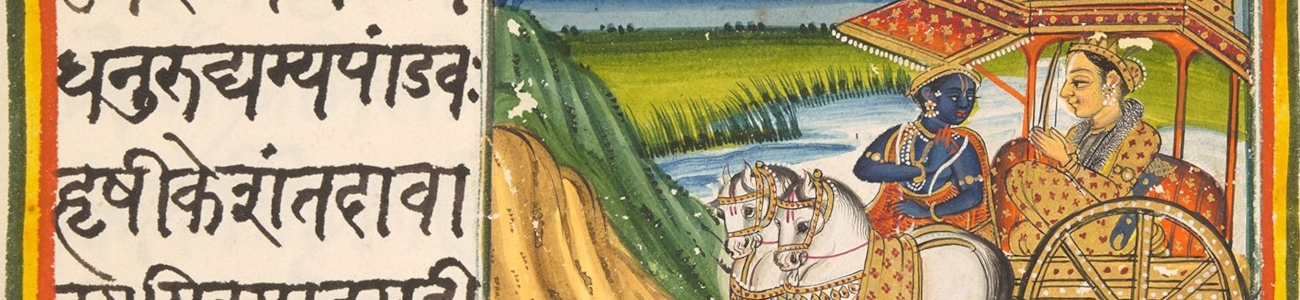
Author: Sri Swami Shivananda
Dedicated to Bhagavan Vyasa and Lord Krishna Avatara of Lord Vishnu Flute-Bearer of Vrindavana Joy of Devaki, Beloved of Radho Redeemer of the Fallen
Chapter 2: सांख्ययोग: SANKHYA YOGA
Verse #1
तथा उवाच |
d तथा कृपया$विष्टमश्रुपूर्णाकुलेक्षणम् | |
विषीदन्तमिदं वाक्यमुवाच मधुसूदनः ॥१॥ ||
tathā uvāca | d tathā कृपया$विष्टमश्रुपूर्णाकुलेक्षणम् | | विषीदन्तमिदं वाक्यमुवाच madhusūdanaḥ ॥१॥ ||
tatha uvaca |
d tatha KaPaYa$VaShhaTaMaShaRaPaRaNaeKaLKaShhaNaeMa | |
VaShhaThaNaTaMaTha VaKaYaMaVaCa madhusudana  ||
तम् to him, तथा thus, कृपया with pity, आविष्टम् overcome, अश्रुपूर्णाकुलेक्षणम् with eyes filled with tears and agitated, विषीदन्तम् despondent, इदम् this, वाक्यम् speech, उवाच spoke, मधुसूदनः Madhusudana. Sanjaya said:
1. To him who was thus overcome with pity and who was despondent, with eyes full of tears and agitated, Madhusudana (the destroyer of Madhu) or Krishna spoke these words:
1. To him who was thus overcome with pity and who was despondent, with eyes full of tears and agitated, Madhusudana (the destroyer of Madhu) or Krishna spoke these words:
Verse #2
श्री भगवानुवा |
कुतस्त्वा कश्मलमिदं विषमे समुपस्थितम् |
अनार्यजुष्टमस्वर्ग्यमकीर्तिकरमर्जुन ॥२॥ ||
śrī भगवानुवा |
कुतस्त्वा कश्मलमिदं viṣame samupasthitam |
अनार्यजुष्टमस्वर्ग्यमकीर्तिकरमर्जुन ॥२॥ ||
sri BhaGaVaNaVa |
KaTaSaTaVa KaShaMaLMaTha visame samupasthitam |
aNaRaYaJaShhaTaMaSaVaRaGaYaMaKaRaTaKaRaMaRaJaNa  ||
कुतः whence, त्वा upon thee, कश्मलम् dejection, इदम् this, विषमे in perilous strait, समुपस्थितम् comes, अनार्यजुष्टम् unworthy (un-aryanlike), अस्वर्ग्यम् heaven-excluding, अकीर्तिकरम् disgraceful, अर्जुन O Arjuna. The Blessed Lord said:
2. Whence is this perilous strait come upon thee, this dejection which is unworthy of you, disgraceful, and which will close the gates of heaven upon you, O Arjuna?
2. Whence is this perilous strait come upon thee, this dejection which is unworthy of you, disgraceful, and which will close the gates of heaven upon you, O Arjuna?
Verse #3
क्लैब्यं मा स्म गमः पार्थ नैतत्त्वय्युपपद्यते |
क्षुद्रं हृदयदौर्बल्यं त्यक्त्वोत्तिष्ठ परन्तप ॥३॥ ||
klaibyaṃ mā sma gamaḥ pārtha नैतत्त्वय्युपपद्यते |
kṣudraṃ hṛdayadaurbalyaṃ त्यक्त्वोत्तिष्ठ parantapa ॥३॥ ||
klaibya ma sma gama partha NaTaTaTaVaYaYaPaPaThaYaTa |
ksudra hdayadaurbalya TaYaKaTaVaTaTaShhaTha parantapa  ||
क्लैब्यम् impotence, मा स्म गमः do not get, पार्थ 0 Partha, न not, एतत् this, त्वयि in thee, उपपद्यते is fitting, YL mean, हृदयदौर्बल्यम् weakness of the heart, त्यक्त्व having abandoned, उत्तिष्ठ stand up, परन्तप O scorcher of the foes.
3. Yield not to impotence, O Arjuna, son of Pritha. It does not befit thee. Cast off this mean weakness of the heart! Stand up, O scorcher of the foes!
3. Yield not to impotence, O Arjuna, son of Pritha. It does not befit thee. Cast off this mean weakness of the heart! Stand up, O scorcher of the foes!
Verse #4
अर्जुन उवाच |
कथं भीष्ममहं संख्ये द्रोणं च मधुसूदन । |
इषुभिः प्रतियोत्स्यामि पूजार्हावरिसूदन ॥४॥ ||
arjuna uvāca |
kathaṃ भीष्ममहं संख्ये droṇam ca madhusūdana । |
iṣubhiḥ pratiyotsyāmi पूजार्हावरिसूदन ॥४॥ ||
arjuna uvaca |
katha BhaShhaMaMaHa SaKhaYa dronam ca madhusudana . |
isubhi pratiyotsyami PaJaRaHaVaRaSaThaNa  ||
कथम् how, भीष्मम् Bhishma, अहम् 1, संख्ये in battle, द्रोणम् Drona, च and, मधुसूदन O Madhusudana, इषुभिः with arrows, प्रतियोत्स्यामि shall fight, पूजाही worthy to be worshipped, अरिसूदन 0 destroyer of enemies.
Arjuna said:
4. How, 0 Madhusudana, shall | fight in battle with arrows against Bhishma and Drona, who are fit to be worshipped, 0 destroyer of. enemies?
Arjuna said:
4. How, 0 Madhusudana, shall | fight in battle with arrows against Bhishma and Drona, who are fit to be worshipped, 0 destroyer of. enemies?
Verse #5
गुरूनहत्वा हि महानुभा श्रेयो भोक्तुं भैक्ष्यमपीह लोके |
हत्वार्थकामांस्तु गुरूनिहै भुञ्जीय भोगान् रुधिरप्रदिग्धान् ॥५ ||
गुरूनहत्वा hi महानुभा श्रेयो भोक्तुं भैक्ष्यमपीह loke | हत्वार्थकामांस्तु गुरूनिहै bhuñjīya भोगान् रुधिरप्रदिग्धान् ॥५ ||
GaNPRNaHaTaVa hi MaHaNaBha ShaRaYa BhaKaTa BhaKaShhaYaMaPaHa loke |
HaTaVaRaThaKaMaSaTa GaNPRNaHa bhunjiya BhaGaNa RaThhaRaPaRaThaGaThhaNa  ||
गुरून् the Gurus (teachers), अहत्वा instead of slaying, हि indeed, महानुभावान् most noble, श्रेयः better, भोक्तुम् to eat, भैक्ष्यम् alms, अपि even, इह here, लोके in the world, हत्वा having slain, अर्थकामान् desirous of wealth, तु indeed, गुरून् Gurus, इह here, एव also, भुञ्जीय enjoy, भोगान् enjoyments, रुधिरप्रदिग्धान् stained with blood.
5. Better it is, indeed, in this world to accept alms than to slay the most noble teachers. But if | kill them, even in this world all my enjoyments of wealth and fulfilled desires will be stained with (their) blood.
5. Better it is, indeed, in this world to accept alms than to slay the most noble teachers. But if | kill them, even in this world all my enjoyments of wealth and fulfilled desires will be stained with (their) blood.
Verse #6
न चैतद्विद्मः कतरन्नो गरीयो यद्वा जयेम यदि वा नो जयेयुः । |
यानेव हत्वा न जिजीविषाम स्तेऽवस्थिताः प्रमुखे धारराष्ट्राः ॥६॥ ||
na चैतद्विद्मः कतरन्नो गरीयो यद्वा jayema yadi vā no jayeyuḥ । |
यानेव hatvā na जिजीविषाम स्तेऽवस्थिताः pramukhe धारराष्ट्राः ..6.. ||
na CaTaThaVaThaMa KaTaRaNaNa GaRaYa YaThaVa jayema yadi va no jayeyu . |
YaNaVa hatva na JaJaVaShhaMa SaTaVaSaThaTa pramukhe ThhaRaRaShhaTaRa ..6.. ||
न not, च and, एतत् this, विद्यः (we) know, कतरत् which, 7: for us, गरीयः better, यत् that, वा or, जयेम we should conquer, यदि if, वा or, नः us, जयेयुः they should conquer, यान् whom, एव even, हत्व having slain, न not, जिजीविषामः we wish to live, ते those, अवस्थिताः (are) standing, प्रमुखे in face, धार्तराष्ट्राः sons of Dhritarashtra.
6. We can hardly tell which will be better, that we should conquer them or that they should conquer us. Even the sons of Dhritarashtra, after slaying whom we do not wish to live, stand facing us.
6. We can hardly tell which will be better, that we should conquer them or that they should conquer us. Even the sons of Dhritarashtra, after slaying whom we do not wish to live, stand facing us.
Verse #7
कार्पण्यदोषोपहतस्वभा पृच्छामि त्वां धर्मसंमूढचेताः |
यच्छ्रेयः स्यान्निश्चितं ब्रूहि तन्मे शिष्यस्तेऽहं शाधि मां त्वां प्रपन्नम् dell ||
कार्पण्यदोषोपहतस्वभा pṛcchāmi tvāṃ धर्मसंमूढचेताः | यच्छ्रेयः स्यान्निश्चितं brūhi तन्मे शिष्यस्तेऽहं śādhi māṃ tvāṃ प्रपन्नम् dell ||
KaRaPaNaeYaThaShhaPaHaTaSaVaBha pcchami tva ThhaRaMaSaMaDhaCaTa |
YaCaChhaRaYa SaYaNaNaShaCaTa bruhi TaNaMa ShaShhaYaSaTaHa sadhi ma tva PaRaPaNaNaMa dell ||
कार्पण्यदोषोपहतस्वभावः with nature overpowered by the taint of pity, पृच्छामि I ask, त्वाम् Thee, धर्मसंमूढचेताः with a mind in confusion about duty, यत् which, #4: good, स्यात् may be, निश्चितम् decisively, afè say, तत् that, मे for me, शिष्यः disciple, ते Thy, अहम् I, शाधि teach, माम् me, त्वाम् to Thee, TT taken refuge.
7. My heart is overpowered by the taint of pity; my mind is confused as to duty. | ask Thee: Tell me decisively what is good for me. | am Thy disciple. Instruct me who has taken refuge in Thee.
7. My heart is overpowered by the taint of pity; my mind is confused as to duty. | ask Thee: Tell me decisively what is good for me. | am Thy disciple. Instruct me who has taken refuge in Thee.
Verse #8
न हि प्रपश्यामि ममापनु च्छोकमुच्छोषणमिन्द्रियाणा |
अवाप्य भूमावसपत्ममृद्ध राज्यं सुराणामपि चाधिपत्यम् ॥८॥ ||
na hi prapaśyāmi ममापनु च्छोकमुच्छोषणमिन्द्रियाणा | avāpya भूमावसपत्ममृद्ध राज्यं सुराणामपि चाधिपत्यम् ॥८॥ ||
na hi prapasyami MaMaPaNa CaChhaKaMaCaChhaShhaNaeMaNaThaRaYaNae |
avapya BhaMaVaSaPaTaMaMaThaThha RaJaYa SaRaNaeMaPa CaThhaPaTaYaMa  ||
न हि not, प्रपश्यामि I see, मम my, अपनुद्यात् would remove, यत् that, शोकम् grief, उच्छोषणम् drying up, इन्द्रियाणाम् of my senses, अवाप्य having obtained, भूमौ on the earth, असपलम् unrivalled, ऋद्धम् prosperous, राज्यम् dominion, सुराणाम् over the gods, अपि even, च and, आधिपत्यम् lordship.
8. | do not see that it would remove this sorrow that burns up my senses, even if | should attain prosperous and unrivalled dominion on earth or lordship over the gods.
8. | do not see that it would remove this sorrow that burns up my senses, even if | should attain prosperous and unrivalled dominion on earth or lordship over the gods.
Verse #9
सञ्जय उवाच |
एवमुक्त्वा हृषीकेशं गुडाकेशः परन्तप । |
न योत्स्य इति गोविन्दमुक्त्वा तूष्णीं बभूव ह ॥९॥ ||
sañjaya uvāca |
एवमुक्त्वा hṛṣīkeśaṃ guḍākeśaḥ parantapa । |
na yotsya गोविन्दमुक्त्वा tūṣṇīm babhūva ha ॥९॥ ||
sanjaya uvaca |
eVaMaKaTaVa hsikesa guakesa parantapa . |
na yotsya GaVaNaThaMaKaTaVa tusnim babhuva ha  ||
वम् thus, उक्त्वा having spoken, हृषीकेशम् to Hrishikesha, गुडाकेशः Arjuna (the conqueror of sleep), परन्तप destroyer of foes, न योत्स्ये 1 will not fight, इति thus, गोविन्दम् to Govinda, उक्त्वा having said, तूष्णीम् silent, बभूव € became. Sanjaya said:
9. Having spoken thus to Hrishikesha (the Lord of the senses), Arjuna (the conqueror of sleep), the destroyer of foes, said to Krishna, "I will not fight" and became silent.
9. Having spoken thus to Hrishikesha (the Lord of the senses), Arjuna (the conqueror of sleep), the destroyer of foes, said to Krishna, "I will not fight" and became silent.
Verse #10
तमुवाच हृषीकेश: प्रहसन्निव भारत | |
सेनयोरुभयोर्मध्ये विषीदन्तमिदं वचः ॥१०॥ ||
तमुवाच हृषीकेश: प्रहसन्निव bhārata | |
सेनयोरुभयोर्मध्ये विषीदन्तमिदं vacaḥ ॥१०॥ ||
TaMaVaCa HaShhaKaSha: PaRaHaSaNaNaVa bharata | |
SaNaYaRaBhaYaRaMaThhaYa VaShhaThaNaTaMaTha vaca  ||
तम् to him, उवाच spoke, हृषीकेशः Hrishikesha, प्रहसन् smiling, इव as it were, भारत O Bharata, सेनयोः of the armies, उभयोः (of) both, मध्ये in the middle, विषीदन्तम् despondent, इदम् this, वचः word.
10. To him who was despondent in the midst of the two armies, Krishna, as if smiling, O Bharata, spoke these words.
10. To him who was despondent in the midst of the two armies, Krishna, as if smiling, O Bharata, spoke these words.
Verse #11
श्री भगवानुवाच |
अशोच्यानन्वशोचस्त्वं प्रज्ञावादांश भाष |
गतासूनगतासुंश्च नानुशोचन्ति पण्डिताः ॥११॥ ||
śrī भगवानुवाच |
अशोच्यानन्वशोचस्त्वं प्रज्ञावादांश भाष |
गतासूनगतासुंश्च नानुशोचन्ति paṇḍitāḥ ॥११॥ ||
sri BhaGaVaNaVaCa |
aShaCaYaNaNaVaShaCaSaTaVa PaRaJaNiaVaThaSha BhaShha |
GaTaSaNaGaTaSaShaCa NaNaShaCaNaTa panita  ||
अशोच्यान् those who should not be grieved for, अन्वशोचः hast grieved, त्वम् thou, परज्ञावादान् words of wisdom, and, भाषसे speakest, गतासून् the dead, अगतासून् the living, च and, न अनुशोचन्ति grieve not, पण्डिताः the wise.
The Blessed Lord said:
11. Thou hast grieved for those that should not be grieved for, yet thou speakest words of wisdom. The wise grieve neither for the living nor for the dead.
Commentary: The philosophy of the Gita begins from this verse.
Bhishma and Drona deserve no grief because they are eternal in their real nature and they are virtuous men who possess very good conduct. Though you speak words of wisdom, you are unwise because you grieve for those who are really eternal and who deserve no grief. They who are endowed with the knowledge of the Self are wise men. They will not grieve for the living or for the dead because they know well that the Self is immortal and that It is unborn. They also know that there is no such a thing as death, that it is a separation of the astral body from the physical, that death is nothing more than a disintegration of matter and that the five elements of which the body is composed return to their source. Arjuna had forgotten the eternal nature of the Soul and the changing nature of the body. Because of his ignorance, he began to act as if the temporary relations with kinsmen, teachers, etc. were permanent. He forgot that his relations with this world in his present life were the results of past actions. These, when exhausted, end all relationship and new ones crop up when one takes on another body.
The result of past actions is known as karma and that portion of the karma which gave rise to the present incarnation is known as prarabdha karma.
The Blessed Lord said:
11. Thou hast grieved for those that should not be grieved for, yet thou speakest words of wisdom. The wise grieve neither for the living nor for the dead.
Commentary: The philosophy of the Gita begins from this verse.
Bhishma and Drona deserve no grief because they are eternal in their real nature and they are virtuous men who possess very good conduct. Though you speak words of wisdom, you are unwise because you grieve for those who are really eternal and who deserve no grief. They who are endowed with the knowledge of the Self are wise men. They will not grieve for the living or for the dead because they know well that the Self is immortal and that It is unborn. They also know that there is no such a thing as death, that it is a separation of the astral body from the physical, that death is nothing more than a disintegration of matter and that the five elements of which the body is composed return to their source. Arjuna had forgotten the eternal nature of the Soul and the changing nature of the body. Because of his ignorance, he began to act as if the temporary relations with kinsmen, teachers, etc. were permanent. He forgot that his relations with this world in his present life were the results of past actions. These, when exhausted, end all relationship and new ones crop up when one takes on another body.
The result of past actions is known as karma and that portion of the karma which gave rise to the present incarnation is known as prarabdha karma.
Verse #12
न त्वेवाहं जातु नासं न त्वं नेमे जनाधिपाः । |
न चैव न भविष्यामः wd वयमतः परम् ॥१२॥ ||
na त्वेवाहं jātu नासं na tvaṃ नेमे janādhipāḥ । | na caiva na bhaviṣyāmaḥ wd वयमतः परम् ॥१२॥ ||
na TaVaVaHa jatu NaSa na tva NaMa janadhipa . |
na caiva na bhavisyama wd VaYaMaTa PaRaMa  ||
न not, तु indeed, एव also, अहम् I, जातु at any time, न not, आसम् was, न not, त्वम् thou, 4 not, इमे these, जनाधिपा: rulers of men, न not, च and, एव also, न not, भविष्यामः shall be, सर्वे all, वयम् we, अतः from this time, परम् after.
12. Nor at any time indeed was | not, nor thou, nor these rulers of men, nor verily shall we ever cease to be hereafter.
Commentary: Lord Krishna speaks here of the immortality of the Soul or the imperishable nature of the Self (Atman). The Soul exists in the three periods of time (past, present and future). Man continues to exist even after the death of the physical body. There is life beyond.
12. Nor at any time indeed was | not, nor thou, nor these rulers of men, nor verily shall we ever cease to be hereafter.
Commentary: Lord Krishna speaks here of the immortality of the Soul or the imperishable nature of the Self (Atman). The Soul exists in the three periods of time (past, present and future). Man continues to exist even after the death of the physical body. There is life beyond.
Verse #13
जातस्य हि gat मृत्युर्धुवं जन्म मृतस्य च |
तस्मादपरिहार्ये$र्थे न त्वं शोचितुमर्हसि ॥२७॥ ||
jātasya hi gat मृत्युर्धुवं janma mṛtasya ca |
तस्मादपरिहार्ये$र्थे na tvaṃ शोचितुमर्हसि ॥२७॥ ||
jatasya hi gat MaTaYaRaThhaVa janma mtasya ca |
TaSaMaThaPaRaHaRaYa$RaTha na tva ShaCaTaMaRaHaSa  ||
जातस्य of the born, हि for, धुव: certain, मृत्युः death, ध्रुवम् certain, जन्म birth, मृतस्य of the dead, च and, तस्मात् therefore, अपरिहार्य inevitable, अर्थे in matter, न not, त्वम् thou, शोचितुम् to grieve, अर्हसि (thou) oughtest.
27. For certain is death for the born, and certain is birth for the dead; therefore, over the inevitable thou shouldst not grieve.
Commentary: Birth is sure to happen to that which is dead; death is sure to happen to that which is born. Birth and death are certainly unavoidable. Therefore, you should not grieve over an inevitable matter.
27. For certain is death for the born, and certain is birth for the dead; therefore, over the inevitable thou shouldst not grieve.
Commentary: Birth is sure to happen to that which is dead; death is sure to happen to that which is born. Birth and death are certainly unavoidable. Therefore, you should not grieve over an inevitable matter.
Verse #14
देहिनोऽस्मिन्यथा देहे कौमारं यौवनं जरा |
तथा देहान्तरप्राप्तर्धीरस्तत्र न मुह्यति ॥१३॥ ||
देहिनोऽस्मिन्यथा dehe कौमारं यौवनं jarā |
tathā देहान्तरप्राप्तर्धीरस्तत्र na muhyati ॥१३॥ ||
ThaHaNaSaMaNaYaTha dehe KaMaRa YaVaNa jara |
tatha ThaHaNaTaRaPaRaPaTaRaThhaRaSaTaTaRa na muhyati  ||
देहिनः of the embodied (soul), अस्मिन् in this, यथा as, देहे in body, कौमारम् childhood, यौवनम् youth, जरा old age, तथा so also, देहान्तरप्राप्तिः the attaining of another body, €: the firm, v3 thereat, न not, Feld grieves.
13. Just as in this body the embodied (soul) passes into childhood, youth and old age, so also does it pass into another body; the firm man does not grieve thereat.
Commentary: Just as there is no interruption in the passing of childhood into youth and youth into old age in this body, so also there is no interruption by death in the continuity of the ego. The Self is not dead at the termination of the stage, viz., childhood. It is certainly not born again at the beginning of the second stage, viz., youth. Just as the Self passes unchanged from childhood to youth and from youth to old age, so also the Self passes unchanged from one body into another. Therefore, the _ wise man is not at all distressed about it.
13. Just as in this body the embodied (soul) passes into childhood, youth and old age, so also does it pass into another body; the firm man does not grieve thereat.
Commentary: Just as there is no interruption in the passing of childhood into youth and youth into old age in this body, so also there is no interruption by death in the continuity of the ego. The Self is not dead at the termination of the stage, viz., childhood. It is certainly not born again at the beginning of the second stage, viz., youth. Just as the Self passes unchanged from childhood to youth and from youth to old age, so also the Self passes unchanged from one body into another. Therefore, the _ wise man is not at all distressed about it.
Verse #15
मात्रास्पर्शास्तु कौन्तेय शीतोष्णसुखदुःख |
आगमापायिनोऽनित्यास्तांस्तितिक्षस्व भारत ||
मात्रास्पर्शास्तु kaunteya शीतोष्णसुखदुःख |
आगमापायिनोऽनित्यास्तांस्तितिक्षस्व bhārata ||
MaTaRaSaPaRaShaSaTa kaunteya ShaTaShhaNaeSaKhaThaKha |
aaGaMaPaYaNaNaTaYaSaTaSaTaTaKaShhaSaVa bharata ||
मात्रास्पर्शा: contacts of senses with objects, तु indeed, कौन्तेय 0 Kaunteya (son of Kunti), शीतोष्णसुखदु *S«T: producers of cold and heat, pleasure and pain, आगमापायिनः with beginning and end, अनित्याः impermanent, तान् them, तितिक्षस्व bear (thou), भारत O Bharata.
14. The contacts of the senses with the objects, O son of Kunti, which cause heat and cold, pleasure and pain, have a beginning and an end; they are impermanent; endure them bravely, O Arjuna.
Commentary: Cold is pleasant at one time and painful at another. Heat is pleasant in winter but painful in summer. The same object that gives pleasure at one time gives pain at another time. So the sense-contacts that give rise to the sensations of heat and cold, pleasure and pain come and go. Therefore, they are impermanent in nature. The objects come in contact with the senses or the Indriyas, viz., skin, ear, eye, nose, etc., and the sensations are carried by the nerves to the mind which has its seat in the brain. It is the mind that feels pleasure and pain. One should try to bear patiently heat and cold, pleasure and pain and develop a balanced state of mind. (Cf. V. 22)
14. The contacts of the senses with the objects, O son of Kunti, which cause heat and cold, pleasure and pain, have a beginning and an end; they are impermanent; endure them bravely, O Arjuna.
Commentary: Cold is pleasant at one time and painful at another. Heat is pleasant in winter but painful in summer. The same object that gives pleasure at one time gives pain at another time. So the sense-contacts that give rise to the sensations of heat and cold, pleasure and pain come and go. Therefore, they are impermanent in nature. The objects come in contact with the senses or the Indriyas, viz., skin, ear, eye, nose, etc., and the sensations are carried by the nerves to the mind which has its seat in the brain. It is the mind that feels pleasure and pain. One should try to bear patiently heat and cold, pleasure and pain and develop a balanced state of mind. (Cf. V. 22)
Verse #16
यं हि न व्यथयन्त्येते पुरुषं पुरुषर्षभ |
समदुःखसुखं धीरं सोऽमृतत्वाय कल्पते ॥१५॥ ||
yaṃ hi na व्यथयन्त्येते puruṣaṃ puruṣarṣabha |
samaduḥkhasukhaṃ dhīraṃ सोऽमृतत्वाय kalpate ॥१५॥ ||
ya hi na VaYaThaYaNaTaYaTa purusa purusarsabha |
samadukhasukha dhira SaMaTaTaVaYa kalpate  ||
यम् whom, हि surely, न व्यथयन्ति afflict not, एते these, पुरुषम् man, पुरुषर्षभ chief among men, समदु.खसुखम् same in pleasure and pain, धीरम् firm man, सः he, अमृतत्वाय for immortality, कल्पते is fit.
15. That firm man whom, surely, these afflict not, 0 chief among men, to whom pleasure and pain are the same, is fit for attaining immortality.
Commentary: Dehadhyasa or identification of the Self with the body is the cause of pleasure and pain. The more you are able to identify yourself with the immortal, all-pervading Self, the less will you be affected by the pairs of opposites (Dvandvas, pleasure and pain, etc.)
Titiksha or the power of endurance develops the will-power. Calm endurance in pleasure and pain, and heat and cold is one of the qualifications of an aspirant on the path of Jnana Yoga. It is one of the Shatsampat or sixfold virtues. It is a condition of right knowledge. Titiksha by itself cannot give you Moksha or liberation, but still, when coupled with discrimination and dispassion, it becomes a means to the attainment of Immortality or knowledge of the Self. (Cf. XVIII. 53)
15. That firm man whom, surely, these afflict not, 0 chief among men, to whom pleasure and pain are the same, is fit for attaining immortality.
Commentary: Dehadhyasa or identification of the Self with the body is the cause of pleasure and pain. The more you are able to identify yourself with the immortal, all-pervading Self, the less will you be affected by the pairs of opposites (Dvandvas, pleasure and pain, etc.)
Titiksha or the power of endurance develops the will-power. Calm endurance in pleasure and pain, and heat and cold is one of the qualifications of an aspirant on the path of Jnana Yoga. It is one of the Shatsampat or sixfold virtues. It is a condition of right knowledge. Titiksha by itself cannot give you Moksha or liberation, but still, when coupled with discrimination and dispassion, it becomes a means to the attainment of Immortality or knowledge of the Self. (Cf. XVIII. 53)
Verse #17
नासतो विद्यते भावो नाभावो विद्यते सतः । |
उभयोरपि दृष्टो5न्तस्त्वनयोस्तत्त्वदर्शिभिः ॥१६॥ ||
नासतो vidyate भावो नाभावो vidyate sataḥ । |
उभयोरपि दृष्टो5न्तस्त्वनयोस्तत्त्वदर्शिभिः ॥१६॥ ||
NaSaTa vidyate BhaVa NaBhaVa vidyate sata . |
uBhaYaRaPa ThaShhaTa5NaTaSaTaVaNaYaSaTaTaTaVaThaRaShaBha  ||
न not, असतः of the unreal, विद्यते 15, भावः being, न not, अभावः non-being, विद्यते 15, सतः of the real, उभयोः of the two, अपि also, दृष्ट: (has been) seen, अन्तः the final truth, तु indeed, अनयोः of these, तत्त्वदर्शिभिः by the knowers of the Truth.
16. The unreal hath no being; there is no non-being of the real; the truth about both has been seen by the knowers of the Truth (or the seers of the Essence).
Commentary: The changeless, homogeneous Atman or the Self always exists. It is the only solid Reality. This phenomenal world of names and forms is ever changing. Hence it is unreal. The sage or the Jivanmukta is fully aware that the Self always exists and that this world is like a mirage. Through his Jnanachakshus or the eye of intuition, he directly cognises the Self. This world vanishes for him like the snake in the rope, after . it has been seen that only the rope exists. He rejects the names and forms and takes the underlying Essence in all the names and forms, viz., Asti-Bhati-Priya or Satchidananda or ExistenceKnowledge-Bliss Absolute. Hence he is a Zattvadarshi or a knower of the Truth or the Essence.
What is changing must be unreal. What is constant or permanent must be real.
16. The unreal hath no being; there is no non-being of the real; the truth about both has been seen by the knowers of the Truth (or the seers of the Essence).
Commentary: The changeless, homogeneous Atman or the Self always exists. It is the only solid Reality. This phenomenal world of names and forms is ever changing. Hence it is unreal. The sage or the Jivanmukta is fully aware that the Self always exists and that this world is like a mirage. Through his Jnanachakshus or the eye of intuition, he directly cognises the Self. This world vanishes for him like the snake in the rope, after . it has been seen that only the rope exists. He rejects the names and forms and takes the underlying Essence in all the names and forms, viz., Asti-Bhati-Priya or Satchidananda or ExistenceKnowledge-Bliss Absolute. Hence he is a Zattvadarshi or a knower of the Truth or the Essence.
What is changing must be unreal. What is constant or permanent must be real.
Verse #18
अविनाशि तु तद्विद्धि येन सर्वमिदं ततम् | |
विनाशमव्ययस्यास्य न कश्चित् कर्तुमर्हति ॥१७ ||
avināśi tu तद्विद्धि yena सर्वमिदं ततम् | | विनाशमव्ययस्यास्य na कश्चित् कर्तुमर्हति ॥१७ ||
avinasi tu TaThaVaThaThha yena SaRaVaMaTha TaTaMa | |
VaNaShaMaVaYaYaSaYaSaYa na KaShaCaTa KaRaTaMaRaHaTa  ||
अविनाशि indestructible, तु indeed, तत् That, विद्धि know (thou), येन by which, सर्वम् all, इदम् this, ततम् is pervaded, विनाशम् destruction, अव्ययस्य अस्य of this Imperishable, न not, कश्चित् anyone, कर्तुम् ।० do, अर्हति is able.
17. Know That to be indestructible, by Which all this is pervaded. None can cause the destruction of That, the Imperishable.
Commentary: Brahman or Atman pervades all the objects like ether. Even if the pot is broken, the ether that is within and without the pot cannot be destroyed. Even so, if the bodies and all other objects perish, Brahman or the Self that pervades them cannot perish. It is the living Truth, Sat.
Brahman has no parts. There cannot be either increase or diminution in Brahman. People are ruined by loss of wealth. But Brahman does not suffer any loss in that way. It is inexhaustible. Therefore, none can bring about the disappearance or destruction of the Self. It always exists. It is always all-full and selfcontained. It is Existence Absolute. It is immutable.
17. Know That to be indestructible, by Which all this is pervaded. None can cause the destruction of That, the Imperishable.
Commentary: Brahman or Atman pervades all the objects like ether. Even if the pot is broken, the ether that is within and without the pot cannot be destroyed. Even so, if the bodies and all other objects perish, Brahman or the Self that pervades them cannot perish. It is the living Truth, Sat.
Brahman has no parts. There cannot be either increase or diminution in Brahman. People are ruined by loss of wealth. But Brahman does not suffer any loss in that way. It is inexhaustible. Therefore, none can bring about the disappearance or destruction of the Self. It always exists. It is always all-full and selfcontained. It is Existence Absolute. It is immutable.
Verse #19
अन्तवन्त इमे देहा नित्यस्योक्ताः शरीरिणः । |
अनाशिनोऽप्रमेयस्य तस्माद्युध्यस्व भारत ॥१८॥ ||
अन्तवन्त ime देहा नित्यस्योक्ताः śarīriṇaḥ । |
अनाशिनोऽप्रमेयस्य तस्माद्युध्यस्व bhārata ॥१८॥ ||
aNaTaVaNaTa ime ThaHa NaTaYaSaYaKaTa saririna . |
aNaShaNaPaRaMaYaSaYa TaSaMaThaYaThhaYaSaVa bharata  ||
अन्तवन्तः having an end, इमे these, देहाः bodies, नित्यस्य of the everlasting, उक्ताः are said, शरीरिणः of the embodied, अनाशिनः of the indestructible, अप्रमेयस्य of the immeasurable, तस्मात् therefore, युध्यस्व fight, भारत O Bharata.
18. These bodies of the embodied Self, Which is eternal, indestructible and immeasurable, are said to have an end. Therefore fight, O Arjuna.
Commentary: Lord Krishna explains to Arjuna the nature of the all-pervading, immortal Self in a variety of ways and thus induces him to fight by removing his- delusion, grief an despondency which are born of ignorance.
18. These bodies of the embodied Self, Which is eternal, indestructible and immeasurable, are said to have an end. Therefore fight, O Arjuna.
Commentary: Lord Krishna explains to Arjuna the nature of the all-pervading, immortal Self in a variety of ways and thus induces him to fight by removing his- delusion, grief an despondency which are born of ignorance.
Verse #20
अवाच्यवादांश्च बहून् वदिष्यन्ति तवाहिताः | |
निन्दन्तस्तव सामर्थ्यं ततो दुःखतरं नु किम् ॥३६॥ ||
अवाच्यवादांश्च बहून् vadiṣyanti तवाहिताः | | निन्दन्तस्तव सामर्थ्यं tato दुःखतरं nu किम् ॥३६॥ ||
aVaCaYaVaThaShaCa BHaNa vadisyanti TaVaHaTa | |
NaNaThaNaTaSaTaVa SaMaRaThaYa tato ThaKhaTaRa nu KaMa  ||
अवाच्यवादान् words that are improper to be spoken, च and, बहून् many, वदिष्यन्ति will say, तव thy, अहिताः enemies, निन्दन्तः cavilling, तव thy, सामर्थ्यम् power, ततः than this, दुःखतरम् more painful, नु indeed, किम् what.
36. Thy enemies also, cavilling at thy power, will speak many abusive words. What is more painful than this?
Commentary: There is really no pain more unbearable and tormenting than that of slander thus incurred.
36. Thy enemies also, cavilling at thy power, will speak many abusive words. What is more painful than this?
Commentary: There is really no pain more unbearable and tormenting than that of slander thus incurred.
Verse #21
य॒ एनं वेत्ति हन्तारं यश्चैनं मन्यते हतम् । |
उभौ तौ न विजानीतो नायं हन्ति न हन्यते ॥१९॥ ||
य॒ enaṃ vetti हन्तारं यश्चैनं manyate हतम् । | ubhau tau na विजानीतो नायं hanti na hanyate ॥१९॥ ||
Ya ena vetti HaNaTaRa YaShaCaNa manyate HaTaMa . |
ubhau tau na VaJaNaTa NaYa hanti na hanyate  ||
यः he who, एनम् this (Self), aft knows, हन्तारम् slayer, यः he who, च and, एनम् this, मन्यते thinks, हतम् slain, उभौ both, तौ those, न not, विजानीतः know, न not, अयम् this, हन्ति slays, न not, हन्यते 15 slain.
19. He who takes the Self to be the slayer and he who thinks It is slain, neither of them knows. It slays not, nor is It slain.
Commentary: The Self is non-doer (Akarta) and as It is immutable, It is neither the agent nor the object of the act of slaying. He who thinks "I slay" or "I am slain" with the body or the Ahamkara (ego), he does not really compréhend the true nature of the Self. The Self is indestructible. It exists in the three periods of time. It is Sat (Existence). When the body is destroyed, the Self is not destroyed. The body has to undergo change in any case. It is inevitable. But the Self is not at all affected by it. Verses 19, 20, 21, 23 and 24 speak of the immortality of the Self or Atman. (Cf. XVIII. 17)
19. He who takes the Self to be the slayer and he who thinks It is slain, neither of them knows. It slays not, nor is It slain.
Commentary: The Self is non-doer (Akarta) and as It is immutable, It is neither the agent nor the object of the act of slaying. He who thinks "I slay" or "I am slain" with the body or the Ahamkara (ego), he does not really compréhend the true nature of the Self. The Self is indestructible. It exists in the three periods of time. It is Sat (Existence). When the body is destroyed, the Self is not destroyed. The body has to undergo change in any case. It is inevitable. But the Self is not at all affected by it. Verses 19, 20, 21, 23 and 24 speak of the immortality of the Self or Atman. (Cf. XVIII. 17)
Verse #22
न जायते म्रियते वा कदाचि- न्नायं भूत्वा भविता वा न भूयः | |
अजो नित्यः शाश्वतोऽयं पुराणो न हन्यते हन्यमाने शरीरे ॥२०॥ ||
na jāyate mriyate vā कदाचि- न्नायं bhūtvā bhavitā vā na bhūyaḥ | |
अजो nityaḥ शाश्वतोऽयं पुराणो na hanyate hanyamāne śarīre ॥२०॥ ||
na jayate mriyate va KaThaCa- NaNaYa bhutva bhavita va na bhuya | |
aJa nitya ShaShaVaTaYa PaRaNae na hanyate hanyamane sarire  ||
न not, जायते is born, म्रियते dies, वा or, कदाचित् at any time, न not, अयम् this (Self), भूत्वा having been, भविता will be, वा or, न not, भूयः (any) more, अज: unborn, नित्यः eternal, शाश्वतः changeless, अयम् this, पुराणः ancient, 4 not, हन्यते 15 killed, हन्यमाने being killed, शरीरे in body.
20. It is not born, nor does It ever die; after having been, It again ceases not to be; unborn, eternal, changeless and ancient, It is not killed when the body is killed.
Commentary: This Self (Atman) is destitute of the six types of transformation or Bhava-Vikaras such as birth, existence, growth, transformation, decline and death. As It is indivisible (Akhanda), It does not diminish in size. It neither grows nor does It decline. It is ever the same. Birth and death are for the physical body only. Birth and death cannot touch the immortal, all-pervading Self.
20. It is not born, nor does It ever die; after having been, It again ceases not to be; unborn, eternal, changeless and ancient, It is not killed when the body is killed.
Commentary: This Self (Atman) is destitute of the six types of transformation or Bhava-Vikaras such as birth, existence, growth, transformation, decline and death. As It is indivisible (Akhanda), It does not diminish in size. It neither grows nor does It decline. It is ever the same. Birth and death are for the physical body only. Birth and death cannot touch the immortal, all-pervading Self.
Verse #23
वेदाविनाशिनं नित्यं य एनमजमव्ययम् | |
कथं स पुरुषः पार्थ कं घातयति हन्ति कम् ॥२१॥ ||
वेदाविनाशिनं nityaṃ ya एनमजमव्ययम् | | kathaṃ sa puruṣaḥ pārtha कं ghātayati hanti कम् ॥२१॥ ||
VaThaVaNaShaNa nitya ya eNaMaJaMaVaYaYaMa | |
katha sa purusa partha Ka ghatayati hanti KaMa  ||
वेद knows, अविनाशिनम् indestructible, नित्यम् eternal, 4: who, एनम् this (Self), अजम् unborn, अव्ययम् inexhaustible, कथम् how, 3: he (that), पुरुष: man, पार्थ Partha (son of Pritha), कम् whom, घातयति causes to be slain, हन्ति kills, कम् whom.
21. Whosoever knows lt to be indestructible, eternal, unborn and inexhaustible, how can that man slay, O Arjuna, or cause to be slain?
Commentary: The enlightened sage who knows the immutable and indestructible Self through direct cognition or spiritual Anubhava (experience) cannot do the act of slaying. He cannot cause another to slay also.
21. Whosoever knows lt to be indestructible, eternal, unborn and inexhaustible, how can that man slay, O Arjuna, or cause to be slain?
Commentary: The enlightened sage who knows the immutable and indestructible Self through direct cognition or spiritual Anubhava (experience) cannot do the act of slaying. He cannot cause another to slay also.
Verse #24
वासांसि जीर्णानि यथा विहाय नवानि गृहणाति नरोऽपराणि । |
तथा शरीराणि विहाय जीर्णा न्यानि संयाति नवानि देही ॥२२॥ ||
vāsāṃsi jīrṇāni yathā vihāya navāni गृहणाति नरोऽपराणि । |
tathā śarīrāṇi vihāya जीर्णा न्यानि saṃyāti navāni dehī ॥२२॥ ||
vasasi jirnani yatha vihaya navani GaHaNaeTa NaRaPaRaNae . |
tatha sarirani vihaya JaRaNae NaYaNa sayati navani dehi  ||
वासांसि clothes, जीर्णानि worn out, यथा as, विहाय having cast away, नवानि new, गृहणाति takes, नरः man, अपराणि others, तथा so, शरीराणि bodies, विहाय having cast away, जीर्णानि worn-out, अन्यानि others, संयाति enters, नवानि new, देही the embodied (one).
22. Just as a man casts off worn-out clothes and puts on new ones, so also the embodied Self casts off worn-out bodies and enters others which are new. _
22. Just as a man casts off worn-out clothes and puts on new ones, so also the embodied Self casts off worn-out bodies and enters others which are new. _
Verse #25
* छिन्दन्ति शस्त्राणि नैनं दहति पावकः । |
न चैनं क्लेदयन्त्यापो न शोषयति मारुतः ॥२३॥ ||
* chindanti śastrāṇi नैनं dahati pāvakaḥ । |
na चैनं क्लेदयन्त्यापो na śoṣayati mārutaḥ ॥२३॥ ||
* chindanti sastrani NaNa dahati pavaka . |
na CaNa KaLThaYaNaTaYaPa na sosayati maruta  ||
न not, एनम् this (Self), छिन्दन्ति cut, शस्त्राणि weapons, न not, एनम् this, दहति burns, पावकः fire, न not, च and, एनम् this, क्लेदयन्ति wet, आपः waters, न not, शोषयति dries, मारुतः wind.
23. Weapons cut It not, fire burns It not, water wets It not, wind dries It not.
Commentary: The Self is indivisible. It has no parts. It is extremely subtle. It is infinite. Therefore, sword cannot cut It; fire cannot burn It; water cannot wet It; wind cannot dry It.
23. Weapons cut It not, fire burns It not, water wets It not, wind dries It not.
Commentary: The Self is indivisible. It has no parts. It is extremely subtle. It is infinite. Therefore, sword cannot cut It; fire cannot burn It; water cannot wet It; wind cannot dry It.
Verse #26
अच्छेद्योऽयमदाह्योऽयमक्लेद्योऽशोष्य ए |
नित्यः सर्वगतः स्थाणुरचलोऽयं सनातनः ॥२४॥ ||
अच्छेद्योऽयमदाह्योऽयमक्लेद्योऽशोष्य e |
nityaḥ sarvagataḥ स्थाणुरचलोऽयं sanātanaḥ ॥२४॥ ||
aCaChhaThaYaYaMaThaHaYaYaMaKaLThaYaShaShhaYa e |
nitya sarvagata SaThaNaeRaCaLYa sanatana  ||
अच्छेद्यः cannot be cut, अयम् this (Self), अदाह्यः cannot be burnt, अयम् this, अक्लेद्यः cannot be wetted, अशोष्यः cannot be dried, एव also, च and, नित्यः eternal, सर्वगतः all-pervading, स्थाणुः stable, अचलः immovable, अयम् this, सनातन: ancient.
24. This Self cannot be cut, burnt, wetted, nor dried up. It is eternal, all-pervading, stable, immovable and ancient.
Commentary: The Self is very subtle. It is beyond the reach of speech and mind. It is very difficult to understand this subtle Self. So Lord Krishna explains the nature of the immortal Self in a variety of ways with various illustrations and examples, so that It can be grasped by the people.
Sword cannot cut this Self. So It is eternal. Because It is eternal, It is all-pervading. Because It is all-pervading, It is stable like a statue. Because It is stable, It is immovable. It is everlasting. Therefore, It is not produced out of any cause. It is not new. It is ancient.
24. This Self cannot be cut, burnt, wetted, nor dried up. It is eternal, all-pervading, stable, immovable and ancient.
Commentary: The Self is very subtle. It is beyond the reach of speech and mind. It is very difficult to understand this subtle Self. So Lord Krishna explains the nature of the immortal Self in a variety of ways with various illustrations and examples, so that It can be grasped by the people.
Sword cannot cut this Self. So It is eternal. Because It is eternal, It is all-pervading. Because It is all-pervading, It is stable like a statue. Because It is stable, It is immovable. It is everlasting. Therefore, It is not produced out of any cause. It is not new. It is ancient.
Verse #27
अव्यक्तोऽयमचिन्त्योऽयमविकार्योऽय |
तस्मादेवं विदित्वैनं नानुशोचितुमर्हसि ॥२५॥ ||
अव्यक्तोऽयमचिन्त्योऽयमविकार्योऽय |
tasmādevaṃ viditvainaṃ नानुशोचितुमर्हसि ॥२५॥ ||
aVaYaKaTaYaMaCaNaTaYaYaMaVaKaRaYaYa |
tasmadeva viditvaina NaNaShaCaTaMaRaHaSa  ||
अव्यक्तः unmanifested, अयम् this (Self), अचिन्त्यः unthinkable, अयम् this, अविकार्यः unchangeable, अयम् this, उच्यते is said, तस्मात् therefore, एवम् thus, विदित्वा having known, एनम् this, न not, अनुशोचितुम् to grieve, अर्हसि (thou) oughtest.
25. This (Self) is said to be unmanifested, unthinkable and unchangeable. Therefore, knowing This to be such, thou shouldst not grieve.
Commentary: The Self is not an object of perception. It can hardly be seen by the physical eyes. Therefore, the Self is unmanifested. That which is seen by the eyes becomes an object of thought. As the Self cannot be perceived by the eyes, It is unthinkable. Milk when mixed with buttermilk changes its form.
The Self cannot change Its form like milk. Hence, It is changeless and immutable. Therefore, thus understanding the Self, thou shouldst not mourn. Thou shouldst not think also that thou art their slayer and that they are killed by thee
25. This (Self) is said to be unmanifested, unthinkable and unchangeable. Therefore, knowing This to be such, thou shouldst not grieve.
Commentary: The Self is not an object of perception. It can hardly be seen by the physical eyes. Therefore, the Self is unmanifested. That which is seen by the eyes becomes an object of thought. As the Self cannot be perceived by the eyes, It is unthinkable. Milk when mixed with buttermilk changes its form.
The Self cannot change Its form like milk. Hence, It is changeless and immutable. Therefore, thus understanding the Self, thou shouldst not mourn. Thou shouldst not think also that thou art their slayer and that they are killed by thee
Verse #28
अथ चैनं नित्यजातं नित्यं वा मन्यसे मृतम् |
तथापि त्वं महाबाहो नैवं शोचितुमर्हसि ॥२६॥ ||
atha चैनं नित्यजातं nityaṃ vā manyase mṛtam |
tathāpi tvaṃ mahābāho नैवं शोचितुमर्हसि ॥२६॥ ||
atha CaNa NaTaYaJaTa nitya va manyase mtam |
tathapi tva mahabaho NaVa ShaCaTaMaRaHaSa  ||
अथ now, च and, एनम् this (Self), नित्यजातम् constantly born, नित्यम् constantly, वा or, मन्यसे thinkest, मृतम् dead, तथापि even then, त्वम् thou, महाबाहो mighty-armed, न not, एवम् thus, शोचितुम् to grieve, अर्हसि (thou) oughtest.
26. But even if thou thinkest of It as being constantly born and constantly dying, even then, O mighty-armed, thou shouldst not grieve.
Commentary: Lord Krishna here, for the sake of argument, takes up the popular supposition. Granting that the Self is again and again born whenever a body comes into being, and again and again dies whenever the body dies, O mighty-armed (O Arjuna of great valour and strength), thou shouldst not grieve thus, because birth is inevitable to what is dead and death is inevitable to what is born. This is the inexorable or unrelenting Law of Nature.
26. But even if thou thinkest of It as being constantly born and constantly dying, even then, O mighty-armed, thou shouldst not grieve.
Commentary: Lord Krishna here, for the sake of argument, takes up the popular supposition. Granting that the Self is again and again born whenever a body comes into being, and again and again dies whenever the body dies, O mighty-armed (O Arjuna of great valour and strength), thou shouldst not grieve thus, because birth is inevitable to what is dead and death is inevitable to what is born. This is the inexorable or unrelenting Law of Nature.
Verse #29
अव्यक्तादीनि भूतानि व्यक्तमध्यानि भारत |
अव्यक्तनिधनान्येव तत्र का परिदेवना ॥२८॥ ||
avyaktādīni bhūtāni vyaktamadhyāni bhārata |
अव्यक्तनिधनान्येव tatra kā paridevanā ॥२८॥ ||
avyaktadini bhutani vyaktamadhyani bharata |
aVaYaKaTaNaThhaNaNaYaVa tatra ka paridevana  ||
अव्यक्तादीनि unmanifested in the beginning, भूतानि beings, व्यक्तमध्यानि manifested in their middle state, भारत O Bharata अव्यक्तनिधनानि unmanifested again in the end, एव also, तत्र there, का what, परिदेवना grief
28. Beings are unmanifested in their beginning, manifested in their middle state, O Arjuna, and unmanifested again in their end. What is there to grieve about?
Commentary: The physical body is a combination of the five elements. It is seen by the physical eyes only after the five elements have entered into such combination. After death, the body disintegrates and the five elements go back to their source; it cannot be seen. Therefore, the body can be seen only in the middle state. The relationship as son, friend, teacher, father, mother, wife, brother and sister is formed through the body on account of attachment and Moha (delusion). Just as planks unite and separate in a river, just as pilgrims unite and separate in a public inn, so also fathers, mothers, sons and brothers unite and separate in this world. This world is a very big public inn. People unite and separate.
There is no pot in the beginning and in the end. Even if you see the pot in the middle, you should think and feel that it is illusory and does not really exist. So also there is no body in the beginning and in the end. That which does not exist in the beginning and in the end must be illusory in the middle also. You must think and feel that the body does not really exist in the middle as well.
He who thus understands the nature of the body and all human relationships based on it, will not grieve.
28. Beings are unmanifested in their beginning, manifested in their middle state, O Arjuna, and unmanifested again in their end. What is there to grieve about?
Commentary: The physical body is a combination of the five elements. It is seen by the physical eyes only after the five elements have entered into such combination. After death, the body disintegrates and the five elements go back to their source; it cannot be seen. Therefore, the body can be seen only in the middle state. The relationship as son, friend, teacher, father, mother, wife, brother and sister is formed through the body on account of attachment and Moha (delusion). Just as planks unite and separate in a river, just as pilgrims unite and separate in a public inn, so also fathers, mothers, sons and brothers unite and separate in this world. This world is a very big public inn. People unite and separate.
There is no pot in the beginning and in the end. Even if you see the pot in the middle, you should think and feel that it is illusory and does not really exist. So also there is no body in the beginning and in the end. That which does not exist in the beginning and in the end must be illusory in the middle also. You must think and feel that the body does not really exist in the middle as well.
He who thus understands the nature of the body and all human relationships based on it, will not grieve.
Verse #30
आश्चर्यवत्पश्यति कश्चिदेन- माश्चर्यवद्वदति तथैव चान्यः |
आश्चर्यवच्चैनमन्यः श्रुणोति आश्चर्यवत् वेद न चैव कश्चित् ॥२९॥ ||
आश्चर्यवत्पश्यति कश्चिदेन- माश्चर्यवद्वदति tathaiva चान्यः | आश्चर्यवच्चैनमन्यः श्रुणोति आश्चर्यवत् veda na caiva कश्चित् ॥२९॥ ||
aaShaCaRaYaVaTaPaShaYaTa KaShaCaThaNa- MaShaCaRaYaVaThaVaThaTa tathaiva CaNaYa |
aaShaCaRaYaVaCaCaNaMaNaYa ShaRaNaeTa aaShaCaRaYaVaTa veda na caiva KaShaCaTa  ||
आश्चर्यवत् as a wonder, पश्यति sees, कश्चित् some one, एनम् this (Self), आश्चर्यवत् 95 a wonder, वदति speaks of, तथा so, एव also, and, अन्यः another, आश्चर्यवत् as a wonder, च and, एनम् this, अन्यः another, शृणोति hears, श्रुत्वा having heard, अपि even, एनम् this, वेद knows, न not, च and, एव also, कश्चित् any one.
29. One sees This (the Self) as a wonder; another speaks of It as a wonder; another hears of It as a wonder; yet having heard, none understands It at all.
Commentary: The verse may also be interpreted in this manner. He that sees, hears and speaks of the Self is a wonderful man. Such a man is very rare. He is one among many thousands. Thus the Self is very hard to understand.
29. One sees This (the Self) as a wonder; another speaks of It as a wonder; another hears of It as a wonder; yet having heard, none understands It at all.
Commentary: The verse may also be interpreted in this manner. He that sees, hears and speaks of the Self is a wonderful man. Such a man is very rare. He is one among many thousands. Thus the Self is very hard to understand.
Verse #31
देही नित्यमवध्योऽयं देहे सर्वस्य भारत |
तस्मात्सर्वाणि भूतानि न त्वं शोचितुमर्हसि ॥३०॥ ||
dehī नित्यमवध्योऽयं dehe sarvasya bhārata |
तस्मात्सर्वाणि bhūtāni na tvaṃ शोचितुमर्हसि ॥३०॥ ||
dehi NaTaYaMaVaThhaYaYa dehe sarvasya bharata |
TaSaMaTaSaRaVaNae bhutani na tva ShaCaTaMaRaHaSa  ||
देही indweller, नित्यम् always, अवध्यः indestructible, अयम् this, देहे in the body, सर्वस्य of all, भारत O Bharata, तस्मात् therefore, सर्वाणि (for) all, भूतानि creatures, न not, & thou, शोचितुम् to grieve, अर्हसि (thou) shouldst.
30. This, the Indweller in the body of everyone, is ever indestructible, O Arjuna; therefore, thou shouldst not grieve for any creature.
Commentary: The body of any creature may be destroyed but the Self cannot be killed. Therefore you should not grieve regarding any creature whatever, Bhishma or anybody else.
30. This, the Indweller in the body of everyone, is ever indestructible, O Arjuna; therefore, thou shouldst not grieve for any creature.
Commentary: The body of any creature may be destroyed but the Self cannot be killed. Therefore you should not grieve regarding any creature whatever, Bhishma or anybody else.
Verse #32
स्वधर्ममपि चावेक्ष्य न विकम्पितुमर्हसि |
धर्म्याद्धि युद्धाछेयोऽन्यतक्षत्रियस्य न विद्यते ||
स्वधर्ममपि चावेक्ष्य na विकम्पितुमर्हसि |
धर्म्याद्धि युद्धाछेयोऽन्यतक्षत्रियस्य na vidyate ||
SaVaThhaRaMaMaPa CaVaKaShhaYa na VaKaMaPaTaMaRaHaSa |
ThhaRaMaYaThaThha YaThaThhaChhaYaNaYaTaKaShhaTaRaYaSaYa na vidyate ||
स्वधर्मम् own duty, अपि also, च and, अवेक्ष्य looking at, न not, विकम्पितुम् to waver, अर्हसि (thou) oughtest, धर्म्यात् than righteous, हि indeed, युद्धात् than war, श्रेयः higher, अन्यत् other, क्षत्रियस्य ofa Kshatriya, न not, विद्यते 15.
31. Further, having regard to thy duty, thou shouldst not waver, for there is nothing higher for a Kshatriya than a righteous war. à
Commentary: Lord Krishna now gives to Arjuna worldly reasons for fighting. Up to this time, He talked to Arjuna on the immortality of the Self and gave him philosophical reasons. Now He says to Arjuna, “0 Arjuna! Fighting is a Kshatriya’s own duty. You ought not to swerve from that duty. To a Kshatriya (one born in the warrior or ruling class) nothing is more welcome than a righteous war. A warrior should fight.”
31. Further, having regard to thy duty, thou shouldst not waver, for there is nothing higher for a Kshatriya than a righteous war. à
Commentary: Lord Krishna now gives to Arjuna worldly reasons for fighting. Up to this time, He talked to Arjuna on the immortality of the Self and gave him philosophical reasons. Now He says to Arjuna, “0 Arjuna! Fighting is a Kshatriya’s own duty. You ought not to swerve from that duty. To a Kshatriya (one born in the warrior or ruling class) nothing is more welcome than a righteous war. A warrior should fight.”
Verse #33
यदृच्छया चोपपन्नं स्वर्गद्वारमपावृतम् | |
सुखिनः क्षत्रियाः पार्थ लभन्ते युद्धमीदृशम् ॥३२॥ ||
yadṛcchayā चोपपन्नं स्वर्गद्वारमपावृतम् | | sukhinaḥ kṣatriyāḥ pārtha labhante युद्धमीदृशम् ॥३२॥ ||
yadcchaya CaPaPaNaNa SaVaRaGaThaVaRaMaPaVaTaMa | |
sukhina ksatriya partha labhante YaThaThhaMaThaShaMa  ||
यदृच्छया of itself, च and, उपपन्नम् come, स्वर्गद्वारम् the gate of heaven, अपावृतम् opened, सुखिनः happy, aa: Kshatriyas, Wi 0 Partha, A obtain, Fs battle, ईदृशम् such.
32. Happy are the Kshatriyas, O Arjuna! who are called upon to fight in such a battle that comes of itself as an open door to heaven.
Commentary: The scriptures declare that if a Kshatriya dies for a righteous cause on the battlefield, he at once goes to heaven.
32. Happy are the Kshatriyas, O Arjuna! who are called upon to fight in such a battle that comes of itself as an open door to heaven.
Commentary: The scriptures declare that if a Kshatriya dies for a righteous cause on the battlefield, he at once goes to heaven.
Verse #34
अथ चेत्त्वमिमं धर्म्यं संग्रामं न करिष्यसि | |
ततः स्वधर्मं कीर्ति च हित्वा पापमवाप्स्यसि ॥३३॥ ||
atha चेत्त्वमिमं धर्म्यं संग्रामं na kariṣyasi | |
tataḥ स्वधर्मं kīrti ca hitvā पापमवाप्स्यसि ॥३३॥ ||
atha CaTaTaVaMaMa ThhaRaMaYa SaGaRaMa na karisyasi | |
tata SaVaThhaRaMa kirti ca hitva PaPaMaVaPaSaYaSa  ||
अथ चेत् but if, त्वम् thou, इमम् 115, धर्म्यम् righteous, संग्रामम् warfare, न not, करिष्यसि will do, ततः then, स्वधर्मम् own duty, कीर्तिम् fame, च and, हित्वा having abandoned, पापम् sin, अवाप्स्यसि shall incur. f
33. But if thou wilt not fight this righteous war, then having abandoned thine own duty and fame, thou shalt incur sin.
Commentary: The Lord reminds Arjuna of the fame he had already earned and which he would now lose if he refused to fight. Arjuna had acquired great fame by fighting with Lord Siva. Arjuna proceeded on a pilgrimage to the Himalayas. He fought with Siva Who appeared in the guise of a mountaineer (Kirata) and got from Him the Pasupatastra, a celestial weapon.
33. But if thou wilt not fight this righteous war, then having abandoned thine own duty and fame, thou shalt incur sin.
Commentary: The Lord reminds Arjuna of the fame he had already earned and which he would now lose if he refused to fight. Arjuna had acquired great fame by fighting with Lord Siva. Arjuna proceeded on a pilgrimage to the Himalayas. He fought with Siva Who appeared in the guise of a mountaineer (Kirata) and got from Him the Pasupatastra, a celestial weapon.
Verse #35
अकीर्तिं चापि भूतानि कथयिष्यन्ति तेऽव्यया |
संभावितस्य चाकीततिर्मरणादतिरिच्यते ॥३ ||
akīrtiṃ cāpi bhūtāni kathayiṣyanti तेऽव्यया |
संभावितस्य चाकीततिर्मरणादतिरिच्यते ॥३ ||
akirti capi bhutani kathayisyanti TaVaYaYa |
SaBhaVaTaSaYa CaKaTaTaRaMaRaNaeThaTaRaCaYaTa  ||
अकीर्तिम् dishonour, च and, अपि also, भूतानि beings, कथयिष्यन्ति will tell, ते thy, अव्ययाम् everlasting, संभावितस्य of the honoured, च and, अकीर्तिः dishonour, मरणात् than death, अतिरिच्यते 2५०8९65.
34. People, too, will recount thy everlasting dishonour; and to one who has been honoured, dishonour is worse than death.
Commentary: The world also will ever recount thy infamy which will survive thee for a long time. Death is really preferable to disgrace to one who has been honoured as a great hero and mighty warrior with noble qualities.
34. People, too, will recount thy everlasting dishonour; and to one who has been honoured, dishonour is worse than death.
Commentary: The world also will ever recount thy infamy which will survive thee for a long time. Death is really preferable to disgrace to one who has been honoured as a great hero and mighty warrior with noble qualities.
Verse #36
भयाद्रणादुपरतं मंस्यन्ते त्वां महारथाः | |
येषां च त्वं बहुमतो भूत्वा यास्यसि लाघवम् ॥३५॥ ||
भयाद्रणादुपरतं maṃsyante tvāṃ mahārathāḥ | | yeṣām ca tvaṃ बहुमतो bhūtvā yāsyasi लाघवम् ॥३५॥ ||
BhaYaThaRaNaeThaPaRaTa masyante tva maharatha | |
yesam ca tva BHaMaTa bhutva yasyasi LGhaVaMa  ||
भयात् from fear, रणात् from the battle, उपरतम् withdrawn, मंस्यन्ते will think, त्वाम् thee, महारथाः the great car-warriors, येषाम् of whom, च and, त्वम् thou, बहुमतः much thought of, भूत्वा having been, यास्यसि will receive, लाघवम् lightness.
35. The great car-warriors will think that thou hast withdrawn from the battle through fear; and thou wilt be lightly held by them who have thought much of thee.
Commentary: Duryodhana and others will certainly think that you have fled from the battle from fear of Karna and others, but not through compassion and reverence for elders and teachers. Duryodhana and others who have shown great esteem to you on account of your chivalry, bravery and other noble qualities, will think very lightly of you and treat you with contempt.
35. The great car-warriors will think that thou hast withdrawn from the battle through fear; and thou wilt be lightly held by them who have thought much of thee.
Commentary: Duryodhana and others will certainly think that you have fled from the battle from fear of Karna and others, but not through compassion and reverence for elders and teachers. Duryodhana and others who have shown great esteem to you on account of your chivalry, bravery and other noble qualities, will think very lightly of you and treat you with contempt.
Verse #37
हतो वा प्राप्स्यसि स्वर्ग जित्वा वा भोक्ष्यसे महीम् । |
तस्मादुत्तिष्ठ कौन्तेय युद्धाय कृतनिश्चयः ॥३७॥ ||
हतो vā prāpsyasi svarga jitvā vā bhokṣyase महीम् । | तस्मादुत्तिष्ठ kaunteya yuddhāya kṛtaniścayaḥ ॥३७॥ ||
HaTa va prapsyasi svarga jitva va bhoksyase MaHaMa . |
TaSaMaThaTaTaShhaTha kaunteya yuddhaya ktaniscaya  ||
हतः slain, वा 0, प्राप्स्यसि (thou) wilt obtain, स्वर्गम् heaven, जित्वा having conquered, वा or, भोक्ष्यसे (thou) wilt enjoy, महीम् the earth, तस्मात् therefore, उत्तिष्ठ stand up, कौन्तेय O son of Kuni, युद्धाय for fight, कृतनिश्चयः resolved.
37. Slain, thou wilt obtain heaven; victorious, thou wilt enjoy the earth; therefore, stand up, O son of Kunti, resolved to fight.
Commentary: In either case you will be benefited. Therefore, stand up with the firm resolution: “I will conquer the enemy or die.”
37. Slain, thou wilt obtain heaven; victorious, thou wilt enjoy the earth; therefore, stand up, O son of Kunti, resolved to fight.
Commentary: In either case you will be benefited. Therefore, stand up with the firm resolution: “I will conquer the enemy or die.”
Verse #38
सुखदुःखे समे कृत्वा लाभालाभौ जयाजयौ । |
ततो युद्धाय युज्यस्व नैवं पापमवाप्स्यसि ॥३८॥ ||
sukhaduḥkhe same kṛtvā lābhālābhau jayājayau । |
tato yuddhāya yujyasva नैवं पापमवाप्स्यसि ॥३८॥ ||
sukhadukhe same ktva labhalabhau jayajayau . |
tato yuddhaya yujyasva NaVa PaPaMaVaPaSaYaSa  ||
सुखदु :खे pleasure and pain, समे same, कृत्वा having made, लाभालाभौ gain and loss, जयाजयौ victory and defeat, dd: then, युद्धाय for battle, युज्यस्व engage thou, न not, एवम् thus, पापम् sin, अवाप्स्यसि shalt incur.
38. Having made pleasure and pain, gain and loss, victory and defeat the same, engage thou in battle for the sake of battle; thus thou shalt not incur sin.
Commentary: This is the Yoga of equanimity or the doctrine of poise in action. If anyone does any action with the above mental attitude or balanced state of mind he will not reap the fruits of his action. Such an action will lead to the purification of his heart and freedom from birth and death. One has to develop such a balanced state of mind through continuous struggle and vigilant efforts.
38. Having made pleasure and pain, gain and loss, victory and defeat the same, engage thou in battle for the sake of battle; thus thou shalt not incur sin.
Commentary: This is the Yoga of equanimity or the doctrine of poise in action. If anyone does any action with the above mental attitude or balanced state of mind he will not reap the fruits of his action. Such an action will lead to the purification of his heart and freedom from birth and death. One has to develop such a balanced state of mind through continuous struggle and vigilant efforts.
Verse #39
एषा तेऽभिहिता सांख्ये बुद्धियोगे त्विमां श्रृणु |
बुद्भ्यायुक्तो यया पार्थ कर्मबन्धं प्रहास्यसि ॥३९ ||
eṣā तेऽभिहिता सांख्ये बुद्धियोगे त्विमां śṛṇu |
बुद्भ्यायुक्तो yayā pārtha karmabandhaṃ prahāsyasi ॥३९ ||
esa TaBhaHaTa SaKhaYa BThaThhaYaGa TaVaMa snu |
BThaBhaYaYaKaTa yaya partha karmabandha prahasyasi  ||
एषा this, ते to thee, अभिहिता (is) declared, सांख्ये in Sankhya, बुद्धिः wisdom, योगे in the Yoga, तु indeed, इमाम् this, शृणु hear, बुद्धया with wisdom, युक्त: endowed with, यया which, पार्थ 0 Partha, कर्मबन्धम् ७०१५३४९ of Karma, प्रहास्यसि (thou) shalt cast off.
39. This, which has been taught to thee, is wisdom concerning Sankhya. Now listen to wisdom concerning Yoga, endowed with which, O Arjuna, thou shalt cast off the bonds of action.
Commentary: Lord Krishna taught Jnana (knowledge) to Arjuna till now. (Sankhya Yoga is the path of Vedanta or Jnana Yoga, which treats of the nature of the Atman or the Self and the methods to attain Self-realisation. It is not the Sankhya philosophy of sage Kapila.) He is now going to teach Arjuna the technique or secret of Karma Yoga endowed with which he (or anybody else) can break through the bonds of Karma. The Karma Yogi should perform work without expectation of fruits of his actions, without the idea of agency (or the notion “I do this"), without attachment, after annihilating or going beyond all the pairs of opposites such as heat and cold, gain and loss, victory and defeat, etc. Dharma and Adharma, or merit and demerit will not touch that Karma Yogi who works without attachment and egoism. The Karma Yogi consecrates all his works and their fruits as offerings unto the Lord (/svararpanam) and thus obtains the grace of the Lord (Isvaraprasada).
39. This, which has been taught to thee, is wisdom concerning Sankhya. Now listen to wisdom concerning Yoga, endowed with which, O Arjuna, thou shalt cast off the bonds of action.
Commentary: Lord Krishna taught Jnana (knowledge) to Arjuna till now. (Sankhya Yoga is the path of Vedanta or Jnana Yoga, which treats of the nature of the Atman or the Self and the methods to attain Self-realisation. It is not the Sankhya philosophy of sage Kapila.) He is now going to teach Arjuna the technique or secret of Karma Yoga endowed with which he (or anybody else) can break through the bonds of Karma. The Karma Yogi should perform work without expectation of fruits of his actions, without the idea of agency (or the notion “I do this"), without attachment, after annihilating or going beyond all the pairs of opposites such as heat and cold, gain and loss, victory and defeat, etc. Dharma and Adharma, or merit and demerit will not touch that Karma Yogi who works without attachment and egoism. The Karma Yogi consecrates all his works and their fruits as offerings unto the Lord (/svararpanam) and thus obtains the grace of the Lord (Isvaraprasada).
Verse #40
नेहाभिक्रमनाशोऽस्ति प्रत्यवायो न विद्यते |
स्वल्पमप्यस्य धर्मस्य त्रायते महतो भयात् ॥४०॥ ||
नेहाभिक्रमनाशोऽस्ति प्रत्यवायो na vidyate | स्वल्पमप्यस्य dharmasya trāyate महतो भयात् ॥४०॥ ||
NaHaBhaKaRaMaNaShaSaTa PaRaTaYaVaYa na vidyate |
SaVaLPaMaPaYaSaYa dharmasya trayate MaHaTa BhaYaTa  ||
न not, इह in this, अभिक्रमनाशः loss of effort, अस्ति 15, प्रत्यवायः production of contrary results, न not, विद्यते is, स्वल्पम् very little, अपि even, अस्य of this, धर्मस्य duty, त्रायते protects, महतः (from) great, भयात् fear.
40. In this there is no loss of effort, nor is there any harm (production of contrary results or transgression). Even a little of this knowledge (even a little practice of this Yoga) protects one from great fear.
Commentary: If a religious ceremony is left uncompleted, itis a wastage as the performer cannot realise the fruits. But it is not so in the case of Karma Yoga because every action causes immediate purification of the heart
In agriculture there is uncertainty. The farmer may till the land, plough and sow the seed; but he may not get a crop if there is no rain. This is not so in Karma Yoga. There is no uncertainty at all. Further, there is no chance of any harm coming out of it In the case of medical treatment great harm will result from the doctor's injudicious treatment if he uses a wrong medicine. But it is not so in the case of Karma Yoga. Anything done, however little it may be, in this path of Yoga, the Yoga of action, saves one from great fear of being caught in the wheel of birth and death. Lord Krishna here extols Karma Yoga in order to create interest in Arjuna in this Yoga.
40. In this there is no loss of effort, nor is there any harm (production of contrary results or transgression). Even a little of this knowledge (even a little practice of this Yoga) protects one from great fear.
Commentary: If a religious ceremony is left uncompleted, itis a wastage as the performer cannot realise the fruits. But it is not so in the case of Karma Yoga because every action causes immediate purification of the heart
In agriculture there is uncertainty. The farmer may till the land, plough and sow the seed; but he may not get a crop if there is no rain. This is not so in Karma Yoga. There is no uncertainty at all. Further, there is no chance of any harm coming out of it In the case of medical treatment great harm will result from the doctor's injudicious treatment if he uses a wrong medicine. But it is not so in the case of Karma Yoga. Anything done, however little it may be, in this path of Yoga, the Yoga of action, saves one from great fear of being caught in the wheel of birth and death. Lord Krishna here extols Karma Yoga in order to create interest in Arjuna in this Yoga.
Verse #41
व्यवसायात्मिका बुद्धिरेकेह कुरुनन्दन | |
बहुशाखा ह्यनन्ताश्च बुद्धयोऽव्यवसायिनाम् ॥ ||
vyavasāyātmikā बुद्धिरेकेह kurunandana | | बहुशाखा ह्यनन्ताश्च बुद्धयोऽव्यवसायिनाम् ॥ ||
vyavasayatmika BThaThhaRaKaHa kurunandana | |
BHaShaKha HaYaNaNaTaShaCa BThaThhaYaVaYaVaSaYaNaMa  ||
व्यवसायात्मिका one-pointed, बुद्धिः determination, एका single, इह "here, कुरुनन्दन O joy of the Kurus, बहुशाखाः many-branched, हि indeed, अनन्ताः endless, च and, बुद्धयः thoughts, अव्यवसायिनाम् of the irresolute
41. Here, O joy of the Kurus, there is but a single one-pointed determination; many-branched and endless are the thoughts of the irresolute
Commentary: Here, in this path to Bliss there is only one thought of a resolute nature; there is single-minded determination. This single thought arises from the right source of knowledge. The student of Yoga collects all the dissipated rays of the mind. He gathers all of them through discrimination dispassion and concentration. He is free from wavering or vacillation of the mind.
The worldly-minded man who is sunk in the mire of Samsara has no single-minded determination. He entertains countless thoughts. His mind is always unsteady and vacillating.
If thoughts cease, Samsara also ceases. Mind generates endless thoughts and this world comes into being. Thoughts, and names and forms are inseparable. If the thoughts are controlled, the mind is controlled and the Yogi is liberated.
41. Here, O joy of the Kurus, there is but a single one-pointed determination; many-branched and endless are the thoughts of the irresolute
Commentary: Here, in this path to Bliss there is only one thought of a resolute nature; there is single-minded determination. This single thought arises from the right source of knowledge. The student of Yoga collects all the dissipated rays of the mind. He gathers all of them through discrimination dispassion and concentration. He is free from wavering or vacillation of the mind.
The worldly-minded man who is sunk in the mire of Samsara has no single-minded determination. He entertains countless thoughts. His mind is always unsteady and vacillating.
If thoughts cease, Samsara also ceases. Mind generates endless thoughts and this world comes into being. Thoughts, and names and forms are inseparable. If the thoughts are controlled, the mind is controlled and the Yogi is liberated.
Verse #42
दूरेण ह्यवरं कर्म बुद्धियोगाद्धनञ्ज |
बुद्धौ शरणमन्विच्छ कृपणाः फलहेतवः ॥४९॥ ||
dūreṇa ह्यवरं karma बुद्धियोगाद्धनञ्ज |
buddhau शरणमन्विच्छ kṛpaṇāḥ phalahetavaḥ ॥४९॥ ||
durena HaYaVaRa karma BThaThhaYaGaThaThhaNaNiaJa |
buddhau ShaRaNaeMaNaVaCaChha kpana phalahetava  ||
दूरेण by far, हि indeed, अवरम् inferior, कर्म action or work, बुद्धियोगात् than the Yoga of wisdom, धनञ्जय 0 Dhananjaya, बुद्धौ in wisdom, शरणम् refuge, अन्विच्छ seek, कृपणाः wretched, फलहेतवः seekers after fruits.
49. Far lower than the Yoga of wisdom is action, O Arjuna. Seek thou refuge in wisdom; wretched are they whose motive is the fruit.
Commentary: Action done with evenness of mind is Yoga of wisdom. The Yogi who is established in the Yoga of wisdom is not affected by success or failure. He does not seek fruits of his actions. He has poised reason. His reason is rooted in the Self. Action performed by one who expects fruits for his actions, is far inferior to the Yoga of wisdom wherein the seeker does not seek fruits; because the former leads to bondage and is the cause of birth and death. (Cf. VIII. 18)
49. Far lower than the Yoga of wisdom is action, O Arjuna. Seek thou refuge in wisdom; wretched are they whose motive is the fruit.
Commentary: Action done with evenness of mind is Yoga of wisdom. The Yogi who is established in the Yoga of wisdom is not affected by success or failure. He does not seek fruits of his actions. He has poised reason. His reason is rooted in the Self. Action performed by one who expects fruits for his actions, is far inferior to the Yoga of wisdom wherein the seeker does not seek fruits; because the former leads to bondage and is the cause of birth and death. (Cf. VIII. 18)
Verse #43
विहाय कामान्यः सर्वान्पुमांश्वरति निःस्पृहः |
निर्ममो निरहंकारः स शांतिमधिगच्छति ive ll ||
vihāya कामान्यः सर्वान्पुमांश्वरति niḥspṛhaḥ |
निर्ममो निरहंकारः sa शांतिमधिगच्छति ive ll ||
vihaya KaMaNaYa SaRaVaNaPaMaShaVaRaTa nispha |
NaRaMaMa NaRaHaKaRa sa ShaTaMaThhaGaCaChhaTa ive ll ||
विहाय abandoning, कामान् desires, यः 112 सर्वान् all, पुमान् man, चरति moves about, निःस्पृहः free from longing, निर्ममः devoid of *mine-ness', निरहंकारः without egoism, सः he, शान्तिम् to peace, अधिगच्छति attains.
71. That man attains peace who, abandoning all desires, moves about without longing, without the sense of mine and without egoism.
Commentary: That man who lives destitute of longing, abandoning all desires, without the senses of ‘T and ‘mine’, who is satisfied with the bare necessities of life, who does not care even for those bare necessities of life, who has no attachment even for the bare necessities of life, attains Moksha or eternal peace. (Cf. II. 55)
71. That man attains peace who, abandoning all desires, moves about without longing, without the sense of mine and without egoism.
Commentary: That man who lives destitute of longing, abandoning all desires, without the senses of ‘T and ‘mine’, who is satisfied with the bare necessities of life, who does not care even for those bare necessities of life, who has no attachment even for the bare necessities of life, attains Moksha or eternal peace. (Cf. II. 55)
Verse #44
यामिमां पुष्पितां वाचं प्रवदन्त्यविपश्चितः |
वेदवादरताः पार्थ नान्यदस्तीति वादिनः ॥४२॥ ||
यामिमां पुष्पितां वाचं प्रवदन्त्यविपश्चितः |
vedavādaratāḥ pārtha नान्यदस्तीति vādinaḥ ॥४२॥ ||
YaMaMa PaShhaPaTa VaCa PaRaVaThaNaTaYaVaPaShaCaTa |
vedavadarata partha NaNaYaThaSaTaTa vadina  ||
याम् which, इमाम् this, पुष्पिताम् flowery, वाचम् speech, प्रवदन्ति utter, अविपश्चितः the unwise, वेदवादरताः taking pleasure in the eulogising words of the Vedas, पार्थ O Partha, न not, अन्यत् other, अस्ति is, इति thus, वादिनः saying.
42. Flowery speech is uttered by the unwise, taking pleasure in the eulogising words of the Vedas, O Arjuna, saying, "There is nothing else."
Commentary: Unwise people who are lacking in discrimination lay great stress upon the Karma Kanda or the ritualistic portion of the Vedas, which lays down specific rules for specific actions for the attainment of specific fruits and extol these actions and rewards unduly. They are highly enamoured of such Vedic passages which prescribe ways for the attainment of heavenly enjoyments. They say that there is nothing else beyond the sensual enjoyments in Svarga (heaven) which can be obtained by performing the rites of the Karma Kanda of the Vedas.
There are two main divisions of the Vedas—Karma Kanda (the section dealing with action) and Jnana Kanda (the section dealing with knowledge). The Karma Kanda comprises the Brahmanas and the Samhitas. This is the authority for the Purvamimamsa school founded by Jaimini. The followers of this school deal with rituals and prescribe many of them for attaining enjoyments and power here and happiness in heaven. They regard this as the ultimate object of human existence. Ordinary people are attracted by their panegyrics. The Jnana Kanda comprises the Aranyakas and the Upanishads which deal with the nature of Brahman or the Supreme Self.
Life in heaven is also transitory. After the fruits of the good actions are exhausted, one has to come back to this earth-plane. Liberation or Moksha can only be attained by knowledge of the Self but not by performing a thousand and one sacrifices.
याम् which, इमाम् this, पुष्पिताम् flowery, वाचम् speech, प्रवदन्ति utter, अविपश्चितः the unwise, वेदवादरताः taking pleasure in the eulogising words of the Vedas, पार्थ O Partha, न not, अन्यत् other, अस्ति is, इति thus, वादिनः saying.
42. Flowery speech is uttered by the unwise, taking pleasure in the eulogising words of the Vedas, O Arjuna, saying, "There is nothing else."
Commentary: Unwise people who are lacking in discrimination lay great stress upon the Karma Kanda or the ritualistic portion of the Vedas, which lays down specific rules for specific actions for the attainment of specific fruits and extol these actions and rewards unduly. They are highly enamoured of such Vedic passages which prescribe ways for the attainment of heavenly enjoyments. They say that there is nothing else beyond the sensual enjoyments in Svarga (heaven) which can be obtained by performing the rites of the Karma Kanda of the Vedas.
There are two main divisions of the Vedas—Karma Kanda (the section dealing with action) and Jnana Kanda (the section dealing with knowledge). The Karma Kanda comprises the Brahmanas and the Samhitas. This is the authority for the Purvamimamsa school founded by Jaimini. The followers of this school deal with rituals and prescribe many of them for attaining enjoyments and power here and happiness in heaven. They regard this as the ultimate object of human existence. Ordinary people are attracted by their panegyrics. The Jnana Kanda comprises the Aranyakas and the Upanishads which deal with the nature of Brahman or the Supreme Self.
Life in heaven is also transitory. After the fruits of the good actions are exhausted, one has to come back to this earth-plane. Liberation or Moksha can only be attained by knowledge of the Self but not by performing a thousand and one sacrifices.
42. Flowery speech is uttered by the unwise, taking pleasure in the eulogising words of the Vedas, O Arjuna, saying, "There is nothing else."
Commentary: Unwise people who are lacking in discrimination lay great stress upon the Karma Kanda or the ritualistic portion of the Vedas, which lays down specific rules for specific actions for the attainment of specific fruits and extol these actions and rewards unduly. They are highly enamoured of such Vedic passages which prescribe ways for the attainment of heavenly enjoyments. They say that there is nothing else beyond the sensual enjoyments in Svarga (heaven) which can be obtained by performing the rites of the Karma Kanda of the Vedas.
There are two main divisions of the Vedas—Karma Kanda (the section dealing with action) and Jnana Kanda (the section dealing with knowledge). The Karma Kanda comprises the Brahmanas and the Samhitas. This is the authority for the Purvamimamsa school founded by Jaimini. The followers of this school deal with rituals and prescribe many of them for attaining enjoyments and power here and happiness in heaven. They regard this as the ultimate object of human existence. Ordinary people are attracted by their panegyrics. The Jnana Kanda comprises the Aranyakas and the Upanishads which deal with the nature of Brahman or the Supreme Self.
Life in heaven is also transitory. After the fruits of the good actions are exhausted, one has to come back to this earth-plane. Liberation or Moksha can only be attained by knowledge of the Self but not by performing a thousand and one sacrifices.
याम् which, इमाम् this, पुष्पिताम् flowery, वाचम् speech, प्रवदन्ति utter, अविपश्चितः the unwise, वेदवादरताः taking pleasure in the eulogising words of the Vedas, पार्थ O Partha, न not, अन्यत् other, अस्ति is, इति thus, वादिनः saying.
42. Flowery speech is uttered by the unwise, taking pleasure in the eulogising words of the Vedas, O Arjuna, saying, "There is nothing else."
Commentary: Unwise people who are lacking in discrimination lay great stress upon the Karma Kanda or the ritualistic portion of the Vedas, which lays down specific rules for specific actions for the attainment of specific fruits and extol these actions and rewards unduly. They are highly enamoured of such Vedic passages which prescribe ways for the attainment of heavenly enjoyments. They say that there is nothing else beyond the sensual enjoyments in Svarga (heaven) which can be obtained by performing the rites of the Karma Kanda of the Vedas.
There are two main divisions of the Vedas—Karma Kanda (the section dealing with action) and Jnana Kanda (the section dealing with knowledge). The Karma Kanda comprises the Brahmanas and the Samhitas. This is the authority for the Purvamimamsa school founded by Jaimini. The followers of this school deal with rituals and prescribe many of them for attaining enjoyments and power here and happiness in heaven. They regard this as the ultimate object of human existence. Ordinary people are attracted by their panegyrics. The Jnana Kanda comprises the Aranyakas and the Upanishads which deal with the nature of Brahman or the Supreme Self.
Life in heaven is also transitory. After the fruits of the good actions are exhausted, one has to come back to this earth-plane. Liberation or Moksha can only be attained by knowledge of the Self but not by performing a thousand and one sacrifices.
Verse #45
कामात्मानः स्वर्गपरा जन्मकर्मफलप्रदा |
क्रियाविशेषबहुलां भोगैश्वर्यगतिं प्रति ॥४३॥ ||
kāmātmānaḥ svargaparā जन्मकर्मफलप्रदा |
क्रियाविशेषबहुलां bhogaiśvaryagatiṃ prati ॥४३॥ ||
kamatmana svargapara JaNaMaKaRaMaFaLPaRaTha |
KaRaYaVaShaShhaBHaL bhogaisvaryagati prati  ||
कामात्मानः full of desires, TR: with heaven as their highest goal, जन्मकर्मफलप्रदाम् leading to (new) births as the result of their works, क्रियाविशेषबहुलाम् exuberant with various specific actions, भोगैश्वर्यगतिम् प्रति for the attainment of pleasure and lordship.
43. Full of desires, having heaven as their goal, (they utter speech which is directed to ends) leading to new births as the result of their works, and prescribe various methods abounding in specific actions, for the attainment of pleasure and power.
43. Full of desires, having heaven as their goal, (they utter speech which is directed to ends) leading to new births as the result of their works, and prescribe various methods abounding in specific actions, for the attainment of pleasure and power.
Verse #46
भोगैश्वर्यप्रसक्तानां तयापहृतचेतसाम् |
व्यवसायात्मिका बुद्धिः समाधौ न विधीयते ॥४४ ||
bhogaiśvaryaprasaktānāṃ तयापहृतचेतसाम् |
vyavasāyātmikā buddhiḥ samādhau na vidhīyate ॥४४ ||
bhogaisvaryaprasaktana TaYaPaHaTaCaTaSaMa |
vyavasayatmika buddhi samadhau na vidhiyate  ||
भोगैश्वर्यप्रसक्तानाम् of the people deeply attached to pleasure and lordship, तया by that, अपहतचेतसाम् whose minds are drawn away, व्यवसायात्मिका determinate, बुद्धि: reason, समाधौ in Samadhi, न not, विधीयते is fixed.
44. For those who are attached to pleasure and power, whose minds are drawn away by such teaching, that determinate reason is not formed which is steadily bent on meditation and Samadhi (superconscious state).
Commentary: Those who cling to pleasure and power cannot have steadiness of mind. They cannot concentrate or meditate. They are ever busy in planning projects for the acquisition of wealth and power. Their minds are ever restless. They have no poised understanding.
44. For those who are attached to pleasure and power, whose minds are drawn away by such teaching, that determinate reason is not formed which is steadily bent on meditation and Samadhi (superconscious state).
Commentary: Those who cling to pleasure and power cannot have steadiness of mind. They cannot concentrate or meditate. They are ever busy in planning projects for the acquisition of wealth and power. Their minds are ever restless. They have no poised understanding.
Verse #47
त्रैगुण्यविषया वेदा निस्त्रैगुण्यो भवार्जु |
fest नित्यसत्त्वस्थो निर्योगक्षेम आत्मवान् ॥४५ ||
traiguṇyaviṣayā vedā निस्त्रैगुण्यो भवार्जु | fest नित्यसत्त्वस्थो निर्योगक्षेम आत्मवान् ॥४५ ||
traigunyavisaya veda NaSaTaRaGaNaeYa BhaVaRaJa |
fest NaTaYaSaTaTaVaSaTha NaRaYaGaKaShhaMa aaTaMaVaNa  ||
त्रैगुण्यविषयाः deal with the three attributes, वेदाः the Vedas, निस्रैगुण्यः without these three attributes, भव be, अर्जुन O Arjuna, fad: free from the pairs of opposites, नित्यसत्त्वस्थः ever remaining in the Sattva (goodness), निर्योगक्षेम: free from (the thought of) acquisition and preservation, आत्मवान् established in the Self.
45. The Vedas deal with the three attributes (of Nature); be thou above these three attributes. O Arjuna, free yourself from the pairs of opposites, and ever remain in the quality of Sattva (goodness), freed from (the thought of) acquisition and preservation, and be established in the Self.
Commentary: Guna means attribute or quality. It is substance as well as quality. Nature (Prakriti) is made up of three Gunas, viz., Sattva (purity, light or harmony), Rajas (passion or motion) and Tamas (darkness or inertia). The pairs of opposites are heat and cold, pleasure and pain, gain and loss, victory and defeat, honour and dishonour, praise and censure. He who is anxious about new acquisitions or about the preservation of his old possessions cannot have peace of mind. He is ever restless. He cannot concentrate or meditate on the Self. He cannot practise virtue. Therefore, Lord Krishna advises Arjuna that he should be free from the thought of acquisition and preservation of things. (Cf. IX. 20, 21)
45. The Vedas deal with the three attributes (of Nature); be thou above these three attributes. O Arjuna, free yourself from the pairs of opposites, and ever remain in the quality of Sattva (goodness), freed from (the thought of) acquisition and preservation, and be established in the Self.
Commentary: Guna means attribute or quality. It is substance as well as quality. Nature (Prakriti) is made up of three Gunas, viz., Sattva (purity, light or harmony), Rajas (passion or motion) and Tamas (darkness or inertia). The pairs of opposites are heat and cold, pleasure and pain, gain and loss, victory and defeat, honour and dishonour, praise and censure. He who is anxious about new acquisitions or about the preservation of his old possessions cannot have peace of mind. He is ever restless. He cannot concentrate or meditate on the Self. He cannot practise virtue. Therefore, Lord Krishna advises Arjuna that he should be free from the thought of acquisition and preservation of things. (Cf. IX. 20, 21)
Verse #48
यावानर्थ उदपाने सर्वतः संप्लुतोदके । |
तावान्सर्वेषु वेदेषु ब्राह्मणस्य विजानतः ॥४६ ||
यावानर्थ udapāne sarvataḥ संप्लुतोदके । |
तावान्सर्वेषु vedeṣu brāhmaṇasya vijānataḥ ॥४६ ||
YaVaNaRaTha udapane sarvata SaPaLTaThaKa . |
TaVaNaSaRaVaShha vedesu brahmanasya vijanata  ||
यावान् as much, अर्थः use, उदपाने in a reservoir, सर्वतः everywhere, संप्लुतोदके being flooded, तावान् so much (use), सर्वेषु in all, वेदेषु in the Vedas, ब्राह्मणस्य of the Brahmana, विजानतः of the knowing. | f
46. To the Brahmana who has known the Self, all the Vedas are of as much use as is a reservoir of water in a place where there is a flood.
Commentary: Only for a sage who has realised the Self, the Vedas are of no use, because he is in possession of the infinite knowledge of the Self. This does not mean that the Vedas are useless. They are useful for the neophytes or the aspirants who have just started on the spiritual path.
All the transient pleasures derivable from the proper performance of all actions enjoined in the Vedas are comprehended in the infinite bliss of Self-knowledge.
46. To the Brahmana who has known the Self, all the Vedas are of as much use as is a reservoir of water in a place where there is a flood.
Commentary: Only for a sage who has realised the Self, the Vedas are of no use, because he is in possession of the infinite knowledge of the Self. This does not mean that the Vedas are useless. They are useful for the neophytes or the aspirants who have just started on the spiritual path.
All the transient pleasures derivable from the proper performance of all actions enjoined in the Vedas are comprehended in the infinite bliss of Self-knowledge.
Verse #49
कर्मण्येवाधिकारस्ते मा फलेषु कदाचन |
मा कर्मफलहेतुर्भूर्मा ते सङ्गोऽस्त्वकर्मणि ||
कर्मण्येवाधिकारस्ते mā phaleṣu kadācana |
mā कर्मफलहेतुर्भूर्मा te सङ्गोऽस्त्वकर्मणि ||
KaRaMaNaeYaVaThhaKaRaSaTa ma phalesu kadacana |
ma KaRaMaFaLHaTaRaBhaRaMa te SaNaGaSaTaVaKaRaMaNae ||
कर्मणि in work, एव only, अधिकारः right, ते thy, मा not, फलेषु in the fruits, कदाचन at any time, मा not, कर्मफलहेतु : 3T: let not the fruits of action be thy motive, मा not, ते thy, सद्ध: attachment, अस्तु let (there) be, अकर्मणि in inaction.
47. Thy right is to work only, but never with its fruits; let not
the fruits of action be thy motive, nor let thy attachment be to inaction.
Commentary: When you perform actions have no desire for the fruits thereof under any circumstances. If you thirst for the fruits of your actions, you will have to take birth again and again to enjoy them. Action done with expectation of fruits (rewards) brings bondage. If you do not thirst for them, you get purification of heart and you will get knowledge of the Self through purity of heart and through the knowledge of the Self you will be freed from the round of births and deaths.
Neither let thy attachment be towards inaction thinking *what is the use of doing actions when I cannot get any reward for them?"
In a broad sense Karma means action. It also means duty which one has to perform according to his caste or station of life. According to the followers of the Karma Kanda of the Vedas (the Mimamsakas) Karma means the rituals and sacrifices prescribed in the Vedas. It has a deep meaning also. It signifies the destiny or the storehouse of tendencies of a man which give rise to his future birth.
47. Thy right is to work only, but never with its fruits; let not
the fruits of action be thy motive, nor let thy attachment be to inaction.
Commentary: When you perform actions have no desire for the fruits thereof under any circumstances. If you thirst for the fruits of your actions, you will have to take birth again and again to enjoy them. Action done with expectation of fruits (rewards) brings bondage. If you do not thirst for them, you get purification of heart and you will get knowledge of the Self through purity of heart and through the knowledge of the Self you will be freed from the round of births and deaths.
Neither let thy attachment be towards inaction thinking *what is the use of doing actions when I cannot get any reward for them?"
In a broad sense Karma means action. It also means duty which one has to perform according to his caste or station of life. According to the followers of the Karma Kanda of the Vedas (the Mimamsakas) Karma means the rituals and sacrifices prescribed in the Vedas. It has a deep meaning also. It signifies the destiny or the storehouse of tendencies of a man which give rise to his future birth.
Verse #50
योगस्थः कुरु कर्माणि सङ्गं त्यक्त्वा धनञ्जय | |
सिद्ध्यसिद्ध्योः समो भूत्वा समत्वं योग उच्यते ॥४८॥ ||
yogasthaḥ kuru karmāṇi saṅgam tyaktvā dhanañjaya | |
siddhyasiddhyoḥ समो bhūtvā samatvaṃ yoga ucyate ॥४८॥ ||
yogastha kuru karmani sangam tyaktva dhananjaya | |
siddhyasiddhyo SaMa bhutva samatva yoga ucyate  ||
योगस्थः steadfast in Yoga, कुरु perform, कर्माणि actions, सङ्गम् attachment, त्यक्त्वा having abandoned, धनञ्जय O Dhananjaya, सिद्धयसिद्धनो: in success and failure, समः the same, भूत्वा having become, समत्वम् evenness of mind, योगः Yoga, उच्यते is called.
48. Perform action, O Arjuna, being steadfast in Yoga, abandoning attachment and balanced in success and failure. Evenness of mind is called Yoga.
Commentary: Dwelling in union with the Divine perform actions merely for God's sake with a balanced mind in success and failure. Equilibrium is Yoga. The attainment of the knowledge of the Self through purity of heart obtained by doing actions without expectation of fruits is success (Siddhi). Failure is the non-attainment of knowledge by doing actions with expectation of fruit. (Cf. III. 9; IV. 14; IV. 20)
48. Perform action, O Arjuna, being steadfast in Yoga, abandoning attachment and balanced in success and failure. Evenness of mind is called Yoga.
Commentary: Dwelling in union with the Divine perform actions merely for God's sake with a balanced mind in success and failure. Equilibrium is Yoga. The attainment of the knowledge of the Self through purity of heart obtained by doing actions without expectation of fruits is success (Siddhi). Failure is the non-attainment of knowledge by doing actions with expectation of fruit. (Cf. III. 9; IV. 14; IV. 20)
Verse #51
बुद्धियुक्तो जहातीह उभे सुकृतदुष्कृते |
तस्माद्योगाय युज्यस्व योगः कर्मसु कौशलम् ॥५०॥ ||
बुद्धियुक्तो जहातीह ubhe sukṛtaduṣkṛte | तस्माद्योगाय yujyasva yogaḥ karmasu कौशलम् ॥५०॥ ||
BThaThhaYaKaTa JaHaTaHa ubhe suktaduskte |
TaSaMaThaYaGaYa yujyasva yoga karmasu KaShaLMa  ||
बुद्धियुक्तः endowed with wisdom, जहाति casts off, इह in this life, उभे 00, सुकृतदुष्कृते good and evil deeds, तस्मात् therefore, योगा to Yoga, युज्यस्व ९४०४९ thyself, योगः Yoga, कर्मसु in actions, कौशलम् skill.
50. Endowed with wisdom (evenness of mind), one casts off in this life both good and evil deeds; therefore, devote thyself to Yoga; Yoga is skill in action.
Commentary: Work performed with motive towards fruits only can bind a man. It will bring the fruits and the performer of the action will have to take birth again in this mortal world to enjoy them. If work is performed with evenness of mind (the Yoga of wisdom, i.e., united to pure Buddhi, intelligence or reason) with the mind resting in the Lord, it will not bind him; it will not bring any fruit; it is no work at all. Actions which^are of a binding nature lose that nature when performed with equanimity of mind, or poised reason. The Yogi of poised reason attributes all actions to the Divine Actor within (Isvara or God).
50. Endowed with wisdom (evenness of mind), one casts off in this life both good and evil deeds; therefore, devote thyself to Yoga; Yoga is skill in action.
Commentary: Work performed with motive towards fruits only can bind a man. It will bring the fruits and the performer of the action will have to take birth again in this mortal world to enjoy them. If work is performed with evenness of mind (the Yoga of wisdom, i.e., united to pure Buddhi, intelligence or reason) with the mind resting in the Lord, it will not bind him; it will not bring any fruit; it is no work at all. Actions which^are of a binding nature lose that nature when performed with equanimity of mind, or poised reason. The Yogi of poised reason attributes all actions to the Divine Actor within (Isvara or God).
Verse #52
कर्मजं बुद्धियुक्ता हि फलं त्यक्त्वा मनीषिणः |
जन्मबन्धविनिर्मुक्ताः पदं गच्छन्त्यनामयम् ॥५१॥ ||
karmajaṃ buddhiyuktā hi phalam tyaktvā manīṣiṇaḥ | janmabandhavinirmuktāḥ padaṃ गच्छन्त्यनामयम् ॥५१॥ ||
karmaja buddhiyukta hi phalam tyaktva manisina |
janmabandhavinirmukta pada GaCaChhaNaTaYaNaMaYaMa  ||
कर्मजम् action-born, बुद्धियुक्ताः possessed of knowledge, हि indeed, फलम् the fruit, त्यक्त्वा having abandoned, मनीषिणः the wise, जन्मबन्धविनिर्मुक्ताः freed from the fetters of birth, पदम् the abode, गच्छन्ति go, अनामयम् beyond evil.
51. The wise, possessed of knowledge, having abandoned
the fruits of their actions, and being freed from the fetters of birth, go to the place which is beyond all evil.
Commentary: Clinging to the fruits of actions is the cause of rebirth. Man takes a body to enjoy them. If anyone performs actions for the sake of God in fulfilment of His purpose without desire for the fruits, he is released from the bonds of birth and attains to the blissful state or the immortal abode.
Sages who possess evenness of mind abandon the fruits of their actions and thus escape from good and bad actions.
Buddhi referred to in the three verses 49, 50 and 51 may be the wisdom of the Sankhyas, i.e., the knowledge of the Self or Atma-Jnana which dawns when the mind is purified by Karma Yoga.
51. The wise, possessed of knowledge, having abandoned
the fruits of their actions, and being freed from the fetters of birth, go to the place which is beyond all evil.
Commentary: Clinging to the fruits of actions is the cause of rebirth. Man takes a body to enjoy them. If anyone performs actions for the sake of God in fulfilment of His purpose without desire for the fruits, he is released from the bonds of birth and attains to the blissful state or the immortal abode.
Sages who possess evenness of mind abandon the fruits of their actions and thus escape from good and bad actions.
Buddhi referred to in the three verses 49, 50 and 51 may be the wisdom of the Sankhyas, i.e., the knowledge of the Self or Atma-Jnana which dawns when the mind is purified by Karma Yoga.
Verse #53
यदा ते मोहकलिलं बुद्धिर्व्यतितरिष्यति |
तदा गन्तासि निर्वेदं श्रोतव्यस्य श्रुतस्य च ॥५२॥ ||
yadā te mohakalilaṃ बुद्धिर्व्यतितरिष्यति |
tadā gantāsi nirvedaṃ śrotavyasya śrutasya ca ॥५२॥ ||
yada te mohakalila BThaThhaRaVaYaTaTaRaShhaYaTa |
tada gantasi nirveda srotavyasya srutasya ca  ||
यदा when, ते thy, मोहकलिलम् mire of delusion, बुद्धिः intellect, व्यतितरिष्यति crosses beyond, तदा then, गन्तासि thou shalt attain, निर्वेदम् to indifference, श्रोतव्यस्य of what has to be heard, श्रुतस्य what has been heard, च and.
52. When thy intellect crosses beyond the mire of delusion, then thou shalt attain to indifference as to what has been heard and what has yet to be heard.
Commentary: The mire of delusion is the identification of the Self with the not-Self. The sense of discrimination between the Self and the not-Self is confounded by the mire of delusion and the mind runs towards the sensual objects and the body is taken as the pure Self. When you attain purity of mind, you will attain to indifference regarding things heard and yet to be heard. They will appear to you to be of no use. You will not care a bit for them. You will entertain disgust for them. (Cf. XVI. 24)
52. When thy intellect crosses beyond the mire of delusion, then thou shalt attain to indifference as to what has been heard and what has yet to be heard.
Commentary: The mire of delusion is the identification of the Self with the not-Self. The sense of discrimination between the Self and the not-Self is confounded by the mire of delusion and the mind runs towards the sensual objects and the body is taken as the pure Self. When you attain purity of mind, you will attain to indifference regarding things heard and yet to be heard. They will appear to you to be of no use. You will not care a bit for them. You will entertain disgust for them. (Cf. XVI. 24)
Verse #54
श्रुतिविप्रतिपन्ना ते यदा स्थास्यति निश्चला |
समाधावचला बुद्धिस्तदा योगमवाप्स्यसि ॥५३॥ ||
śrutivipratipannā te yadā sthāsyati niścalā |
समाधावचला बुद्धिस्तदा योगमवाप्स्यसि ॥५३॥ ||
srutivipratipanna te yada sthasyati niscala |
SaMaThhaVaCaL BThaThhaSaTaTha YaGaMaVaPaSaYaSa  ||
gfafasfatal perplexed by what thou hast heard, ते thy, यदा when, स्थास्यति shall stand, निश्चला immovable, समाधौ in the Self, अचला steady, बुद्धिः intellect, तदा then, योगम् Self-realisation, अवाप्स्यसि (thou) shalt attain.
53. When thy intellect, which is perplexed by the Veda text, which thou hast read, shall stand immovable and steady in the Self, then thou shalt attain Self-realisation.
Commentary: When your intellect which is tossed about by the conflict of opinions regarding the Pravritti Marga (the path of action) and the Nivritti Marga (the path of retirement or renunciation) has become immovable without distraction and doubt and firmly established in the Self, then thou shalt attain Self-realisation or knowledge of the Self (Atma-Jnana).
53. When thy intellect, which is perplexed by the Veda text, which thou hast read, shall stand immovable and steady in the Self, then thou shalt attain Self-realisation.
Commentary: When your intellect which is tossed about by the conflict of opinions regarding the Pravritti Marga (the path of action) and the Nivritti Marga (the path of retirement or renunciation) has become immovable without distraction and doubt and firmly established in the Self, then thou shalt attain Self-realisation or knowledge of the Self (Atma-Jnana).
Verse #55
अर्जुन उवाच |
स्थितप्रज्ञस्य का भाषा समाधिस्थस्य केशव | |
स्थितधीः किं प्रभाषेत किमासीत व्रजेत किम् ॥५४॥ ||
arjuna uvāca | sthitaprajñasya kā bhāṣā samādhisthasya keśava | | sthitadhīḥ kiṃ prabhāṣeta किमासीत vrajeta किम् ॥५४॥ ||
arjuna uvaca |
sthitaprajnasya ka bhasa samadhisthasya kesava | |
sthitadhi ki prabhaseta KaMaSaTa vrajeta KaMa  ||
स्थितप्रज्ञस्य of the (sage of) steady wisdom, का what, भाषा description, समाधिस्थस्य of the (man) merged in the superconscious state, केशव O Kesava, स्थितधीः the sage of steady wisdom, किम् what (how), प्रभाषेत speaks, किम् what (how), आसीत sits, व्रजेत walks, किम् what (how). Arjuna said:
54. What, O Krishna, is the description of him who has steady wisdom, and is merged in the superconscious state? How does one of steady wisdom speak, how does he sit, how does he walk?
Commentary: Arjuna wants to know from Lord Krishna the characteristic marks of one who is established in the Self in Samadhi; how he speaks, how he sits, how he moves about.
The characteristic marks of the sage of steady wisdom and the means of attaining that steady knowledge of the Self are described in the verses from 55 to 72 of this chapter.
Steady wisdom is settled knowledge of one's identity with Brahman attained by direct realisation. (Cf. XIV. 21, 27)
54. What, O Krishna, is the description of him who has steady wisdom, and is merged in the superconscious state? How does one of steady wisdom speak, how does he sit, how does he walk?
Commentary: Arjuna wants to know from Lord Krishna the characteristic marks of one who is established in the Self in Samadhi; how he speaks, how he sits, how he moves about.
The characteristic marks of the sage of steady wisdom and the means of attaining that steady knowledge of the Self are described in the verses from 55 to 72 of this chapter.
Steady wisdom is settled knowledge of one's identity with Brahman attained by direct realisation. (Cf. XIV. 21, 27)
Verse #56
प्रजहाति यदा कामान् सर्वान् पार्थ मनोगतान् |
आत्मन्येवात्मना तुष्टः स्थितप्रज्ञस्तदोच्यते ॥५ ||
prajahāti yadā कामान् सर्वान् pārtha manogatān | आत्मन्येवात्मना tuṣṭaḥ स्थितप्रज्ञस्तदोच्यते ॥५ ||
prajahati yada KaMaNa SaRaVaNa partha manogatan |
aaTaMaNaYaVaTaMaNa tusta SaThaTaPaRaJaNiaSaTaThaCaYaTa  ||
प्रजहाति casts off, यदा when, कामान् desires, सर्वान् all, we 0 Partha, मनोगतान् of the mind, आत्मनि in the Self, एव only, आत्मना by the Self, तुष्ट: satisfied, स्थितप्रज्ञः of steady wisdom, तदा then, उच्यते (he) is called.
The Blessed Lord said:
55. When a man completely casts off, O Arjuna, all the desires of the mind and is satisfied in the Self by the Self, then is he said to be one of steady wisdom.
Commentary: In this verse Lord Krishna gives His answer to the first part of Arjuna's question.
If anyone gets sugarcandy will he crave for black-sugar? Certainly not. If anyone can attain the supreme bliss of the Self, will he thirst for the sensual pleasures? No, not at all. The sum-total of all the pleasures of the world will seem worthless for the sage of steady wisdom who is satisfied in the Sele. (CT: IIL 17; VL. 75, 8)
The Blessed Lord said:
55. When a man completely casts off, O Arjuna, all the desires of the mind and is satisfied in the Self by the Self, then is he said to be one of steady wisdom.
Commentary: In this verse Lord Krishna gives His answer to the first part of Arjuna's question.
If anyone gets sugarcandy will he crave for black-sugar? Certainly not. If anyone can attain the supreme bliss of the Self, will he thirst for the sensual pleasures? No, not at all. The sum-total of all the pleasures of the world will seem worthless for the sage of steady wisdom who is satisfied in the Sele. (CT: IIL 17; VL. 75, 8)
Verse #57
दुःखेष्वनुद्विग्ममनाः सुखेषु विगतस्पृ |
वीतरागभयक्रोधः स्थितधीर्मुनिरुच्यते ॥५६॥ ||
दुःखेष्वनुद्विग्ममनाः sukheṣu विगतस्पृ |
vītarāgabhayakrodhaḥ स्थितधीर्मुनिरुच्यते ॥५६॥ ||
ThaKhaShhaVaNaThaVaGaMaMaNa sukhesu VaGaTaSaPa |
vitaragabhayakrodha SaThaTaThhaRaMaNaRaCaYaTa  ||
दु :खेषु in adversity, अनुद्विग्नमनाः of unshaken mind, सुखेषु in pleasure, विगतस्पृहः without hankering, वीतरागभयक्रोधः free from attachment, fear and anger, स्थितधीः of steady wisdom, मुनिः sage, उच्यते (he) is called.
56. He whose mind is not shaken by adversity, who does
not hanker after pleasures, and is free from attachment, fear and anger, is called a sage of steady wisdom.
Commentary: Lord Krishna gives His answer to the second part of Arjuna's question as to the conduct of a sage of steady wisdom in the 56th, 57th and 58th verses.
The mind of a sage of steady wisdom is not distressed in calamities. He is not affected by the three afflictions (Taapas) —Adhyatmika (arising from diseases or disorders in one’s own body), Adhidaivika (arising from thunder, lightning, storm, flood, etc.), and Adhibhautika (arising from scorpions, cobras, tigers, etc.). When he is placed in an affluent condition he does not long for sensual pleasures. (Cf. IV. 10)
56. He whose mind is not shaken by adversity, who does
not hanker after pleasures, and is free from attachment, fear and anger, is called a sage of steady wisdom.
Commentary: Lord Krishna gives His answer to the second part of Arjuna's question as to the conduct of a sage of steady wisdom in the 56th, 57th and 58th verses.
The mind of a sage of steady wisdom is not distressed in calamities. He is not affected by the three afflictions (Taapas) —Adhyatmika (arising from diseases or disorders in one’s own body), Adhidaivika (arising from thunder, lightning, storm, flood, etc.), and Adhibhautika (arising from scorpions, cobras, tigers, etc.). When he is placed in an affluent condition he does not long for sensual pleasures. (Cf. IV. 10)
Verse #58
यः सर्वत्रानभिस्नेहस्तत्तत्म्राप्य शुभाशुभम् । |
नाभिनन्दति न द्वेष्टि तस्य प्रज्ञा प्रतिष्ठिता ॥५७॥ ||
yaḥ सर्वत्रानभिस्नेहस्तत्तत्म्राप्य शुभाशुभम् । | नाभिनन्दति na dveṣṭi tasya prajñā pratiṣṭhitā ॥५७॥ ||
ya SaRaVaTaRaNaBhaSaNaHaSaTaTaTaTaMaRaPaYa ShaBhaShaBhaMa . |
NaBhaNaNaThaTa na dvesti tasya prajna pratisthita  ||
यः he who, सर्वत्र everywhere, अनभिस्नेहः without attachment, तत् that, तत् that, WA having obtained, शुभाशुभम् good and evi], न . not, अभिनन्दति rejoices, न not, द्वेष्टि hates, तस्य of him, प्रज्ञा wisdom, प्रतिष्ठिता 15 fixed.
57. He who is everywhere without attachment, on meeting with anything good or bad, who neither rejoices nor hates, his wisdom is fixed.
Commentary: The sage possesses poised understanding or evenness of mind. He does not rejoice in pleasure nor is he averse to pain that may befall him. He is quite indifferent as he is rooted in the Self. He has no attachment even for his life or body as he identifies himself with Brahman or the Supreme Self. He will not praise anybody when the latter does any good to him nor censure anyone when one does him any harm. This is the answer given by the Lord to Arjuna's query: *How does a sage of steady wisdom talk?"
57. He who is everywhere without attachment, on meeting with anything good or bad, who neither rejoices nor hates, his wisdom is fixed.
Commentary: The sage possesses poised understanding or evenness of mind. He does not rejoice in pleasure nor is he averse to pain that may befall him. He is quite indifferent as he is rooted in the Self. He has no attachment even for his life or body as he identifies himself with Brahman or the Supreme Self. He will not praise anybody when the latter does any good to him nor censure anyone when one does him any harm. This is the answer given by the Lord to Arjuna's query: *How does a sage of steady wisdom talk?"
Verse #59
यदा संहरते चायं कूर्मोऽङ्गानीव सर्वशः |
इन्द्रियाणीन्द्रियार्थेभ्यस्तस्य प्रज्ञा प्रतिष्ठिता ॥५८ ||
yadā saṃharate चायं कूर्मोऽङ्गानीव sarvaśaḥ |
इन्द्रियाणीन्द्रियार्थेभ्यस्तस्य prajñā pratiṣṭhitā ॥५८ ||
yada saharate CaYa KaRaMaNaGaNaVa sarvasa |
iNaThaRaYaNaeNaThaRaYaRaThaBhaYaSaTaSaYa prajna pratisthita  ||
यदा when, संहरते withdraws, च and, अयम् this (Yogi), pf: tortoise, अङ्गानि limbs, इव like, सर्वशः everywhere, इन्द्रियाणि the senses, इन्द्रियार्थेभ्य: from the sense-objects, तस्य of him, प्रज्ञा wisdom, प्रतिष्ठिता 15 steadied.
58. When, like the tortoise which withdraws on all sides its limbs, he withdraws his senses from the sense-objects, then his wisdom becomes steady.
Commentary: Withdrawal of the senses is Pratyahara or abstraction. The mind has a natural tendency to run towards external objects. The Yogi again and again withdraws the mind from the objects of the senses and fixes it on the Self. A Yogi who is endowed with the power of Pratyahara can enter into Samadhi even in a crowded place by withdrawing his senses within the twinkling of an eye. He is not disturbed by tumultuous sounds and noises of any description. Even on the battlefield he can rest in his centre, the Self, by withdrawing his senses. He who practises Pratyahara is dead to the world. He will not be affected by the outside vibrations. At any time by mere willing he can bring his senses under his perfect control. They are his obedient servants or instruments.
58. When, like the tortoise which withdraws on all sides its limbs, he withdraws his senses from the sense-objects, then his wisdom becomes steady.
Commentary: Withdrawal of the senses is Pratyahara or abstraction. The mind has a natural tendency to run towards external objects. The Yogi again and again withdraws the mind from the objects of the senses and fixes it on the Self. A Yogi who is endowed with the power of Pratyahara can enter into Samadhi even in a crowded place by withdrawing his senses within the twinkling of an eye. He is not disturbed by tumultuous sounds and noises of any description. Even on the battlefield he can rest in his centre, the Self, by withdrawing his senses. He who practises Pratyahara is dead to the world. He will not be affected by the outside vibrations. At any time by mere willing he can bring his senses under his perfect control. They are his obedient servants or instruments.
Verse #60
विषया विनिवर्तन्ते निराहारस्य देहिनः । |
wat रसोऽप्यस्य परं दृष्ट्वा निवर्तते ॥५९॥ ||
viṣayāḥ vinivartante nirāhārasya dehinaḥ । |
wat रसोऽप्यस्य paraṃ dṛṣṭvā nivartate ॥५९॥ ||
visaya vinivartante niraharasya dehina . |
wat RaSaPaYaSaYa para dstva nivartate  ||
विषया: the objects of senses, विनिवर्तन्ते turn away, निराहारस्य abstinent, देहिन: of the man, रसवर्जम् leaving the longing, रसः loving (taste), अपि even, अस्य of his, परम् the Supreme, दृष्ट्व having seen, निवर्तते turns away.
59. The objects of the senses turn away from the abstinent man leaving the longing (behind); but his longing also turns away on seeing the Supreme.
Commentary: Knowledge of the Self alone can destroy in toto the subtle Vasanas (latent tendencies) and all the subtle desires, all subtle attachments and even the longing for objects. By practising severe austerities, by abandoning the sensual objects, the objects of the senses may turn away from the ascetic but the relish or taste or longing for the objects will still remain.
59. The objects of the senses turn away from the abstinent man leaving the longing (behind); but his longing also turns away on seeing the Supreme.
Commentary: Knowledge of the Self alone can destroy in toto the subtle Vasanas (latent tendencies) and all the subtle desires, all subtle attachments and even the longing for objects. By practising severe austerities, by abandoning the sensual objects, the objects of the senses may turn away from the ascetic but the relish or taste or longing for the objects will still remain.
Verse #61
यततो ह्यपि कौन्तेय पुरुषस्य विपश्चितः | |
इन्द्रियाणि प्रमाथीनि हरन्ति प्रसभं मनः ॥६०॥ ||
यततो ह्यपि kaunteya puruṣasya vipaścitaḥ | |
indriyāṇi pramāthīni haranti prasabhaṃ manaḥ ॥६०॥ ||
YaTaTa HaYaPa kaunteya purusasya vipascita | |
indriyani pramathini haranti prasabha mana  ||
यततः of the striving, हि indeed, अपि even, कौन्तेय 0. Kaunteya (son of Kuni), पुरुषस्य of man, विपश्चितः (of the) wise, इन्द्रियाणि the senses, प्रमाथीनि turbulent, हरन्ति carry away, प्रसभम् violently, मन: the mind.
60. The turbulent senses, O Arjuna, do violently carry away the mind of a wise man though he be striving (to control them).
Commentary: The aspirant should first bring the senses under his control. The senses are like horses. If you keep the horses under your perfect control you can reach your destination safely. Turbulent horses will throw you down on the way. Even so the turbulent senses will hurl you down into the objects of the senses and you cannot reach your spiritual destination, viz., Param Dhamá (the supreme abode) or the abode of eternal peace and immortality or Moksha (final liberation). (Cf. III. 33; V. 14)
60. The turbulent senses, O Arjuna, do violently carry away the mind of a wise man though he be striving (to control them).
Commentary: The aspirant should first bring the senses under his control. The senses are like horses. If you keep the horses under your perfect control you can reach your destination safely. Turbulent horses will throw you down on the way. Even so the turbulent senses will hurl you down into the objects of the senses and you cannot reach your spiritual destination, viz., Param Dhamá (the supreme abode) or the abode of eternal peace and immortality or Moksha (final liberation). (Cf. III. 33; V. 14)
Verse #62
तानि सर्वाणि संयम्य युक्त आसीत मत्परः | |
वशे हि यस्येन्द्रियाणि तस्य प्रज्ञा प्रतिष्ठिता ॥६१॥ ||
tāni sarvāṇi saṃyamya yukta āsīta matparaḥ | |
vaśe hi यस्येन्द्रियाणि tasya prajñā pratiṣṭhitā ॥६१॥ ||
tani sarvani sayamya yukta asita matpara | |
vase hi YaSaYaNaThaRaYaNae tasya prajna pratisthita  ||
तानि them, सर्वाणि all, संयम्य having restrained, युक्त: joined, आसीत should sit, YR: intent on Me, वशे under control, हि indeed, यस्य whose, इन्द्रियाणि senses, तस्य his, YIT wisdom, प्रतिष्ठिता is settled.
61. Having restrained them all he should sit steadfast, intent on Me; his wisdom is steady whose senses are under control.
Commentary: He should control the senses and sit focussed on Me as the Supreme, with a calm mind. The wisdom of the Yogi who thus seated has brought all his senses under subjugation is doubtless quite steady. He is established in the Self. Sri Sankaracharya explains Asita Matparah as *He should sit contemplating: ‘I am no other than He’.” (Cf. II. 64)
61. Having restrained them all he should sit steadfast, intent on Me; his wisdom is steady whose senses are under control.
Commentary: He should control the senses and sit focussed on Me as the Supreme, with a calm mind. The wisdom of the Yogi who thus seated has brought all his senses under subjugation is doubtless quite steady. He is established in the Self. Sri Sankaracharya explains Asita Matparah as *He should sit contemplating: ‘I am no other than He’.” (Cf. II. 64)
Verse #63
ध्यायतो विषयान्पुंसः सङ्गस्तेषूपजायते |
सङ्गात् संजायते कामः कामात्क्रोधोऽभिजायते ॥६२॥ ||
ध्यायतो विषयान्पुंसः सङ्गस्तेषूपजायते | सङ्गात् संजायते kāmaḥ कामात्क्रोधोऽभिजायते ॥६२॥ ||
ThhaYaYaTa VaShhaYaNaPaSa SaNaGaSaTaShhaPaJaYaTa |
SaNaGaTa SaJaYaTa kama KaMaTaKaRaThhaBhaJaYaTa  ||
ध्यायतः thinking, विषयान् (on) objects of the senses, पुंसः of a man, सङ्ग: attachment, तेषु in them, उपजायते arises, सङ्गात् from attachment, संजायते 15 born, कामः desire, कामातू from desire, क्रोधः anger, अभिजायते arises.
62. When a man thinks of the objects, attachment for them arises; from attachment desire is born; from desire anger arises.
Commentary: When a man thinks of the beauty and the pleasant and alluring features of the sense-objects he becomes attached to them. He then regards them as something worthy. of acquisition and possession and hankers after them. He develops a strong desire to possess them. Then he endeavours his level best to obtain them. When his desire is frustrated by some cause or other, anger arises in his mind. If anybody puts any obstruction in his way of obtaining the objects he hates him, fights with him and develops hostility towards him. (Cf. II. 64)
62. When a man thinks of the objects, attachment for them arises; from attachment desire is born; from desire anger arises.
Commentary: When a man thinks of the beauty and the pleasant and alluring features of the sense-objects he becomes attached to them. He then regards them as something worthy. of acquisition and possession and hankers after them. He develops a strong desire to possess them. Then he endeavours his level best to obtain them. When his desire is frustrated by some cause or other, anger arises in his mind. If anybody puts any obstruction in his way of obtaining the objects he hates him, fights with him and develops hostility towards him. (Cf. II. 64)
Verse #64
क्रोधाद्भवति संमोहः संमोहात्स्मृतिविभ्र |
स्मृतिभ्रंशाद् बुद्धिनाशो बुद्धिनाशात्रणश्यति ॥६ ||
क्रोधाद्भवति संमोहः संमोहात्स्मृतिविभ्र | स्मृतिभ्रंशाद् बुद्धिनाशो बुद्धिनाशात्रणश्यति ॥६ ||
KaRaThhaThaBhaVaTa SaMaHa SaMaHaTaSaMaTaVaBhaRa |
SaMaTaBhaRaShaTha BThaThhaNaSha BThaThhaNaShaTaRaNaeShaYaTa  ||
क्रोधात् from anger, भवति comes, संमोहः delusion, संमोहात् from delusion, स्मृतिविभ्रमः loss of memory, स्मृतिभ्रंशात् from loss of memory, बुद्धिनाशः the destruction of discrimination, बुद्धिनाशात् from the destruction of discrimination, प्रणश्यति (he) perishes.
63. From anger comes delusion; from delusion loss of memory; from loss of memory the destruction of discrimination; from the destruction of discrimination he perishes.
Commentary: From anger arises delusion. When a man becomes angry he loses his power of discrimination between right and wrong. He will speak and do anything he likes. He will be swept away by the impulse of passion and emotion and will act irrationally.
63. From anger comes delusion; from delusion loss of memory; from loss of memory the destruction of discrimination; from the destruction of discrimination he perishes.
Commentary: From anger arises delusion. When a man becomes angry he loses his power of discrimination between right and wrong. He will speak and do anything he likes. He will be swept away by the impulse of passion and emotion and will act irrationally.
Verse #65
रागद्वेषवियुक्तैस्तु विषयानिन्द्रियैश्व |
आत्मवश्यैर्विधेयात्मा प्रसादमधिगच्छति ॥ ||
rāgadveṣaviyuktaiḥ विषयानिन्द्रियैश्व |
आत्मवश्यैर्विधेयात्मा प्रसादमधिगच्छति ॥ ||
ragadvesaviyuktai VaShhaYaNaNaThaRaYaShaVa |
aaTaMaVaShaYaRaVaThhaYaTaMa PaRaSaThaMaThhaGaCaChhaTa  ||
रागद्वेषवियुक्तैः free from attraction and repulsion, तु but, विषयान् objects, इन्द्रियैः with senses, चरन् moving (amongst), आत्मवश्यैः self-restrained, विधेयात्म the self-controlled, प्रसादम् to peace, अधिगच्छति attains.
64. But the self-controlled man, moving among the objects with the senses under restraint and free from attraction and repulsion, attains to peace.
Commentary: The mind and the senses are naturally endowed with the two currents of attraction and repulsion. Therefore, the mind and the senses like certain objects and dislike certain other objects. But the disciplined man moves among sense-objects with the mind and the senses free from attraction and repulsion and mastered by the Self, attains to the peace of the Eternal. The senses and the mind obey his will, as the disciplined self has a very strong Will. The disciplined self takes only those objects which are quite necessary for the maintenance of the body Without any love or hatred. He never takes those objects which are forbidden by the scriptures.
In this verse Lord Krishna gives the answer to Arjuna's fourth question, *How does a sage of steady wisdom move about?" (Cf. III. 7, 19, 25; XVIII. 9)
64. But the self-controlled man, moving among the objects with the senses under restraint and free from attraction and repulsion, attains to peace.
Commentary: The mind and the senses are naturally endowed with the two currents of attraction and repulsion. Therefore, the mind and the senses like certain objects and dislike certain other objects. But the disciplined man moves among sense-objects with the mind and the senses free from attraction and repulsion and mastered by the Self, attains to the peace of the Eternal. The senses and the mind obey his will, as the disciplined self has a very strong Will. The disciplined self takes only those objects which are quite necessary for the maintenance of the body Without any love or hatred. He never takes those objects which are forbidden by the scriptures.
In this verse Lord Krishna gives the answer to Arjuna's fourth question, *How does a sage of steady wisdom move about?" (Cf. III. 7, 19, 25; XVIII. 9)
Verse #66
प्रसादे सर्वदुःखानां हानिरस्योपजाय |
प्रसन्नचेतसो ह्याशु बुद्धिः पर्यवतिष्ठते ॥६५॥ ||
prasāde sarvaduḥkhānāṃ हानिरस्योपजाय |
प्रसन्नचेतसो ह्याशु buddhiḥ paryavatiṣṭhate ॥६५॥ ||
prasade sarvadukhana HaNaRaSaYaPaJaYa |
PaRaSaNaNaCaTaSa HaYaSha buddhi paryavatisthate  ||
प्रसादे 11 peace, सर्वदु :खानाम् (of) all pains, हानिः destruction, अस्य of him, उपजायते arises (or happens), प्रसन्नचेतसः of the tranquilminded, हि because, आशु soon, बुद्धि : intellect (or reason), पर्यवतिष्ठते becomes steady.
65. In that peace all pains are destroyed; for the intellect of the tranquil-minded soon becomes steady-
Commentary: When the mental peace is attained, there is no hankering after sense-objects. The Yogi has perfect mastery over his reason. The intellect abides in the Self. It is quite steady The miseries of the body and the mind come to an end.
65. In that peace all pains are destroyed; for the intellect of the tranquil-minded soon becomes steady-
Commentary: When the mental peace is attained, there is no hankering after sense-objects. The Yogi has perfect mastery over his reason. The intellect abides in the Self. It is quite steady The miseries of the body and the mind come to an end.
Verse #67
नास्ति बुद्धिरयुक्तस्य न चायुक्तस्य भावना । |
न चाभावयतः शान्तिरशान्तस्य कुतः सुखम् ॥६६॥ ||
nāsti बुद्धिरयुक्तस्य na चायुक्तस्य bhāvanā । | na चाभावयतः शान्तिरशान्तस्य kutaḥ सुखम् ॥६६॥ ||
nasti BThaThhaRaYaKaTaSaYa na CaYaKaTaSaYa bhavana . |
na CaBhaVaYaTa ShaNaTaRaShaNaTaSaYa kuta SaKhaMa  ||
3 not, अस्ति is, बुद्धिः knowledge (of the Self), अयुक्तस्य of the unsteady, 4 not, च and, अयुक्तस्य of the unsteady, भावना meditation, न not, च and, अभावयतः of the unmeditated, शान्तिः peace, अशान्तस्य of the peaceless, कुत: whence, सुखम् happiness.
66. There is no knowledge of the Self to the unsteady and to the unsteady no meditation is possible, and to the
unmeditative there can be no peace, and to the man who has no peace, how can there be happiness?
Commentary: The man who cannot fix his mind in meditation cannot have knowledge of the Self. The unsteady man cannot practise meditation. He cannot have even intense devotion to Self-knowledge nor can he have burning longing for liberation or Moksha. He who does not practise meditation cannot possess peace of mind. How can the man who has no peace of mind enjoy happiness?
Desire or Trishna (thirsting for sense-objects) is the enemy of peace. There cannot be an iota or tinge of happiness for a man who is thirsting for sensual objects. The mind will be ever restless, and will be hankering for the objects. Only when this thirsting dies, does man enjoy peace. Only then can he meditate and rest in the Self.
66. There is no knowledge of the Self to the unsteady and to the unsteady no meditation is possible, and to the
unmeditative there can be no peace, and to the man who has no peace, how can there be happiness?
Commentary: The man who cannot fix his mind in meditation cannot have knowledge of the Self. The unsteady man cannot practise meditation. He cannot have even intense devotion to Self-knowledge nor can he have burning longing for liberation or Moksha. He who does not practise meditation cannot possess peace of mind. How can the man who has no peace of mind enjoy happiness?
Desire or Trishna (thirsting for sense-objects) is the enemy of peace. There cannot be an iota or tinge of happiness for a man who is thirsting for sensual objects. The mind will be ever restless, and will be hankering for the objects. Only when this thirsting dies, does man enjoy peace. Only then can he meditate and rest in the Self.
Verse #68
इन्द्रियाणां हि चरतां यन्मनोऽनुविधीय |
तदस्य हरति प्रज्ञां वायुर्नावमिवाम्भसि ॥६७॥ ||
indriyāṇām hi caratām यन्मनोऽनुविधीय |
तदस्य harati प्रज्ञां वायुर्नावमिवाम्भसि ॥६७॥ ||
indriyanam hi caratam YaNaMaNaNaVaThhaYa |
TaThaSaYa harati PaRaJaNia VaYaRaNaVaMaVaMaBhaSa  ||
इन्द्रियाणाम् senses, हि for, चरताम् wandering, यत् which, मनः mind, अनुविधीयते follows, तत् that, अस्य his, हरति caries away, प्रज्ञाम् discrimination, वायुः the wind, नावम् boat, इव like, अम्भसि in the water.
67. For the mind, which follows in the wake of the wandering senses, carries away his discrimination, as the wind (carries away) a boat on the waters.
Commentary: The mind which constantly dwells on the ' sensual objects and moves in company with the senses destroys altogether the discrimination of the man. Just as the wind carries away a boat from its course, 50 also the mind carries away the aspirant from his spiritual path and turns him towards the objects of the senses.
67. For the mind, which follows in the wake of the wandering senses, carries away his discrimination, as the wind (carries away) a boat on the waters.
Commentary: The mind which constantly dwells on the ' sensual objects and moves in company with the senses destroys altogether the discrimination of the man. Just as the wind carries away a boat from its course, 50 also the mind carries away the aspirant from his spiritual path and turns him towards the objects of the senses.
Verse #69
तस्माद्यस्य महाबाहो निगृहीतानि सर्वशः |
इन्द्रियाणीन्द्रियार्थेभ्यस्तस्य प्रज्ञा प्रतिष्ठिता ॥६८ ||
तस्माद्यस्य mahābāho nigṛhītāni sarvaśaḥ |
इन्द्रियाणीन्द्रियार्थेभ्यस्तस्य prajñā pratiṣṭhitā ॥६८ ||
TaSaMaThaYaSaYa mahabaho nighitani sarvasa |
iNaThaRaYaNaeNaThaRaYaRaThaBhaYaSaTaSaYa prajna pratisthita  ||
तस्मात् therefore, यस्य whose, महाबाहो 0 mighty-armed, निगृहीतानि restrained, सर्वशः completely, इन्द्रियाणि the senses, इन्द्रियार्थभ्य from the sense-objects, तस्य his, प्रज्ञा knowledge, प्रतिष्ठिता 15 steady.
68. Therefore, O mighty-armed Arjuna, his knowledge is steady whose senses are completely restrained from . sense-objects.
Commentary: When the senses are completely controlled, the mind cannot wander wildly in the sensual grooves. It becomes steady like the lamp in a windless place. The Yogi is now established in the Self and his knowledge is steady. (Cf. III. 7)
68. Therefore, O mighty-armed Arjuna, his knowledge is steady whose senses are completely restrained from . sense-objects.
Commentary: When the senses are completely controlled, the mind cannot wander wildly in the sensual grooves. It becomes steady like the lamp in a windless place. The Yogi is now established in the Self and his knowledge is steady. (Cf. III. 7)
Verse #70
या निशा सर्वभूतानां तस्यां जागर्ति संयमी । |
यस्यां जाग्रति भूतानि सा निशा पश्यतो मुनेः ॥६९॥ ||
yā niśā sarvabhūtānāṃ tasyāṃ jāgarti saṃyamī । |
yasyāṃ jāgrati bhūtāni sā niśā paśyataḥ muneḥ ॥६९॥ ||
ya nisa sarvabhutana tasya jagarti sayami . |
yasya jagrati bhutani sa nisa pasyata mune  ||
या which, निशा night, सर्वभूतानाम् of all beings, तस्याम् in that, ` जागर्ति wakes, संयमी the self-controlled, यस्याम् in which, जाग्रति wake, भूतानि all beings, सा that, निशा night, पश्यतः (of the) seeing, मुनेः of the Muni.
69. That which is night to all beings, in that the self-controlled man is awake; when all beings are awake, that is night for the Muni (sage) who sees.
Commentary: That which is real for the worldly-minded people is illusion for the sage, and vice versa. The sage lives in the Self. This is day for him. He is unconscious of the worldly phenomena. They are night for him, as it were. The ordinary man is unconscious of his real nature. Life in the spirit is night for him. He is experiencing the objects of sensual enjoyment. This is day for him. The Self is a non-entity for him! For a sage this world is a non-entity.
The worldly-minded people are in utter darkness as they have no knowledge of the Self. What is darkness for them is all light for the sage. The Self, Atman or Brahman is night for the worldly-minded persons. But the sage is fully awake. He is directly cognising the supreme Reality, the Light of lights. He is full of illumination and Atma-Jnana or knowledge of the Self.
69. That which is night to all beings, in that the self-controlled man is awake; when all beings are awake, that is night for the Muni (sage) who sees.
Commentary: That which is real for the worldly-minded people is illusion for the sage, and vice versa. The sage lives in the Self. This is day for him. He is unconscious of the worldly phenomena. They are night for him, as it were. The ordinary man is unconscious of his real nature. Life in the spirit is night for him. He is experiencing the objects of sensual enjoyment. This is day for him. The Self is a non-entity for him! For a sage this world is a non-entity.
The worldly-minded people are in utter darkness as they have no knowledge of the Self. What is darkness for them is all light for the sage. The Self, Atman or Brahman is night for the worldly-minded persons. But the sage is fully awake. He is directly cognising the supreme Reality, the Light of lights. He is full of illumination and Atma-Jnana or knowledge of the Self.
Verse #71
आपूर्यमाणमचलप्रतिष्ठं समुद्रमापः प्रविशन्ति यद्वत् | |
तद्वत्कामा यं प्रविशन्ति सर्वे स शान्तिमाप्नोति न कामकामी io |! ||
आपूर्यमाणमचलप्रतिष्ठं समुद्रमापः praviśanti यद्वत् | | तद्वत्कामा yaṃ praviśanti sarve sa शान्तिमाप्नोति na kāmakāmī io |! ||
aaPaRaYaMaNaeMaCaLPaRaTaShhaTha SaMaThaRaMaPa pravisanti YaThaVaTa | |
TaThaVaTaKaMa ya pravisanti sarve sa ShaNaTaMaPaNaTa na kamakami io |! ||
आपूर्यमाणम् filled from all sides, अचलत्रतिष्ठम् based in stillness, समुद्रम् ocean, आपः water, प्रविशन्ति enter, यद्वत् as, तद्वत् so, कामाः desires, यम् whom, प्रविशन्ति enter, सर्वे all, सः he, शान्तिम् peace, आपनोति attains, न not, कामकामी desirer of desires.
70. He attains peace into whom all desires enter as waters enter the ocean which, filled from all sides, remains unmoved; but not the man who is full of desires.
Commentary: Just as the ocean filled with waters from all sides remains unmoved, 50 also the sage who is resting in his own Svarupa or the Self is not a bit affected though desires of all sorts enter from all sides. The sage attains peace or liberation but not he who longs for objects of sensual enjoyment and entertains various desires. (Cf. XVIII. 53, 54)
70. He attains peace into whom all desires enter as waters enter the ocean which, filled from all sides, remains unmoved; but not the man who is full of desires.
Commentary: Just as the ocean filled with waters from all sides remains unmoved, 50 also the sage who is resting in his own Svarupa or the Self is not a bit affected though desires of all sorts enter from all sides. The sage attains peace or liberation but not he who longs for objects of sensual enjoyment and entertains various desires. (Cf. XVIII. 53, 54)
Verse #72
एषा ब्राह्मी स्थितिः पार्थ नैनां प्राप्य विमुह्यति । |
स्थित्वाऽस्यामन्तकालेऽपि ब्रह्मनिर्वाणमृच्छति ॥७२ ||
eṣā brāhmī sthitiḥ pārtha नैनां prāpya vimuhyati । |
स्थित्वाऽस्यामन्तकालेऽपि ब्रह्मनिर्वाणमृच्छति ॥७२ ||
esa brahmi sthiti partha NaNa prapya vimuhyati . |
SaThaTaVaSaYaMaNaTaKaLPa BRaHaMaNaRaVaNaeMaCaChhaTa  ||
एषा this, Wet of Brahmic, स्थितिः state, पार्थ O Partha, न not, एनाम् this, WA having obtained, - विमुह्यति is deluded, स्थित्वा being established, अस्याम् in this, अन्तकाले at the end of life, अपि even, ब्रह्मनिर्वाणम् oneness with Brahman, ऋच्छति attains.
72. This is the Brahmic seat (eternal state), 0 son of Pritha. Attaining to this, none is deluded. Being established therein, even at the end of life, one attains to oneness with Brahman.
Commentary: The state described in the previous verse—to renounce everything and to live in Brahman—is the Brahmic state or the state of Brahman. If one attains to this state one is never deluded. He attains Moksha if he stays in that state even at the hour of his death. It is needless to say that he who gets established in Brahman throughout his life attains to the state of Brahman or Brahma-Nirvana. (Cf. VIII. 5, 6)
Maharshi Vidyaranya says in his Panchadasi that Antakala here means *the moment at which Avidya or mutual superimposition of the Self and the not-Self ends."
72. This is the Brahmic seat (eternal state), 0 son of Pritha. Attaining to this, none is deluded. Being established therein, even at the end of life, one attains to oneness with Brahman.
Commentary: The state described in the previous verse—to renounce everything and to live in Brahman—is the Brahmic state or the state of Brahman. If one attains to this state one is never deluded. He attains Moksha if he stays in that state even at the hour of his death. It is needless to say that he who gets established in Brahman throughout his life attains to the state of Brahman or Brahma-Nirvana. (Cf. VIII. 5, 6)
Maharshi Vidyaranya says in his Panchadasi that Antakala here means *the moment at which Avidya or mutual superimposition of the Self and the not-Self ends."
Verse #73
ॐ तत्मतू इति श्रीमङ्गगवढ्गीतामूपनिषत्मु |
ब्रह्मविद्यायां योगशावत्रे श्रीकृष्णार्जुनमंवाढे |
आांख्ययोगो नाम द्वितीयोऽध्यायः i ||
oṃ तत्मतू श्रीमङ्गगवढ्गीतामूपनिषत्मु |
brahmavidyāyāṃ योगशावत्रे श्रीकृष्णार्जुनमंवाढे |
आांख्ययोगो nāma द्वितीयोऽध्यायः i ||
o TaTaMaTa ShaRaMaNaGaGaVaDhaGaTaMaPaNaShhaTaMa |
brahmavidyaya YaGaShaVaTaRa ShaRaKaShhaNaeRaJaNaMaVaDha |
aaKhaYaYaGa nama ThaVaTaYaThhaYaYa i ||
Thus in the Upanishads of the glorious Bhagavad Gita, the science of the Eternal, the scripture of Yoga, the dialogue between Sri Krishna and Arjuna, ends the second discourse nentitled:
The Sankhya Yoga.
The Sankhya Yoga.