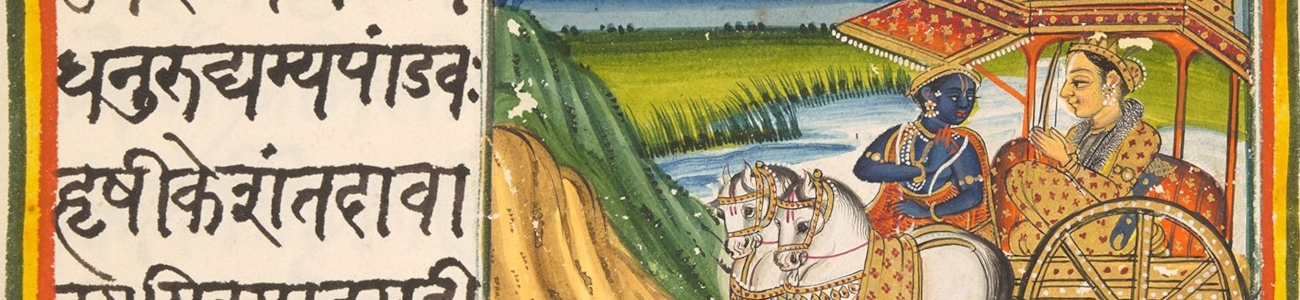
Bhagavad Gita banner

Author: Sri Swami Shivananda

Dedicated to Bhagavan Vyasa and Lord Krishna Avatara of Lord Vishnu Flute-Bearer of Vrindavana Joy of Devaki, Beloved of Radho Redeemer of the Fallen

Chapter 1: Preface

Verse #1
The Bhagavad Gita has been acclaimed to be a gospel of life. It has been translated into almost all The languages and has drawn The attention of scholars, saints and mystics, The world over. The importance of The Bhagavad Gita is in its offering satisfactory solutions to The problems that beset mankind of all times. His Holiness Sri Swami Sivanandaji Maharaj is one of The great exponents of The philosophy, religion and The technique of The Bhagavad Gita system, and His commentary is regarded as one of The most authoritative expositions available. |
This work originally appeared, in The early days of The Divine Life Society, as a series in six parts, published separately, which, later on, was combined into a single volume and released for The benefit of The students of Yoga. Having passed through several editions, It is now once again being made available to The public, after It ran out of print some time ago. It has been our endeavour to bring out This edition in as neat a form as possible, which, we are confident, will meet The demands of students as well as The public in general, in an appreciable manner. ||
The Bhagavad Gita has been acclaimed to be a gospel of life. It has been translated into almost all The languages and has drawn The attention of scholars, saints and mystics, The world over. The importance of The Bhagavad Gita is in its offering satisfactory solutions to The problems that beset mankind of all times. His Holiness Sri Swami Sivanandaji Maharaj is one of The great exponents of The philosophy, religion and The technique of The Bhagavad Gita system, and His commentary is regarded as one of The most authoritative expositions available. |
This work originally appeared, in The early days of The Divine Life Society, as a series in six parts, published separately, which, later on, was combined into a single volume and released for The benefit of The students of Yoga. Having passed through several editions, It is now once again being made available to The public, after It ran out of print some time ago. It has been our endeavour to bring out This edition in as neat a form as possible, which, we are confident, will meet The demands of students as well as The public in general, in an appreciable manner. ||
The Bhagavad Gita has been acclaimed to be a gospel of life. It has been translated into almost all The languages and has drawn The attention of scholars, saints and mystics, The world over. The importance of The Bhagavad Gita is in its offering satisfactory solutions to The problems that beset mankind of all times. His Holiness Sri Swami Sivanandaji Maharaj is one of The great exponents of The philosophy, religion and The technique of The Bhagavad Gita system, and His commentary is regarded as one of The most authoritative expositions available. |
This work originally appeared, in The early days of The Divine Life Society, as a series in six parts, published separately, which, later on, was combined into a single volume and released for The benefit of The students of Yoga. Having passed through several editions, It is now once again being made available to The public, after It ran out of print some time ago. It has been our endeavour to bring out This edition in as neat a form as possible, which, we are confident, will meet The demands of students as well as The public in general, in an appreciable manner. ||
No purport available for this verse.

Chapter 1: The Universal Prayer

Verse #1
O Adorable Lord of Mercy and Love! |
Salutations and prostrations unto Thee. |
Thou art Satchidananda. |
Thou art Omnipresent, Omnipotent and Omniscient. |
Thou art The Indweller of all beings. ||
O Adorable Lord of Mercy and Love! |
Salutations and prostrations unto Thee. |
Thou art Satchidananda. |
Thou art Omnipresent, Omnipotent and Omniscient. |
Thou art The Indweller of all beings. ||
O Adorable Lord of Mercy and Love! |
Salutations and prostrations unto Thee. |
Thou art Satchidananda. |
Thou art Omnipresent, Omnipotent and Omniscient. |
Thou art The Indweller of all beings. ||
No purport available for this verse.
Verse #2
Grant us an understanding heart, |
Equal vision, balanced mind, |
Faith, devotion and wisdom. |
Grant us inner spiritual strength |
to resist temptations and to control The mind. |
Free us from egoism, lust, greed, hatred, anger and jealousy. |
Fill our hearts with Divine virtues. ||
Grant us an understanding heart, |
Equal vision, balanced mind, |
Faith, devotion and wisdom. |
Grant us inner spiritual strength |
to resist temptations and to control The mind. |
Free us from egoism, lust, greed, hatred, anger and jealousy. |
Fill our hearts with Divine virtues. ||
Grant us an understanding heart, |
Equal vision, balanced mind, |
Faith, devotion and wisdom. |
Grant us inner spiritual strength |
to resist temptations and to control The mind. |
Free us from egoism, lust, greed, hatred, anger and jealousy. |
Fill our hearts with Divine virtues. ||
No purport available for this verse.
Verse #3
Let us behold Thee in all these names and forms. |
Let us serve Thee in all these names and forms. |
Let us ever remember Thee. |
Let us ever sing Thy glories. |
Let Thy Name be ever on our lips. |
Let us abide in Thee for ever and ever. |
-- |
Swami Sivananda ||
Let us behold Thee in all these names and forms. |
Let us serve Thee in all these names and forms. |
Let us ever remember Thee. |
Let us ever sing Thy glories. |
Let Thy Name be ever on our lips. |
Let us abide in Thee for ever and ever. |
-- |
Swami Sivananda ||
Let us behold Thee in all these names and forms. |
Let us serve Thee in all these names and forms. |
Let us ever remember Thee. |
Let us ever sing Thy glories. |
Let Thy Name be ever on our lips. |
Let us abide in Thee for ever and ever. |
-- |
Swami Sivananda ||
No purport available for this verse.

Chapter 4: PRAYER TO BHAGAVAN VYASA

Verse #1
नमो$स्तु ते व्यास विशालबुद्धे फुल्लारविन्दायतपत्रने |
येन त्वया भारततैलपूर्णः प्रज्वालितो ज्ञानमयः प्रदीपः ||
नमो$स्तु te vyāsa विशालबुद्धे फुल्लारविन्दायतपत्रने |
yena tvayaa भारततैलपूर्णः प्रज्वालितो jñānamayaḥ प्रदीपः ॥ ||
NaMa$SaTa te vyasa VaShaLBThaThha FaLLRaVaNaThaYaTaPaTaRaNa |
yena tvayaa BhaRaTaTaLPaRaNae PaRaJaVaLTa jnanamaya PaRaThaPa  ||
Salutations to Thee, 0 Vyasa, of broad intellect, with eyes large like the petals of full-blown lotus, by whom the lamp of knowledge, filled with the oil of the Mahabharata, has been lighted.

Chapter 5: PRAYER TO THE GURU

Verse #1
गुरुविष्णुर्गुर्देवो महेश्वरः | |
गुरुः साक्षात्‌ परं ब्रह्म तस्मै श्रीगुरवे नमः ||
गुरुविष्णुर्गुर्देवो maheśvaraḥ | |
guruḥ साक्षात्‌ param brahma tasmai श्रीगुरवे namaḥ ॥ ||
GaRaVaShhaNaeRaGaRaThaVa mahesvara | |
guru SaKaShhaTa param brahma tasmai ShaRaGaRaVa nama  ||
Guru is the Creator (Brahma); Guru is the Preserver (Vishnu);
Guru is the Destroyer (Mahesvara); Guru is verily the Supreme Absolute. Prostration to That Guru.
Verse #2
ध्यानमूलं गुरोर्मूर्तिः पूजामूलं गुरोः पदम् |
मन्रमूलं गुरोर्वाक्यं मोक्षमूलं गुरोः कृपा ||
ध्यानमूलं गुरोर्मूर्तिः पूजामूलं guroḥ padam |
मन्रमूलं गुरोर्वाक्यं मोक्षमूलं guroḥ kṛpā ||
ThhaYaNaMaL GaRaRaMaRaTa PaJaMaL guro padam |
MaNaRaMaL GaRaRaVaKaYa MaKaShhaMaL guro kpa ||
The Guru's Form is the root of meditation; the Guru's Feet
are the root of worship; the Guru's Word is the root of Mantra; the Guru's Grace is the root of Liberation.

Chapter 6: PRAYER TO LORD SRI KRISHNA

Verse #1
कृष्णाय वासुदेवाय देवकीनन्दनाय |
नन्दगोपकुमाराय गोविन्दाय नमो नमः ||
kṛṣṇāya वासुदेवाय देवकीनन्दनाय ca |
नन्दगोपकुमाराय गोविन्दाय नमो namaḥ ॥ ||
ksnaya VaSaThaVaYa ThaVaKaNaNaThaNaYa ca |
NaNaThaGaPaKaMaRaYa GaVaNaThaYa NaMa nama  ||
Prostration, again and again, to Lord Sri Krishna, the son of Vasudeva, the delighter of Devaki, the darling of Nandagopa, the protector of the cows.

Krishna! Thou art my sweet companion now. Thou hast a soft corner for me in Thy heart. Teach me now the mysteries of Thy divine play (Lilas) and the secrets of Vedanta. Thou sayest in the Gita: *I am the Vedantakrit and the Vedavit (the author of Vedanta and the knower of the Vedas)." Thou art my best teacher. Explain to me the intricate problems of Vedanta. Give me easy lessons. Kindly explain: why did Sukadeva, a Brahma Jnani who was absorbed in Brahman (established in Advaita-Samadhi or the highest non-dual state), teach the Bhagavata to Parikshit? What are the differences in the experiences of a Bhakta who enjoys Sayujya state (of union with his God), of a Yogi who is established in Asamprajnata-Samadhi (the highest superconscious state) and of a Jnani who has Advaita-Avastharupa-Samadhi (a state in which he is firmly established in Oneness or Brahman)? What is the real difference between Jivanmukti (liberation while living) and Videhamukti (disembodied liberation), Turiya (transcendent state) and Turiyatita (beyond the Turiya), Kshara-Purusha (mutable Person), Akshara-Purusha (imperishable Person), and Purushottama (Supreme Person)?

Let me be frank with Thee, O Krishna, because Thou art the indweller of my heart, the witness of my mind, and the Lord of my Prana (life-breath). I cannot hide anything from Thee, because Thou directly witnessest all the thoughts that emanate from my mind. I have no fear of Thee. Thou art my friend now. Treat me as Thou didst treat Arjuna. I shall sing and dance. You can play on the flute. Let us eat butter and sugar-candy together. Let us sing. Teach me the Gita. Let me hear it directly from Thy lips once more.

O Thou invisible One! O adorable and supreme One! Thou permeatest and penetratest this vast universe from the unlimited space down to the tiny blade of grass at my feet. Thou art the basis of all these names and forms. Thou art the apple of my eye, and the Prema (divine love) of my heart, the very life of my life, the very soul of my soul, the illuminator of my intellect and senses, the sweet Anahata (mystic) music of my heart, and the substance of my physical, mental and causal frames.

I recognise Thee alone as the mighty ruler of this universe and the inner controller of my three bodies. I prostrate myself again and again before Thee, my Lord! Thou art my sole refuge. I trust Thee alone, O ocean of mercy and love! Elevate! Enlighten! Guide! Protect! Remove the obstacles from my spiritual path. Remove Avidya or the veil of ignorance. O Thou Jagadguru! I cannot bear any longer, even for a second, the miseries of this body, this life and this Samsara. Meet me quickly. O Prabho! I am pining, I am melting. Listen, listen, listen to my fervent, Antarika (innermost) prayer. Do not be cruel, my Lord. Thou art Dinabandhu (friend of the afflicted). Thou art Adhama-Uddharaka (one who raises the down-trodden). Thou art Patitapavana (purifier of the fallen).

O Magnificent Lord of love and compassion! O fountainhead of bliss and knowledge! Thou art the eye of our eyes, the ear of our ears, the Prana of our Pranas, the mind of our minds, and the soul of our souls. Thou art the unseen seer, the unheard hearer, the unthought thinker and the unknown knower. Pray, deliver us from all temptations. Give us light, purity and knowledge.

O Prabho, Prananatha (Lord of my Prana), Vibhu-Visvanatha (all-pervading Lord of the universe)! Accept our prayer. Guide us. Lift us from the mire of Samsara. Enlighten us. Protect us. Thee alone we adore, Thee alone we worship, on Thee alone we meditate, in Thee alone we have taken refuge.

Chapter 8: INTRODUCTION

Verse #1
GLORY of The Gita ||
The Bhagavad Gita is a dialogue between Lord Krishna and Arjuna, narrated in the Bhishma-Parva of the Mahabharata. It comprises eighteen chapters of a total of 700 Sanskrit verses. Considerable matter has been condensed and compressed within these verses. On the battlefield of Kurukshetra, Lord Krishna, during the course of His most interesting and instructive talk with Arjuna, revealed the profound, sublime and soul-stirring spiritual truths, and expounded to him the rare secrets of Yoga, Vedanta, Bhakti and Karma. All the teachings of Lord Krishna were subsequently recorded as the Song Celestial or the Bhagavad Gita by Sri Bhagavan Vyasa for the benefit of humanity at large. The world is under a great debt of gratitude to Sri Vyasa who has presented this Celestial Song to humanity for their daily conduct in life, spiritual uplift and Self-realisation. Only those who are self-controlled and are endowed with faith can reap the full benefit

of the Gita, which is the Science of the Soul.

The Gita Jayanti day or the birthday of the Bhagavad Gita is celebrated throughout India by all the admirers and lovers of this unique book on the 110 day (Ekadasi) of the bright half of the Margasirsha month according to the Hindu almanac. It was the day on which this scripture was revealed to the world by Sanjaya.

In the whole world-literature there is no book so elevating and so inspiring as the Gita. The Gita expounds very lucidly the cardinal principles or the fundamentals of the Hindu religion and the Hindu Dharma. It is the source of all wisdom. It is your great guide. It is your supreme teacher. It is an inexhaustible spiritual treasure. It is a fountain of bliss. It is an ocean of knowledge. It is full of divine splendour and grandeur.

The Gita is the cream of the Vedas. It is the essence of the Upanishads. It is the universal scripture for all people of all temperaments and for all times. It is a wonderful book with sublime thoughts and practical instructions on Yoga, devotion, Vedanta and action. It is a marvellous book, profound in thoughts and sublime in heights of vision. It gives peace and solace to the souls who are afflicted by the three fires (Taapas) of this mortal world (Samsara), viz., Adhyatmika (afflictions caused by one's own body), Adhibhautika (those caused by beings around one), and Adhidaivika (those caused by the gods).

The Bhagavad Gita contains the divine nectar. It is the Chintamani, Kalpataru and Kamadhenu (wish-fulfilling gem, tree and cow respectively). You can milk out anything from it. It is a book of eternity. It is not a catch-penny book which has a life like that of a mushroom. The Gita has been my constant companion of life. It is a vade mecum for all. Peace, Bliss, Ananda, Happiness, Wisdom, Atman, Brahman, Purusha, Dhama, Nirvana, Param Padam, Gita are all only synonymous terms.

The Gita is a boundless ocean of nectar. It is an immortal celestial fruit of the tree of the Upanishads. In this unique book, you will find an unbiased exposition of the philosophy of action, devotion and knowledge, and a wonderful synthesis. The Bhagavad Gita is a rare and splendid flower that wafts its sweet aroma throughout the world. All the Upanishads represent the cows. Sri Krishna is the milker of the Upanishad-cows; Partha (Arjuna) is te calf who first tasted that milk of wisdom of the Self, which was milked by the Divine Cowherd, Sri Krishna, for the benefit or Arjuna and all humanity, as the Bhagavad Gita. It helps to solve not only Arjuna’s problems and doubts, but also the world problems and the problems and doubts of every individual. Glory to Lord Krishna, the friend of the cowherds of Gokula, the Joy of Devaki! He who drinks the nectar of the Gita through purification of the heart and meditation, attains immortality, eternal bliss, everlasting peace and perennial joy.

Just as the dark, unfathomed depths of the ocean contain most precious pearls, so also the Gita contains spiritual gems of incalculable value. You will have to dive deep into the depths of the ocean of the Gita with sincere attitude of reverence and faith. Only then will you be able to collect the spiritual pearls of the Gita. Only then will you be able to comprehend the profound and subtle teachings of the Gita.

-The Gita is a unique book for all ages. It is a book that comes under the category of Prasthanatraya, the authoritative books of the Hindu religion. The Gita is the Immortal Song of the Soul, which bespeaks of the glory of life. The instructions that are inculcated by Lord Krishna are for the whole world. It is a standard book on Yoga for all. The language is as simple as it could be. Even a man who has an elementary knowledge of Sanskrit can go through the book. It deals with the four Yogas, viz., Karma Yoga, Bhakti Yoga, Raja Yoga and Jnana Yoga.

There are countless commentaries on the Gita at the present day. A volume can be written on each verse. A busy man with Karmic tendencies will be benefited by the commentary of Sri Bala Gangadhara Tilak (Gita Rahasya), a man of devotion by studying Sridhara's commentary, and a man of reason by Sri Sankara's commentary.

There are now hundreds of commentaries on this wonderful book. The Gita is like an ocean. Sri Sankara, Sri Ramanuja and Sri Madhva have given their own interpretations of the Gita and established their own philosophy. Anyone can dive deep into this ocean of the Gita, bring out the most precious pearls of divine knowledge and give his own interpretation. Glory to the Gita! Glory to the Lord of the Gita!

The teachings of the Gita are broad, universal and sublime. Jts teachings do not belong to any cult, sect, creed, particular age, place or country. They are meant for the people of the whole world at large. The teachings are based on the Upanishads, the ancient wisdom of the seers (Rishis) and sages. It teaches a method which is within the reach of all. It has a message for the solace, peace, freedom, salvation and perfection of all human beings.

The Gita is like the lake Manasasarovara for the Paramahamsas (monks and renunciates) and thirsting aspirants to sport in. It is the ocean of bliss in which the seekers of Truth swim with joy and ecstasy. If the philusopher's stone touches a piece of iron even at one point, the whole of it is transformed into gold. Even so, if you live in the spirit of even one verse, you will doubtless be transmuted into divinity.

Study of the Gita alone is sufficient for the purpose of daily Svadhyaya (scriptural study). You will find a solution here for all your doubts. The more you study with devotion and faith, the more you will get deeper knowledge, penetrative insight and clear right thinking. Even if you live in the spirit of one verse of the Gita, all your miseries will come to an end and you will attain the goal of life—Immortality and Eternal Peace.

The Gita is a gospel for the whole world. It is meant for the generality of mankind. It was given over five thousand years ago on the battlefield of Kurukshetra, by Lord Krishna to Arjuna.

None but the Lord can bring out such an unprecedented and marvellous book which gives peace to the readers, which helps and guides them in the attainment of Supreme Bliss, which has survived up to this time. This itself proves clearly that God exists, that God is an embodiment of knowledge and that one can attain perfection or liberation by realising God alone.

The whole world is a big battlefield. The real Kurukshetra is within you. The battle of Mahabharata is still raging within you. Ignorance (Avidya) is Dhritarashtra. The individual soul is Arjuna. The Indweller Who dwells in your heart is Lord Krishna, the charioteer. The body is your chariot. The senses (Indriyas) are the horses. The mind, egoism, senses, Samskaras (mental impressions), Vasanas (latent tendencies), cravings, Raga-Dvesha (likes and dislikes), lust, jealousy, greed, pride and hypocrisy are your dire enemies.
Verse #2
GUIDE for STUDY ||
GUIDE for STUDY ||
GUIDE for STUDY ||
As the Gita contains subtle and profound teachings, you should study the Gita under a qualified teacher—a Brahma-Nishtha Guru (a preceptor who is established in the Absolute), with great and intense faith, single-minded devotion and purity. Only then will the truths of the Gita be revealed unto you like the fruit on the palm of your hand. Good commentaries like those of Swami Madhusudana Sarasvati, Swami Sankarananda, and Sri Sankara, written by sages of Self-realisation, will be of immense help to you.

Worldly-minded people, however intellectual they may be, cannot grasp the essential teachings of the Gita. They will enter into unnecessary discussions and useless debates. They will cavil and carp at the teachings. Ignorant people only say: “There is no intimate connection between the verses. They are thrown together in a disorderly manner. There is a great deal of repetition." If they study the Gita with reverence and faith under a qualified teacher, all their doubts will vanish. They will realise that there is a close connection between the verses in all the chapters. Repetitions in the Gita and the Upanishads are useful repetitions. They are calculated to create a deep and indelible impression on the minds of the aspirants.

Lord Krishna speaks from different levels of consciousness. In the Gita, the term “Avyakta” sometimes refers to Mulaprakriti (primordial Nature), sometimes also to Para Brahman (the Absolute). Therefore, the help of a teacher is necessary if you wish to know the right significance of the verses. In the Kathopanishad, the term ‘brick’ is used to denote the Devata (god). In Hatha Yoga it is said: *At the junction of the rivers Ganga and Yamuna, there is a young virgin.” The esoteric meaning is: “There is the SushumnaNadi between the Ida and the Pingala.” You cannot understand the real meaning of these terms without the help of a Master. Even so, you cannot rightly comprehend the meaning of the verses of the Gita without the help of a teacher. Otherwise, you will be like the man who brought a horse before one who asked for “Saindhava”, when he was taking his food. “Saindhava” means “salt” as well as "horse"!
Verse #3
HARMONY in The Gita ||
Man is a composite of three fundamental factors, viz., cognition, feeling and will. There are people with three kinds of temperaments, viz. the active temperament, the emotional temperament and the rational temperament. So, there are the three Yogas, viz., Jnana Yoga for the man of enquiry and self-analysis or rational temperament, Bhakti Yoga for the man of emotional temperament, and Karma Yoga for the man of active temperament. One Yoga is as efficacious as the other.

The Gita formulates the theory of the three Margas (paths), viz., the Jnana Marga, the Bhakti Marga and the Karma Marga. According to the teaching of the Gita, there is no conflict among the three. The Gita harmonises wonderfully the philosophy of action, devotion and knowledge. All the three must be harmoniously blended if you wish to attain perfection. You should have the head of Sri Sankara, the heart of Lord Buddha and the hand of Raja Janaka. The three horses of this body-chariot—action, emotion and intellect—should work in perfect harmony. Only then will this body-chariot move smoothly and you can reach the destination safely and quickly. Only then can you rejoice in the Self within. Only then can you sing the song of Soham (I am He).

Only then can you be in tune with the Infinite. Only then can you hear the soundless voice of the soul and enjoy the sweet internal music of the Self.

The central teaching of the Gita is the attainment of the final beatitude of life or perfection or freedom (Moksha) by doing the duties of life or one's Svadharma. The Lord says to Arjuna: "Therefore without attachment, do thou always perform action which should be done; for by performing action without attachment man reaches the Supreme."

The Gita is divided into three sections, illustrative of the three terms of the Mahavakya or the Great Sentence of the Sama Veda, Tat-Tvam-Asi, (That thou art). In accordance with this view, the first six chapters deal with the path of action or Karma Yoga and the nature of "thou" or the Tvam-Pada. The next six chapters explain the path of devotion or Bhakti Yoga and the nature of "That", Tat-Pada. The last six chapters treat of the path of knowledge or Jnana Yoga and the nature of the term “art” or Asi-Pada which establishes the identity of the individual and the Supreme Soul, Jiva-Brahma-Aikya.

The eighteen chapters of the Gita are nov woven in a disconnecied or discordant manner. There is an intimate relationship or vital connection between one chapter and another. Arjuna became very despondent and the teachings of the second chapter which bespeak of the immortality of the Soul, opened his eyes and gave him strength and courage. Arjuna then understood the technique of Karma Yoga and renunciation of the fruits of actions. Then he learnt the methods to control the senses and the mind and to practise concentration and meditation. Then Lord Krishna gave a description of His various Vibhutis (manifestations) in order to prepare him for the vision of the Cosmic Form or Visvarupa-Darsana. Then Arjuna: experienced the magnificent Cosmic Vision. Then he understood the nature of a Jivanmukta or Bhagavata. Then he had knowledge of the field and the knower of the three Gunas and the Purushottama. Then he had knowledge of the divine attributes and the three kinds of faith, and the essence of Sannyasa Yoga in the end. Just as a student is coached up in the university, so also Arjuna was coached up by Lord Krishna for the attainment of knowledge of the Self in the Adhyatmic (spiritual) University. Arjuna had various kinds of doubts. Lord Krishna cleared his doubts one by one. He pushed Arjuna up the ladder of Yoga from one rung to another. Ultimately Arjuna placed his foot on the highest rung of the ladder, attained knowledge of the Self, and then exclaimed in joy: “O my Lord! My delusion has been destroyed. I have attained knowledge through Thy Grace. I am firm now. My doubts have now vanished in toto. I will act according to Thy word."

You can become a Jivanmukta by annihilating the ego, and the two currents of Raga (likes) and Dvesha (dislikes). You can become a liberated sage by annihilating the desires and cravings and by destroying the residual potencies (Samskaras) and Sankalpas (desireful thoughts). You can thus rest in your own Satchidananda-Svarupa (essential nature as Existence-KnowledgeBliss Absolute) and still you can be active in the affairs of the world like Raja Janaka. You will not be bound by Karmas. You will not be tainted by the actions, because the idea of doership has been destroyed by the attainment of knowledge of the Self or Brahma-Jnana. This is the keynote of the Gita.
Verse #4
The TWO WAYS ||
The TWO WAYS ||
The TWO WAYS ||
The seers of the Upanishads emphatically declare that the real man is the-all-pervading, immortal Soul which is the substratum of this body, mind and world, which is behind the five sheaths, viz., the food sheath, the vital sheath, the mental sheath, the intellectual sheath and the blissful sheath. |

The goal of life is the direct cognition or realisation of this self-Iuminous Self which is hidden in this body like fire in wood, and butter in milk. This Self (Atman) is the inner ruler or Antaryamin. He is the unseen governor or hidden proprietor of this house, the body.

Real religion is the attainment of this transcendental, supreme, undying, undecaying Tattva or principle through constant and profound meditation. Real life is life in the eternal Atman or Soul. True life is identification with this Supreme Soul which exists in the past, present and future, which has neither beginning, middle nor end, which has neither parts nor limbs, which is neither subtle nor gross.

The Rishis of yore attained this mysterious and marvelous Atman through the eye of intuition or the divine inner third eye (Jnanachakshus) and then explained things of this world in the light of their knowledge of the Self. This is the direct method of Self-realisation.

You can ascend the summit of the hill of knowledge of the Self through science, art, Nature, music, etc. This is the indirect method. From the effect you go to the cause and ultimately reach the causeless Cause or Para Brahman or the ultimate, transcendental Truth. Our Western scientists will be groping in utter darkness if their purpose is only to invent some things for our physical comforts or convenient living. The goal of science is to find out the one ultimate Truth which is the substratum of the atoms, molecules, electrons, energy, motion and all physical and mental phenomena and all the laws of Nature through enquiry, observation, analysis, investigation and study of the laws of Nature. A real scientist is only a Vedantin. His mode of approach to the Truth only is different. The scientist who was saying previously: “There is nothing beyond this world”, proclaims now: “The more I know of the phenomena, the more I am puzzled. Intellect is finite and cold. Behind these changing phenomena, there is the unchanging Noumenon. Behind the rotating dynamic electrons, there is the static, motionless something: or something beyond the intellect and the world.” The Brahman of the Upanishads is the Atman of the Vedantins, Who is the Lord of these laws of Nature. “My method of approach is a posteriori method, from the effect to the cause. The Vedantins’ method is the a priori method, from the cause to the effect. The goal is the same.”
Verse #5
RECONCILIATION of The PATHS ||
In the Vishnu Purana, Bhagavan Vishnu is highly eulogised and a secondary place is given to Lord Siva. In the Siva Purana, Lord Siva is immensely praised and a secondary place is given to Lord Hari. In Devi Bhagavatam, Devi is highly praised and a secondary place is given to Lord Siva and Lord Hari. This is done in order to create intense and unswerving faith in the aspirant for his Ishta Devata or a ourite deity. Siva, Hari and Devi are one. They are different aspects of the Lord. It is simply absurd if you believe that Siva is inferior to Hari or Hari is inferior to Siva.

Even so, in one place Lord Krishna praises Karma Yoga.
"Karmasannyasat karmayogo visishyate—Yoga of action is verily better than renunciation of action." (Chapter V. 2). In another place He praises Yoga. “The Yogi is greater than the ascetic; he is thought to be even greater than the wise; the Yogi is greater than the man of action; therefore, become thou a Yogi, O Arjuna." (Chapter VI. 46). In another place, the Lord praises Bhakti Yoga. "He, the Highest Spirit, O Partha, may be reached by unswerving devotion to Him alone." (Chapter VIII. 22). In another place, He praises Jnana Yoga. *Noble are all these, but I hold the wise as verily Myself; he, self-united, is fixed on Me, the highest path." (Chapter VII. 18)

A neophyte will be confused when he comes across these verses. But there is no room for any confusion if you think deeply. Lord Krishna has praised each Yoga in order to create interest in the aspirant in his particular Marga or path. You must remember that the Gita is a book for the people of the world at large. It was not meant for Arjuna alone. Each Yoga is as efficacious and potent as the other.
Verse #6
ESSENCE of The Gita ||
The Gita emphasises again and again that one should cultivate an attitude of non-attachment or detachment. It urges repeatedly that one should live in the world like the lotus-leaf, which is unaffected by water. He who acts placing all actions in the Eternal,

abandoning attachment, is as unaffected by sin as a lotus-leaf by water—Padmapatramivambhasa. (Chapter V. 10)

Attachment is due to Moha. Attachment is the offspring of the quality of Rajas. Non-attachment is born of Sattva. Attachment is an Asuri-Sampat, demoniacal quality. Non-attachment is a Daivi-Sampat, divine attribute. Attachment is born of ignorance, selfishness and passion. Attachment brings death. Non-attachment is wisdom. Non-attachment brings freedom. Practice of detachment is a rigorous discipline indeed. You will have to practise it again and again. You may tumble down like a baby who is just learning to walk, but you will have to rise up again with a smile and a cheerful heart. Failures are not stumbling blocks, but steppingstones to success. Try to dwell always in your own Self. Abide in your own Self. Abide in your centre. Think of the Self constantly. All attachments will die automatically. Attachment to God or Atman is a potent antidote to annihilate all worldly attachments. He who has no attachment can really love others. He has pure love or divine Prema. Therefore, without attachment, constantly perform action which is duty, for, by performing actions without attachment, man verily reacheth the Supreme. (Chapter III. 19)

The thirteenth, fourteenth and fifteenth discourses deal with Jnana Yoga. He who has knowledge of Prakriti and. Purusha (Nature and God), the three Gunas (qualities of Nature) and their operation, and of the wonderful tree of Maya (illusory power) or the Samsara-Vriksha, can transcend the Prakriti and the Gunas, and cut this marvellous, deep-rooted tree with the sword of wisdom of the Self or the axe of dispassion, 'and attain Atma-Sakshatkara or direct Self-realisation which releases him from the round of births and deaths. The fifteenth discourse is a soul-elevating one. It contains the essence of Vedanta. He who rightly understands this discourse will soon attain Moksha or the imperishable Seat of Brahman. Get by heart the twenty verses and repeat them before you take your food. All Sannyasins repeat them before they take food.

The eighteenth chapter must be studied again and again. It contains the quintessence of the whole Gita Sastra. It is the supreme pinnacle on the magnificent hill of the knowledge of the Gita. It is the crowning jewel in the priceless necklace and in it is condensed the substance of those teachings found in the first seventeen chapters.

Constant remembrance and practice of the teachings of verses 19, 20, 23, and 24 of chapter II will confer on you Immortality and will remove fear and Dehadhyasa (identification of the Self with the body).

Constant remembrance and practice of the teachings of verse 22 of chapter V: Ye hi samsparsaja bhogah......., verse 8 of chapter XIII: Indriyartheshu vairagyam...... and verse 38 of chapter XVIII: Vishayendriya samyogat...... will induce dispassion (Vairagya).

Life in the spirit of verses II. 71, and IV. 39, will give you supreme peace. Verses V. 27, 28, VI. 11 to 14, and 26, VIII. 8, 12, 13 and 14, IX. 34, XII. 8 to 10, XVIII. 51 to 53, deal with Yoga Sadhana or spiritual practice for Self-realisation. The philosophy of the Gita begins from verse II. 11. Verse XVIII. 66 is the most important one in the Gita: “Abandoning all duties, come unto Me alone for shelter; sorrow not; I will liberate thee from all sins." Arjuna asks Lord Krishna: “My heart is overpowered by the taint of pity; my mind is confused as to duty. I ask Thee: tell me decisively what is good for me. I am Thy disciple. Instruct me who has taken refuge in Thee.” (Chapter II. 17) Lord Krishna gives His answer to this question of Arjuna in verse XVIII. 66. The essence of the whole Gita is contained in verses 65 and 66 of chapter XVIII.

Verse 65 of chapter XVIII contains the essence of Navavidha-Bhakti or the nine modes of devotion. Here is the Sadhana for perfect control of thoughts. By fixing the mind again and again on the. Lord, all worldly thoughts die by themselves. Bhakti Yoga can hardly be separated from Raja Yoga. There is a blending of these two Yogas. Patanjali Maharshi says that Samadhi can be attained through devotion unto the Lord: /svarapranidhanadva, or by self-surrender to the Lord. Self-surrender to the Lord is an important item in the Kriya Yoga and Niyama of Raja Yoga. Manmana Bhava is merging the mind. It is a Raja Yoga Sadhana. It is difficult to say where Bhakti Yoga ends and where Raja Yoga begins. Raja Yoga is the fulfilment of Bhakti Yoga. There is no hard and fast rule or line of demarcation between Bhakti Yoga and Raja Yoga. A Raja Yogi is also a Bhakta. A devotee is also a Raja Yogi. There is difference only in name. Lord Krishna gives His word of assurance to Arjuna to encourage him as he is in a despondent and confused state of mind by saying: “Thou shalt come even to Me. I pledge thee My Truth (word); thou art dear to Me." Follow these instructions. He who has practised these four vital instructions will be able to effect unconditioned, unreserved self-surrender.

The next verse contains the essence of self-surrender. The Advaita Vedantin explains the verse thus: “Give up the notion that you are an individual soul. You will attain liberation. You will become a Jivanmukta (a sage liberated while living)." An Acharya (teacher) of the Bhakti cult explains it thus: "Surrender the fruits of all actions and the actions themselves at the Feet of the Lord. The Lord will give you liberation." Dharma here cannot signify the Dharma of the senses, because even a Jivanmukta sees, hears, tastes, and so forth; but, he stands as a witness; he does not identify himself with the actions of the senses. In this verse, Lord Krishna gives His definite answer to the query of Arjuna contained in the verse: “My heart is overpowered by the taint of pity; my mind is confused as to duty. I ask Thee: tell me decisively what is good for me. I am Thy disciple. Instruct me who has taken refuge in Thee."

You need not study many books on Yoga and Vedanta. If you can live in the true spirit of those two verses, you will attain the summum bonum of existence, i.e., immortality, eternal bliss and knowledge of the Self.

“Work without egoism, without expectation of fruits. Surrender the actions and their fruits as offerings unto the Lord. Divinise your life by melting the mind and the ego in the Lord. Spiritualise your life by dedicating your mind and intellect to the Lord (Macchitta, Yukta, Matparah). Fix the mind on the Lord. Be devoted to Him. Be intent on the welfare of all beings, sarvabhutahite ratah. Sacrifice everything unto the Lord. Then, you will enter into His Being.” This is the note ringing throughout the Gita.

Sadhana in the Gita is explained in the following verses:

Karma Yoga: II. 48, IV. 20 to 22 and 24.

Bhakti Yoga: IX. 27, 34, XII. 8, XVIII. 52 to 54.

Japa Yoga: VIII. 14.

Abhyasa Yoga: XII. 9.

Hatha Yoga: VIII. 10, 12.

Raja Yoga: VI. 25, 26.

Jnana Yoga: III. 28, V. 8, 9.

IN DEFENCE

Some people study the Gita in order to find out loopholes in it and criticise the teachings contained in it. The teachings of the Gita can only be understood if you approach it with a reverential attitude of mind and with intense faith.

Someone in a newspaper gave vent to the criticism thus: “The Gita is not a sacred book at all. It teaches violence. Lord Krishna has asked Arjuna to kill even his dear relations and preceptors." It seems that this critic has obviously no real knowledge of the Gita. He is like Virochana who received spiritual instructions from Prajapati and took the body for the Self on account of his perverted intellect. He is obviously a follower of the philosophy of the flesh.

He cannot comprehend the depths of the Gita philosophy as his mind is callous and impervious to the reception of Truth. He has read the Gita not for gaining spiritual knowledge, but for attacking it! If he really understood the right significance of the three verses, viz., "He who regardeth this as a slayer, and he who thinketh he is slain, both of them are ignorant. He slayeth not, nor is He slain." (Chapter II. 19). "Therefore, stand up. By Me they have already been overcome. Be thou the outward cause." (Chapter XI. 33). "He who is free from the egoistic notion, whose intellect is not affected, though he slays these people, he slayeth not, nor is he bound." (Chapter XVIII. 17)—he would not have made this vain criticism. The Universal Being transcends all parochial values.

Just as coloured water penetrates a piece of cloth freely and nicely when it is pure white, so also the instructions of a sage can penetrate and settle down in the hearts of aspirants only when their minds are calm, when there are no desires for enjoyments and when the impurities of their minds are destroyed. That is the reason why an aspirant is expected to possess the qualifications of Viveka (discrimination), Vairagya (dispassion), Sama (control of the mind), Dama (control of the senses), Uparati (turning away from worldly attractions), before he could practise the threefold Sadhana of hearing of the scriptures, reflection, and meditation on them. Discipline and purification of the mind and the senses are the prerequisites in the aspirants on the path of Truth and God-realisation.

Even when the nature of God is explained, those who have not been purged of their faults and impurities, either disbelieve or misbelieve it, as was the case with Indra and Virochana. Therefore, knowledge as inculcated arises only in him who has purified himself by Tapas (austerity), etc., performed either in this or in a previous birth. The Sruti (Upanishad) says: “To that high-souled man whose devotion to his preceptor is as great as that to the Lord, these secrets explained here become illumined.”

Some people catch fish in the river Ganga for satisfying their palate and quote the Gita to support their evil action: “Weapons cleave him not, nor fire burneth him.” (Chap. II. 23). Wonderful philosophy indeed! Devils also can quote scriptures. These people are also followers of the Virochana school. They are the evil-doing, the deluded and the vilest of men. They cannot understand the teachings of the Gita as their wisdom has been destroyed by illusion and as they have embraced the nature of demons. May the Lord grant them subtle and pure intellect, inner spiritual strength and right understanding to comprehend the teachings of the Gita in their proper light and live in the spirit of the teachings.

Some ignorant people say: “Krishna is not God. He is not an . Avatara (incarnation). He was a passionate cow-herd who lustfully played with the Gopis." What was the age of Lord Krishna at that time? Was He not a boy of seven? Could there have been a tinge of passion in Him? Who can understand the secret of Rasa Lila and Madhurya Bhava (the lover-beloved relationship between the devotee and God), the culmination of highest Bhakti, Amanivedana or total surrender to the Lord. It is only Narada, Suka Deva, Chaitanya, Mira, Hafiz, Ramananda, the Sakhis or the Gopis that could understand the secret of Rasa Lila. The Sakhis only are qualified for this. Did He not perform miracles when He was a. boy? Did He not show that He was the Avatara of Lord Hari? Did He not show His Cosmic Form to His mother when He was a baby? Did He not subdue the Kaliya-serpent by standing on its hood? Did He not multiply Himself as countless Krishnas? Who were the Gopis? Were they not God-intoxicated beings who saw Krishna alone everywhere, who saw themselves also as Krishna? The sound of the Murali could throw them in a state of divine ecstasy or holy communion. They were above body-consciousness.

What is the fate of such people who cavil and carp against the Lord? Just listen. “Those devoid of reason think of Me, the unmanifested, as having manifestation, knowing not My supreme nature, imperishable, most excellent." (Chapter VII. 24) “The foolish disregard Me, when clad in human semblance, ignorant of My supreme nature, the great Lord of beings. Empty of hope, empty of deeds, empty of wisdom, senseless, partaking of the deceitful, brutal and demoniacal nature (chapter IX. 11, 12), they, enwrapped in darkness, think wrong to be right, and see things in a perverted light. These demoniacal men know neither action nor renunciation, neither purity nor right conduct, neither truth nor uprightness. They do not know what ought to be done and what ought not to be done. I ever throw them into demoniacal wombs. Deluded birth after birth, not attaining Me, they sink into the lowest depths.” (Chapter XVI. 19, 20)

Some thoughtless people begin to entertain a doubt and say: . *How could the Gita have been taught to Arjuna on the battlefield in such a short time? It could not." This is wrong. It was all a revelation to Arjuna. Lord Krishna gave Arjuna the divine eye of intuition. The omniscient, omnipotent Lord can do anything. His Grace can make the dumb man eloquent and the cripple a climber of mountains.
Verse #7
SOLUTION for CONFLICTING VERSES ||
n opponent writes: "In the Gita, chapter III. 33, it is said, *Even the man of knowledge behaves in conformity with his own nature; beings follow Nature; what shall restraint do?' What is the use of our attempt at controlling the senses and the mind when

Nature is all in all? When Nature is all-powerful and overwhelming, how can Sadhana overcome it?"

In the next verse, Lord Krishna distinctly advises us to control Raga-Dvesha (likes and dislikes). Nature can be subdued by Sadhana. In the study of the Gita, you should not try to confine the meaning to one verse alone. You will have to connect it with the previous and succeeding verses of the same chapter and the verses of the previous chapters. You will also have to make crossreferences. Only then will you get the right answer.

Those who disregard the Lord's commandment in III. 30: "Renouncing all actions in Me, with the mind centred in tke Self, free from hope and egoism, free from mental fever, do thou fight," and sit quiet renouncing their own duty will not derive any benefit by such renunciation. This Maya is invincible by even wise men: then how much more difficult will it be for worldly men to conquer it! For them, renunciation of work without attainment of knowledge is not desirable. They will be caught in the clutches of Maya. Of what avail is their effort to control the senses or what can restraint do in their case? These worldly men cannot escape the clutches of Raga-Dvesha.

Even the residual Sattvic Vasanas (good tendencies) in Jnanis which keep the body, work in accordance with the qualities of Nature, viz., Sattva, Rajas and Tamas. Even the wise men are affected by the three Gunas when they are not actually in Samadhi. They have no attachment to the body and other objects of enjoyment and, therefore, they will not be affected mentally. They will be self-contented and self-satisfied. They will not long for objects not attained, nor weep over things lost.

The objector says: "In the Gita, chapter XVIII. 61, Lord Krishna says: "The Lord dwelleth in the hearts of all beings, O Arjuna, by His illusive power, causing all beings to revolve, as though mounted on a potter's wheel.' Is man then a perfect slave? Is he like straw tossed about here and there? Has he not got free will to act?"

Lord Krishna tries His level best to persuade Arjuna to do his duty. He wants to extract work from Arjuna. So He speaks of his utter helplessness. In chapter VI. 5, Lord Krishna preaches about Purushartha or right exertion: “Uddharedatmanatmanam natmanamavasadayet—Let him raise the self by the Self and let not the self become depressed."

Being under the sway of Nature, the natural Karmas or duties can never be forsaken. One's duty should in no case be ignored. The Lord, the inner ruler, is the director of the individual soul. So long as he is not free from ignorance, he is bound to his own Dharma. Lord Krishna wants to make Arjuna fight as he is a Kshatriya. Elsewhere, the Lord has said: "Sreyan svadharmah —one’s own duty is good." (XVIII. 47)

The opponent says: “In chapter XV. 7, Lord Krishna says: ‘A portion of Mine own Self, transformed in the world of life into an immortal spirit, draweth round itself the five senses with the mind as the: sixth, veiled in matter.’ It is quite clear that the Jiva (individual soul) is an Amsa or part of Brahman, the Absolute. How can we say that the Jiva is identical with Brahman? The doctrine of Advaita (non-dualism) is wrong."

In chapter VII. 17, the Lord says: "I hold the wise as verily Myself." Here He speaks of identity. The doctrine of non-dualism is quite correct. Non-dualism is the highest realisation. The Lord gives instructions according to the type of the Adhikari (qualified aspirant). Advaita philosophy can be grasped only by the microscopic few. So, He speaks of other kinds of philosophical doctrines in other places, to suit different kinds of aspirants. There is neither Jiva nor Self-realisation from the Absolute viewpoint. Brahman alone exists in reality. Dvaita (dualism), Visishtadvaita (qualified monism), Suddha Advaita (pure monism) are different rungs in the ladder of realisation. The truth is that the Jiva and Brahman are One in essence. The Dvaitin and the Visishtadvaitin eventually reach the Advaitic goal or Vedantic realisation of Oneness. Do not be confused. Clarify your ideas and understand things in their proper light.
Verse #8
EPILOGUE ||
EPILOGUE ||
EPILOGUE ||
India is held in high esteem by the Westerners on account of the Gita. Mahatma Gandhi once visited one of the biggest libraries in London and asked the librarian: “What spiritual book is most often issued?" The librarian replied: "It is the Gita." The Gita is very popular throughout the world. All aspirants should try to get the whole 18 chapters by heart. This can be done through daily Svadhyaya (scriptural study) in about two years, by getting by heart two verses daily.

Study of the Gita must be made compulsory in all schools and colleges of India: nay, of the whole world. It must become a textbook for students of schools and colleges. It must be introduced in their curriculum. It should find a very important place in every scheme of education. Only that system of education wherein moral and spiritual training is imparted along with secular knowledge, can be deemed sound, practical, sensible and perfect.

Everyone of you should study very carefully the Gita, a sublime and soul-stirring book that can bestow on you supreme peace, immortality and eternal bliss.

Hold the magnificent torch of faith. Let float high the unique banner of peace. Carry the magnificent shield of dispassion. Wear the marvellous armour of discrimination. Sing the immortal song of Soham or Sivoham or Radhesyam or Sitaram. March boldly with the band of Pranava, Om, Om. Blow the wonderful conch of courage. Kill the enemies: doubt, ignorance, passion and egoism, and enter the illimitable kingdom of Atman. Taste the divine immortal essence. Drink the nectar of immortality.

My silent adorations to Lord Ganesa, Lord Subrahmanya, Lord Rama, Sita Devi, Sri Sarasvati, Sri Bhagavan Vyasa, Sri Adi Sankaracharya, Padmapadacharya, Hastamalakacharya, Trotakacharya, Suresvaracharya, Sri Jnanadeva, Sri Swami Vishvananda, Sri Swami Vishnudevananda, all the Brahma Vidya Gurus, Saints, Acharyas, all commentators on the Bhagavad Gita, through whose grace and blessings alone I was able to write a commentary on the Bhagavad Gita. May their blessings be upon you all.

Glory, glory to the Gita. Glory to Lord Krishna. Who has placed the Gita before men of this world for attaining Sreyas or Moksha. May His blessings be upon you all! May the Gita be your centre, ideal and goal! Blessed is the man who studies the Gita daily. Twice blessed is he who lives in the spirit of the Gita. Thrice blessed is he who has realised the knowledge of the Gita, Atmajnana or Self-knowledge!
Verse #9
Om Tat Sat |
Om Santih, Santih, Santih |
. |
Sivananda ||
Om Tat Sat |
Om Santih, Santih, Santih |
. |
Sivananda ||
Om Tat Sat |
Om Santih, Santih, Santih |
. |
Sivananda ||
No purport available for this verse.

Chapter 10: Gītā Māhātmya

Verse #1
श्रीगीतामाहात्म्य |
श्री गणेशाय नमः श्री गोपालकृष्णाय नमः |
धरोवाच |
भगवन्‌ परमेशान भक्तिरव्यभिचारिणी |
भुज्यमानस्य कथं भवति हे प्रभो ॥१॥ ||
श्रीगीतामाहात्म्य |
śrī गणेशाय namaḥ ॥ śrī गोपालकृष्णाय namaḥ ॥ |
धरोवाच |
भगवन्‌ परमेशान भक्तिरव्यभिचारिणी । |
भुज्यमानस्य kathaṃ bhavati he prabho ॥१॥ ||
ShaRaGaTaMaHaTaMaYa |
sri GaNaeShaYa nama  sri GaPaLKaShhaNaeYa nama  |
ThhaRaVaCa |
BhaGaVaNa PaRaMaShaNa BhaKaTaRaVaYaBhaCaRaNae . |
BhaJaYaMaNaSaYa katha bhavati he prabho  ||
Mother Earth said:

1. O Bhagavan! The Supreme Lord! How can unflinching devotion arise in him who is immersed in his Prarabdha Karmas (worldly life), O Lord?
Verse #2
श्रीविष्णुरुवाच |
प्रारब्धं भुज्यमानो हि गीताभ्यासरतः सदा | |
मुक्तः सुखी लोके कर्मणा नोपलिप्यते ॥२॥ ||
श्रीविष्णुरुवाच |
prārabdhaṃ भुज्यमानो hi गीताभ्यासरतः sadā | |
sa muktaḥ sa sukhī loke karmaṇā नोपलिप्यते ॥२॥ ||
ShaRaVaShhaNaeRaVaCa |
prarabdha BhaJaYaMaNa hi GaTaBhaYaSaRaTa sada | |
sa mukta sa sukhi loke karmana NaPaLPaYaTa  ||
The Lord Vishnu said:

2. Though engaged in the performance of worldly duties, one who is regular in the study of the Gita, becomes free. He is the happy man in this world. He is not bound by Karma.
Verse #3
महापापादिपापानि गीताध्यानं करोति चेत् |
क्वचित्स्पर्शं कुर्वन्ति नलिनीदलमम्बुवत्‌ ॥३ ||
महापापादिपापानि गीताध्यानं karoti cet |
क्वचित्स्पर्शं na kurvanti नलिनीदलमम्बुवत्‌ ॥३ ||
MaHaPaPaThaPaPaNa GaTaThhaYaNa karoti cet |
KaVaCaTaSaPaRaSha na kurvanti NaLNaThaLMaMaBVaTa  ||
3. Just as the water stains not the lotus-leaf, even 50, sins do not taint him who is regular in the recitation of the Gita.
Verse #4
गीतायाः पुस्तकं यत्र यत्र पाठःः प्रवर्तते | |
तत्र सर्वाणि तीर्थानि प्रयागादीनि तत्र वै ॥४॥ ||
गीतायाः पुस्तकं yatra yatra पाठःः pravartate | |
tatra sarvāṇi तीर्थानि प्रयागादीनि tatra vai ॥४॥ ||
GaTaYa PaSaTaKa yatra yatra PaTha pravartate | |
tatra sarvani TaRaThaNa PaRaYaGaThaNa tatra vai  ||
4. All the sacred places of pilgrimage like Prayaga and others, dwell in that place where the book, the Gita, is Kept, and where the Gita is read.
Verse #5
सर्वे देवाश्च ऋषयो योगिनः पन्नगाश्च ये |
गोपाला गोपिका वापि नारदोद्धवपार्षदैः ॥५॥ ||
sarve देवाश्च ऋषयो yoginaḥ पन्नगाश्च ye । |
गोपाला गोपिका वापि नारदोद्धवपार्षदैः ॥५॥ ||
sarve ThaVaShaCa RiShhaYa yogina PaNaNaGaShaCa ye . |
GaPaL GaPaKa VaPa NaRaThaThaThhaVaPaRaShhaTha  ||
5. All the gods, sages, Yogins, divine serpents, Gopalas, Gopikas (friends and devotees of Lord Krishna), Narada, Uddhava and others (dwell here).
Verse #6
सहायो जायते vili यत्र गीता प्रवर्तते |
यत्र गीताविचारश्च पठनं पाठनं श्रुतम्‌ | |
तत्राहं निश्चितं पृथ्वि निवसामि सदैव हि ॥६॥ ||
सहायो jāyate vili yatra gītā pravartate । |
yatra गीताविचारश्च पठनं पाठनं श्रुतम्‌ | |
तत्राहं niścitam पृथ्वि निवसामि sadaiva hi ..6.. ||
SaHaYa jayate vili yatra gita pravartate . |
yatra GaTaVaCaRaShaCa PaThaNa PaThaNa ShaRaTaMa | |
TaTaRaHa niscitam PaThaVa NaVaSaMa sadaiva hi ..6.. ||
6. Help comes quickly where the Gita is recited and, O Earth, I dwell at all times where the Gita is read, heard, taught and contemplated upon.
Verse #7
गीताश्रयेऽहं तिष्ठामि गीता मे चोत्तमं गृहम्‌ |
गीताज्ञानमुपाश्रित्य त्रील्लोकान्पालयाम्यह ||
गीताश्रयेऽहं तिष्ठामि gītā me चोत्तमं गृहम्‌ । |
गीताज्ञानमुपाश्रित्य त्रील्लोकान्पालयाम्यह ||
GaTaShaRaYaHa TaShhaThaMa gita me CaTaTaMa GaHaMa . |
GaTaJaNiaNaMaPaShaRaTaYa TaRaLLKaNaPaLYaMaYaHa ||
7. I reside in the Gita and the Gita is My best abode. I protect the three worlds with the knowledge of the Gita.
Verse #8
गीता मे परमा विद्या ब्रह्मरूपा संशयः |
अर्धमात्राक्षरा नित्या स्वानिर्वाच्यपदात्मिका ॥८॥ ||
gītā me paramā vidyā ब्रह्मरूपा na saṃśayaḥ । |
अर्धमात्राक्षरा nityā स्वानिर्वाच्यपदात्मिका ॥८॥ ||
gita me parama vidya BRaHaMaNPRPa na sasaya . |
aRaThhaMaTaRaKaShhaRa nitya SaVaNaRaVaCaYaPaThaTaMaKa  ||
8. The Gita is My highest science, which is, without doubt, of the form of Brahman, the eternal, the Ardhamatra (of the Pranava Om), the ineffable splendour of the Self.
Verse #9
चिदानन्देन कृष्णेन प्रोक्ता स्वमुखतोऽर्जुनम् |
वेदत्रयी परानन्दा तत्त्वार्थज्ञानसंयुता ॥९ ||
चिदानन्देन कृष्णेन proktā स्वमुखतोऽर्जुनम् |
वेदत्रयी परानन्दा तत्त्वार्थज्ञानसंयुता ॥९ ||
CaThaNaNaThaNa KaShhaNaeNa prokta SaVaMaKhaTaRaJaNaMa |
VaThaTaRaYa PaRaNaNaTha TaTaTaVaRaThaJaNiaNaSaYaTa  ||
9. It was spoken by the blessed Krishna, the all-knowing, with His own mouth to Arjuna. It contains the essence of the three Vedas, the knowledge of the Reality. It is full of supreme bliss.
Verse #10
योऽष्टादश जपेन्नित्यं नरो निश्चलमानसः | |
ज्ञानसिद्धि लभते ततो याति परं पदम्‌ ॥१०॥ ||
योऽष्टादश जपेन्नित्यं नरो निश्चलमानसः | |
ज्ञानसिद्धि sa labhate ततो yāti param पदम्‌ ॥१०॥ ||
YaShhaTaThaSha JaPaNaNaTaYa NaRa NaShaCaLMaNaSa | |
JaNiaNaSaThaThha sa labhate TaTa yati param PaThaMa  ||
10. He who recites the eighteen chapters of the Gita daily, with a pure, unshaken mind, attains perfection in knowledge and reaches the highest state or supreme goal.
Verse #11
पाठेऽसमर्थः संपूर्णे ततोऽद्ध पाठमाचरेत्‌ | |
तदा गोदानजं पुण्यं लभते नात्र संशयः ॥११॥ ||
पाठेऽसमर्थः संपूर्णे ततोऽद्ध पाठमाचरेत्‌ | |
tadā गोदानजं पुण्यं labhate नात्र saṃśayaḥ ॥११॥ ||
PaThaSaMaRaTha SaPaRaNae TaTaThaThha PaThaMaCaRaTa | |
tada GaThaNaJa PaNaeYa labhate NaTaRa sasaya  ||
11. If a complete reading is not possible, even if only half of it is read, he attains the benefit of giving a cow as a gift. There is no doubt about this.
Verse #12
त्रिभागं पठमानस्तु गङ्गास्नानफलं लभेत्‌ |
षडंशं जपमानस्तु सोमयागफलं लभेत्‌ ॥१२॥ ||
त्रिभागं पठमानस्तु गङ्गास्नानफलं लभेत्‌ । |
षडंशं जपमानस्तु सोमयागफलं लभेत्‌ ॥१२॥ ||
TaRaBhaGa PaThaMaNaSaTa GaNaGaSaNaNaFaL LBhaTa . |
ShhaDaSha JaPaMaNaSaTa SaMaYaGaFaL LBhaTa  ||
12. He who recites one-third part of it achieves the merit of a bath in the sacred Ganga, and who recites one-sixth of it attains the merit of performing a Soma-sacrifice (a ritual).
Verse #13
एकाध्यायं तु यो नित्यं wed भक्तिसंयुतः |
रुद्रलोकमवाप्नोति गणो भूत्वा वसेच्चिरम्‌ ॥१३॥ ||
एकाध्यायं tu yaḥ nityaṃ wed भक्तिसंयुतः । |
रुद्रलोकमवाप्नोति गणो bhūtvā वसेच्चिरम्‌ ॥१३॥ ||
eKaThhaYaYa tu ya nitya wed BhaKaTaSaYaTa . |
RaThaRaLKaMaVaPaNaTa GaNae bhutva VaSaCaCaRaMa  ||
13. That person who reads one chapter with great devotion attains the world of Rudra and, having become a Gana (attendant of Lord Siva), lives there for many years.
Verse #14
अध्यायं श्लोकपादं वा नित्यं यः पठते नरः |
याति नरतां यावन्मन्वन्तरं वसुन्धरे dil ||
अध्यायं श्लोकपादं vā nityaṃ yah पठते narah । |
sa yāti नरतां यावन्मन्वन्तरं वसुन्धरे dil ||
aThhaYaYa ShaLKaPaTha va nitya yah PaThaTa narah . |
sa yati NaRaTa YaVaNaMaNaVaNaTaRa VaSaNaThhaRa dil ||
14. If one reads a chapter or even a part of a verse daily, he, O Earth, retains a human body till the end of a Manvantara (71 Mahayugas or 308,448,000 years).
Verse #15
गीतायाः श्लोकदशकं सप्त पञ्च चतुष्टयम्‌ | |
त्रीनेकं तदर्धं वा श्लोकानां यः पठेन्नरः ॥१५॥ |
चन्द्रलोकमवाप्नोति वर्षाणामयुतं धुव |
गीतापाठसमायुक्तो मृतो मानुषतां व्रजेत्‌ ॥१६ ||
गीतायाः श्लोकदशकं sapta pañca चतुष्टयम्‌ | |
त्रीनेकं तदर्धं vā श्लोकानां yah पठेन्नरः ॥१५॥ |
चन्द्रलोकमवाप्नोति वर्षाणामयुतं धुव |
गीतापाठसमायुक्तो मृतो मानुषतां व्रजेत्‌ ॥१६ ||
GaTaYa ShaLKaThaShaKa sapta panca CaTaShhaTaYaMa | |
TaRaNaKa TaThaRaThha va ShaLKaNa yah PaThaNaNaRa  |
CaNaThaRaLKaMaVaPaNaTa VaRaShhaNaeMaYaTa ThhaVa |
GaTaPaThaSaMaYaKaTa MaTa MaNaShhaTa VaRaJaTa  ||
15, 16. He who repeats ten, seven, five, four, three, two Verses or even one or half of a verse, attains the region of the moon and lives there for 10,000 years. Accustomed to the daily study of the Gita, a person, after death, is born again as a human being.
Verse #16
गीताभ्यासं पुनः कृत्वा लभते मुक्तिमुत्तमाम्‌ |
गीतेत्युच्चारसंयुक्तो म्रियमाणो गतिं लभेत्‌ ॥१७॥ ||
गीताभ्यासं punaḥ kṛtvā labhate मुक्तिमुत्तमाम्‌ । |
गीतेत्युच्चारसंयुक्तो म्रियमाणो gatiṃ लभेत्‌ ॥१७॥ ||
GaTaBhaYaSa puna ktva labhate MaKaTaMaTaTaMaMa . |
GaTaTaYaCaCaRaSaYaKaTa MaRaYaMaNae gati LBhaTa  ||
17. By repeated study of the Gita, one attains the highest liberation. Uttering “Gita” at the time of death, he attains the Goal (of life).
Verse #17
गीतार्थश्रवणासक्तो महापापयुतोऽपि वा |
वैकुण्ठं समवाप्नोति विष्णुना सह मोदते ॥१८॥ ||
गीतार्थश्रवणासक्तो महापापयुतोऽपि vā |
वैकुण्ठं समवाप्नोति विष्णुना saha मोदते ॥१८॥ ||
GaTaRaThaShaRaVaNaeSaKaTa MaHaPaPaYaTaPa va |
VaKaNaeTha SaMaVaPaNaTa VaShhaNaeNa saha MaThaTa  ||
18. Though full of sins, one who is ever intent on hearing the meaning of the Gita, goes to the kingdom of God and rejoices with Lord Vishnu.
Verse #18
गीतार्थ ध्यायते नित्यं कृत्वा कर्माणि भूरिशः |
जीवन्मुक्तः विज्ञेयो देहान्ते परमं पदम्‌ ॥१९॥ ||
गीतार्थ ध्यायते nityaṃ kṛtvā karmaani bhūriśaḥ । |
jīvanmuktaḥ sa विज्ञेयो देहान्ते paramaṃ पदम्‌ ॥१९॥ ||
GaTaRaTha ThhaYaYaTa nitya ktva karmaani bhurisa . |
jivanmukta sa VaJaNiaYa ThaHaNaTa parama PaThaMa  ||
19. He who meditates on the meaning of the Gita, having performed a great number of good actions, attains the supreme Goal after death. Such a man should be known as a Jivanmukta (a person liberated while living).
Verse #19
मलनिर्मोचनं पुंसां जलस्नानं दिने दिने |
सकृद्गीताम्भसि स्नानं संसारमलनाशनम्‌ ॥२०॥ ||
मलनिर्मोचनं puṃsāṃ जलस्नानं दिने दिने । |
सकृद्गीताम्भसि स्नानं संसारमलनाशनम्‌ ॥२०॥ ||
MaLNaRaMaCaNa pusa JaLSaNaNa ThaNa ThaNa . |
SaKaThaGaTaMaBhaSa SaNaNa SaSaRaMaLNaShaNaMa  ||
20. A daily bath in water cleanses people of their bodily dirt; a bath taken once in the waters of the Gita cleanses them of the dirt of Samsara.
Verse #20
गीतामाश्रित्य बहवो भूभुजो जनकादयः | |
निर्धूतकल्मषा लोके गीता याताः परं पदम्‌ ॥२१॥ ||
गीतामाश्रित्य बहवो भूभुजो janakādayaḥ | |
निर्धूतकल्मषा loke gītā याताः param पदम्‌ ॥२१॥ ||
GaTaMaShaRaTaYa BHaVa BhaBhaJa janakadaya | |
NaRaThhaTaKaLMaShha loke gita YaTa param PaThaMa  ||
21. In this world, taking refuge in the Gita many kings like Janaka and others have reached the highest state or goal, purified of all sins. It is so sung.
Verse #21
ये श्रृण्वन्ति पठन्त्येव गीताशास्तरमहर्निशम् |
ते वै मानुषा ज्ञेया देवा एव संशयः ॥२२॥ ||
ye श्रृण्वन्ति पठन्त्येव गीताशास्तरमहर्निशम् |
na te vai मानुषा ज्ञेया देवा eva na saṃśayaḥ ॥२२॥ ||
ye ShaRaNaeVaNaTa PaThaNaTaYaVa GaTaShaSaTaRaMaHaRaNaShaMa |
na te vai MaNaShha JaNiaYa ThaVa eva na sasaya  ||
22. Those who hear or read day and night the scripture Gita should not be regarded as human beings; they are verily gods.
Verse #22
ज्ञानाज्ञानकृतं नित्यमिन्द्रियैर्जनितं यत् |
तत्सर्वं नाशमायाति गीतापाठेन तत्क्षणम्‌ ॥२३॥ ||
ज्ञानाज्ञानकृतं नित्यमिन्द्रियैर्जनितं ca yat |
तत्सर्वं नाशमायाति गीतापाठेन तत्क्षणम्‌ ॥२३॥ ||
JaNiaNaJaNiaNaKaTa NaTaYaMaNaThaRaYaRaJaNaTa ca yat |
TaTaSaRaVa NaShaMaYaTa GaTaPaThaNa TaTaKaShhaNaeMa  ||
23. All sins whether committed knowingly or unknowingly, through senses or otherwise, get destroyed instantaneously by a constant study of the Gita.
Verse #23
धिक्‌ तस्य ज्ञानमाचारं व्रतं चेष्टां तपो यशः | |
गीतार्थपठनं नास्ति नाधमस्तत्परो जनः ॥२४॥ ||
धिक्‌ tasya ज्ञानमाचारं व्रतं चेष्टां tapo yaśaḥ | |
गीतार्थपठनं nāsti नाधमस्तत्परो janaḥ ॥२४॥ ||
ThhaKa tasya JaNiaNaMaCaRa VaRaTa CaShhaTa tapo yasa | |
GaTaRaThaPaThaNa nasti NaThhaMaSaTaTaPaRa jana  ||
24. Fie on the learning, conduct, observances, activity, austerity and renown of that person who has not studied the Gita; he is lowly indeed.
Verse #24
संसारसागरं घोरं तर्तुमिच्छति यो जनः |
गीतानावं समारुह्य पारं याति सुखेन सः ॥२५॥ ||
संसारसागरं ghoraṃ तर्तुमिच्छति yaḥ janaḥ |
गीतानावं समारुह्य पारं yāti sukhena saḥ ॥२५॥ ||
SaSaRaSaGaRa ghora TaRaTaMaCaChhaTa ya jana |
GaTaNaVa SaMaRaHaYa PaRa yati sukhena sa  ||
25. He who wishes to cross the fearful ocean of Samsara reaches its other shore easily by mounting on the boat of the Gita.
Verse #25
गीतायाः पठनं कृत्वा माहात्म्यं नैव यः पठेत्‌ |
वृथा पाठो भवेत्तस्य श्रम एव ह्युदाहृतः ॥२६॥ ||
गीतायाः पठनं kṛtvā माहात्म्यं naiva yah पठेत्‌ । |
vṛthā पाठो भवेत्तस्य śrama eva ह्युदाहृतः ॥२६॥ ||
GaTaYa PaThaNa ktva MaHaTaMaYa naiva yah PaThaTa . |
vtha PaTha BhaVaTaTaSaYa srama eva HaYaThaHaTa  ||
26. He who fails to read this Glory of the Gita (the Gita Mahatmyam), after having read the Gita, loses the benefit thereby, and the effort alone remains.

This is to test and confirm the faith of the reader in the Gita. It is not a mere book but the Word of God and should therefore be studied with great faith and devotion which this Mahatmyam generates in one’s heart.
Verse #26
एतन्माहात्म्यसंयुक्तं गीताभ्यासं करोति यः |
तत्फलमवाप्नोति दुर्लभां गतिमाप्नुयात्‌ ॥२७॥ ||
एतन्माहात्म्यसंयुक्तं गीताभ्यासं karoti yah |
sa तत्फलमवाप्नोति दुर्लभां गतिमाप्नुयात्‌ ॥२७॥ ||
eTaNaMaHaTaMaYaSaYaKaTa GaTaBhaYaSa karoti yah |
sa TaTaFaLMaVaPaNaTa ThaRaLBha GaTaMaPaNaYaTa  ||
27. One who studies the Gita, together with this Glory of the Gita, attains the fruit mentioned above and reaches the state which is otherwise very difficult to be attained.
Verse #27
सूत उवाच |
माहात्म्यमेतदगीताया: मया प्रोक्तं सनात |
गीतान्ते पठेद्यस्तु यदुक्तं तत्फलं लभेत्‌ ॥२८॥ ||
sūta uvāca |
माहात्म्यमेतदगीताया: māyā proktaṃ सनात |
गीतान्ते ca पठेद्यस्तु yaduktaṃ तत्फलं लभेत्‌ ॥२८॥ ||
suta uvaca |
MaHaTaMaYaMaTaThaGaTaYa: maya prokta SaNaTa |
GaTaNaTa ca PaThaThaYaSaTa yadukta TaTaFaL LBhaTa  ||
28. This greatness or Glory of the Gita which is eternal, as narrated by me, should be read at the end of the study of the Gita and the fruits mentioned therein will be obtained.
Verse #28
इति श्रीवराहपुराणे श्रीगीतामाहात्म्यं सम्पूर्णम् ||
iti श्रीवराहपुराणे श्रीगीतामाहात्म्यं sampūrṇam ||
iti ShaRaVaRaHaPaRaNae ShaRaGaTaMaHaTaMaYa sampurnam ||
Thus ends the Glory of the Gita, contained in the Varaha Purana.
Verse #29
Om Santih, Santih, Santih. ||
Om Santih, Santih, Santih.

Chapter 11: The sacred Gītā Kara-nyāsa and related Nyāsa rites

Verse #1
श्रीगीताकारादिन्यासः |
श्रीगणेशाय नमः श्रीगोपालकृष्णाय नमः |
अस्य श्रीमद्भगवद्गीतामालामन्त्रस्य भगवान्वेदव्यास ऋषिः |
अनुष्टुप्छन्दः श्रीकृष्णः परमात्मा देवता |
अशोच्यानन्वशोचस्त्वं प्रज्ञावादांश्च भाषसे इति बीजम् |
सर्वधर्मान्परित्यज्य मामेकं शरणं व्रज इति शक्तिः |
अहं त्वा सर्वपापेभ्यो मोक्षयिष्यामि मा शुचः इति कीलकम् |
नैनं छिन्दन्ति शस्त्राणि नैनं दहति पावकः |
इत्यङ्गुष्ठाभ्यां नमः |
चैनं क्लेदयन्त्यापो शोषयति मारुतः |
इति तर्जनीभ्यां नमः |
अच्छेद्योऽयमदाह्योऽयमक्लेद्योऽशोष्य एव |
इति मध्यमाभ्यां नमः |
नित्यः सर्वगतः स्थाणुरचलोऽयं सनातनः |
इत्यनामिकाभ्यां नमः |
पश्य मे पार्थ रूपाणि शतशोऽथ सहस्रशः |
इति कनिष्ठिकाभ्यां नमः |
नानाविधानि दिव्यानि नानावर्णाकृतीनि |
इति करतलकरपृष्ठाभ्यां नमः |
इति करन्यासः |
अथ हृदयादिन्यासः |
नैनं छिन्दन्ति शस्त्राणि नैनं दहति पावकः |
इति हृदयाय नमः |
चैनं क्लेदयन्त्यापो शोषयति मारुतः |
इति शिरसे स्वाहा |
अच्छेद्योऽयमदाह्योऽयमक्लेद्योऽशोष्य एव |
इति शिखायै वषट् |
नित्यः सर्वगतः स्थाणुरचलोऽयं सनातनः |
इति कवचाय हुं |
पश्य मे पार्थ रूपाणि शतशोऽथ सहस्रशः |
इति नेत्रत्रयाय वौषट् |
नानाविधानि दिव्यानि नानावर्णाकृतीनि |
इत्यस्त्राय फट् |
श्रीकृष्णप्रीत्यर्थे पाठे विनियोगः ||
श्रीगीताकारादिन्यासः |
श्रीगणेशाय namaḥ ॥ श्रीगोपालकृष्णाय namaḥ ॥ |
oṃ asya श्रीमद्भगवद्गीतामालामन्त्रस्य भगवान्वेदव्यास ṛṣiḥ । |
अनुष्टुप्छन्दः । श्रीकृष्णः paramātmā devatā ॥ |
अशोच्यानन्वशोचस्त्वं प्रज्ञावादांश्च bhāṣase iti bījam । |
सर्वधर्मान्परित्यज्य मामेकं śaraṇaṃ vraja iti śaktiḥ ॥ |
ahaṃ tvā सर्वपापेभ्यो mokṣayiṣyāmi mā śucaḥ iti कीलकम् ॥ |
नैनं chindanti śastrāṇi नैनं dahati pāvakaḥ |
इत्यङ्गुष्ठाभ्यां namaḥ ॥ |
na चैनं क्लेदयन्त्यापो na śoṣayati mārutaḥ |
iti तर्जनीभ्यां namaḥ ॥ |
अच्छेद्योऽयमदाह्योऽयमक्लेद्योऽशोष्य eva ca |
iti मध्यमाभ्यां namaḥ ॥ |
nityah sarvagataḥ स्थाणुरचलोऽयं sanātanaḥ |
इत्यनामिकाभ्यां namaḥ ॥ |
paśya me pārtha rūpāṇi शतशोऽथ sahasraśaḥ |
iti कनिष्ठिकाभ्यां namaḥ ॥ |
nānāvidhāni divyāni nānāvarṇākṛtīni ca |
iti करतलकरपृष्ठाभ्यां namaḥ ॥ |
iti करन्यासः ॥ |
atha हृदयादिन्यासः ॥ |
नैनं chindanti śastrāṇi नैनं dahati pāvakaḥ |
iti हृदयाय namaḥ ॥ |
na चैनं क्लेदयन्त्यापो na śoṣayati mārutaḥ |
iti शिरसे svāhā ॥ |
अच्छेद्योऽयमदाह्योऽयमक्लेद्योऽशोष्य eva ca |
iti शिखायै vaṣaṭ ॥ |
nityah sarvagataḥ स्थाणुरचलोऽयं sanātanaḥ |
iti कवचाय हुं ॥ |
paśya me pārtha rūpāṇi शतशोऽथ sahasraśaḥ |
iti नेत्रत्रयाय vauṣaṭ ॥ |
nānāvidhāni divyāni nānāvarṇākṛtīni ca |
इत्यस्त्राय phaṭ ॥ |
श्रीकृष्णप्रीत्यर्थे पाठे viniyogaḥ ॥ ||
ShaRaGaTaKaRaThaNaYaSa |
ShaRaGaNaeShaYa nama  ShaRaGaPaLKaShhaNaeYa nama  |
o asya ShaRaMaThaBhaGaVaThaGaTaMaLMaNaTaRaSaYa BhaGaVaNaVaThaVaYaSa si . |
aNaShhaTaPaChhaNaTha . ShaRaKaShhaNae paramatma devata  |
aShaCaYaNaNaVaShaCaSaTaVa PaRaJaNiaVaThaShaCa bhasase iti bijam . |
SaRaVaThhaRaMaNaPaRaTaYaJaYa MaMaKa sarana vraja iti sakti  |
aha tva SaRaVaPaPaBhaYa moksayisyami ma suca iti KaLKaMa  |
NaNa chindanti sastrani NaNa dahati pavaka |
iTaYaNaGaShhaThaBhaYa nama  |
na CaNa KaLThaYaNaTaYaPa na sosayati maruta |
iti TaRaJaNaBhaYa nama  |
aCaChhaThaYaYaMaThaHaYaYaMaKaLThaYaShaShhaYa eva ca |
iti MaThhaYaMaBhaYa nama  |
nityah sarvagata SaThaNaeRaCaLYa sanatana |
iTaYaNaMaKaBhaYa nama  |
pasya me partha rupani ShaTaShaTha sahasrasa |
iti KaNaShhaThaKaBhaYa nama  |
nanavidhani divyani nanavarnaktini ca |
iti KaRaTaLKaRaPaShhaThaBhaYa nama  |
iti KaRaNaYaSa  |
atha HaThaYaThaNaYaSa  |
NaNa chindanti sastrani NaNa dahati pavaka |
iti HaThaYaYa nama  |
na CaNa KaLThaYaNaTaYaPa na sosayati maruta |
iti ShaRaSa svaha  |
aCaChhaThaYaYaMaThaHaYaYaMaKaLThaYaShaShhaYa eva ca |
iti ShaKhaYa vasat  |
nityah sarvagata SaThaNaeRaCaLYa sanatana |
iti KaVaCaYa Ha  |
pasya me partha rupani ShaTaShaTha sahasrasa |
iti NaTaRaTaRaYaYa vausat  |
nanavidhani divyani nanavarnaktini ca |
iTaYaSaTaRaYa phat  |
ShaRaKaShhaNaePaRaTaYaRaTha PaTha viniyoga  ||
Śrī Gītā Kara-ādi Nyāsaḥ

(The Ritual Placement of the Bhagavad Gītā Mantra on the Hands and Body)

Salutations to Ganesha.
Salutations to Gopāla Kṛṣṇa.

Om.
For this garland-mantra of the Bhagavad Gītā, the sage is the divine Vedavyāsa.
The metre is Anuṣṭubh.
The deity is Śrī Kṛṣṇa, the Supreme Self.

“You grieve for those who should not be grieved for, yet you speak words of wisdom” — this is the seed (bīja).

“Abandoning all duties, take refuge in Me alone” — this is the power (śakti).

“I shall liberate you from all sins; do not grieve” — this is the pin/key (kīlaka).

Kara-nyāsa (Placement upon the Fingers and Hands)

“Weapons do not cut this Self, nor does fire burn It” —
thus, obeisance to the thumbs.

“Water does not wet It, nor does the wind dry It” —
thus, obeisance to the index fingers.

“This Self cannot be cut, cannot be burned, cannot be wetted, and cannot be dried” —
thus, obeisance to the middle fingers.

“It is eternal, all-pervading, stable, immovable, and everlasting” —
thus, obeisance to the ring fingers.

“Behold, O Partha, My forms by the hundreds and by the thousands” —
thus, obeisance to the little fingers.

“Various divine forms of many colours and shapes” —
thus, obeisance to the front and back of the hands.

Thus ends the Kara-nyāsa.

Hṛdayādi-nyāsa (Placement upon the Heart and Other Parts)

“Weapons do not cut this Self, nor does fire burn It” —
thus, obeisance to the heart.

“Water does not wet It, nor does the wind dry It” —
thus, offering unto the head.

“This Self cannot be cut, cannot be burned, cannot be wetted, and cannot be dried” —
thus, offering unto the crown tuft (śikhā).

“It is eternal, all-pervading, stable, immovable, and everlasting” —
thus, offering unto the protective armour (kavaca).

“Behold, O Pārtha, My forms by the hundreds and by the thousands” —
thus, offering unto the three eyes.

“Various divine forms of many colours and shapes” —
thus, as the missile/weapon of protection (astra) — phaṭ!

Note:
This text is not a continuous prose prayer — it is a tantric/vaidika preparatory nyāsa, where verses from the Bhagavad Gītā are ritually assigned to:

the fingers,
palms,
heart,
head,
crown,
armour,
eyes,
and astric protection.

The practitioner symbolically installs the teaching of the Gītā into the body before recitation.

Chapter 12: MEDITATION ON THE GITA

Verse #1
श्रीगीताध्यान ||
श्रीगीताध्यान ||
ShaRaGaTaThhaYaNa ||
MEDITATION ON THE GITA
Verse #2
पार्थाय प्रतिबोधितां भगवता नारायणेन स्वयम् |
व्यासेन ग्रथितां पुराणमुनिना मध्ये महाभारतम् |
अद्वैतामृतवर्षिणीं भगवतीमष्टादशाध्यायिनीम् |
अम्ब त्वामनुसन्दधामि भगवद्गीते भवद्वेषिणीम् ॥२॥ ||
oṃ pārthāya प्रतिबोधितां भगवता नारायणेन svayam |
व्यासेन ग्रथितां पुराणमुनिना madhye महाभारतम् । |
अद्वैतामृतवर्षिणीं भगवतीमष्टादशाध्यायिनीम् |
अम्ब त्वामनुसन्दधामि भगवद्गीते भवद्वेषिणीम् ॥२॥ ||
o parthaya PaRaTaBThhaTa BhaGaVaTa NaRaYaNaeNa svayam |
VaYaSaNa GaRaThaTa PaRaNaeMaNaNa madhye MaHaBhaRaTaMa . |
aThaVaTaMaTaVaRaShhaNae BhaGaVaTaMaShhaTaThaShaThhaYaYaNaMa |
aMaB TaVaMaNaSaNaThaThhaMa BhaGaVaThaGaTa BhaVaThaVaShhaNaeMa  ||
Om (the monosyllable indicative of the Supreme Brahman), पार्थाय प्रतिबोधिताम्‌ with which Partha (Arjuna) was illumined, भगवता by the Lord, नारायणेन by Narayana, स्वयम्‌ Himself, व्यासेन by Vyasa, ग्रथिताम्‌ composed, पुराणमुनिना by the ancient Muni, मध्येमहाभारतम्‌ in the midst of Mahabharata, अद्वैतामृतवर्षिणीम्‌ the showerer of the nectar of Advaita, भगवतीम्‌ the Divine Mother, अष्टादशाध्यायिनीम्‌ in the form of eighteen chapters, अम्ब affectionate Mother, त्वाम्‌ Thee, अनुसन्दधामि I meditate, भगवद्गीते O Bhagavad Gita, भवद्वेषिणीम्‌ destroyer of rebirth.

1. Om, O Bhagavad Gita, with which Partha (Arjuna) was illumined by Lord Narayana Himself and which was composed in the middle of the Mahabharata by the ancient sage Vyasa, O Divine Mother, the destroyer of rebirth, the showerer of the nectar of Advaita (teaching on the Oneness of all things) and consisting of eighteen chapters—upon Thee, O Bhagavad Gita! O affectionate mother! I meditate.
Verse #3
नमोऽस्तु ते व्यास विशालबुद्धे फुल्लारविन्दायतपत्ने |
येन त्वया भारततैलपूर्ण : प्रज्वालितो ज्ञानमयः प्रदीपः ॥२॥ ||
नमोऽस्तु te vyāsa विशालबुद्धे फुल्लारविन्दायतपत्ने |
yena tvayaa भारततैलपूर्ण : प्रज्वालितो jñānamayaḥ प्रदीपः ॥२॥ ||
NaMaSaTa te vyasa VaShaLBThaThha FaLLRaVaNaThaYaTaPaTaNa |
yena tvayaa BhaRaTaTaLPaRaNae : PaRaJaVaLTa jnanamaya PaRaThaPa  ||
नमः. salutation, अस्तु be, ते unto thee, व्यास (O) Vyasa, विशालबुद्धे 0 broad intellect, फुल्लारविन्दायतपत्रनेत्र with eyes like the petals of a full-blown lotus, येन by which, त्वया by thee, भारततैलपूर्णः full of the oil of the Mahabharata, प्रज्वालितः lighted, ज्ञानमयः consisting of wisdom, प्रदीपः lamp.

2. Salutations unto thee, O Vyasa of broad intellect and with eyes like the petals of full-blown lotus, by whom the lamp of knowledge, filled with the oil of the Mahabharata, has been lighted.
Verse #4
प्रपन्नपारिजाताय तोत्रवेत्रैकपाणये |
ज्ञाममुद्राय कृष्णाय गीतामृतदुहे नमः ॥३॥ ||
प्रपन्नपारिजाताय तोत्रवेत्रैकपाणये । |
ज्ञाममुद्राय kṛṣṇāya गीतामृतदुहे namaḥ ॥३॥ ||
PaRaPaNaNaPaRaJaTaYa TaTaRaVaTaRaKaPaNaeYa . |
JaNiaMaMaThaRaYa ksnaya GaTaMaTaThaHa nama  ||
प्रपन्नपारिजाताय the Parijata, or the Kalpataru, the bestower of
all desires, for those who take refuge in Him, तोत्रवेत्रैकपाणये who
holds a whip in one hand, ज्ञानमुद्राय the holder of knowledge-
symbol, कृष्णाय to Krishna, गीतामृतदुहे the milker of the Gita
Nectar, नमः salutation.


3. Salutations to Krishna, the Parijata tree or the Kalpataru or
the bestower of all desires for those who take refuge in Him, the
holder of the whip in one hand, the wielder of the symbol of
knowledge, and the milker of the nectar of the Bhagavad Gita.
Verse #5
सर्वोपनिषदो गावो दोग्धा गोपालनन्दनः |
पार्थो वत्सः सुधीर्भोक्ता दुग्धं गीतामृतं महत्‌ ॥४॥ ||
सर्वोपनिषदो गावो दोग्धा गोपालनन्दनः । |
पार्थो वत्सः सुधीर्भोक्ता दुग्धं गीतामृतं महत्‌ ॥४॥ ||
SaRaVaPaNaShhaTha GaVa ThaGaThha GaPaLNaNaThaNa . |
PaRaTha VaTaSa SaThhaRaBhaKaTa ThaGaThha GaTaMaTa MaHaTa  ||
सर्वोपनिषदः all the Upanishads, गावः the cows, दोग्धा the
milker, गोपालनन्दनः Krishna, the cowherd boy, पार्थः Arjuna, वत्सः
the calf, सुधीः (man) of purified intellect, भोक्ता the drinker, दुग्धम्‌
the milk, गीता Gita, अमृतम्‌ nectar, महत्‌ the great.

4. All the Upanishads are the cows; the Milker is Krishna, the cowherd-boy; Partha (Arjuna) is the calf; men of purified intellect are the drinkers, the milk is the great nectar of the Gita.
Verse #6
वसुदेवसुतं देवं कंसचाणूरमर्दनम्‌ |
देवकीपरमानन्दं कृष्णं वन्दे जगद्गुरुम्‌ ॥५॥ ||
वसुदेवसुतं देवं कंसचाणूरमर्दनम्‌ । |
देवकीपरमानन्दं kṛṣṇam वन्दे जगद्गुरुम्‌ ॥५॥ ||
VaSaThaVaSaTa ThaVa KaSaCaNaeRaMaRaThaNaMa . |
ThaVaKaPaRaMaNaNaTha ksnam VaNaTha JaGaThaGaRaMa  ||
वसुदेवसुतम्‌ the son of Vasudeva, देवम्‌ God, कंसचाणूरमर्दनम्‌ the
destroyer of Kamsa and Chanura, देवकीपरमानन्दम्‌ the Supreme
bliss of Devaki (mother of Krishna), कृष्णम्‌ to Krishna, वन्दे 1
salute, जगद्गुरुम्‌ the world-teacher.


5. I salute Lord Krishna, the world-teacher, the son of
Vasudeva, the destroyer of Kamsa and Chanura, the supreme bliss
of Devaki.
Verse #7
भीष्मद्रोणतटा जयद्रथजला गान्धारनीलोत्पला |
शल्यग्राहवती कृपेण वहनी कर्णेन वेलाकुला |
अश्वत्थामविकर्णघोरमकरा दुर्योधनावर्तिनी |
सोत्तीर्णा खलु पाण्डवै रणनदी कैवर्तकः केशवः ॥६॥ ||
भीष्मद्रोणतटा जयद्रथजला गान्धारनीलोत्पला |
शल्यग्राहवती कृपेण वहनी कर्णेन वेलाकुला । |
अश्वत्थामविकर्णघोरमकरा दुर्योधनावर्तिनी |
सोत्तीर्णा khalu पाण्डवै रणनदी कैवर्तकः केशवः ..6.. ||
BhaShhaMaThaRaNaeTaTa JaYaThaRaThaJaL GaNaThhaRaNaLTaPaL |
ShaLYaGaRaHaVaTa KaPaNae VaHaNa KaRaNaeNa VaLKaL . |
aShaVaTaThaMaVaKaRaNaeGhaRaMaKaRa ThaRaYaThhaNaVaRaTaNa |
SaTaTaRaNae khalu PaNaeDaVa RaNaeNaTha KaVaRaTaKa KaShaVa ..6.. ||
भीष्मद्रोणतटा with Bhishma and Drona as the banks, जयद्रथजला
with Jayadratha as the water, गान्धारनीलोत्पला with the king of
Gandhara as the blue water-lily, शल्यग्राहवती with Salya as the
crocodile, कृपेण वहनी with Kripa as the current, कर्णेन वेलाकुला with
Karna as the billow, अश्वत्थामविकर्णघोरमकरा with Asvatthama and
Vikarna as terrible alligators, दुर्योधनावर्तिनी with Duryodhana as
the whirlpool, 3: that, उत्तीर्णा crossed over, खलु indeed, पाण्डवैः by
Pandavas, रणनदी the battle-river, कैवर्तकः the helmsman, केशवः
Kesava (Krishna).


6. With Kesava as the helmsman, verily was crossed by the
Pandavas, the battle-river whose banks were Bhishma and Drona,
whose water was Jayadratha, whose blue lotus was the king of
Gandhara, whose crocodile was Salya, whose current was Kripa,
whose billow was Karna, whose terrible alligators were
Asvatthama and Vikarna, whose whirlpool was Duryodhana.
Verse #8
पाराशर्यवच:सरोजममलं गीतार्थगन्धोत्कटं |
नानाख्यानककेसरं हरिकथासम्बोधनाबोधितम्‌ |
लोके सज्जनषट्पदैरहरहः पेपीयमानं मुदा |
भूयाद्भारतपङ्कजं कलिमलप्रध्वंसिन: श्रेयसे ॥७॥ ||
पाराशर्यवच:सरोजममलं गीतार्थगन्धोत्कटं |
नानाख्यानककेसरं हरिकथासम्बोधनाबोधितम्‌ । |
loke सज्जनषट्पदैरहरहः पेपीयमानं mudā |
भूयाद्भारतपङ्कजं कलिमलप्रध्वंसिन: śreyase ॥७॥ ||
PaRaShaRaYaVaCa:SaRaJaMaMaL GaTaRaThaGaNaThhaTaKaTa |
NaNaKhaYaNaKaKaSaRa HaRaKaThaSaMaBThhaNaBThhaTaMa . |
loke SaJaJaNaShhaTaPaThaRaHaRaHa PaPaYaMaNa muda |
BhaYaThaBhaRaTaPaNaKaJa KaLMaLPaRaThhaVaSaNa: sreyase  ||
पाराशर्यवचःसरोजम्‌ born in the lake of the words of the son of
Parasara (Vyasa), अमलम्‌ spotless, गीतार्थगन्धोत्कटम्‌ sweet with the
fragrance of the meaning of the Gita, नानाख्यानककेसरम्‌ with many
stories as its stamens, हरिकथासम्बोधनाबोधितम्‌- fully opened by the
discourses on Hari, लोके in the world, सज्जनषटपदै : by the bees of
good men, अहरह: day by day, पेपीयमानम्‌ drunk, मुदा joyously, भूयात्‌
may be, MANTA the lotus of the Mahabharata, कलिमलप्रध्वंसि the
destroyer of the dirt of Kali age, न: to us, श्रेयसे for the supreme
good.

7. May this lotus of the Mahabharata, born in the lake of the
words of Vyasa, sweet with the fragrance of the meaning of the
Gita, with many stories as its stamens, fully opened by the
discourses on Hari, the destroyer of the sins of the Kali age, and
drunk joyously by the bees of good men in the world, day by day,
become the bestower of good to us.
Verse #9
मूकं करोति वाचालं wg लङ्कयते गिरिम्‌ |
यत्कृपा तमहं वन्दे परमानन्दमाधवम्‌ ॥८॥ ||
मूकं karoti वाचालं wg लङ्कयते गिरिम्‌ । |
यत्कृपा तमहं वन्दे परमानन्दमाधवम्‌ ॥८॥ ||
MaKa karoti VaCaL wg LNaKaYaTa GaRaMa . |
YaTaKaPa TaMaHa VaNaTha PaRaMaNaNaThaMaThhaVaMa  ||
मूकम्‌ the dumb, करोति makes, वाचालम्‌ eloquent, पङ्गुम्‌ the cripple, लङ्घयते enables to climb, गिरिम्‌ mountain, यत्कृप whose grace, तम्‌ that, अहम्‌ I, वन्दे salute, परमानन्दमाधवम्‌ Madhava, the source of supreme Bliss.

8. I salute that Madhava, the source of supreme bliss, whose grace makes the dumb man eloquent and the cripple cross
mountains.
Verse #10
यं ब्रह्मावरुणेनद्ररुद्रमरुतः स्तुन्वन्ति दिव्यैः स्तवै- |
वेदैः सांगपदक्रमोपनिषदैर्गायन्ति यं सामगाः | |
ध्यानावस्थिततदगतेन मनसा पश्यन्ति यं योगिनो |
यस्यान्तं विदु > सुरासुरगणा देवाय तस्मै नमः ॥९॥ ||
yaṃ ब्रह्मावरुणेनद्ररुद्रमरुतः स्तुन्वन्ति दिव्यैः स्तवै- |
vedaiḥ सांगपदक्रमोपनिषदैर्गायन्ति yaṃ सामगाः | |
ध्यानावस्थिततदगतेन manasaa paśyanti yaṃ योगिनो |
यस्यान्तं na विदु > सुरासुरगणा देवाय tasmai namaḥ ॥९॥ ||
ya BRaHaMaVaRaNaeNaThaRaRaThaRaMaRaTa SaTaNaVaNaTa ThaVaYa SaTaVa- |
vedai SaGaPaThaKaRaMaPaNaShhaThaRaGaYaNaTa ya SaMaGa | |
ThhaYaNaVaSaThaTaTaThaGaTaNa manasaa pasyanti ya YaGaNa |
YaSaYaNaTa na VaTha > SaRaSaRaGaNae ThaVaYa tasmai nama  ||
यम्‌ whom, ब्रह्मावरुणेन्द्ररुद्रमरुतः Brahma, Varuna, Indra, Rudra and Maruts, स्तुन्वन्ति praise, दिव्यैः divine, स्तवैः with hymns, वेदैः with the Vedas, सांगपदक्रमोपनिषदै : with their Angas in the Pada and Krama methods and by the Upanishads, गायन्ति sing, यम्‌ whom, सामगा: the Sama-chanters, ध्यानावस्थिततद्गतेन मनसा with the mind absorbed in Him through meditation, पश्यन्ति see, यम्‌ whom, योगिनः the Yogins, यस्य whose, अन्तम्‌ end, 4 not, fag: know, सुरासुरगणाः the hosts of Devas and Asuras, देवाय to God, तस्मै that, नमः salutation.

9. Salutations to that God Whom Brahma, Varuna, Indra, Rudra and the Maruts praise with divine hymns, of Whom the Sama-chanters sing by the Vedas and their Angas, in the Pada and
the Krama methods, and by the Upanishads, Whom the Yogins see with their minds absorbed in Him through meditation, and Whose end the hosts of Devas and Asuras know not.

Chapter 1: THE YOGA OF THE DESPONDENCY OF ARJUNA

Verse #1
तस्य संजनयन्हर्ष pegs: पितामहः | |
सिंहनादं विनद्योच्चैः शङ्खं दध्मौ प्रतापवान्‌ ॥१२॥ ||
tasya संजनयन्हर्ष pegs: pitāmahaḥ | |
siṃhanādaṃ विनद्योच्चैः śaṅkhaṃ dadhmau प्रतापवान्‌ ॥१२॥ ||
tasya SaJaNaYaNaHaRaShha pegs: pitamaha | |
sihanada VaNaThaYaCaCa sankha dadhmau PaRaTaPaVaNa  ||
तस्य his (Duryodhana's), संजनयन्‌ causing, हर्षम्‌ joy, कुरुवृद्धः oldest of the Kurus, पितामहः grandfather, सिंहनादम्‌ lion’s roar, विन having sounded, उच्चै: loudly, शङ्खम्‌ concn, दध्मौ blew, प्रतापवान्‌ the glorious.

12. His glorious grandsire (Bhishma), the oldest of the Kauravas, in order to cheer Duryodhana, now roared like a lion, and blew his conch.
Verse #2
धृतराष्ट्र उवाच |
धर्मक्षेत्रे कुरुक्षेत्रे समवेता युयुत्सवः | |
मामकाः पाण्डवाश्चैव किमकुर्वत सञ्जय ॥१॥ ||
dhṛtarāṣṭra uvāca |
dharmakṣetre kurukṣetre समवेता yuyutsavaḥ | |
māmakāḥ पाण्डवाश्चैव किमकुर्वत sañjaya ॥१॥ ||
dhtarastra uvaca |
dharmaksetre kuruksetre SaMaVaTa yuyutsava | |
mamaka PaNaeDaVaShaCaVa KaMaKaRaVaTa sanjaya  ||
धर्मक्षेत्रे on the holy plain, कुरुक्षेत्र in Kurukshetra, समवेताः assembled together, युयुत्सवः desirous to fight, मामकाः my people, पाण्डवा: the sons of Pandu, च and, एव also, किम्‌ what, अकुर्वत did do, सञ्जय O Sanjaya.

1. What did my people and the sons of Pandu do when they had assembled together eager for battle on the holy plain of Kurukshetra, O Sanjaya?

Commentary: Dharmakshetra—that place which protects Dharma is Dharmakshetra. Because it was in the land of the Kurus, it was called Kurukshetra.

Sanjaya is one who has conquered likes and dislikes and who is impartial.
Verse #3
दृष्ट्वा तु पाण्डवानीकं व्यूढं दुर्योधनस्त |
आचार्यमुपसङ्गम्य राजा वचनमब्रवीत्‌ ॥२॥ ||
dṛṣṭvā tu पाण्डवानीकं व्यूढं दुर्योधनस्त |
आचार्यमुपसङ्गम्य rājā वचनमब्रवीत्‌ ॥२॥ ||
dstva tu PaNaeDaVaNaKa VaYaDha ThaRaYaThhaNaSaTa |
aaCaRaYaMaPaSaNaGaMaYa raja VaCaNaMaBRaVaTa  ||
दृष्ट्व having seen, d indeed, पाण्डवानीकम्‌ the army of the Pandavas, व्यूढम्‌ drawn up in battle-array, दुर्योधन : Duryodhana, तदा then, आचार्यम्‌ the teacher, उपसङ्गम्य having approached, राजा the king, वचनम्‌ speech, अब्रवीत्‌ said.

Sanjaya said:

2. Having seen the army of the Pandavas drawn up in
battle-array, King Duryodhana then approached his teacher (Drona) and spoke these words.
Verse #4
पश्यैतां पाण्डुपुत्राणामाचार्य महतीं चमूम्‌ |
व्यूढां द्रुपदपुत्रेण तव शिष्येण धीमता ॥३॥ ||
पश्यैतां पाण्डुपुत्राणामाचार्य महतीं चमूम्‌ । |
व्यूढां drupadaputreṇa tava śiṣyeṇa dhīmatā ॥३॥ ||
PaShaYaTa PaNaeDaPaTaRaNaeMaCaRaYa MaHaTa CaMaMa . |
VaYaDha drupadaputrena tava sisyena dhimata  ||
पश्य behold, एताम्‌ (115, पाण्डुपुत्राणाम्‌ of the sons of Pandu, आचार्य 0 Teacher, महतीम्‌ great, चमूम्‌ army, व्यूढाम्‌ arrayed, द्रुपदपुत्रेण 501 of Drupada, तव शिष्येण by your disciple, धीमता wise.

3. "Behold, O Teacher! this mighty army of the sons of Pandu, arrayed by the son of Drupada, thy wise disciple.
Verse #5
अत्र शूरा महेष्वासा भीमार्जुनसमा युधि | |
युयुधानो विराटश्च द्रुपदश्च महारथः ॥४॥ ||
atra śūrā maheṣvāsā bhīmārjunasamā yudhi | |
युयुधानो विराटश्च द्रुपदश्च mahārathaḥ ॥४॥ ||
atra sura mahesvasa bhimarjunasama yudhi | |
YaYaThhaNa VaRaTaShaCa ThaRaPaThaShaCa maharatha  ||
अत्र here, शूरा: heroes, महेष्वासाः mighty archers, भीमार्जुनसमाः equal to Bhima and Arjuna, युधि in battle, युयुधानः Yuyudhana, विराटः Virata, च 810, द्रुपदः Drupada, च and, महारथः of the great car.

4. “Here are heroes, mighty archers, equal in battle to Bhima and Arjuna, Yuyudhana (Satyaki), Virata and Drupada, of the great car (mighty warriors).

Commentary: Technically, maharatha means a warrior who is proficient in the science of war and who is able to fight alone with ten thousand archers.
Verse #6
ृष्टकेतुश्चेकितानः काशिराजश्च वीर्यवा |
पुरुजित्कुन्तिभोजश्च शैब्यश्च नरपुङ्गवः ॥५॥ ||
ृष्टकेतुश्चेकितानः काशिराजश्च वीर्यवा |
पुरुजित्कुन्तिभोजश्च शैब्यश्च narapuṅgavaḥ ॥५॥ ||
ShhaTaKaTaShaCaKaTaNa KaShaRaJaShaCa VaRaYaVa |
PaRaJaTaKaNaTaBhaJaShaCa ShaBYaShaCa narapungava  ||
धृष्टकेतुः Dhrishtaketu, चेकितानः Chekitana, काशिराजः king of Kasi, च and, वीर्यवान्‌ valiant, पुरुजित्‌ Purujit, कुन्तिभोजः Kuntibhoja, च and, शैब्यः son of Sibi, च and, नरपुङ्गवः the best of men.

5. “Dhrishtaketu, Chekitana and the valiant king of Kasi, Purujit and Kuntibhoja and Saibya, the best of men.
Verse #7
युधामन्युश्च विक्रान्त उत्तमौजाश्च वीर्यवान् |
सौभद्रो द्रौपदेयाश्च सर्व एव महारथा: ॥६॥ ||
युधामन्युश्च vikrānta उत्तमौजाश्च vīryavān |
सौभद्रो द्रौपदेयाश्च sarva eva महारथा: ..6.. ||
YaThhaMaNaYaShaCa vikranta uTaTaMaJaShaCa viryavan |
SaBhaThaRa ThaRaPaThaYaShaCa sarva eva MaHaRaTha: ..6.. ||
युधामन्युः Yudhamanyu, च and, विक्रान्तः the strong, उत्तमौजाः Uttamaujas, च and, वीर्यवान्‌ the brave, सौभद्र: the son of Subhadra, द्रौपदेयाः the sons of Draupadi, च and, सर्वे all, एव even, महारथा: great car-warriors.

6. “The strong Yudhamanyu and the brave Uttamaujas, the son of Subhadra (Abhimanyu, the son of Subhadra and Arjuna), and the sons of Draupadi, all of great chariots (great heroes).
Verse #8
अस्माकं तु विशिष्टा ये तान्निबोध द्विजोत्तम |
नायका मम सैन्यस्य संज्ञार्थं तान्बवीमि ते ॥७॥ ||
asmākaṃ tu viśiṣṭā ye तान्निबोध dvijottama । |
nāyakā mama sainyasya saṃjñārthaṃ तान्बवीमि te ॥७॥ ||
asmaka tu visista ye TaNaNaBThha dvijottama . |
nayaka mama sainyasya sajnartha TaNaBVaMa te  ||
अस्माकम्‌ ours, तु also, विशिष्टाः the best, ये who (those), तान्‌ those, निबोध know (thou), द्विजोत्तम (0) best among the twice-born ones, नायकाः the leaders, मम my, सैन्यस्य of the army, संज्ञार्थम्‌ for information, तान्‌ them, ब्रवीमि speak, ते 10 thee.

7. “Know also, O best among the twice-born! the names of those who are the most distinguished amongst ourselves, the leaders of my army; these | name to thee for thy information.
Verse #9
भवान्भीष्मश्च कर्णश्च कृपश्च समितिञ्जयः |
अश्वत्थामा विकर्णश्च सौमदत्तिस्तथैव ॥८॥ ||
भवान्भीष्मश्च कर्णश्च कृपश्च समितिञ्जयः । |
aśvatthāmā विकर्णश्च सौमदत्तिस्तथैव ca ॥८॥ ||
BhaVaNaBhaShhaMaShaCa KaRaNaeShaCa KaPaShaCa SaMaTaNiaJaYa . |
asvatthama VaKaRaNaeShaCa SaMaThaTaTaSaTaThaVa ca  ||
भवान्‌ yourself, भीष्म: Bhishma, च and, कर्णः Karna, च and, कृपः Kripa, च and, समितिञ्जयः victorious in war, अश्वत्थाम Asvatthama, the son of Dronacharya, विकर्ण: Vikarna, च and, सौमदत्तिः the son of Somadatta, तथा thus, एव even, च and.

8. “Thyself and Bhishma, and Karna and also Kripa, the victorious in war, Asvatthama, Vikarna, and also Bhurisrava, the son of Somadatta.
Verse #10
अन्ये “बहवः शूरा मदर्थं त्यक्तजीविताः | |
नानाशस्तरप्रहणाः सर्वे युद्धविशारदाः ॥९॥ ||
anye ca “बहवः śūrā मदर्थं tyaktajīvitāḥ | |
नानाशस्तरप्रहणाः sarve yuddhaviśāradāḥ ॥९॥ ||
anye ca "BHaVa sura MaThaRaTha tyaktajivita | |
NaNaShaSaTaRaPaRaHaNae sarve yuddhavisarada  ||
अन्ये others, च and, बहव: many, शूरा: heroes, मदर्थे for my sake, त्यक्तजीविताः who are ready to give up their lives, नानाशस्त्रप्रहरणा: armed with various weapons and missiles, सर्वे all, युद्धविशारदाः well-skilled in battle.

9. “And also many other heroes who are ready to give up
their lives for my sake, armed with various weapons and missiles, all well-skilled in battle.
Verse #11
अपर्याप्तं तदस्माकं बलं भीष्माभिरक्षितम् |
पर्याप्तं त्विदमेतेषां बलं भीमाभिरक्षितम्‌ ॥१०॥ ||
aparyāptaṃ तदस्माकं balaṃ भीष्माभिरक्षितम् |
paryāptaṃ त्विदमेतेषां balaṃ भीमाभिरक्षितम्‌ ॥१०॥ ||
aparyapta TaThaSaMaKa bala BhaShhaMaBhaRaKaShhaTaMa |
paryapta TaVaThaMaTaShha bala BhaMaBhaRaKaShhaTaMa  ||
अपर्याप्तम्‌ insufficient, ,तत्‌ that, अस्माकम्‌ ours, बलम्‌ army, भीष्माभिरक्षितम्‌ marshalled by ‘Bhishma, पर्याप्तम्‌ sufficient, तु while, इदम्‌ this, एतेषाम्‌ their, बलम्‌ army, भीमाभिरक्षितम्‌ marshalled by Bhima.

10. “This army of ours marshalled by Bhishma is insufficient, whereas that army of theirs marshalled by Bhima is sufficient.

Commentary: The verse is differently interpreted by different commentators. Sridhara Swami takes the word aparyaptam to mean ‘insufficient’. Ananda Giri takes it to mean ‘unlimited’.
Verse #12
अयनेषु सर्वेषु यथाभागमवस्थिताः | |
भीष्ममेवाभिरक्षन्तु भवन्तः सर्व एव हि ॥११॥ ||
ayaneṣu ca sarveṣu यथाभागमवस्थिताः | |
भीष्ममेवाभिरक्षन्तु bhavantaḥ sarva eva hi ॥११॥ ||
ayanesu ca sarvesu YaThaBhaGaMaVaSaThaTa | |
BhaShhaMaMaVaBhaRaKaShhaNaTa bhavanta sarva eva hi  ||
अयनेषु in the arrays (of the army); च and, सर्वेषु in all, यथाभागम्‌ according to division, अवस्थिताः being stationed, भीष्मम्‌ Bhishma, एव alone, अभिरक्षन्तु protect, भवन्तः ye, सर्वे all, एव even, हि indeed.

11. *Therefore, do ye all, stationed in your respective positions, in the several divisions of the army, protect Bhishma alone."
Verse #13
ततः शङ्खाश्च भेर्यश्च पणवानकगोमुखाः | |
सहसैवाभ्यहन्यन्त शब्दस्तुमुलोऽभवत्‌ ॥१ ||
tataḥ शङ्खाश्च भेर्यश्च पणवानकगोमुखाः | |
सहसैवाभ्यहन्यन्त sa शब्दस्तुमुलोऽभवत्‌ ॥१ ||
tata ShaNaKhaShaCa BhaRaYaShaCa PaNaeVaNaKaGaMaKha | |
SaHaSaVaBhaYaHaNaYaNaTa sa ShaBThaSaTaMaLBhaVaTa  ||
ततः then, शङ्खाः conches, च and, भेर्यः kettledrums, च and, पणवानकगोमुखाः tabors, drums and cow-horns, सहसा एव quite suddenly, अभ्यहन्यन्त blared forth, सः that, शब्दः sound, तुमुलः tremendous, अभवत्‌ was.

13. Then (following Bhishma), conches and kettledrums, tabors, drums and cow-horns blared forth quite suddenly (from the Kaurava side) and the sound was tremendous.
Verse #14
पाञ्चजन्यं हृषीकेशो देवदत्तं धनंजयः |
qug दध्मौ महाशङ्खं भीमकर्मा वृकोदरः ॥१५॥ ||
pāñcajanyaṃ हृषीकेशो devadattaṃ धनंजयः |
qug dadhmau mahāśaṅkhaṃ bhīmakarmā vṛkodaraḥ ॥१५॥ ||
pancajanya HaShhaKaSha devadatta ThhaNaJaYa |
qug dadhmau mahasankha bhimakarma vkodara  ||
पाञ्चजन्यम्‌ (the conch named) Panchajanya, हषीकेशः (the Lord of the senses) Krishna, देवदत्तम्‌ (the conch named) Devadatta, धनंजयः (the victor of wealth) Arjuna, पौण्ड्म्‌ (the conch named) Poundra, दध्मौ blew, महाशङ्खम्‌ great conch, भीमकर्मा doer of terrible deeds, वृकोदरः (having the belly of a wolf) Bhima.

15. Hrishikesha blew the Panchajanya and Arjuna blew the Devadatta and Bhima (the wolf-bellied), the doer of terrible deeds, blew the great conch Paundra.
Verse #15
अनन्तविजयं राजा कुन्तीपुत्रो युधिष्ठिरः |
नकुलः सहदेवश्च सुघोषमणिपुष्पकौ ॥१६॥ ||
anantavijayam rājā कुन्तीपुत्रो yudhiṣṭhiraḥ |
nakulaḥ सहदेवश्च sughoṣamaṇipuṣpakau ॥१६॥ ||
anantavijayam raja KaNaTaPaTaRa yudhisthira |
nakula SaHaThaVaShaCa sughosamanipuspakau  ||
अनन्तविजयम्‌ (the conch named) Anantavijayam, राजा the king, कुन्तीपुत्रः son of Kunti, युधिष्ठिरः Yudhishthira, नकुलः Nakula, सहदेवः Sahadeva, च and, सुघोषमणिपुष्पकौ (the conches named) Sughosha and Manipushpaka.

16. The king Yudhishthira, the son of Kunti, blew the Anantavijaya; Nakula and Sahadeva blew the Sughosha and the Manipushpaka.
Verse #16
काश्यश्च परमेष्वासः शिखण्डी महारथः | |
gegen विराटश्च सात्यकिश्चापराजितः ॥१७॥ ||
काश्यश्च parameṣvāsaḥ śikhaṇḍī ca mahārathaḥ | |
gegen विराटश्च सात्यकिश्चापराजितः ॥१७॥ ||
KaShaYaShaCa paramesvasa sikhani ca maharatha | |
gegen VaRaTaShaCa SaTaYaKaShaCaPaRaJaTa  ||
काश्यः Kasya, the king of Kasi, च and, परमेष्वासः an excellent archer, शिखण्डी Sikhandi, च and, महारथः mighty car-warrior, YEgH: Dhrishtadyumna, विराट: Virata, च and, सात्यकिः Satyaki, च and, अपराजितः unconquered.

17. The king of Kasi, an excellent archer, Sikhandi, the mighty car-warrior, Dhrishtadyumna and Virata and Satyaki, the unconquered,
Verse #17
द्रुपदो द्रौपदेयाश्च सर्वशः पृथिवीपते |
सौभद्रश्च महाबाहुः शङ्खान्दध्मुः पृथकपृथक्‌ ॥१८॥ ||
द्रुपदो द्रौपदेयाश्च sarvaśaḥ pṛthivīpate । |
सौभद्रश्च mahābāhuḥ शङ्खान्दध्मुः पृथकपृथक्‌ ॥१८॥ ||
ThaRaPaTha ThaRaPaThaYaShaCa sarvasa pthivipate . |
SaBhaThaRaShaCa mahabahu ShaNaKhaNaThaThhaMa PaThaKaPaThaKa  ||
द्रुपद: Drupada, द्रौपदेयाः the sons of Draupadi, च and, सर्वशः all, पृथिवीपते O Lord of the earth, सौभद्रः the son of Subhadra (Abhimanyu), च and, महाबाहः the mighty-armed, शङ्खान्‌ conches, दध्मुः blew, पृथक्‌ पृथक्‌ separately.

18. Drupada and the sons of Draupadi, O Lord of the earth, and the son of Subhadra, the mighty-armed, blew their conches separately.

Commentary: This blowing of conches announced the commencement of the battle.
Verse #18
घोषो धार्तराष्ट्राणां हृदयानि व्यदारय |
नभश्च पृथिवीं चैव तुमुलो व्यनुनादयन्‌ ॥१९॥ ||
sa घोषो धार्तराष्ट्राणां hṛdayāni व्यदारय |
नभश्च पृथिवीं caiva तुमुलो व्यनुनादयन्‌ ॥१९॥ ||
sa GhaShha ThhaRaTaRaShhaTaRaNae hdayani VaYaThaRaYa |
NaBhaShaCa PaThaVa caiva TaMaL VaYaNaNaThaYaNa  ||
सः that, घोषः uproar, धातरष्ट्राणाम्‌ of Dhritarashtra's party, हृदयानि hearts, व्यदारयतू rent, नभ: sky, च and, पृथिवीम्‌ earth, च and, एव also, तुमुलः tumultuous, व्यनुनादयन्‌ resounding.

19. That tumultuous sound rent the hearts of (the members of) Dhritarashtra's party, making both the heaven and the earth resound.
Verse #19
अथ व्यवस्थितान्‌ दृष्ट्वा धार्तराष्ट्रान्कपिध्व |
प्रवृत्ते शखसंपाते धनुरुद्यम्य पाण्डवः ॥२०॥ |
हृषीकेशं तदा वाक्यमिदमाह महीपते | ||
atha व्यवस्थितान्‌ dṛṣṭvā धार्तराष्ट्रान्कपिध्व |
pravṛtte शखसंपाते धनुरुद्यम्य pāṇḍavaḥ ॥२०॥ |
hṛṣīkeśaṃ tadā वाक्यमिदमाह mahīpate | ||
atha VaYaVaSaThaTaNa dstva ThhaRaTaRaShhaTaRaNaKaPaThhaVa |
pravtte ShaKhaSaPaTa ThhaNaRaThaYaMaYa panava  |
hsikesa tada VaKaYaMaThaMaHa mahipate | ||
अथ now, व्यवस्थितान्‌ standing arrayed, दृष्ट्वा seeing, धार्तराष्ट्रान्‌ Dhritarashtra's party, कपिध्वज: monkey-ensigned, NqW about to begin, शस्त्रसंपाते discharge of weapons, धनुः bow, उद्यम्य having taken up, पाण्डव: the son of Pandu, हषीकेशम्‌ to Hrishikesha, तदा then, वाक्यम्‌ word, इदम्‌ this, आह said, महीपते O Lord of the earth.

20. Then, seeing the people of Dhritarashtra's party standing arrayed and the discharge of weapons about to begin, Arjuna, the son of Pandu, whose ensign was a monkey, took up his bow and said the following to Krishna, O Lord of the earth.
Verse #20
ततः श्रेतैहयैर्युक्ते महति स्यन्दने स्थितौ |
माधवः पाण्डवश्चैव दिव्यौ शङ्खौ प्रदध्मतुः ॥१४॥ ||
tataḥ श्रेतैहयैर्युक्ते mahati syandane sthitau |
mādhavaḥ पाण्डवश्चैव divyau śaṅkhau pradadhmatuḥ ॥१४॥ ||
tata ShaRaTaHaYaRaYaKaTa mahati syandane sthitau |
madhava PaNaeDaVaShaCaVa divyau sankhau pradadhmatu  ||
ततः then, श्वेतैः (with) white, हयैः horses, युक्ते yoked, महति magnificent, स्यन्दने in the chariot, स्थितौ seated, माधव: Madhava, पाण्डव: Pandava, the son of Pandu, च and, एव also, दिव्यौ divine, शङ्खौ conches, प्रदध्मतुः blew.

14. Then, also, Madhava (Krishna) and the son of Pandu (Arjuna), seated in the magnificent chariot, yoked with white, horses, blew their divine conches.
Verse #21
सेनयोरुभयोर्मध्ये रथं स्थापय मेऽच्युत ॥२१॥ |
यावदेतान्निरीक्षेऽहं योद्धुकामानव |
कैर्मया सह योद्धव्यमस्मिन्रणसमुद्यमे ॥२२ ||
सेनयोरुभयोर्मध्ये rathaṃ sthāpaya मेऽच्युत ॥२१॥ |
यावदेतान्निरीक्षेऽहं योद्धुकामानव |
कैर्मया saha योद्धव्यमस्मिन्रणसमुद्यमे ॥२२ ||
SaNaYaRaBhaYaRaMaThhaYa ratha sthapaya MaCaYaTa  |
YaVaThaTaNaNaRaKaShhaHa YaThaThhaKaMaNaVa |
KaRaMaYa saha YaThaThhaVaYaMaSaMaNaRaNaeSaMaThaYaMa  ||
सेनयोः of the armies, उभयोः of both, मध्ये in the middle, रथम्‌ car, स्थापय place, मे my, अच्युत O Achyuta (O changeless, Krishna), यावत्‌ while, एतान्‌ these, निरीक्षे behold, अहम्‌ I, योद्धुकामान्‌ desirous to fight, अवस्थितान्‌ standing, कैः with whom, मया by me, सह together, योद्धव्यम्‌ must be fought, अस्मिन्‌ 11 this, रणसमुद्यमे eve of battle.

21, 22. In the middle between the two armies, place my chariot, 0 Krishna, so that | may behold those who stand here desirous to fight, and know with whom | must fight, when the battle is about to commence.
Verse #22
योत्स्यमानानवेक्षेऽहं एतेऽत्र समागताः |
धार्तराष्ट्रस्य ziada प्रियचिकीर्षवः ॥२३॥ ||
योत्स्यमानानवेक्षेऽहं ya एतेऽत्र samāgatāḥ |
dhārtarāṣṭrasya ziada priyacikīrṣavaḥ ॥२३॥ ||
YaTaSaYaMaNaNaVaKaShhaHa ya eTaTaRa samagata |
dhartarastrasya ziada priyacikirsava  ||
योत्स्यमानान्‌ with the object of fighting, अवेक्षे ०७५९7४०, अहम्‌ I, ये who, एते those, अत्र here (in this Kurukshetra), समागताः assembled, धार्तराष्ट्रस्य of the son of Dhritarashtra, दुर्बुद्धेः of the evil-minded, युद्धे in battle, प्रियचिकीर्षवः wishing to please.

23. For | desire to observe those who are assembled here to fight, wishing to please in battle the evil-minded Duryodhana (the son of Dhritarashtra).
Verse #23
एवम्‌ उवाच |
एवमुक्तो हृषीकेशो गुडाकेशेन भारत |
सेनयोरुभयोर्मध्ये स्थापयित्वा रथोत्तमम्‌ ||
एवम्‌ uvāca |
एवमुक्तो हृषीकेशो guḍākeśena bhārata |
सेनयोरुभयोर्मध्ये sthāpayitvā रथोत्तमम्‌ ॥ ||
eVaMa uvaca |
eVaMaKaTa HaShhaKaSha guakesena bharata |
SaNaYaRaBhaYaRaMaThhaYa sthapayitva RaThaTaTaMaMa  ||
एवम्‌ thus, उक्तः addressed, हृषीकेशः Hrishikesha, गुडाकेशेन by Gudakesha (the conqueror of sleep, Arjuna), भारत O Bharata (descendant of king Bharata, Dhritarashtra), सेनयोः: of the armies, उभयोः of both, मध्ये in the middle, स्थापयित्वा having stationed, रथोत्तमम्‌ best of chariots. Sanjaya said:

24. Thus addressed by Arjuna, Krishna, having stationed that best of chariots, O Dhritarashtra, in the midst of the two armies,
Verse #24
भीष्मद्रोणप्रमुखतः सर्वेषां महीक्षि |
उवाच पार्थ पश्यैतान्समवेतान्कुरूनिति ||
भीष्मद्रोणप्रमुखतः sarveṣāṃ ca महीक्षि |
uvāca pārtha पश्यैतान्समवेतान्कुरूनिति ॥ ||
BhaShhaMaThaRaNaePaRaMaKhaTa sarvesa ca MaHaKaShha |
uvaca partha PaShaYaTaNaSaMaVaTaNaKaNPRNaTa  ||
भीष्मद्रोणप्रमुखतः in front of Bhishma and Drona, सर्वेषाम्‌ of all, च and, महीक्षिताम्‌ rulers of the earth, उवाच said, पार्थ O Partha, पश्य behold, एतान्‌ these, समवेंतान्‌ gathered, कुरून्‌ Kurus, इति thus

25. In front of Bhishma and Drona, and all the rulers of the earth, said: “O Arjuna (son of Pritha), behold these Kurus gathered together."
Verse #25
तत्रापश्यत्स्थितान् पार्थ: पितृ नथ पितामहान् | |
आचार्यान्मातुलान्भ्रातृ न्पुत्रान्पौत्रान्सखींस्तथा || २६ || ||
तत्रापश्यत्स्थितान् पार्थ: pitṛ नथ pitāmahān | |
आचार्यान्मातुलान्भ्रातृ न्पुत्रान्पौत्रान्सखींस्तथा || २६ || ||
TaTaRaPaShaYaTaSaThaTaNa PaRaTha: pit NaTha pitamahan | |
aaCaRaYaNaMaTaLNaBhaRaTa NaPaTaRaNaPaTaRaNaSaKhaSaTaTha ||  || ||
तत्र there, अपश्यत्‌ saw, स्थितान्‌ stationed, पार्थः Partha, पितृन्‌ fathers, अथ 8150, पितामहान्‌ grandfathers, आचार्यान्‌ teachers, मातुलान्‌ maternal uncles, भ्रातृन्‌ brothers, पुत्रान्‌ sons, पौत्रान्‌ grandsons, सखीन्‌ friends, तथा (00.

26. Then, Arjuna (son of Pritha) saw there (in the armies) stationed, fathers and grandfathers, teachers, maternal uncles, brothers, sons, grandsons and friends too.
Verse #26
श्वशुरान्सुहृदश्वैव सेनयोरुभयोरपि |
तान्समीक्ष्य कौन्तेयः सर्वान्बन्धूनवस्थितान् |
कृपया परयाऽऽविष्टो विषीदन्निदमब्रवी ||
श्वशुरान्सुहृदश्वैव सेनयोरुभयोरपि |
तान्समीक्ष्य sa kaunteyaḥ सर्वान्बन्धूनवस्थितान् |
kṛpayā परयाऽऽविष्टो विषीदन्निदमब्रवी ||
ShaVaShaRaNaSaHaThaShaVaVa SaNaYaRaBhaYaRaPa |
TaNaSaMaKaShhaYa sa kaunteya SaRaVaNaBNaThhaNaVaSaThaTaNa |
kpaya PaRaYaVaShhaTa VaShhaThaNaNaThaMaBRaVa ||
श्वशुरान्‌ fathers-in-law, सुहृदः friends, च and, एव also, सेनयोः in armies, उभयोः (in) both, अपि also, तान्‌ those, समीक्ष्य having seen, सः he, कौन्तेयः Kaunteya, सर्वान्‌ all, बन्धून्‌ relatives, अवस्थितान्‌ standing (arrayed), कृपया by pity, परया deep, आविष्टः filled, विषीदन्‌ sorrowfully, इदम्‌ this, अब्रवीत्‌ said.

27. (He saw) fathers-in-law and friends also in both the armies. The son of Kunti, Arjuna, seeing all those kinsmen thus standing arrayed, spoke this, sorrowfully filled with deep pity.
Verse #27
अर्जुन उवाच |
दृष्ट्वेमं स्वजनं कृष्ण युयुत्सुं समुपस्थितम्‌ ॥२८॥ ||
arjuna uvāca |
दृष्ट्वेमं svajanam kṛṣṇa युयुत्सुं समुपस्थितम्‌ ॥२८॥ ||
arjuna uvaca |
ThaShhaTaVaMa svajanam ksna YaYaTaSa SaMaPaSaThaTaMa  ||
दृष्ट्वा having seen, इमम्‌ these, स्वजनम्‌ kinsmen, कृष्ण O Krishna (the dark one, He who attracts), युयुत्सुम्‌ eager to fight, समुपस्थितम्‌ arrayed. Arjuna said:

28. Seeing these, my kinsmen, O Krishna, arrayed, eager to fight,
Verse #28
सीदन्ति मम गात्राणि मुखं परिशुष्यति |
वेपथुश्च शरीरे मे रोमहर्षश्च जायते ॥२९॥ ||
sīdanti mama gātrāṇi mukhaṃ ca pariśuṣyati |
वेपथुश्च śarīre me रोमहर्षश्च jāyate ॥२९॥ ||
sidanti mama gatrani mukha ca parisusyati |
VaPaThaShaCa sarire me RaMaHaRaShhaShaCa jayate  ||
सीदन्ति fail, मम my, गात्राणि limbs, मुखम्‌ mouth, च and, परिशुष्यति is parching, वेपथुः shivering, च and, शरीरे in body, मे my, रोमहर्षः horripilation, च and, जायते arises.

29. My limbs fail and my mouth is parched, my body quivers and my hair stands on end,
Verse #29
गाण्डीवं dat हस्तात्त्वक्चैव परिदह्यते | |
शक्नोम्यवस्थातुं भ्रमतीव मे मनः ॥३०॥ ||
gāṇḍīvam dat हस्तात्त्वक्चैव paridahyate | |
na ca शक्नोम्यवस्थातुं भ्रमतीव ca me manah ॥३०॥ ||
ganivam dat HaSaTaTaTaVaKaCaVa paridahyate | |
na ca ShaKaNaMaYaVaSaThaTa BhaRaMaTaVa ca me manah  ||
गाण्डीवम्‌ Gandia, स्रंसते slips, हस्तात्‌ from (my) hand, त्वक्‌ (my) skin, च and, एव also, परिदह्यते burns all over, न not, च and, शक्नोमि (D ` am able, अवस्थातुम्‌ to stand, भ्रमति इव seems whirling, च and, मे my, मनः mind.

30. The (bow) Gandiva slips from my hand, and also my skin burns all over; | am unable even to stand and my mind is reeling, as it were.
Verse #30
निमित्तानि पश्यामि विपरीतानि केशव |
श्रेयोऽनुपश्यामि हत्वा स्वजनमाहवे ॥३१॥ ||
nimittāni ca paśyāmi viparītāni keśava । |
na ca श्रेयोऽनुपश्यामि hatvā स्वजनमाहवे ॥३१॥ ||
nimittani ca pasyami viparitani kesava . |
na ca ShaRaYaNaPaShaYaMa hatva SaVaJaNaMaHaVa  ||
निमित्तानि omens, च and, पश्यामि I see, विपरीतानि adverse, केशव 0 Kesava, न not, च and, श्रेयः good, अनुपश्यामि (I) see, हत्वा killing, स्वजनम्‌ our people, आहवे in battle.

31. And | see adverse omeris, O Kesava. | do not see any good in killing my kinsmen in battle.

Commentary: Kesava means ‘he who has fine or luxuriant hair'.
Verse #31
काडक्षे विजयं कृष्ण राज्यं सुखानि |
किं नो राज्येन गोविन्द कि भोगैजीवितेन वा ॥३२॥ ||
na काडक्षे विजयं kṛṣṇa na ca राज्यं sukhāni ca । |
kiṃ no rājyena govinda ki भोगैजीवितेन vā ॥३२॥ ||
na KaDaKaShha VaJaYa ksna na ca RaJaYa sukhani ca . |
ki no rajyena govinda ki BhaGaJaVaTaNa va  ||
न not, काङ्क्षे (I) desire, विजयम्‌ victory, कृष्ण O Krishna, न not, च and, राज्यम्‌ kingdom, सुखानि pleasures, च and, किम्‌ what, नः to us, राज्येन by kingdom, गोविन्द O Govinda, किम्‌ what, भोगैः by pleasures, जीवितेन life, वा or.

32. I desire not victory, O Krishna, nor kingdom, , pleasures. Of what avail is dominion to us, O Krishna, or pleasures or even life?
Verse #32
येषामर्थे काडिक्षतं नो राज्यं भोगाः सुखानि | |
इमेऽवस्थिता युद्धे प्राणांस्त्यक्त्वा धनानि ॥३३ ||
येषामर्थे काडिक्षतं no राज्यं bhogāḥ sukhāni ca | |
ta इमेऽवस्थिता yuddhe प्राणांस्त्यक्त्वा dhanāni ca ॥३३ ||
YaShhaMaRaTha KaDaKaShhaTa no RaJaYa bhoga sukhani ca | |
ta iMaVaSaThaTa yuddhe PaRaNaeSaTaYaKaTaVa dhanani ca  ||
येषाम्‌ of whose, अर्थे sake, काडिक्षतम्‌ (15) desired, नः by us, राज्यम्‌ kingdom, भोगाः enjoyment, सुखानि pleasures, "and, ते they, मे these, अवस्थिताः stand, युद्धे in battle, प्राणान्‌ life, त्यक्त्व having abandoned, धनानि wealth, च and.

33. Those for whose sake we desire kingdom, enjoyments and pleasures, stand here in battle, having renounced life and wealth.
Verse #33
आचार्याः पितरः पुत्रास्तथैव पितामहाः | |
मातुलाः श्वशुराः पौत्राः श्यालाः सम्बन्धिनस्तथा ॥३४॥ ||
ācāryāḥ pitaraḥ पुत्रास्तथैव ca pitāmahāḥ | |
mātulāḥ śvaśurāḥ pautrāḥ śyālāḥ सम्बन्धिनस्तथा ॥३४॥ ||
acarya pitara PaTaRaSaTaThaVa ca pitamaha | |
matula svasura pautra syala SaMaBNaThhaNaSaTaTha  ||
आचार्याः teachers, पितरः fathers, पुत्राः sons, तथा thus, एव also, च and, पितामहाः grandfathers, मातुलाः maternal uncles, श्वशुराः fathers-in-law, पौत्राः grandsons, श्यालाः brothers-in-law, सम्बन्धिनः relatives, तथा as well as.

34. Teachers, fathers, sons and also grandfathers, maternal uncles, fathers-in-law, grandsons, brothers-in-law and other relatives,—
Verse #34
एतान्न हन्तुमिच्छामि घ्नतोऽपि मधुसूदन |
अपि त्रैलोक्यराज्यस्य हेतोः किं नु महीकृते ॥३५ ||
एतान्न हन्तुमिच्छामि घ्नतोऽपि madhusūdana । |
api trailokyarājyasya hetoḥ kiṃ nu mahīkṛte ॥३५ ||
eTaNaNa HaNaTaMaCaChhaMa GhaNaTaPa madhusudana . |
api trailokyarajyasya heto ki nu mahikte  ||
एतान्‌ these, न not, हन्तुम्‌ to kill, इच्छामि (I) wish, घ्नतःअपि even if they kill me, मधुसूदन O Madhusudana (the slayer of Madhu, a demon), अपि even, त्रैलोक्यराज्यस्य dominion over the three worlds, हेतोः for the sake of, किम्‌ how, नु then, महीकृते for the sake of the earth.

35. These | do not wish to kill, though they kill me, O Krishna, even for the sake of dominion over the three worlds; leave alone killing them for the sake of the earth.
Verse #35
निहत्य धार्तराष्ट्रान्नः का प्रीतिः स्याञ्जनार्दन |
पापमेवाश्रयेदस्मान्हत्वैतानाततायिनः ॥३६॥ ||
nihatya धार्तराष्ट्रान्नः kā prītiḥ स्याञ्जनार्दन |
पापमेवाश्रयेदस्मान्हत्वैतानाततायिनः ॥३६॥ ||
nihatya ThhaRaTaRaShhaTaRaNaNa ka priti SaYaNiaJaNaRaThaNa |
PaPaMaVaShaRaYaThaSaMaNaHaTaVaTaNaTaTaYaNa  ||
निहत्य having slain, धार्तराष्ट्रान्‌ sons of Dhritarashtra, 4: to us, का what, प्रीतिः pleasure, स्यातू may be, जनार्दन 0 Janardana, पापम्‌ 511, एव only, आश्रयेत्‌ would take hold, अस्मान्‌ to us, हत्वा having killed, एतान्‌ these, आततायिनः felons. |

36. By killing these sons of Dhritarashtra, what pleasure can be ours, 0 Janardana? Only sin will accrue to us from killing these felons.

Commentary: ‘Janardana’ means ‘one who is worshipped by all for prosperity and salvation’—Krishna.

He who sets fire to the house of another, who gives poison, who runs with sword to kill, who has plundered wealth and lands, and who has taken hold of the wife of somebody else is an atatayi. Duryodhana had done all these evil actions.
Verse #36
तस्मान्नार्हा वयं हन्तुं धार्तराष्ट्रान्स्वबान्धवा |
स्वजनं हि कथं हत्वा सुखिनः स्याम माधव ॥३७॥ ||
तस्मान्नार्हा वयं hantuṃ धार्तराष्ट्रान्स्वबान्धवा |
svajanam hi kathaṃ hatvā sukhinaḥ syāma mādhava ॥३७॥ ||
TaSaMaNaNaRaHa VaYa hantu ThhaRaTaRaShhaTaRaNaSaVaBNaThhaVa |
svajanam hi katha hatva sukhina syama madhava  ||
तस्मात्‌ therefore, न (are) not, अर्हाः justified, वयम्‌ we, हन्तुम्‌ to kill, धार्तराष्ट्रान्‌ the sons of Dhritarashtra, स्वबान्धवान्‌ our relatives, स्वजनम्‌ kinsmen, हि indeed, कथम्‌ how, हत्वा having killed, सुखिनः happy, स्याम may (we) be, माधव O Madhava.

37. Therefore, we should not kill the sons of Dhritarashtra, our relatives; for how can we be happy by killing our own people, O Madhava (Krishna)?
Verse #37
यद्यप्येते पश्यन्ति लोभोपहतचेतसः |
कुलक्षयकृतं दोषं मित्रद्रोहे पातकम्‌ ॥३८॥ ||
यद्यप्येते na paśyanti lobhopahatacetasaḥ । |
kulakṣayakṛtaṃ doṣaṃ mitradrohe ca पातकम्‌ ॥३८॥ ||
YaThaYaPaYaTa na pasyanti lobhopahatacetasa . |
kulaksayakta dosa mitradrohe ca PaTaKaMa  ||
यद्यपि though, एते these, न not, पश्यन्ति 5०७, लोभोपहतचेतसः with intelligence overpowered by greed, कुलक्षयकृतम्‌ in the destruction of families, दोषम्‌ evil, मित्रद्रोहे in hostility to friends, च and, पातकम्‌ sin.

38. Though they, with intelligence overpowered by greed, see no evil in the destruction of families, and no sin in hostility to friends,
Verse #38
कथं ज्ञेयमस्माभिः पापादस्मान्निवर्ति |
कुलक्षयकृतं दोषं प्रपश्यद्िर्जनार्दन ॥३९॥ ||
kathaṃ na ज्ञेयमस्माभिः पापादस्मान्निवर्ति |
kulakṣayakṛtaṃ doṣaṃ प्रपश्यद्िर्जनार्दन ॥३९॥ ||
katha na JaNiaYaMaSaMaBha PaPaThaSaMaNaNaVaRaTa |
kulaksayakta dosa PaRaPaShaYaThaRaJaNaRaThaNa  ||
कथम्‌ why, न 10, ज्ञेयम्‌ should be learnt, अस्माभिः by us, पापात्‌ from sin, अस्मात्‌ this, निवर्तितुम्‌ to turn away, कुलक्षयकृतम्‌ in the destruction of families, दोषम्‌ 6४1, प्रपश्यद्भिः clearly seeing, जनार्दन O Janardana.

39. Why should not we who clearly see evil in the destruction of families, learn to turn away from this sin, O Janardana (Krishna)?

Commentary: Ignorance of law is no excuse; but wanton sinful conduct is a grave crime, unworthy of us, who are wiser.
Verse #39
कुलक्षये प्रणश्यन्ति कुलधर्माः सनातनाः |
धर्मे नष्टे कुलं कृत्स्नमधर्मोऽभिभवत्युत ॥४० ||
kulakṣaye praṇaśyanti kuladharmāḥ sanātanāḥ |
dharme naṣṭe kulaṃ कृत्स्नमधर्मोऽभिभवत्युत ॥४० ||
kulaksaye pranasyanti kuladharma sanatana |
dharme naste kula KaTaSaNaMaThhaRaMaBhaBhaVaTaYaTa  ||
कुलक्षये in the destruction of a family, प्रणश्यन्ति perish, कुलधर्माः family religious rites, सनातनाः immemorial, धर्मे spirituality, नष्टे being destroyed, कुलम्‌ कृत्स्मम्‌ the whole family, अधर्मः impiety, अभिभवति overcomes, उत indeed.

40. In the destruction of a family, the immemorial religious rites of that family perish; on the destruction of spirituality, impiety, indeed, overcomes the whole family.

Commentary: Dharma—the duties and ceremonies practised by the family in accordance with the injunctions of the scriptures.
Verse #40
अधर्माभिभवात्कृष्ण प्रदुष्यन्ति कुलस्त्रियः |
Sy दुष्टासु वार्ष्णेय जायते वर्णसङ्करः ॥४१॥ ||
अधर्माभिभवात्कृष्ण praduṣyanti kulastriyaḥ |
Sy duṣṭāsu vārṣṇeya jāyate varṇasaṅkaraḥ ॥४१॥ ||
aThhaRaMaBhaBhaVaTaKaShhaNae pradusyanti kulastriya |
Sy dustasu varsneya jayate varnasankara  ||
अधर्माभिभवात्‌ from the prevalence of impiety, कृष्ण 0 Krishna, प्रदुष्यन्ति become corrupt, कुलखियः the women of the family, सतीषु in women, दुष्टासु (being) corrupt, amfa. 0 Varshneya, जायते arises, वर्णसङ्कर : caste-admixture.

41. By the prevalence of impiety, O Krishna, the women of the family become corrupt; and, women being corrupted, O Varshneya (descendant of Vrishni), there arises intermingling of castes.
Verse #41
सङ्करो नरकायैव कुलध्नानां कुलस्य |
पतन्ति पितरो ह्येषां लुप्तपिण्डोदकक्रियाः ||
सङ्करो नरकायैव कुलध्नानां kulasya ca |
patanti पितरो ह्येषां luptapiṇḍodakakriyāḥ ॥ ||
SaNaKaRa NaRaKaYaVa KaLThhaNaNa kulasya ca |
patanti PaTaRa HaYaShha luptapinodakakriya  ||
सङ्करः confusion of castes, नरकाय for the hell, एव also, कुलघ्नानाम्‌ of the slayers of the family, कुलस्य of the family, च and, Taft fall, पितर: the forefathers, हि verily, एषां their, लुप्तपिण्डोदकक्रियाः deprived of the offerings of rice-ball and water.

42. Confusion of castes leads to hell the slayers of the family, for their forefathers fall, deprived of the offerings of rice-ball and water (libations).
Verse #42
दोषैरेतैः कुलध्नानां वर्णसङ्करकारकैः |
उत्साद्यन्ते जातिधर्माः कुलधर्माश्च शाश्वताः ॥४३ ||
दोषैरेतैः कुलध्नानां varṇasaṅkarakārakaiḥ |
utsādyante jātidharmāḥ कुलधर्माश्च śāśvatāḥ ॥४३ ||
ThaShhaRaTa KaLThhaNaNa varnasankarakarakai |
utsadyante jatidharma KaLThhaRaMaShaCa sasvata  ||
दोषैः by evil deeds, एतैः (by) these, कुलघ्नानाम्‌ of the family destroyers, वर्णसङ्करकारकैः causing intermingling of castes, उत्साद्यन्ते are destroyed, जातिधर्माः religious rites of the caste, कुलधर्माः family religious rites, च and, शाश्वता: eternal.

43. By these evil deeds of the destroyers of the family, which cause confusion of castes, the eternal religious rites of the caste and the family are destroyed.
Verse #43
उत्सन्नकुलधर्माणां मनुष्याणां जनार्द |
नरकेऽनियतं वासो भवतीत्यनुशुश्रुम ॥४४॥ ||
utsannakuladharmāṇām manuṣyāṇām जनार्द |
नरकेऽनियतं वासो भवतीत्यनुशुश्रुम ॥४४॥ ||
utsannakuladharmanam manusyanam JaNaRaTha |
NaRaKaNaYaTa VaSa BhaVaTaTaYaNaShaShaRaMa  ||
उत्सन्नकृलधर्माणाम्‌ whose family religious practices are destroyed, मनुष्याणाम्‌ of the men, जनार्दन 0 Janardana, नरके in hell, अनियतं for unknown period, वासः dwelling, भवति is, इति thus, अनुशुश्रुम we have heard.

44. We have heard, O Janardana, that inevitable is the dwelling for an unknown period in hell for those men in whose families the religious practices have been destroyed.
Verse #44
अहो बत महत्पापं कर्तु व्यवसिता वयम्‌ | |
यद्राज्यसुखलोभेन हन्तुं स्वजनमुद्यताः ॥४५॥ ||
aho bata महत्पापं कर्तु vyavasitā वयम्‌ | |
यद्राज्यसुखलोभेन hantuṃ स्वजनमुद्यताः ॥४५॥ ||
aho bata MaHaTaPaPa KaRaTa vyavasita VaYaMa | |
YaThaRaJaYaSaKhaLBhaNa hantu SaVaJaNaMaThaYaTa  ||
अहो बत alas, महत्‌ great, पापम्‌ sin, कर्तुम्‌ 10 do, व्यवसिताः prepared, वयम्‌ we, यत्‌ that, राज्यसुखलोभेन by the greed of pleasure of kingdom, हन्तुम्‌ 10 kill, स्वजनम्‌ kinsmen, उद्यताः prepared.

45. Alas! We are involved in a great sin, in that we are prepared to kill our kinsmen, through greed for the pleasures of a kingdom.
Verse #45
यदि मामप्रतीकारमशस्त्र॑ शस्त्रपाणयः |
धार्तराष्ट्रा रणे हन्युस्तन्मे क्षेमतरं भवेत्‌ ॥४६॥ ||
yadi मामप्रतीकारमशस्त्र॑ śastrapāṇayaḥ |
धार्तराष्ट्रा raṇe हन्युस्तन्मे kṣemataraṃ भवेत्‌ ॥४६॥ ||
yadi MaMaPaRaTaKaRaMaShaSaTaRa sastrapanaya |
ThhaRaTaRaShhaTaRa rane HaNaYaSaTaNaMa ksematara BhaVaTa  ||
यदि if, माम्‌ me, अप्रतीकारम्‌ unresisting, NNSA, unarmed, शस्त्रपाणयः with weapons in hand, धार्तराष्ट्राः the sons of Dhritarashtra, रणे in the battle, हन्युः should slay, तत्‌ that, मे of me, क्षेमतरम्‌ better, भवेत्‌ would be.

46. If the sons of Dhritarashtra with weapons in hand should slay me in battle, unresisting and unarmed, that would be better for me.
Verse #46
एवम्‌ उवाच |
एवमुक्त्वाऽर्जुनः संख्ये स्थोपस्थ उपाविशत्‌ | |
विसृज्य सशरं चापं शोकसंविग्नमानसः ॥४७॥ ||
एवम्‌ uvāca |
एवमुक्त्वाऽर्जुनः संख्ये स्थोपस्थ उपाविशत्‌ | |
visrijya सशरं चापं śokasaṃvignamānasaḥ ॥४७॥ ||
eVaMa uvaca |
eVaMaKaTaVaRaJaNa SaKhaYa SaThaPaSaTha uPaVaShaTa | |
visrijya SaShaRa CaPa sokasavignamanasa  ||
एवम्‌ thus, उक्त्वा having said, अर्जुनः Arjuna, संख्ये in the battle, रथोपस्थे on the seat of the chariot, उपाविशत्‌ sat down, विसृज्य having cast away, सशरम्‌ with arrow, चापम्‌ bow, शोकसंविग्नमानसः with a mind distressed with sorrow.

Sanjaya said:

47. Having thus spoken in the midst of the battlefield, Arjuna, casting away his bow and arrow, sat down on the seat of the chariot with his mind overwhelmed with sorrow.
Verse #47
3% तत्सत्‌ इति श्रीमद्धगवद्गीतासूपनि |
ब्रह्मविद्यायां WMA APMP MAS |
अर्जुनविषादयोगो नाम प्रथमोऽध्यायः ||
3% तत्सत्‌ iti श्रीमद्धगवद्गीतासूपनि |
brahmavidyāyāṃ WMA APMP MAS |
अर्जुनविषादयोगो nāma प्रथमोऽध्यायः ||
3% TaTaSaTa iti ShaRaMaThaThhaGaVaThaGaTaSaPaNa |
brahmavidyaya WMA APMP MAS |
aRaJaNaVaShhaThaYaGa nama PaRaThaMaThhaYaYa ||
Thus in the Upanishads of the glorious Bhagavad ‘Gita, the science of the Eternal, the scripture of Yoga, the dialogue between Sri Krishna and Arjuna, ends the first discourse entitled:
The Yoga of the Despondency of Arjuna.

Chapter 2: सांख्ययोग: SANKHYA YOGA

Verse #1
तथा उवाच |
d तथा कृपया$विष्टमश्रुपूर्णाकुलेक्षणम्‌ | |
विषीदन्तमिदं वाक्यमुवाच मधुसूदनः ॥१॥ ||
tathā uvāca |
d tathā कृपया$विष्टमश्रुपूर्णाकुलेक्षणम्‌ | |
विषीदन्तमिदं वाक्यमुवाच madhusūdanaḥ ॥१॥ ||
tatha uvaca |
d tatha KaPaYa$VaShhaTaMaShaRaPaRaNaeKaLKaShhaNaeMa | |
VaShhaThaNaTaMaTha VaKaYaMaVaCa madhusudana  ||
तम्‌ to him, तथा thus, कृपया with pity, आविष्टम्‌ overcome, अश्रुपूर्णाकुलेक्षणम्‌ with eyes filled with tears and agitated, विषीदन्तम्‌ despondent, इदम्‌ this, वाक्यम्‌ speech, उवाच spoke, मधुसूदनः Madhusudana. Sanjaya said:

1. To him who was thus overcome with pity and who was despondent, with eyes full of tears and agitated, Madhusudana (the destroyer of Madhu) or Krishna spoke these words:
Verse #2
श्री भगवानुवा |
कुतस्त्वा कश्मलमिदं विषमे समुपस्थितम् |
अनार्यजुष्टमस्वर्ग्यमकीर्तिकरमर्जुन ॥२॥ ||
śrī भगवानुवा |
कुतस्त्वा कश्मलमिदं viṣame samupasthitam |
अनार्यजुष्टमस्वर्ग्यमकीर्तिकरमर्जुन ॥२॥ ||
sri BhaGaVaNaVa |
KaTaSaTaVa KaShaMaLMaTha visame samupasthitam |
aNaRaYaJaShhaTaMaSaVaRaGaYaMaKaRaTaKaRaMaRaJaNa  ||
कुतः whence, त्वा upon thee, कश्मलम्‌ dejection, इदम्‌ this, विषमे in perilous strait, समुपस्थितम्‌ comes, अनार्यजुष्टम्‌ unworthy (un-aryanlike), अस्वर्ग्यम्‌ heaven-excluding, अकीर्तिकरम्‌ disgraceful, अर्जुन O Arjuna. The Blessed Lord said:

2. Whence is this perilous strait come upon thee, this dejection which is unworthy of you, disgraceful, and which will close the gates of heaven upon you, O Arjuna?
Verse #3
क्लैब्यं मा स्म गमः पार्थ नैतत्त्वय्युपपद्यते |
क्षुद्रं हृदयदौर्बल्यं त्यक्त्वोत्तिष्ठ परन्तप ॥३॥ ||
klaibyaṃ mā sma gamaḥ pārtha नैतत्त्वय्युपपद्यते |
kṣudraṃ hṛdayadaurbalyaṃ त्यक्त्वोत्तिष्ठ parantapa ॥३॥ ||
klaibya ma sma gama partha NaTaTaTaVaYaYaPaPaThaYaTa |
ksudra hdayadaurbalya TaYaKaTaVaTaTaShhaTha parantapa  ||
क्लैब्यम्‌ impotence, मा स्म गमः do not get, पार्थ 0 Partha, न not, एतत्‌ this, त्वयि in thee, उपपद्यते is fitting, YL mean, हृदयदौर्बल्यम्‌ weakness of the heart, त्यक्त्व having abandoned, उत्तिष्ठ stand up, परन्तप O scorcher of the foes.

3. Yield not to impotence, O Arjuna, son of Pritha. It does not befit thee. Cast off this mean weakness of the heart! Stand up, O scorcher of the foes!
Verse #4
अर्जुन उवाच |
कथं भीष्ममहं संख्ये द्रोणं मधुसूदन |
इषुभिः प्रतियोत्स्यामि पूजार्हावरिसूदन ॥४॥ ||
arjuna uvāca |
kathaṃ भीष्ममहं संख्ये droṇam ca madhusūdana । |
iṣubhiḥ pratiyotsyāmi पूजार्हावरिसूदन ॥४॥ ||
arjuna uvaca |
katha BhaShhaMaMaHa SaKhaYa dronam ca madhusudana . |
isubhi pratiyotsyami PaJaRaHaVaRaSaThaNa  ||
कथम्‌ how, भीष्मम्‌ Bhishma, अहम्‌ 1, संख्ये in battle, द्रोणम्‌ Drona, च and, मधुसूदन O Madhusudana, इषुभिः with arrows, प्रतियोत्स्यामि shall fight, पूजाही worthy to be worshipped, अरिसूदन 0 destroyer of enemies.

Arjuna said:
4. How, 0 Madhusudana, shall | fight in battle with arrows against Bhishma and Drona, who are fit to be worshipped, 0 destroyer of. enemies?
Verse #5
गुरूनहत्वा हि महानुभा श्रेयो भोक्तुं भैक्ष्यमपीह लोके |
हत्वार्थकामांस्तु गुरूनिहै भुञ्जीय भोगान्‌ रुधिरप्रदिग्धान्‌ ॥५ ||
गुरूनहत्वा hi महानुभा श्रेयो भोक्तुं भैक्ष्यमपीह loke |
हत्वार्थकामांस्तु गुरूनिहै bhuñjīya भोगान्‌ रुधिरप्रदिग्धान्‌ ॥५ ||
GaNPRNaHaTaVa hi MaHaNaBha ShaRaYa BhaKaTa BhaKaShhaYaMaPaHa loke |
HaTaVaRaThaKaMaSaTa GaNPRNaHa bhunjiya BhaGaNa RaThhaRaPaRaThaGaThhaNa  ||
गुरून्‌ the Gurus (teachers), अहत्वा instead of slaying, हि indeed, महानुभावान्‌ most noble, श्रेयः better, भोक्तुम्‌ to eat, भैक्ष्यम्‌ alms, अपि even, इह here, लोके in the world, हत्वा having slain, अर्थकामान्‌ desirous of wealth, तु indeed, गुरून्‌ Gurus, इह here, एव also, भुञ्जीय enjoy, भोगान्‌ enjoyments, रुधिरप्रदिग्धान्‌ stained with blood.

5. Better it is, indeed, in this world to accept alms than to slay the most noble teachers. But if | kill them, even in this world all my enjoyments of wealth and fulfilled desires will be stained with (their) blood.
Verse #6
चैतद्विद्मः कतरन्नो गरीयो यद्वा जयेम यदि वा नो जयेयुः |
यानेव हत्वा जिजीविषाम स्तेऽवस्थिताः प्रमुखे धारराष्ट्राः ॥६॥ ||
na चैतद्विद्मः कतरन्नो गरीयो यद्वा jayema yadi vā no jayeyuḥ । |
यानेव hatvā na जिजीविषाम स्तेऽवस्थिताः pramukhe धारराष्ट्राः ..6.. ||
na CaTaThaVaThaMa KaTaRaNaNa GaRaYa YaThaVa jayema yadi va no jayeyu . |
YaNaVa hatva na JaJaVaShhaMa SaTaVaSaThaTa pramukhe ThhaRaRaShhaTaRa ..6.. ||
न not, च and, एतत्‌ this, विद्यः (we) know, कतरत्‌ which, 7: for us, गरीयः better, यत्‌ that, वा or, जयेम we should conquer, यदि if, वा or, नः us, जयेयुः they should conquer, यान्‌ whom, एव even, हत्व having slain, न not, जिजीविषामः we wish to live, ते those, अवस्थिताः (are) standing, प्रमुखे in face, धार्तराष्ट्राः sons of Dhritarashtra.

6. We can hardly tell which will be better, that we should conquer them or that they should conquer us. Even the sons of Dhritarashtra, after slaying whom we do not wish to live, stand facing us.
Verse #7
कार्पण्यदोषोपहतस्वभा पृच्छामि त्वां धर्मसंमूढचेताः |
यच्छ्रेयः स्यान्निश्चितं ब्रूहि तन्मे शिष्यस्तेऽहं शाधि मां त्वां प्रपन्नम्‌ dell ||
कार्पण्यदोषोपहतस्वभा pṛcchāmi tvāṃ धर्मसंमूढचेताः |
यच्छ्रेयः स्यान्निश्चितं brūhi तन्मे शिष्यस्तेऽहं śādhi māṃ tvāṃ प्रपन्नम्‌ dell ||
KaRaPaNaeYaThaShhaPaHaTaSaVaBha pcchami tva ThhaRaMaSaMaDhaCaTa |
YaCaChhaRaYa SaYaNaNaShaCaTa bruhi TaNaMa ShaShhaYaSaTaHa sadhi ma tva PaRaPaNaNaMa dell ||
कार्पण्यदोषोपहतस्वभावः with nature overpowered by the taint of pity, पृच्छामि I ask, त्वाम्‌ Thee, धर्मसंमूढचेताः with a mind in confusion about duty, यत्‌ which, #4: good, स्यात्‌ may be, निश्चितम्‌ decisively, afè say, तत्‌ that, मे for me, शिष्यः disciple, ते Thy, अहम्‌ I, शाधि teach, माम्‌ me, त्वाम्‌ to Thee, TT taken refuge.

7. My heart is overpowered by the taint of pity; my mind is confused as to duty. | ask Thee: Tell me decisively what is good for me. | am Thy disciple. Instruct me who has taken refuge in Thee.
Verse #8
हि प्रपश्यामि ममापनु च्छोकमुच्छोषणमिन्द्रियाणा |
अवाप्य भूमावसपत्ममृद्ध राज्यं सुराणामपि चाधिपत्यम्‌ ॥८॥ ||
na hi prapaśyāmi ममापनु च्छोकमुच्छोषणमिन्द्रियाणा |
avāpya भूमावसपत्ममृद्ध राज्यं सुराणामपि चाधिपत्यम्‌ ॥८॥ ||
na hi prapasyami MaMaPaNa CaChhaKaMaCaChhaShhaNaeMaNaThaRaYaNae |
avapya BhaMaVaSaPaTaMaMaThaThha RaJaYa SaRaNaeMaPa CaThhaPaTaYaMa  ||
न हि not, प्रपश्यामि I see, मम my, अपनुद्यात्‌ would remove, यत्‌ that, शोकम्‌ grief, उच्छोषणम्‌ drying up, इन्द्रियाणाम्‌ of my senses, अवाप्य having obtained, भूमौ on the earth, असपलम्‌ unrivalled, ऋद्धम्‌ prosperous, राज्यम्‌ dominion, सुराणाम्‌ over the gods, अपि even, च and, आधिपत्यम्‌ lordship.

8. | do not see that it would remove this sorrow that burns up my senses, even if | should attain prosperous and unrivalled dominion on earth or lordship over the gods.
Verse #9
सञ्जय उवाच |
एवमुक्त्वा हृषीकेशं गुडाकेशः परन्तप |
योत्स्य इति गोविन्दमुक्त्वा तूष्णीं बभूव ॥९॥ ||
sañjaya uvāca |
एवमुक्त्वा hṛṣīkeśaṃ guḍākeśaḥ parantapa । |
na yotsya iti गोविन्दमुक्त्वा tūṣṇīm babhūva ha ॥९॥ ||
sanjaya uvaca |
eVaMaKaTaVa hsikesa guakesa parantapa . |
na yotsya iti GaVaNaThaMaKaTaVa tusnim babhuva ha  ||
वम्‌ thus, उक्त्वा having spoken, हृषीकेशम्‌ to Hrishikesha, गुडाकेशः Arjuna (the conqueror of sleep), परन्तप destroyer of foes, न योत्स्ये 1 will not fight, इति thus, गोविन्दम्‌ to Govinda, उक्त्वा having said, तूष्णीम्‌ silent, बभूव € became. Sanjaya said:

9. Having spoken thus to Hrishikesha (the Lord of the senses), Arjuna (the conqueror of sleep), the destroyer of foes, said to Krishna, "I will not fight" and became silent.
Verse #10
तमुवाच हृषीकेश: प्रहसन्निव भारत | |
सेनयोरुभयोर्मध्ये विषीदन्तमिदं वचः ॥१०॥ ||
तमुवाच हृषीकेश: प्रहसन्निव bhārata | |
सेनयोरुभयोर्मध्ये विषीदन्तमिदं vacaḥ ॥१०॥ ||
TaMaVaCa HaShhaKaSha: PaRaHaSaNaNaVa bharata | |
SaNaYaRaBhaYaRaMaThhaYa VaShhaThaNaTaMaTha vaca  ||
तम्‌ to him, उवाच spoke, हृषीकेशः Hrishikesha, प्रहसन्‌ smiling, इव as it were, भारत O Bharata, सेनयोः of the armies, उभयोः (of) both, मध्ये in the middle, विषीदन्तम्‌ despondent, इदम्‌ this, वचः word.

10. To him who was despondent in the midst of the two armies, Krishna, as if smiling, O Bharata, spoke these words.
Verse #11
श्री भगवानुवाच |
अशोच्यानन्वशोचस्त्वं प्रज्ञावादांश भाष |
गतासूनगतासुंश्च नानुशोचन्ति पण्डिताः ॥११॥ ||
śrī भगवानुवाच |
अशोच्यानन्वशोचस्त्वं प्रज्ञावादांश भाष |
गतासूनगतासुंश्च नानुशोचन्ति panditaah ॥११॥ ||
sri BhaGaVaNaVaCa |
aShaCaYaNaNaVaShaCaSaTaVa PaRaJaNiaVaThaSha BhaShha |
GaTaSaNaGaTaSaShaCa NaNaShaCaNaTa panditaah  ||
अशोच्यान्‌ those who should not be grieved for, अन्वशोचः hast grieved, त्वम्‌ thou, परज्ञावादान्‌ words of wisdom, and, भाषसे speakest, गतासून्‌ the dead, अगतासून्‌ the living, च and, न अनुशोचन्ति grieve not, पण्डिताः the wise.

The Blessed Lord said:
11. Thou hast grieved for those that should not be grieved for, yet thou speakest words of wisdom. The wise grieve neither for the living nor for the dead.

Commentary: The philosophy of the Gita begins from this verse.
Bhishma and Drona deserve no grief because they are eternal in their real nature and they are virtuous men who possess very good conduct. Though you speak words of wisdom, you are unwise because you grieve for those who are really eternal and who deserve no grief. They who are endowed with the knowledge of the Self are wise men. They will not grieve for the living or for the dead because they know well that the Self is immortal and that It is unborn. They also know that there is no such a thing as death, that it is a separation of the astral body from the physical, that death is nothing more than a disintegration of matter and that the five elements of which the body is composed return to their source. Arjuna had forgotten the eternal nature of the Soul and the changing nature of the body. Because of his ignorance, he began to act as if the temporary relations with kinsmen, teachers, etc. were permanent. He forgot that his relations with this world in his present life were the results of past actions. These, when exhausted, end all relationship and new ones crop up when one takes on another body.

The result of past actions is known as karma and that portion of the karma which gave rise to the present incarnation is known as prarabdha karma.
Verse #12
त्वेवाहं जातु नासं त्वं नेमे जनाधिपाः |
चैव भविष्यामः wd वयमतः परम्‌ ॥१२॥ ||
na त्वेवाहं jātu नासं na tvaṃ नेमे janādhipāḥ । |
na caiva na bhaviṣyāmaḥ wd वयमतः परम्‌ ॥१२॥ ||
na TaVaVaHa jatu NaSa na tva NaMa janadhipa . |
na caiva na bhavisyama wd VaYaMaTa PaRaMa  ||
न not, तु indeed, एव also, अहम्‌ I, जातु at any time, न not, आसम्‌ was, न not, त्वम्‌ thou, 4 not, इमे these, जनाधिपा: rulers of men, न not, च and, एव also, न not, भविष्यामः shall be, सर्वे all, वयम्‌ we, अतः from this time, परम्‌ after.

12. Nor at any time indeed was | not, nor thou, nor these rulers of men, nor verily shall we ever cease to be hereafter.

Commentary: Lord Krishna speaks here of the immortality of the Soul or the imperishable nature of the Self (Atman). The Soul exists in the three periods of time (past, present and future). Man continues to exist even after the death of the physical body. There is life beyond.
Verse #13
जातस्य हि gat मृत्युर्धुवं जन्म मृतस्य |
तस्मादपरिहार्ये$र्थे त्वं शोचितुमर्हसि ॥२७॥ ||
jātasya hi gat मृत्युर्धुवं janma mṛtasya ca |
तस्मादपरिहार्ये$र्थे na tvaṃ शोचितुमर्हसि ॥२७॥ ||
jatasya hi gat MaTaYaRaThhaVa janma mtasya ca |
TaSaMaThaPaRaHaRaYa$RaTha na tva ShaCaTaMaRaHaSa  ||
जातस्य of the born, हि for, धुव: certain, मृत्युः death, ध्रुवम्‌ certain, जन्म birth, मृतस्य of the dead, च and, तस्मात्‌ therefore, अपरिहार्य inevitable, अर्थे in matter, न not, त्वम्‌ thou, शोचितुम्‌ to grieve, अर्हसि (thou) oughtest.

27. For certain is death for the born, and certain is birth for the dead; therefore, over the inevitable thou shouldst not grieve.

Commentary: Birth is sure to happen to that which is dead; death is sure to happen to that which is born. Birth and death are certainly unavoidable. Therefore, you should not grieve over an inevitable matter.
Verse #14
देहिनोऽस्मिन्यथा देहे कौमारं यौवनं जरा |
तथा देहान्तरप्राप्तर्धीरस्तत्र मुह्यति ॥१३॥ ||
देहिनोऽस्मिन्यथा dehe कौमारं यौवनं jarā |
tathā देहान्तरप्राप्तर्धीरस्तत्र na muhyati ॥१३॥ ||
ThaHaNaSaMaNaYaTha dehe KaMaRa YaVaNa jara |
tatha ThaHaNaTaRaPaRaPaTaRaThhaRaSaTaTaRa na muhyati  ||
देहिनः of the embodied (soul), अस्मिन्‌ in this, यथा as, देहे in body, कौमारम्‌ childhood, यौवनम्‌ youth, जरा old age, तथा so also, देहान्तरप्राप्तिः the attaining of another body, €: the firm, v3 thereat, न not, Feld grieves.

13. Just as in this body the embodied (soul) passes into childhood, youth and old age, so also does it pass into another body; the firm man does not grieve thereat.

Commentary: Just as there is no interruption in the passing of childhood into youth and youth into old age in this body, so also there is no interruption by death in the continuity of the ego. The Self is not dead at the termination of the stage, viz., childhood. It is certainly not born again at the beginning of the second stage, viz., youth. Just as the Self passes unchanged from childhood to youth and from youth to old age, so also the Self passes unchanged from one body into another. Therefore, the _ wise man is not at all distressed about it.
Verse #15
मात्रास्पर्शास्तु कौन्तेय शीतोष्णसुखदुःख |
आगमापायिनोऽनित्यास्तांस्तितिक्षस्व भारत ||
मात्रास्पर्शास्तु kaunteya शीतोष्णसुखदुःख |
आगमापायिनोऽनित्यास्तांस्तितिक्षस्व bhārata ||
MaTaRaSaPaRaShaSaTa kaunteya ShaTaShhaNaeSaKhaThaKha |
aaGaMaPaYaNaNaTaYaSaTaSaTaTaKaShhaSaVa bharata ||
मात्रास्पर्शा: contacts of senses with objects, तु indeed, कौन्तेय 0 Kaunteya (son of Kunti), शीतोष्णसुखदु *S«T: producers of cold and heat, pleasure and pain, आगमापायिनः with beginning and end, अनित्याः impermanent, तान्‌ them, तितिक्षस्व bear (thou), भारत O Bharata.

14. The contacts of the senses with the objects, O son of Kunti, which cause heat and cold, pleasure and pain, have a beginning and an end; they are impermanent; endure them bravely, O Arjuna.

Commentary: Cold is pleasant at one time and painful at another. Heat is pleasant in winter but painful in summer. The same object that gives pleasure at one time gives pain at another time. So the sense-contacts that give rise to the sensations of heat and cold, pleasure and pain come and go. Therefore, they are impermanent in nature. The objects come in contact with the senses or the Indriyas, viz., skin, ear, eye, nose, etc., and the sensations are carried by the nerves to the mind which has its seat in the brain. It is the mind that feels pleasure and pain. One should try to bear patiently heat and cold, pleasure and pain and develop a balanced state of mind. (Cf. V. 22)
Verse #16
यं हि व्यथयन्त्येते पुरुषं पुरुषर्षभ |
समदुःखसुखं धीरं सोऽमृतत्वाय कल्पते ॥१५॥ ||
yaṃ hi na व्यथयन्त्येते puruṣaṃ puruṣarṣabha |
samaduḥkhasukhaṃ dhīraṃ सोऽमृतत्वाय kalpate ॥१५॥ ||
ya hi na VaYaThaYaNaTaYaTa purusa purusarsabha |
samadukhasukha dhira SaMaTaTaVaYa kalpate  ||
यम्‌ whom, हि surely, न व्यथयन्ति afflict not, एते these, पुरुषम्‌ man, पुरुषर्षभ chief among men, समदु.खसुखम्‌ same in pleasure and pain, धीरम्‌ firm man, सः he, अमृतत्वाय for immortality, कल्पते is fit.

15. That firm man whom, surely, these afflict not, 0 chief among men, to whom pleasure and pain are the same, is fit for attaining immortality.

Commentary: Dehadhyasa or identification of the Self with the body is the cause of pleasure and pain. The more you are able to identify yourself with the immortal, all-pervading Self, the less will you be affected by the pairs of opposites (Dvandvas, pleasure and pain, etc.)

Titiksha or the power of endurance develops the will-power. Calm endurance in pleasure and pain, and heat and cold is one of the qualifications of an aspirant on the path of Jnana Yoga. It is one of the Shatsampat or sixfold virtues. It is a condition of right knowledge. Titiksha by itself cannot give you Moksha or liberation, but still, when coupled with discrimination and dispassion, it becomes a means to the attainment of Immortality or knowledge of the Self. (Cf. XVIII. 53)
Verse #17
नासतो विद्यते भावो नाभावो विद्यते सतः |
उभयोरपि दृष्टो5न्तस्त्वनयोस्तत्त्वदर्शिभिः ॥१६॥ ||
नासतो vidyate भावो नाभावो vidyate sataḥ । |
उभयोरपि दृष्टो5न्तस्त्वनयोस्तत्त्वदर्शिभिः ॥१६॥ ||
NaSaTa vidyate BhaVa NaBhaVa vidyate sata . |
uBhaYaRaPa ThaShhaTa5NaTaSaTaVaNaYaSaTaTaTaVaThaRaShaBha  ||
न not, असतः of the unreal, विद्यते 15, भावः being, न not, अभावः non-being, विद्यते 15, सतः of the real, उभयोः of the two, अपि also, दृष्ट: (has been) seen, अन्तः the final truth, तु indeed, अनयोः of these, तत्त्वदर्शिभिः by the knowers of the Truth.

16. The unreal hath no being; there is no non-being of the real; the truth about both has been seen by the knowers of the Truth (or the seers of the Essence).

Commentary: The changeless, homogeneous Atman or the Self always exists. It is the only solid Reality. This phenomenal world of names and forms is ever changing. Hence it is unreal. The sage or the Jivanmukta is fully aware that the Self always exists and that this world is like a mirage. Through his Jnanachakshus or the eye of intuition, he directly cognises the Self. This world vanishes for him like the snake in the rope, after . it has been seen that only the rope exists. He rejects the names and forms and takes the underlying Essence in all the names and forms, viz., Asti-Bhati-Priya or Satchidananda or ExistenceKnowledge-Bliss Absolute. Hence he is a Zattvadarshi or a knower of the Truth or the Essence.

What is changing must be unreal. What is constant or permanent must be real.
Verse #18
अविनाशि तु तद्विद्धि येन सर्वमिदं ततम्‌ | |
विनाशमव्ययस्यास्य कश्चित्‌ कर्तुमर्हति ॥१७ ||
avināśi tu तद्विद्धि yena सर्वमिदं ततम्‌ | |
विनाशमव्ययस्यास्य na कश्चित्‌ कर्तुमर्हति ॥१७ ||
avinasi tu TaThaVaThaThha yena SaRaVaMaTha TaTaMa | |
VaNaShaMaVaYaYaSaYaSaYa na KaShaCaTa KaRaTaMaRaHaTa  ||
अविनाशि indestructible, तु indeed, तत्‌ That, विद्धि know (thou), येन by which, सर्वम्‌ all, इदम्‌ this, ततम्‌ is pervaded, विनाशम्‌ destruction, अव्ययस्य अस्य of this Imperishable, न not, कश्चित्‌ anyone, कर्तुम्‌ ।० do, अर्हति is able.

17. Know That to be indestructible, by Which all this is pervaded. None can cause the destruction of That, the Imperishable.

Commentary: Brahman or Atman pervades all the objects like ether. Even if the pot is broken, the ether that is within and without the pot cannot be destroyed. Even so, if the bodies and all other objects perish, Brahman or the Self that pervades them cannot perish. It is the living Truth, Sat.

Brahman has no parts. There cannot be either increase or diminution in Brahman. People are ruined by loss of wealth. But Brahman does not suffer any loss in that way. It is inexhaustible. Therefore, none can bring about the disappearance or destruction of the Self. It always exists. It is always all-full and selfcontained. It is Existence Absolute. It is immutable.
Verse #19
अन्तवन्त इमे देहा नित्यस्योक्ताः शरीरिणः |
अनाशिनोऽप्रमेयस्य तस्माद्युध्यस्व भारत ॥१८॥ ||
अन्तवन्त ime देहा नित्यस्योक्ताः śarīriṇaḥ । |
अनाशिनोऽप्रमेयस्य तस्माद्युध्यस्व bhārata ॥१८॥ ||
aNaTaVaNaTa ime ThaHa NaTaYaSaYaKaTa saririna . |
aNaShaNaPaRaMaYaSaYa TaSaMaThaYaThhaYaSaVa bharata  ||
अन्तवन्तः having an end, इमे these, देहाः bodies, नित्यस्य of the everlasting, उक्ताः are said, शरीरिणः of the embodied, अनाशिनः of the indestructible, अप्रमेयस्य of the immeasurable, तस्मात्‌ therefore, युध्यस्व fight, भारत O Bharata.

18. These bodies of the embodied Self, Which is eternal, indestructible and immeasurable, are said to have an end. Therefore fight, O Arjuna.

Commentary: Lord Krishna explains to Arjuna the nature of the all-pervading, immortal Self in a variety of ways and thus induces him to fight by removing his- delusion, grief an despondency which are born of ignorance.
Verse #20
अवाच्यवादांश्च बहून्‌ वदिष्यन्ति तवाहिताः | |
निन्दन्तस्तव सामर्थ्यं ततो दुःखतरं नु किम्‌ ॥३६॥ ||
अवाच्यवादांश्च बहून्‌ vadiṣyanti तवाहिताः | |
निन्दन्तस्तव सामर्थ्यं ततो दुःखतरं nu किम्‌ ॥३६॥ ||
aVaCaYaVaThaShaCa BHaNa vadisyanti TaVaHaTa | |
NaNaThaNaTaSaTaVa SaMaRaThaYa TaTa ThaKhaTaRa nu KaMa  ||
अवाच्यवादान्‌ words that are improper to be spoken, च and, बहून्‌ many, वदिष्यन्ति will say, तव thy, अहिताः enemies, निन्दन्तः cavilling, तव thy, सामर्थ्यम्‌ power, ततः than this, दुःखतरम्‌ more painful, नु indeed, किम्‌ what.

36. Thy enemies also, cavilling at thy power, will speak many abusive words. What is more painful than this?

Commentary: There is really no pain more unbearable and tormenting than that of slander thus incurred.
Verse #21
य॒ एनं वेत्ति हन्तारं यश्चैनं मन्यते हतम्‌ |
उभौ तौ विजानीतो नायं हन्ति हन्यते ॥१९॥ ||
य॒ enaṃ vetti हन्तारं यश्चैनं manyate हतम्‌ । |
ubhau tau na विजानीतो नायं hanti na hanyate ॥१९॥ ||
Ya ena vetti HaNaTaRa YaShaCaNa manyate HaTaMa . |
ubhau tau na VaJaNaTa NaYa hanti na hanyate  ||
यः he who, एनम्‌ this (Self), aft knows, हन्तारम्‌ slayer, यः he who, च and, एनम्‌ this, मन्यते thinks, हतम्‌ slain, उभौ both, तौ those, न not, विजानीतः know, न not, अयम्‌ this, हन्ति slays, न not, हन्यते 15 slain.

19. He who takes the Self to be the slayer and he who thinks It is slain, neither of them knows. It slays not, nor is It slain.

Commentary: The Self is non-doer (Akarta) and as It is immutable, It is neither the agent nor the object of the act of slaying. He who thinks "I slay" or "I am slain" with the body or the Ahamkara (ego), he does not really compréhend the true nature of the Self. The Self is indestructible. It exists in the three periods of time. It is Sat (Existence). When the body is destroyed, the Self is not destroyed. The body has to undergo change in any case. It is inevitable. But the Self is not at all affected by it. Verses 19, 20, 21, 23 and 24 speak of the immortality of the Self or Atman. (Cf. XVIII. 17)
Verse #22
जायते म्रियते वा कदाचि- न्नायं भूत्वा भविता वा भूयः | |
अजो नित्यः शाश्वतोऽयं पुराणो हन्यते हन्यमाने शरीरे ॥२०॥ ||
na jāyate mriyate vā कदाचि- न्नायं bhūtvā bhavitā vā na bhūyaḥ | |
अजो nityah शाश्वतोऽयं पुराणो na hanyate hanyamāne śarīre ॥२०॥ ||
na jayate mriyate va KaThaCa- NaNaYa bhutva bhavita va na bhuya | |
aJa nityah ShaShaVaTaYa PaRaNae na hanyate hanyamane sarire  ||
न not, जायते is born, म्रियते dies, वा or, कदाचित्‌ at any time, न not, अयम्‌ this (Self), भूत्वा having been, भविता will be, वा or, न not, भूयः (any) more, अज: unborn, नित्यः eternal, शाश्वतः changeless, अयम्‌ this, पुराणः ancient, 4 not, हन्यते 15 killed, हन्यमाने being killed, शरीरे in body.

20. It is not born, nor does It ever die; after having been, It again ceases not to be; unborn, eternal, changeless and ancient, It is not killed when the body is killed.

Commentary: This Self (Atman) is destitute of the six types of transformation or Bhava-Vikaras such as birth, existence, growth, transformation, decline and death. As It is indivisible (Akhanda), It does not diminish in size. It neither grows nor does It decline. It is ever the same. Birth and death are for the physical body only. Birth and death cannot touch the immortal, all-pervading Self.
Verse #23
वेदाविनाशिनं नित्यं एनमजमव्ययम्‌ | |
कथं पुरुषः पार्थ कं घातयति हन्ति कम्‌ ॥२१॥ ||
वेदाविनाशिनं nityaṃ ya एनमजमव्ययम्‌ | |
kathaṃ sa puruṣaḥ pārtha कं ghātayati hanti कम्‌ ॥२१॥ ||
VaThaVaNaShaNa nitya ya eNaMaJaMaVaYaYaMa | |
katha sa purusa partha Ka ghatayati hanti KaMa  ||
वेद knows, अविनाशिनम्‌ indestructible, नित्यम्‌ eternal, 4: who, एनम्‌ this (Self), अजम्‌ unborn, अव्ययम्‌ inexhaustible, कथम्‌ how, 3: he (that), पुरुष: man, पार्थ Partha (son of Pritha), कम्‌ whom, घातयति causes to be slain, हन्ति kills, कम्‌ whom.

21. Whosoever knows lt to be indestructible, eternal, unborn and inexhaustible, how can that man slay, O Arjuna, or cause to be slain?

Commentary: The enlightened sage who knows the immutable and indestructible Self through direct cognition or spiritual Anubhava (experience) cannot do the act of slaying. He cannot cause another to slay also.
Verse #24
वासांसि जीर्णानि यथा विहाय नवानि गृहणाति नरोऽपराणि |
तथा शरीराणि विहाय जीर्णा न्यानि संयाति नवानि देही ॥२२॥ ||
vāsāṃsi jīrṇāni yathā vihāya navāni गृहणाति नरोऽपराणि । |
tathā śarīrāṇi vihāya जीर्णा न्यानि saṃyāti navāni dehī ॥२२॥ ||
vasasi jirnani yatha vihaya navani GaHaNaeTa NaRaPaRaNae . |
tatha sarirani vihaya JaRaNae NaYaNa sayati navani dehi  ||
वासांसि clothes, जीर्णानि worn out, यथा as, विहाय having cast away, नवानि new, गृहणाति takes, नरः man, अपराणि others, तथा so, शरीराणि bodies, विहाय having cast away, जीर्णानि worn-out, अन्यानि others, संयाति enters, नवानि new, देही the embodied (one).

22. Just as a man casts off worn-out clothes and puts on new ones, so also the embodied Self casts off worn-out bodies and enters others which are new. _
Verse #25
* छिन्दन्ति शस्त्राणि नैनं दहति पावकः |
चैनं क्लेदयन्त्यापो शोषयति मारुतः ॥२३॥ ||
* chindanti śastrāṇi नैनं dahati pāvakaḥ । |
na चैनं क्लेदयन्त्यापो na śoṣayati mārutaḥ ॥२३॥ ||
* chindanti sastrani NaNa dahati pavaka . |
na CaNa KaLThaYaNaTaYaPa na sosayati maruta  ||
न not, एनम्‌ this (Self), छिन्दन्ति cut, शस्त्राणि weapons, न not, एनम्‌ this, दहति burns, पावकः fire, न not, च and, एनम्‌ this, क्लेदयन्ति wet, आपः waters, न not, शोषयति dries, मारुतः wind.

23. Weapons cut It not, fire burns It not, water wets It not, wind dries It not.

Commentary: The Self is indivisible. It has no parts. It is extremely subtle. It is infinite. Therefore, sword cannot cut It; fire cannot burn It; water cannot wet It; wind cannot dry It.
Verse #26
अच्छेद्योऽयमदाह्योऽयमक्लेद्योऽशोष्य |
नित्यः सर्वगतः स्थाणुरचलोऽयं सनातनः ॥२४॥ ||
अच्छेद्योऽयमदाह्योऽयमक्लेद्योऽशोष्य e |
nityah sarvagataḥ स्थाणुरचलोऽयं sanātanaḥ ॥२४॥ ||
aCaChhaThaYaYaMaThaHaYaYaMaKaLThaYaShaShhaYa e |
nityah sarvagata SaThaNaeRaCaLYa sanatana  ||
अच्छेद्यः cannot be cut, अयम्‌ this (Self), अदाह्यः cannot be burnt, अयम्‌ this, अक्लेद्यः cannot be wetted, अशोष्यः cannot be dried, एव also, च and, नित्यः eternal, सर्वगतः all-pervading, स्थाणुः stable, अचलः immovable, अयम्‌ this, सनातन: ancient.

24. This Self cannot be cut, burnt, wetted, nor dried up. It is eternal, all-pervading, stable, immovable and ancient.

Commentary: The Self is very subtle. It is beyond the reach of speech and mind. It is very difficult to understand this subtle Self. So Lord Krishna explains the nature of the immortal Self in a variety of ways with various illustrations and examples, so that It can be grasped by the people.

Sword cannot cut this Self. So It is eternal. Because It is eternal, It is all-pervading. Because It is all-pervading, It is stable like a statue. Because It is stable, It is immovable. It is everlasting. Therefore, It is not produced out of any cause. It is not new. It is ancient.
Verse #27
अव्यक्तोऽयमचिन्त्योऽयमविकार्योऽय |
तस्मादेवं विदित्वैनं नानुशोचितुमर्हसि ॥२५॥ ||
अव्यक्तोऽयमचिन्त्योऽयमविकार्योऽय |
tasmādevaṃ viditvainaṃ नानुशोचितुमर्हसि ॥२५॥ ||
aVaYaKaTaYaMaCaNaTaYaYaMaVaKaRaYaYa |
tasmadeva viditvaina NaNaShaCaTaMaRaHaSa  ||
अव्यक्तः unmanifested, अयम्‌ this (Self), अचिन्त्यः unthinkable, अयम्‌ this, अविकार्यः unchangeable, अयम्‌ this, उच्यते is said, तस्मात्‌ therefore, एवम्‌ thus, विदित्वा having known, एनम्‌ this, न not, अनुशोचितुम्‌ to grieve, अर्हसि (thou) oughtest.

25. This (Self) is said to be unmanifested, unthinkable and unchangeable. Therefore, knowing This to be such, thou shouldst not grieve.

Commentary: The Self is not an object of perception. It can hardly be seen by the physical eyes. Therefore, the Self is unmanifested. That which is seen by the eyes becomes an object of thought. As the Self cannot be perceived by the eyes, It is unthinkable. Milk when mixed with buttermilk changes its form.

The Self cannot change Its form like milk. Hence, It is changeless and immutable. Therefore, thus understanding the Self, thou shouldst not mourn. Thou shouldst not think also that thou art their slayer and that they are killed by thee
Verse #28
अथ चैनं नित्यजातं नित्यं वा मन्यसे मृतम् |
तथापि त्वं महाबाहो नैवं शोचितुमर्हसि ॥२६॥ ||
atha चैनं नित्यजातं nityaṃ vā manyase mṛtam |
tathāpi tvaṃ mahābāho नैवं शोचितुमर्हसि ॥२६॥ ||
atha CaNa NaTaYaJaTa nitya va manyase mtam |
tathapi tva mahabaho NaVa ShaCaTaMaRaHaSa  ||
अथ now, च and, एनम्‌ this (Self), नित्यजातम्‌ constantly born, नित्यम्‌ constantly, वा or, मन्यसे thinkest, मृतम्‌ dead, तथापि even then, त्वम्‌ thou, महाबाहो mighty-armed, न not, एवम्‌ thus, शोचितुम्‌ to grieve, अर्हसि (thou) oughtest.

26. But even if thou thinkest of It as being constantly born and constantly dying, even then, O mighty-armed, thou shouldst not grieve.

Commentary: Lord Krishna here, for the sake of argument, takes up the popular supposition. Granting that the Self is again and again born whenever a body comes into being, and again and again dies whenever the body dies, O mighty-armed (O Arjuna of great valour and strength), thou shouldst not grieve thus, because birth is inevitable to what is dead and death is inevitable to what is born. This is the inexorable or unrelenting Law of Nature.
Verse #29
अव्यक्तादीनि भूतानि व्यक्तमध्यानि भारत |
अव्यक्तनिधनान्येव तत्र का परिदेवना ॥२८॥ ||
avyaktādīni bhūtāni vyaktamadhyāni bhārata |
अव्यक्तनिधनान्येव tatra kā paridevanā ॥२८॥ ||
avyaktadini bhutani vyaktamadhyani bharata |
aVaYaKaTaNaThhaNaNaYaVa tatra ka paridevana  ||
अव्यक्तादीनि unmanifested in the beginning, भूतानि beings, व्यक्तमध्यानि manifested in their middle state, भारत O Bharata अव्यक्तनिधनानि unmanifested again in the end, एव also, तत्र there, का what, परिदेवना grief

28. Beings are unmanifested in their beginning, manifested in their middle state, O Arjuna, and unmanifested again in their end. What is there to grieve about?

Commentary: The physical body is a combination of the five elements. It is seen by the physical eyes only after the five elements have entered into such combination. After death, the body disintegrates and the five elements go back to their source; it cannot be seen. Therefore, the body can be seen only in the middle state. The relationship as son, friend, teacher, father, mother, wife, brother and sister is formed through the body on account of attachment and Moha (delusion). Just as planks unite and separate in a river, just as pilgrims unite and separate in a public inn, so also fathers, mothers, sons and brothers unite and separate in this world. This world is a very big public inn. People unite and separate.

There is no pot in the beginning and in the end. Even if you see the pot in the middle, you should think and feel that it is illusory and does not really exist. So also there is no body in the beginning and in the end. That which does not exist in the beginning and in the end must be illusory in the middle also. You must think and feel that the body does not really exist in the middle as well.

He who thus understands the nature of the body and all human relationships based on it, will not grieve.
Verse #30
आश्चर्यवत्पश्यति कश्चिदेन- माश्चर्यवद्वदति तथैव चान्यः |
आश्चर्यवच्चैनमन्यः श्रुणोति आश्चर्यवत्‌ वेद चैव कश्चित्‌ ॥२९॥ ||
आश्चर्यवत्पश्यति कश्चिदेन- माश्चर्यवद्वदति tathaiva चान्यः |
आश्चर्यवच्चैनमन्यः श्रुणोति आश्चर्यवत्‌ veda na caiva कश्चित्‌ ॥२९॥ ||
aaShaCaRaYaVaTaPaShaYaTa KaShaCaThaNa- MaShaCaRaYaVaThaVaThaTa tathaiva CaNaYa |
aaShaCaRaYaVaCaCaNaMaNaYa ShaRaNaeTa aaShaCaRaYaVaTa veda na caiva KaShaCaTa  ||
आश्चर्यवत्‌ as a wonder, पश्यति sees, कश्चित्‌ some one, एनम्‌ this (Self), आश्चर्यवत्‌ 95 a wonder, वदति speaks of, तथा so, एव also, and, अन्यः another, आश्चर्यवत्‌ as a wonder, च and, एनम्‌ this, अन्यः another, शृणोति hears, श्रुत्वा having heard, अपि even, एनम्‌ this, वेद knows, न not, च and, एव also, कश्चित्‌ any one.

29. One sees This (the Self) as a wonder; another speaks of It as a wonder; another hears of It as a wonder; yet having heard, none understands It at all.

Commentary: The verse may also be interpreted in this manner. He that sees, hears and speaks of the Self is a wonderful man. Such a man is very rare. He is one among many thousands. Thus the Self is very hard to understand.
Verse #31
देही नित्यमवध्योऽयं देहे सर्वस्य भारत |
तस्मात्सर्वाणि भूतानि त्वं शोचितुमर्हसि ॥३०॥ ||
dehī नित्यमवध्योऽयं dehe sarvasya bhārata |
तस्मात्सर्वाणि bhūtāni na tvaṃ शोचितुमर्हसि ॥३०॥ ||
dehi NaTaYaMaVaThhaYaYa dehe sarvasya bharata |
TaSaMaTaSaRaVaNae bhutani na tva ShaCaTaMaRaHaSa  ||
देही indweller, नित्यम्‌ always, अवध्यः indestructible, अयम्‌ this, देहे in the body, सर्वस्य of all, भारत O Bharata, तस्मात्‌ therefore, सर्वाणि (for) all, भूतानि creatures, न not, & thou, शोचितुम्‌ to grieve, अर्हसि (thou) shouldst.

30. This, the Indweller in the body of everyone, is ever indestructible, O Arjuna; therefore, thou shouldst not grieve for any creature.

Commentary: The body of any creature may be destroyed but the Self cannot be killed. Therefore you should not grieve regarding any creature whatever, Bhishma or anybody else.
Verse #32
स्वधर्ममपि चावेक्ष्य विकम्पितुमर्हसि |
धर्म्याद्धि युद्धाछेयोऽन्यतक्षत्रियस्य विद्यते ||
स्वधर्ममपि चावेक्ष्य na विकम्पितुमर्हसि |
धर्म्याद्धि युद्धाछेयोऽन्यतक्षत्रियस्य na vidyate ||
SaVaThhaRaMaMaPa CaVaKaShhaYa na VaKaMaPaTaMaRaHaSa |
ThhaRaMaYaThaThha YaThaThhaChhaYaNaYaTaKaShhaTaRaYaSaYa na vidyate ||
स्वधर्मम्‌ own duty, अपि also, च and, अवेक्ष्य looking at, न not, विकम्पितुम्‌ to waver, अर्हसि (thou) oughtest, धर्म्यात्‌ than righteous, हि indeed, युद्धात्‌ than war, श्रेयः higher, अन्यत्‌ other, क्षत्रियस्य ofa Kshatriya, न not, विद्यते 15.

31. Further, having regard to thy duty, thou shouldst not waver, for there is nothing higher for a Kshatriya than a righteous war. à

Commentary: Lord Krishna now gives to Arjuna worldly reasons for fighting. Up to this time, He talked to Arjuna on the immortality of the Self and gave him philosophical reasons. Now He says to Arjuna, “0 Arjuna! Fighting is a Kshatriya’s own duty. You ought not to swerve from that duty. To a Kshatriya (one born in the warrior or ruling class) nothing is more welcome than a righteous war. A warrior should fight.”
Verse #33
यदृच्छया चोपपन्नं स्वर्गद्वारमपावृतम्‌ | |
सुखिनः क्षत्रियाः पार्थ लभन्ते युद्धमीदृशम्‌ ॥३२॥ ||
yadṛcchayā चोपपन्नं स्वर्गद्वारमपावृतम्‌ | |
sukhinaḥ kṣatriyāḥ pārtha labhante युद्धमीदृशम्‌ ॥३२॥ ||
yadcchaya CaPaPaNaNa SaVaRaGaThaVaRaMaPaVaTaMa | |
sukhina ksatriya partha labhante YaThaThhaMaThaShaMa  ||
यदृच्छया of itself, च and, उपपन्नम्‌ come, स्वर्गद्वारम्‌ the gate of heaven, अपावृतम्‌ opened, सुखिनः happy, aa: Kshatriyas, Wi 0 Partha, A obtain, Fs battle, ईदृशम्‌ such.

32. Happy are the Kshatriyas, O Arjuna! who are called upon to fight in such a battle that comes of itself as an open door to heaven.

Commentary: The scriptures declare that if a Kshatriya dies for a righteous cause on the battlefield, he at once goes to heaven.
Verse #34
अथ चेत्त्वमिमं धर्म्यं संग्रामं करिष्यसि | |
ततः स्वधर्मं कीर्ति हित्वा पापमवाप्स्यसि ॥३३॥ ||
atha चेत्त्वमिमं धर्म्यं संग्रामं na kariṣyasi | |
tataḥ स्वधर्मं kīrti ca hitvaa पापमवाप्स्यसि ॥३३॥ ||
atha CaTaTaVaMaMa ThhaRaMaYa SaGaRaMa na karisyasi | |
tata SaVaThhaRaMa kirti ca hitvaa PaPaMaVaPaSaYaSa  ||
अथ चेत्‌ but if, त्वम्‌ thou, इमम्‌ 115, धर्म्यम्‌ righteous, संग्रामम्‌ warfare, न not, करिष्यसि will do, ततः then, स्वधर्मम्‌ own duty, कीर्तिम्‌ fame, च and, हित्वा having abandoned, पापम्‌ sin, अवाप्स्यसि shall incur. f

33. But if thou wilt not fight this righteous war, then having abandoned thine own duty and fame, thou shalt incur sin.

Commentary: The Lord reminds Arjuna of the fame he had already earned and which he would now lose if he refused to fight. Arjuna had acquired great fame by fighting with Lord Siva. Arjuna proceeded on a pilgrimage to the Himalayas. He fought with Siva Who appeared in the guise of a mountaineer (Kirata) and got from Him the Pasupatastra, a celestial weapon.
Verse #35
अकीर्तिं चापि भूतानि कथयिष्यन्ति तेऽव्यया |
संभावितस्य चाकीततिर्मरणादतिरिच्यते ॥३ ||
akīrtiṃ चापि bhūtāni kathayiṣyanti तेऽव्यया |
संभावितस्य चाकीततिर्मरणादतिरिच्यते ॥३ ||
akirti CaPa bhutani kathayisyanti TaVaYaYa |
SaBhaVaTaSaYa CaKaTaTaRaMaRaNaeThaTaRaCaYaTa  ||
अकीर्तिम्‌ dishonour, च and, अपि also, भूतानि beings, कथयिष्यन्ति will tell, ते thy, अव्ययाम्‌ everlasting, संभावितस्य of the honoured, च and, अकीर्तिः dishonour, मरणात्‌ than death, अतिरिच्यते 2५०8९65.

34. People, too, will recount thy everlasting dishonour; and to one who has been honoured, dishonour is worse than death.

Commentary: The world also will ever recount thy infamy which will survive thee for a long time. Death is really preferable to disgrace to one who has been honoured as a great hero and mighty warrior with noble qualities.
Verse #36
भयाद्रणादुपरतं मंस्यन्ते त्वां महारथाः | |
येषां त्वं बहुमतो भूत्वा यास्यसि लाघवम्‌ ॥३५॥ ||
भयाद्रणादुपरतं maṃsyante tvāṃ mahārathāḥ | |
yeṣāṃ ca tvaṃ बहुमतो bhūtvā yāsyasi लाघवम्‌ ॥३५॥ ||
BhaYaThaRaNaeThaPaRaTa masyante tva maharatha | |
yesa ca tva BHaMaTa bhutva yasyasi LGhaVaMa  ||
भयात्‌ from fear, रणात्‌ from the battle, उपरतम्‌ withdrawn, मंस्यन्ते will think, त्वाम्‌ thee, महारथाः the great car-warriors, येषाम्‌ of whom, च and, त्वम्‌ thou, बहुमतः much thought of, भूत्वा having been, यास्यसि will receive, लाघवम्‌ lightness.

35. The great car-warriors will think that thou hast withdrawn from the battle through fear; and thou wilt be lightly held by them who have thought much of thee.

Commentary: Duryodhana and others will certainly think that you have fled from the battle from fear of Karna and others, but not through compassion and reverence for elders and teachers. Duryodhana and others who have shown great esteem to you on account of your chivalry, bravery and other noble qualities, will think very lightly of you and treat you with contempt.
Verse #37
हतो वा प्राप्स्यसि स्वर्ग जित्वा वा भोक्ष्यसे महीम्‌ |
तस्मादुत्तिष्ठ कौन्तेय युद्धाय कृतनिश्चयः ॥३७॥ ||
हतो vā prāpsyasi svarga jitvā vā bhokṣyase महीम्‌ । |
तस्मादुत्तिष्ठ kaunteya yuddhāya kṛtaniścayaḥ ॥३७॥ ||
HaTa va prapsyasi svarga jitva va bhoksyase MaHaMa . |
TaSaMaThaTaTaShhaTha kaunteya yuddhaya ktaniscaya  ||
हतः slain, वा 0, प्राप्स्यसि (thou) wilt obtain, स्वर्गम्‌ heaven, जित्वा having conquered, वा or, भोक्ष्यसे (thou) wilt enjoy, महीम्‌ the earth, तस्मात्‌ therefore, उत्तिष्ठ stand up, कौन्तेय O son of Kuni, युद्धाय for fight, कृतनिश्चयः resolved.

37. Slain, thou wilt obtain heaven; victorious, thou wilt enjoy the earth; therefore, stand up, O son of Kunti, resolved to fight.

Commentary: In either case you will be benefited. Therefore, stand up with the firm resolution: “I will conquer the enemy or die.”
Verse #38
सुखदुःखे समे कृत्वा लाभालाभौ जयाजयौ |
ततो युद्धाय युज्यस्व नैवं पापमवाप्स्यसि ॥३८॥ ||
sukhaduḥkhe same kṛtvā lābhālābhau jayājayau । |
ततो yuddhāya yujyasva नैवं पापमवाप्स्यसि ॥३८॥ ||
sukhadukhe same ktva labhalabhau jayajayau . |
TaTa yuddhaya yujyasva NaVa PaPaMaVaPaSaYaSa  ||
सुखदु :खे pleasure and pain, समे same, कृत्वा having made, लाभालाभौ gain and loss, जयाजयौ victory and defeat, dd: then, युद्धाय for battle, युज्यस्व engage thou, न not, एवम्‌ thus, पापम्‌ sin, अवाप्स्यसि shalt incur.

38. Having made pleasure and pain, gain and loss, victory and defeat the same, engage thou in battle for the sake of battle; thus thou shalt not incur sin.

Commentary: This is the Yoga of equanimity or the doctrine of poise in action. If anyone does any action with the above mental attitude or balanced state of mind he will not reap the fruits of his action. Such an action will lead to the purification of his heart and freedom from birth and death. One has to develop such a balanced state of mind through continuous struggle and vigilant efforts.
Verse #39
एषा तेऽभिहिता सांख्ये बुद्धियोगे त्विमां श्रृणु |
बुद्भ्यायुक्तो यया पार्थ कर्मबन्धं प्रहास्यसि ॥३९ ||
eṣā तेऽभिहिता सांख्ये बुद्धियोगे त्विमां śṛṇu |
बुद्भ्यायुक्तो yayā pārtha karmabandhaṃ prahāsyasi ॥३९ ||
esa TaBhaHaTa SaKhaYa BThaThhaYaGa TaVaMa snu |
BThaBhaYaYaKaTa yaya partha karmabandha prahasyasi  ||
एषा this, ते to thee, अभिहिता (is) declared, सांख्ये in Sankhya, बुद्धिः wisdom, योगे in the Yoga, तु indeed, इमाम्‌ this, शृणु hear, बुद्धया with wisdom, युक्त: endowed with, यया which, पार्थ 0 Partha, कर्मबन्धम्‌ ७०१५३४९ of Karma, प्रहास्यसि (thou) shalt cast off.

39. This, which has been taught to thee, is wisdom concerning Sankhya. Now listen to wisdom concerning Yoga, endowed with which, O Arjuna, thou shalt cast off the bonds of action.

Commentary: Lord Krishna taught Jnana (knowledge) to Arjuna till now. (Sankhya Yoga is the path of Vedanta or Jnana Yoga, which treats of the nature of the Atman or the Self and the methods to attain Self-realisation. It is not the Sankhya philosophy of sage Kapila.) He is now going to teach Arjuna the technique or secret of Karma Yoga endowed with which he (or anybody else) can break through the bonds of Karma. The Karma Yogi should perform work without expectation of fruits of his actions, without the idea of agency (or the notion “I do this"), without attachment, after annihilating or going beyond all the pairs of opposites such as heat and cold, gain and loss, victory and defeat, etc. Dharma and Adharma, or merit and demerit will not touch that Karma Yogi who works without attachment and egoism. The Karma Yogi consecrates all his works and their fruits as offerings unto the Lord (/svararpanam) and thus obtains the grace of the Lord (Isvaraprasada).
Verse #40
नेहाभिक्रमनाशोऽस्ति प्रत्यवायो विद्यते |
स्वल्पमप्यस्य धर्मस्य त्रायते महतो भयात्‌ ॥४०॥ ||
नेहाभिक्रमनाशोऽस्ति प्रत्यवायो na vidyate |
स्वल्पमप्यस्य dharmasya trāyate महतो भयात्‌ ॥४०॥ ||
NaHaBhaKaRaMaNaShaSaTa PaRaTaYaVaYa na vidyate |
SaVaLPaMaPaYaSaYa dharmasya trayate MaHaTa BhaYaTa  ||
न not, इह in this, अभिक्रमनाशः loss of effort, अस्ति 15, प्रत्यवायः production of contrary results, न not, विद्यते is, स्वल्पम्‌ very little, अपि even, अस्य of this, धर्मस्य duty, त्रायते protects, महतः (from) great, भयात्‌ fear.

40. In this there is no loss of effort, nor is there any harm (production of contrary results or transgression). Even a little of this knowledge (even a little practice of this Yoga) protects one from great fear.

Commentary: If a religious ceremony is left uncompleted, itis a wastage as the performer cannot realise the fruits. But it is not so in the case of Karma Yoga because every action causes immediate purification of the heart

In agriculture there is uncertainty. The farmer may till the land, plough and sow the seed; but he may not get a crop if there is no rain. This is not so in Karma Yoga. There is no uncertainty at all. Further, there is no chance of any harm coming out of it In the case of medical treatment great harm will result from the doctor's injudicious treatment if he uses a wrong medicine. But it is not so in the case of Karma Yoga. Anything done, however little it may be, in this path of Yoga, the Yoga of action, saves one from great fear of being caught in the wheel of birth and death. Lord Krishna here extols Karma Yoga in order to create interest in Arjuna in this Yoga.
Verse #41
व्यवसायात्मिका बुद्धिरेकेह कुरुनन्दन | |
बहुशाखा ह्यनन्ताश्च बुद्धयोऽव्यवसायिनाम्‌ ||
vyavasāyātmikā बुद्धिरेकेह kurunandana | |
बहुशाखा ह्यनन्ताश्च बुद्धयोऽव्यवसायिनाम्‌ ॥ ||
vyavasayatmika BThaThhaRaKaHa kurunandana | |
BHaShaKha HaYaNaNaTaShaCa BThaThhaYaVaYaVaSaYaNaMa  ||
व्यवसायात्मिका one-pointed, बुद्धिः determination, एका single, इह "here, कुरुनन्दन O joy of the Kurus, बहुशाखाः many-branched, हि indeed, अनन्ताः endless, च and, बुद्धयः thoughts, अव्यवसायिनाम्‌ of the irresolute

41. Here, O joy of the Kurus, there is but a single one-pointed determination; many-branched and endless are the thoughts of the irresolute

Commentary: Here, in this path to Bliss there is only one thought of a resolute nature; there is single-minded determination. This single thought arises from the right source of knowledge. The student of Yoga collects all the dissipated rays of the mind. He gathers all of them through discrimination dispassion and concentration. He is free from wavering or vacillation of the mind.

The worldly-minded man who is sunk in the mire of Samsara has no single-minded determination. He entertains countless thoughts. His mind is always unsteady and vacillating.

If thoughts cease, Samsara also ceases. Mind generates endless thoughts and this world comes into being. Thoughts, and names and forms are inseparable. If the thoughts are controlled, the mind is controlled and the Yogi is liberated.
Verse #42
दूरेण ह्यवरं कर्म बुद्धियोगाद्धनञ्ज |
बुद्धौ शरणमन्विच्छ कृपणाः फलहेतवः ॥४९॥ ||
dūreṇa ह्यवरं karma बुद्धियोगाद्धनञ्ज |
buddhau शरणमन्विच्छ kṛpaṇāḥ phalahetavaḥ ॥४९॥ ||
durena HaYaVaRa karma BThaThhaYaGaThaThhaNaNiaJa |
buddhau ShaRaNaeMaNaVaCaChha kpana phalahetava  ||
दूरेण by far, हि indeed, अवरम्‌ inferior, कर्म action or work, बुद्धियोगात्‌ than the Yoga of wisdom, धनञ्जय 0 Dhananjaya, बुद्धौ in wisdom, शरणम्‌ refuge, अन्विच्छ seek, कृपणाः wretched, फलहेतवः seekers after fruits.

49. Far lower than the Yoga of wisdom is action, O Arjuna. Seek thou refuge in wisdom; wretched are they whose motive is the fruit.

Commentary: Action done with evenness of mind is Yoga of wisdom. The Yogi who is established in the Yoga of wisdom is not affected by success or failure. He does not seek fruits of his actions. He has poised reason. His reason is rooted in the Self. Action performed by one who expects fruits for his actions, is far inferior to the Yoga of wisdom wherein the seeker does not seek fruits; because the former leads to bondage and is the cause of birth and death. (Cf. VIII. 18)
Verse #43
विहाय कामान्यः सर्वान्पुमांश्वरति निःस्पृहः |
निर्ममो निरहंकारः शांतिमधिगच्छति ive ll ||
vihāya कामान्यः सर्वान्पुमांश्वरति niḥspṛhaḥ |
निर्ममो निरहंकारः sa शांतिमधिगच्छति ive ll ||
vihaya KaMaNaYa SaRaVaNaPaMaShaVaRaTa nispha |
NaRaMaMa NaRaHaKaRa sa ShaTaMaThhaGaCaChhaTa ive ll ||
विहाय abandoning, कामान्‌ desires, यः 112 सर्वान्‌ all, पुमान्‌ man, चरति moves about, निःस्पृहः free from longing, निर्ममः devoid of *mine-ness', निरहंकारः without egoism, सः he, शान्तिम्‌ to peace, अधिगच्छति attains.

71. That man attains peace who, abandoning all desires, moves about without longing, without the sense of mine and without egoism.

Commentary: That man who lives destitute of longing, abandoning all desires, without the senses of ‘T and ‘mine’, who is satisfied with the bare necessities of life, who does not care even for those bare necessities of life, who has no attachment even for the bare necessities of life, attains Moksha or eternal peace. (Cf. II. 55)
Verse #44
यामिमां पुष्पितां वाचं प्रवदन्त्यविपश्चितः |
वेदवादरताः पार्थ नान्यदस्तीति वादिनः ॥४२॥ ||
यामिमां पुष्पितां वाचं प्रवदन्त्यविपश्चितः |
vedavādaratāḥ pārtha नान्यदस्तीति vādinaḥ ॥४२॥ ||
YaMaMa PaShhaPaTa VaCa PaRaVaThaNaTaYaVaPaShaCaTa |
vedavadarata partha NaNaYaThaSaTaTa vadina  ||
याम्‌ which, इमाम्‌ this, पुष्पिताम्‌ flowery, वाचम्‌ speech, प्रवदन्ति utter, अविपश्चितः the unwise, वेदवादरताः taking pleasure in the eulogising words of the Vedas, पार्थ O Partha, न not, अन्यत्‌ other, अस्ति is, इति thus, वादिनः saying.

42. Flowery speech is uttered by the unwise, taking pleasure in the eulogising words of the Vedas, O Arjuna, saying, "There is nothing else."

Commentary: Unwise people who are lacking in discrimination lay great stress upon the Karma Kanda or the ritualistic portion of the Vedas, which lays down specific rules for specific actions for the attainment of specific fruits and extol these actions and rewards unduly. They are highly enamoured of such Vedic passages which prescribe ways for the attainment of heavenly enjoyments. They say that there is nothing else beyond the sensual enjoyments in Svarga (heaven) which can be obtained by performing the rites of the Karma Kanda of the Vedas.

There are two main divisions of the Vedas—Karma Kanda (the section dealing with action) and Jnana Kanda (the section dealing with knowledge). The Karma Kanda comprises the Brahmanas and the Samhitas. This is the authority for the Purvamimamsa school founded by Jaimini. The followers of this school deal with rituals and prescribe many of them for attaining enjoyments and power here and happiness in heaven. They regard this as the ultimate object of human existence. Ordinary people are attracted by their panegyrics. The Jnana Kanda comprises the Aranyakas and the Upanishads which deal with the nature of Brahman or the Supreme Self.

Life in heaven is also transitory. After the fruits of the good actions are exhausted, one has to come back to this earth-plane. Liberation or Moksha can only be attained by knowledge of the Self but not by performing a thousand and one sacrifices.

याम्‌ which, इमाम्‌ this, पुष्पिताम्‌ flowery, वाचम्‌ speech, प्रवदन्ति utter, अविपश्चितः the unwise, वेदवादरताः taking pleasure in the eulogising words of the Vedas, पार्थ O Partha, न not, अन्यत्‌ other, अस्ति is, इति thus, वादिनः saying.

42. Flowery speech is uttered by the unwise, taking pleasure in the eulogising words of the Vedas, O Arjuna, saying, "There is nothing else."

Commentary: Unwise people who are lacking in discrimination lay great stress upon the Karma Kanda or the ritualistic portion of the Vedas, which lays down specific rules for specific actions for the attainment of specific fruits and extol these actions and rewards unduly. They are highly enamoured of such Vedic passages which prescribe ways for the attainment of heavenly enjoyments. They say that there is nothing else beyond the sensual enjoyments in Svarga (heaven) which can be obtained by performing the rites of the Karma Kanda of the Vedas.

There are two main divisions of the Vedas—Karma Kanda (the section dealing with action) and Jnana Kanda (the section dealing with knowledge). The Karma Kanda comprises the Brahmanas and the Samhitas. This is the authority for the Purvamimamsa school founded by Jaimini. The followers of this school deal with rituals and prescribe many of them for attaining enjoyments and power here and happiness in heaven. They regard this as the ultimate object of human existence. Ordinary people are attracted by their panegyrics. The Jnana Kanda comprises the Aranyakas and the Upanishads which deal with the nature of Brahman or the Supreme Self.

Life in heaven is also transitory. After the fruits of the good actions are exhausted, one has to come back to this earth-plane. Liberation or Moksha can only be attained by knowledge of the Self but not by performing a thousand and one sacrifices.
Verse #45
कामात्मानः स्वर्गपरा जन्मकर्मफलप्रदा |
क्रियाविशेषबहुलां भोगैश्वर्यगतिं प्रति ॥४३॥ ||
kāmātmānaḥ svargaparā जन्मकर्मफलप्रदा |
क्रियाविशेषबहुलां bhogaiśvaryagatiṃ prati ॥४३॥ ||
kamatmana svargapara JaNaMaKaRaMaFaLPaRaTha |
KaRaYaVaShaShhaBHaL bhogaisvaryagati prati  ||
कामात्मानः full of desires, TR: with heaven as their highest goal, जन्मकर्मफलप्रदाम्‌ leading to (new) births as the result of their works, क्रियाविशेषबहुलाम्‌ exuberant with various specific actions, भोगैश्वर्यगतिम्‌ प्रति for the attainment of pleasure and lordship.

43. Full of desires, having heaven as their goal, (they utter speech which is directed to ends) leading to new births as the result of their works, and prescribe various methods abounding in specific actions, for the attainment of pleasure and power.
Verse #46
भोगैश्वर्यप्रसक्तानां तयापहृतचेतसाम् |
व्यवसायात्मिका बुद्धिः समाधौ विधीयते ॥४४ ||
bhogaiśvaryaprasaktānāṃ तयापहृतचेतसाम् |
vyavasāyātmikā buddhih samādhau na vidhīyate ॥४४ ||
bhogaisvaryaprasaktana TaYaPaHaTaCaTaSaMa |
vyavasayatmika buddhih samadhau na vidhiyate  ||
भोगैश्वर्यप्रसक्तानाम्‌ of the people deeply attached to pleasure and lordship, तया by that, अपहतचेतसाम्‌ whose minds are drawn away, व्यवसायात्मिका determinate, बुद्धि: reason, समाधौ in Samadhi, न not, विधीयते is fixed.

44. For those who are attached to pleasure and power, whose minds are drawn away by such teaching, that determinate reason is not formed which is steadily bent on meditation and Samadhi (superconscious state).

Commentary: Those who cling to pleasure and power cannot have steadiness of mind. They cannot concentrate or meditate. They are ever busy in planning projects for the acquisition of wealth and power. Their minds are ever restless. They have no poised understanding.
Verse #47
त्रैगुण्यविषया वेदा निस्त्रैगुण्यो भवार्जु |
fest नित्यसत्त्वस्थो निर्योगक्षेम आत्मवान्‌ ॥४५ ||
traiguṇyaviṣayā vedā निस्त्रैगुण्यो भवार्जु |
fest नित्यसत्त्वस्थो निर्योगक्षेम आत्मवान्‌ ॥४५ ||
traigunyavisaya veda NaSaTaRaGaNaeYa BhaVaRaJa |
fest NaTaYaSaTaTaVaSaTha NaRaYaGaKaShhaMa aaTaMaVaNa  ||
त्रैगुण्यविषयाः deal with the three attributes, वेदाः the Vedas, निस्रैगुण्यः without these three attributes, भव be, अर्जुन O Arjuna, fad: free from the pairs of opposites, नित्यसत्त्वस्थः ever remaining in the Sattva (goodness), निर्योगक्षेम: free from (the thought of) acquisition and preservation, आत्मवान्‌ established in the Self.

45. The Vedas deal with the three attributes (of Nature); be thou above these three attributes. O Arjuna, free yourself from the pairs of opposites, and ever remain in the quality of Sattva (goodness), freed from (the thought of) acquisition and preservation, and be established in the Self.

Commentary: Guna means attribute or quality. It is substance as well as quality. Nature (Prakriti) is made up of three Gunas, viz., Sattva (purity, light or harmony), Rajas (passion or motion) and Tamas (darkness or inertia). The pairs of opposites are heat and cold, pleasure and pain, gain and loss, victory and defeat, honour and dishonour, praise and censure. He who is anxious about new acquisitions or about the preservation of his old possessions cannot have peace of mind. He is ever restless. He cannot concentrate or meditate on the Self. He cannot practise virtue. Therefore, Lord Krishna advises Arjuna that he should be free from the thought of acquisition and preservation of things. (Cf. IX. 20, 21)
Verse #48
यावानर्थ उदपाने सर्वतः संप्लुतोदके |
तावान्सर्वेषु वेदेषु ब्राह्मणस्य विजानतः ॥४६ ||
यावानर्थ udapāne sarvatah संप्लुतोदके । |
तावान्सर्वेषु vedeṣu brāhmaṇasya vijānataḥ ॥४६ ||
YaVaNaRaTha udapane sarvatah SaPaLTaThaKa . |
TaVaNaSaRaVaShha vedesu brahmanasya vijanata  ||
यावान्‌ as much, अर्थः use, उदपाने in a reservoir, सर्वतः everywhere, संप्लुतोदके being flooded, तावान्‌ so much (use), सर्वेषु in all, वेदेषु in the Vedas, ब्राह्मणस्य of the Brahmana, विजानतः of the knowing. | f

46. To the Brahmana who has known the Self, all the Vedas are of as much use as is a reservoir of water in a place where there is a flood.

Commentary: Only for a sage who has realised the Self, the Vedas are of no use, because he is in possession of the infinite knowledge of the Self. This does not mean that the Vedas are useless. They are useful for the neophytes or the aspirants who have just started on the spiritual path.

All the transient pleasures derivable from the proper performance of all actions enjoined in the Vedas are comprehended in the infinite bliss of Self-knowledge.
Verse #49
कर्मण्येवाधिकारस्ते मा फलेषु कदाचन |
मा कर्मफलहेतुर्भूर्मा ते सङ्गोऽस्त्वकर्मणि ||
कर्मण्येवाधिकारस्ते mā phaleṣu kadācana |
mā कर्मफलहेतुर्भूर्मा te सङ्गोऽस्त्वकर्मणि ||
KaRaMaNaeYaVaThhaKaRaSaTa ma phalesu kadacana |
ma KaRaMaFaLHaTaRaBhaRaMa te SaNaGaSaTaVaKaRaMaNae ||
कर्मणि in work, एव only, अधिकारः right, ते thy, मा not, फलेषु in the fruits, कदाचन at any time, मा not, कर्मफलहेतु : 3T: let not the fruits of action be thy motive, मा not, ते thy, सद्ध: attachment, अस्तु let (there) be, अकर्मणि in inaction.

47. Thy right is to work only, but never with its fruits; let not

the fruits of action be thy motive, nor let thy attachment be to inaction.

Commentary: When you perform actions have no desire for the fruits thereof under any circumstances. If you thirst for the fruits of your actions, you will have to take birth again and again to enjoy them. Action done with expectation of fruits (rewards) brings bondage. If you do not thirst for them, you get purification of heart and you will get knowledge of the Self through purity of heart and through the knowledge of the Self you will be freed from the round of births and deaths.

Neither let thy attachment be towards inaction thinking *what is the use of doing actions when I cannot get any reward for them?"

In a broad sense Karma means action. It also means duty which one has to perform according to his caste or station of life. According to the followers of the Karma Kanda of the Vedas (the Mimamsakas) Karma means the rituals and sacrifices prescribed in the Vedas. It has a deep meaning also. It signifies the destiny or the storehouse of tendencies of a man which give rise to his future birth.
Verse #50
योगस्थः कुरु कर्माणि सङ्गं त्यक्त्वा धनञ्जय | |
सिद्ध्यसिद्ध्योः समो भूत्वा समत्वं योग उच्यते ॥४८॥ ||
yogasthaḥ kuru karmaani saṅgam tyaktvā dhanañjaya | |
siddhyasiddhyoḥ समो bhūtvā samatvaṃ yoga ucyate ॥४८॥ ||
yogastha kuru karmaani sangam tyaktva dhananjaya | |
siddhyasiddhyo SaMa bhutva samatva yoga ucyate  ||
योगस्थः steadfast in Yoga, कुरु perform, कर्माणि actions, सङ्गम्‌ attachment, त्यक्त्वा having abandoned, धनञ्जय O Dhananjaya, सिद्धयसिद्धनो: in success and failure, समः the same, भूत्वा having become, समत्वम्‌ evenness of mind, योगः Yoga, उच्यते is called.

48. Perform action, O Arjuna, being steadfast in Yoga, abandoning attachment and balanced in success and failure. Evenness of mind is called Yoga.

Commentary: Dwelling in union with the Divine perform actions merely for God's sake with a balanced mind in success and failure. Equilibrium is Yoga. The attainment of the knowledge of the Self through purity of heart obtained by doing actions without expectation of fruits is success (Siddhi). Failure is the non-attainment of knowledge by doing actions with expectation of fruit. (Cf. III. 9; IV. 14; IV. 20)
Verse #51
बुद्धियुक्तो जहातीह उभे सुकृतदुष्कृते |
तस्माद्योगाय युज्यस्व योगः कर्मसु कौशलम्‌ ॥५०॥ ||
बुद्धियुक्तो जहातीह ubhe sukṛtaduṣkṛte |
तस्माद्योगाय yujyasva yogaḥ karmasu कौशलम्‌ ॥५०॥ ||
BThaThhaYaKaTa JaHaTaHa ubhe suktaduskte |
TaSaMaThaYaGaYa yujyasva yoga karmasu KaShaLMa  ||
बुद्धियुक्तः endowed with wisdom, जहाति casts off, इह in this life, उभे 00, सुकृतदुष्कृते good and evil deeds, तस्मात्‌ therefore, योगा to Yoga, युज्यस्व ९४०४९ thyself, योगः Yoga, कर्मसु in actions, कौशलम्‌ skill.

50. Endowed with wisdom (evenness of mind), one casts off in this life both good and evil deeds; therefore, devote thyself to Yoga; Yoga is skill in action.

Commentary: Work performed with motive towards fruits only can bind a man. It will bring the fruits and the performer of the action will have to take birth again in this mortal world to enjoy them. If work is performed with evenness of mind (the Yoga of wisdom, i.e., united to pure Buddhi, intelligence or reason) with the mind resting in the Lord, it will not bind him; it will not bring any fruit; it is no work at all. Actions which^are of a binding nature lose that nature when performed with equanimity of mind, or poised reason. The Yogi of poised reason attributes all actions to the Divine Actor within (Isvara or God).
Verse #52
कर्मजं बुद्धियुक्ता हि फलं त्यक्त्वा मनीषिणः |
जन्मबन्धविनिर्मुक्ताः पदं गच्छन्त्यनामयम्‌ ॥५१॥ ||
karmajaṃ buddhiyuktā hi phalaṃ tyaktvā manīṣiṇaḥ |
janmabandhavinirmuktāḥ padam गच्छन्त्यनामयम्‌ ॥५१॥ ||
karmaja buddhiyukta hi phala tyaktva manisina |
janmabandhavinirmukta padam GaCaChhaNaTaYaNaMaYaMa  ||
कर्मजम्‌ action-born, बुद्धियुक्ताः possessed of knowledge, हि indeed, फलम्‌ the fruit, त्यक्त्वा having abandoned, मनीषिणः the wise, जन्मबन्धविनिर्मुक्ताः freed from the fetters of birth, पदम्‌ the abode, गच्छन्ति go, अनामयम्‌ beyond evil.

51. The wise, possessed of knowledge, having abandoned

the fruits of their actions, and being freed from the fetters of birth, go to the place which is beyond all evil.

Commentary: Clinging to the fruits of actions is the cause of rebirth. Man takes a body to enjoy them. If anyone performs actions for the sake of God in fulfilment of His purpose without desire for the fruits, he is released from the bonds of birth and attains to the blissful state or the immortal abode.

Sages who possess evenness of mind abandon the fruits of their actions and thus escape from good and bad actions.

Buddhi referred to in the three verses 49, 50 and 51 may be the wisdom of the Sankhyas, i.e., the knowledge of the Self or Atma-Jnana which dawns when the mind is purified by Karma Yoga.
Verse #53
यदा ते मोहकलिलं बुद्धिर्व्यतितरिष्यति |
तदा गन्तासि निर्वेदं श्रोतव्यस्य श्रुतस्य ॥५२॥ ||
yadā te mohakalilaṃ बुद्धिर्व्यतितरिष्यति |
tadā gantāsi nirvedaṃ śrotavyasya śrutasya ca ॥५२॥ ||
yada te mohakalila BThaThhaRaVaYaTaTaRaShhaYaTa |
tada gantasi nirveda srotavyasya srutasya ca  ||
यदा when, ते thy, मोहकलिलम्‌ mire of delusion, बुद्धिः intellect, व्यतितरिष्यति crosses beyond, तदा then, गन्तासि thou shalt attain, निर्वेदम्‌ to indifference, श्रोतव्यस्य of what has to be heard, श्रुतस्य what has been heard, च and.

52. When thy intellect crosses beyond the mire of delusion, then thou shalt attain to indifference as to what has been heard and what has yet to be heard.

Commentary: The mire of delusion is the identification of the Self with the not-Self. The sense of discrimination between the Self and the not-Self is confounded by the mire of delusion and the mind runs towards the sensual objects and the body is taken as the pure Self. When you attain purity of mind, you will attain to indifference regarding things heard and yet to be heard. They will appear to you to be of no use. You will not care a bit for them. You will entertain disgust for them. (Cf. XVI. 24)
Verse #54
श्रुतिविप्रतिपन्ना ते यदा स्थास्यति निश्चला |
समाधावचला बुद्धिस्तदा योगमवाप्स्यसि ॥५३॥ ||
śrutivipratipannā te yadā sthāsyati niścalā |
समाधावचला बुद्धिस्तदा योगमवाप्स्यसि ॥५३॥ ||
srutivipratipanna te yada sthasyati niscala |
SaMaThhaVaCaL BThaThhaSaTaTha YaGaMaVaPaSaYaSa  ||
gfafasfatal perplexed by what thou hast heard, ते thy, यदा when, स्थास्यति shall stand, निश्चला immovable, समाधौ in the Self, अचला steady, बुद्धिः intellect, तदा then, योगम्‌ Self-realisation, अवाप्स्यसि (thou) shalt attain.

53. When thy intellect, which is perplexed by the Veda text, which thou hast read, shall stand immovable and steady in the Self, then thou shalt attain Self-realisation.

Commentary: When your intellect which is tossed about by the conflict of opinions regarding the Pravritti Marga (the path of action) and the Nivritti Marga (the path of retirement or renunciation) has become immovable without distraction and doubt and firmly established in the Self, then thou shalt attain Self-realisation or knowledge of the Self (Atma-Jnana).
Verse #55
अर्जुन उवाच |
स्थितप्रज्ञस्य का भाषा समाधिस्थस्य केशव | |
स्थितधीः किं प्रभाषेत किमासीत व्रजेत किम्‌ ॥५४॥ ||
arjuna uvāca |
sthitaprajñasya kā bhāṣā samādhisthasya keśava | |
sthitadhīḥ kiṃ prabhāṣeta किमासीत vrajeta किम्‌ ॥५४॥ ||
arjuna uvaca |
sthitaprajnasya ka bhasa samadhisthasya kesava | |
sthitadhi ki prabhaseta KaMaSaTa vrajeta KaMa  ||
स्थितप्रज्ञस्य of the (sage of) steady wisdom, का what, भाषा description, समाधिस्थस्य of the (man) merged in the superconscious state, केशव O Kesava, स्थितधीः the sage of steady wisdom, किम्‌ what (how), प्रभाषेत speaks, किम्‌ what (how), आसीत sits, व्रजेत walks, किम्‌ what (how). Arjuna said:

54. What, O Krishna, is the description of him who has steady wisdom, and is merged in the superconscious state? How does one of steady wisdom speak, how does he sit, how does he walk?

Commentary: Arjuna wants to know from Lord Krishna the characteristic marks of one who is established in the Self in Samadhi; how he speaks, how he sits, how he moves about.

The characteristic marks of the sage of steady wisdom and the means of attaining that steady knowledge of the Self are described in the verses from 55 to 72 of this chapter.

Steady wisdom is settled knowledge of one's identity with Brahman attained by direct realisation. (Cf. XIV. 21, 27)
Verse #56
प्रजहाति यदा कामान्‌ सर्वान्‌ पार्थ मनोगतान् |
आत्मन्येवात्मना तुष्टः स्थितप्रज्ञस्तदोच्यते ॥५ ||
prajahāti yadā कामान्‌ सर्वान्‌ pārtha manogatān |
आत्मन्येवात्मना tuṣṭaḥ स्थितप्रज्ञस्तदोच्यते ॥५ ||
prajahati yada KaMaNa SaRaVaNa partha manogatan |
aaTaMaNaYaVaTaMaNa tusta SaThaTaPaRaJaNiaSaTaThaCaYaTa  ||
प्रजहाति casts off, यदा when, कामान्‌ desires, सर्वान्‌ all, we 0 Partha, मनोगतान्‌ of the mind, आत्मनि in the Self, एव only, आत्मना by the Self, तुष्ट: satisfied, स्थितप्रज्ञः of steady wisdom, तदा then, उच्यते (he) is called.

The Blessed Lord said:
55. When a man completely casts off, O Arjuna, all the desires of the mind and is satisfied in the Self by the Self, then is he said to be one of steady wisdom.

Commentary: In this verse Lord Krishna gives His answer to the first part of Arjuna's question.

If anyone gets sugarcandy will he crave for black-sugar? Certainly not. If anyone can attain the supreme bliss of the Self, will he thirst for the sensual pleasures? No, not at all. The sum-total of all the pleasures of the world will seem worthless for the sage of steady wisdom who is satisfied in the Sele. (CT: IIL 17; VL. 75, 8)
Verse #57
दुःखेष्वनुद्विग्ममनाः सुखेषु विगतस्पृ |
वीतरागभयक्रोधः स्थितधीर्मुनिरुच्यते ॥५६॥ ||
दुःखेष्वनुद्विग्ममनाः sukheṣu विगतस्पृ |
vītarāgabhayakrodhaḥ स्थितधीर्मुनिरुच्यते ॥५६॥ ||
ThaKhaShhaVaNaThaVaGaMaMaNa sukhesu VaGaTaSaPa |
vitaragabhayakrodha SaThaTaThhaRaMaNaRaCaYaTa  ||
दु :खेषु in adversity, अनुद्विग्नमनाः of unshaken mind, सुखेषु in pleasure, विगतस्पृहः without hankering, वीतरागभयक्रोधः free from attachment, fear and anger, स्थितधीः of steady wisdom, मुनिः sage, उच्यते (he) is called.

56. He whose mind is not shaken by adversity, who does

not hanker after pleasures, and is free from attachment, fear and anger, is called a sage of steady wisdom.

Commentary: Lord Krishna gives His answer to the second part of Arjuna's question as to the conduct of a sage of steady wisdom in the 56th, 57th and 58th verses.

The mind of a sage of steady wisdom is not distressed in calamities. He is not affected by the three afflictions (Taapas) —Adhyatmika (arising from diseases or disorders in one’s own body), Adhidaivika (arising from thunder, lightning, storm, flood, etc.), and Adhibhautika (arising from scorpions, cobras, tigers, etc.). When he is placed in an affluent condition he does not long for sensual pleasures. (Cf. IV. 10)
Verse #58
यः सर्वत्रानभिस्नेहस्तत्तत्म्राप्य शुभाशुभम्‌ |
नाभिनन्दति द्वेष्टि तस्य प्रज्ञा प्रतिष्ठिता ॥५७॥ ||
yah सर्वत्रानभिस्नेहस्तत्तत्म्राप्य शुभाशुभम्‌ । |
नाभिनन्दति na dveṣṭi tasya prajñā pratiṣṭhitā ॥५७॥ ||
yah SaRaVaTaRaNaBhaSaNaHaSaTaTaTaTaMaRaPaYa ShaBhaShaBhaMa . |
NaBhaNaNaThaTa na dvesti tasya prajna pratisthita  ||
यः he who, सर्वत्र everywhere, अनभिस्नेहः without attachment, तत्‌ that, तत्‌ that, WA having obtained, शुभाशुभम्‌ good and evi], न . not, अभिनन्दति rejoices, न not, द्वेष्टि hates, तस्य of him, प्रज्ञा wisdom, प्रतिष्ठिता 15 fixed.

57. He who is everywhere without attachment, on meeting with anything good or bad, who neither rejoices nor hates, his wisdom is fixed.

Commentary: The sage possesses poised understanding or evenness of mind. He does not rejoice in pleasure nor is he averse to pain that may befall him. He is quite indifferent as he is rooted in the Self. He has no attachment even for his life or body as he identifies himself with Brahman or the Supreme Self. He will not praise anybody when the latter does any good to him nor censure anyone when one does him any harm. This is the answer given by the Lord to Arjuna's query: *How does a sage of steady wisdom talk?"
Verse #59
यदा संहरते चायं कूर्मोऽङ्गानीव सर्वशः |
इन्द्रियाणीन्द्रियार्थेभ्यस्तस्य प्रज्ञा प्रतिष्ठिता ॥५८ ||
yadā saṃharate चायं कूर्मोऽङ्गानीव sarvaśaḥ |
इन्द्रियाणीन्द्रियार्थेभ्यस्तस्य prajñā pratiṣṭhitā ॥५८ ||
yada saharate CaYa KaRaMaNaGaNaVa sarvasa |
iNaThaRaYaNaeNaThaRaYaRaThaBhaYaSaTaSaYa prajna pratisthita  ||
यदा when, संहरते withdraws, च and, अयम्‌ this (Yogi), pf: tortoise, अङ्गानि limbs, इव like, सर्वशः everywhere, इन्द्रियाणि the senses, इन्द्रियार्थेभ्य: from the sense-objects, तस्य of him, प्रज्ञा wisdom, प्रतिष्ठिता 15 steadied.

58. When, like the tortoise which withdraws on all sides its limbs, he withdraws his senses from the sense-objects, then his wisdom becomes steady.

Commentary: Withdrawal of the senses is Pratyahara or abstraction. The mind has a natural tendency to run towards external objects. The Yogi again and again withdraws the mind from the objects of the senses and fixes it on the Self. A Yogi who is endowed with the power of Pratyahara can enter into Samadhi even in a crowded place by withdrawing his senses within the twinkling of an eye. He is not disturbed by tumultuous sounds and noises of any description. Even on the battlefield he can rest in his centre, the Self, by withdrawing his senses. He who practises Pratyahara is dead to the world. He will not be affected by the outside vibrations. At any time by mere willing he can bring his senses under his perfect control. They are his obedient servants or instruments.
Verse #60
विषया विनिवर्तन्ते निराहारस्य देहिनः |
wat रसोऽप्यस्य परं दृष्ट्वा निवर्तते ॥५९॥ ||
viṣayāḥ vinivartante nirāhārasya dehinaḥ । |
wat रसोऽप्यस्य param dṛṣṭvā nivartate ॥५९॥ ||
visaya vinivartante niraharasya dehina . |
wat RaSaPaYaSaYa param dstva nivartate  ||
विषया: the objects of senses, विनिवर्तन्ते turn away, निराहारस्य abstinent, देहिन: of the man, रसवर्जम्‌ leaving the longing, रसः loving (taste), अपि even, अस्य of his, परम्‌ the Supreme, दृष्ट्व having seen, निवर्तते turns away.

59. The objects of the senses turn away from the abstinent man leaving the longing (behind); but his longing also turns away on seeing the Supreme.

Commentary: Knowledge of the Self alone can destroy in toto the subtle Vasanas (latent tendencies) and all the subtle desires, all subtle attachments and even the longing for objects. By practising severe austerities, by abandoning the sensual objects, the objects of the senses may turn away from the ascetic but the relish or taste or longing for the objects will still remain.
Verse #61
यततो ह्यपि कौन्तेय पुरुषस्य विपश्चितः | |
इन्द्रियाणि प्रमाथीनि हरन्ति प्रसभं मनः ॥६०॥ ||
यततो ह्यपि kaunteya puruṣasya vipaścitaḥ | |
indriyāṇi pramāthīni haranti prasabhaṃ manah ॥६०॥ ||
YaTaTa HaYaPa kaunteya purusasya vipascita | |
indriyani pramathini haranti prasabha manah  ||
यततः of the striving, हि indeed, अपि even, कौन्तेय 0. Kaunteya (son of Kuni), पुरुषस्य of man, विपश्चितः (of the) wise, इन्द्रियाणि the senses, प्रमाथीनि turbulent, हरन्ति carry away, प्रसभम्‌ violently, मन: the mind.

60. The turbulent senses, O Arjuna, do violently carry away the mind of a wise man though he be striving (to control them).

Commentary: The aspirant should first bring the senses under his control. The senses are like horses. If you keep the horses under your perfect control you can reach your destination safely. Turbulent horses will throw you down on the way. Even so the turbulent senses will hurl you down into the objects of the senses and you cannot reach your spiritual destination, viz., Param Dhamá (the supreme abode) or the abode of eternal peace and immortality or Moksha (final liberation). (Cf. III. 33; V. 14)
Verse #62
तानि सर्वाणि संयम्य युक्त आसीत मत्परः | |
वशे हि यस्येन्द्रियाणि तस्य प्रज्ञा प्रतिष्ठिता ॥६१॥ ||
tāni sarvāṇi saṃyamya yukta āsīta matparaḥ | |
vaśe hi यस्येन्द्रियाणि tasya prajñā pratiṣṭhitā ॥६१॥ ||
tani sarvani sayamya yukta asita matpara | |
vase hi YaSaYaNaThaRaYaNae tasya prajna pratisthita  ||
तानि them, सर्वाणि all, संयम्य having restrained, युक्‍त: joined, आसीत should sit, YR: intent on Me, वशे under control, हि indeed, यस्य whose, इन्द्रियाणि senses, तस्य his, YIT wisdom, प्रतिष्ठिता is settled.

61. Having restrained them all he should sit steadfast, intent on Me; his wisdom is steady whose senses are under control.

Commentary: He should control the senses and sit focussed on Me as the Supreme, with a calm mind. The wisdom of the Yogi who thus seated has brought all his senses under subjugation is doubtless quite steady. He is established in the Self. Sri Sankaracharya explains Asita Matparah as *He should sit contemplating: ‘I am no other than He’.” (Cf. II. 64)
Verse #63
ध्यायतो विषयान्पुंसः सङ्गस्तेषूपजायते |
सङ्गात्‌ संजायते कामः कामात्क्रोधोऽभिजायते ॥६२॥ ||
ध्यायतो विषयान्पुंसः सङ्गस्तेषूपजायते |
सङ्गात्‌ संजायते kāmaḥ कामात्क्रोधोऽभिजायते ॥६२॥ ||
ThhaYaYaTa VaShhaYaNaPaSa SaNaGaSaTaShhaPaJaYaTa |
SaNaGaTa SaJaYaTa kama KaMaTaKaRaThhaBhaJaYaTa  ||
ध्यायतः thinking, विषयान्‌ (on) objects of the senses, पुंसः of a man, सङ्ग: attachment, तेषु in them, उपजायते arises, सङ्गात्‌ from attachment, संजायते 15 born, कामः desire, कामातू from desire, क्रोधः anger, अभिजायते arises.

62. When a man thinks of the objects, attachment for them arises; from attachment desire is born; from desire anger arises.

Commentary: When a man thinks of the beauty and the pleasant and alluring features of the sense-objects he becomes attached to them. He then regards them as something worthy. of acquisition and possession and hankers after them. He develops a strong desire to possess them. Then he endeavours his level best to obtain them. When his desire is frustrated by some cause or other, anger arises in his mind. If anybody puts any obstruction in his way of obtaining the objects he hates him, fights with him and develops hostility towards him. (Cf. II. 64)
Verse #64
क्रोधाद्भवति संमोहः संमोहात्स्मृतिविभ्र |
स्मृतिभ्रंशाद्‌ बुद्धिनाशो बुद्धिनाशात्रणश्यति ॥६ ||
क्रोधाद्भवति संमोहः संमोहात्स्मृतिविभ्र |
स्मृतिभ्रंशाद्‌ बुद्धिनाशो बुद्धिनाशात्रणश्यति ॥६ ||
KaRaThhaThaBhaVaTa SaMaHa SaMaHaTaSaMaTaVaBhaRa |
SaMaTaBhaRaShaTha BThaThhaNaSha BThaThhaNaShaTaRaNaeShaYaTa  ||
क्रोधात्‌ from anger, भवति comes, संमोहः delusion, संमोहात्‌ from delusion, स्मृतिविभ्रमः loss of memory, स्मृतिभ्रंशात्‌ from loss of memory, बुद्धिनाशः the destruction of discrimination, बुद्धिनाशात्‌ from the destruction of discrimination, प्रणश्यति (he) perishes.

63. From anger comes delusion; from delusion loss of memory; from loss of memory the destruction of discrimination; from the destruction of discrimination he perishes.

Commentary: From anger arises delusion. When a man becomes angry he loses his power of discrimination between right and wrong. He will speak and do anything he likes. He will be swept away by the impulse of passion and emotion and will act irrationally.
Verse #65
रागद्वेषवियुक्तैस्तु विषयानिन्द्रियैश्व |
आत्मवश्यैर्विधेयात्मा प्रसादमधिगच्छति ||
rāgadveṣaviyuktaiḥ विषयानिन्द्रियैश्व |
आत्मवश्यैर्विधेयात्मा प्रसादमधिगच्छति ॥ ||
ragadvesaviyuktai VaShhaYaNaNaThaRaYaShaVa |
aaTaMaVaShaYaRaVaThhaYaTaMa PaRaSaThaMaThhaGaCaChhaTa  ||
रागद्वेषवियुक्तैः free from attraction and repulsion, तु but, विषयान्‌ objects, इन्द्रियैः with senses, चरन्‌ moving (amongst), आत्मवश्यैः self-restrained, विधेयात्म the self-controlled, प्रसादम्‌ to peace, अधिगच्छति attains.

64. But the self-controlled man, moving among the objects with the senses under restraint and free from attraction and repulsion, attains to peace.

Commentary: The mind and the senses are naturally endowed with the two currents of attraction and repulsion. Therefore, the mind and the senses like certain objects and dislike certain other objects. But the disciplined man moves among sense-objects with the mind and the senses free from attraction and repulsion and mastered by the Self, attains to the peace of the Eternal. The senses and the mind obey his will, as the disciplined self has a very strong Will. The disciplined self takes only those objects which are quite necessary for the maintenance of the body Without any love or hatred. He never takes those objects which are forbidden by the scriptures.

In this verse Lord Krishna gives the answer to Arjuna's fourth question, *How does a sage of steady wisdom move about?" (Cf. III. 7, 19, 25; XVIII. 9)
Verse #66
प्रसादे सर्वदुःखानां हानिरस्योपजाय |
प्रसन्नचेतसो ह्याशु बुद्धिः पर्यवतिष्ठते ॥६५॥ ||
prasāde sarvaduḥkhānāṃ हानिरस्योपजाय |
प्रसन्नचेतसो ह्याशु buddhih paryavatiṣṭhate ॥६५॥ ||
prasade sarvadukhana HaNaRaSaYaPaJaYa |
PaRaSaNaNaCaTaSa HaYaSha buddhih paryavatisthate  ||
प्रसादे 11 peace, सर्वदु :खानाम्‌ (of) all pains, हानिः destruction, अस्य of him, उपजायते arises (or happens), प्रसन्नचेतसः of the tranquilminded, हि because, आशु soon, बुद्धि : intellect (or reason), पर्यवतिष्ठते becomes steady.

65. In that peace all pains are destroyed; for the intellect of the tranquil-minded soon becomes steady-

Commentary: When the mental peace is attained, there is no hankering after sense-objects. The Yogi has perfect mastery over his reason. The intellect abides in the Self. It is quite steady The miseries of the body and the mind come to an end.
Verse #67
नास्ति बुद्धिरयुक्तस्य चायुक्तस्य भावना |
चाभावयतः शान्तिरशान्तस्य कुतः सुखम्‌ ॥६६॥ ||
nāsti बुद्धिरयुक्तस्य na चायुक्तस्य bhāvanā । |
na चाभावयतः शान्तिरशान्तस्य kutaḥ सुखम्‌ ॥६६॥ ||
nasti BThaThhaRaYaKaTaSaYa na CaYaKaTaSaYa bhavana . |
na CaBhaVaYaTa ShaNaTaRaShaNaTaSaYa kuta SaKhaMa  ||
3 not, अस्ति is, बुद्धिः knowledge (of the Self), अयुक्तस्य of the unsteady, 4 not, च and, अयुक्तस्य of the unsteady, भावना meditation, न not, च and, अभावयतः of the unmeditated, शान्तिः peace, अशान्तस्य of the peaceless, कुत: whence, सुखम्‌ happiness.

66. There is no knowledge of the Self to the unsteady and to the unsteady no meditation is possible, and to the

unmeditative there can be no peace, and to the man who has no peace, how can there be happiness?

Commentary: The man who cannot fix his mind in meditation cannot have knowledge of the Self. The unsteady man cannot practise meditation. He cannot have even intense devotion to Self-knowledge nor can he have burning longing for liberation or Moksha. He who does not practise meditation cannot possess peace of mind. How can the man who has no peace of mind enjoy happiness?

Desire or Trishna (thirsting for sense-objects) is the enemy of peace. There cannot be an iota or tinge of happiness for a man who is thirsting for sensual objects. The mind will be ever restless, and will be hankering for the objects. Only when this thirsting dies, does man enjoy peace. Only then can he meditate and rest in the Self.
Verse #68
इन्द्रियाणां हि चरतां यन्मनोऽनुविधीय |
तदस्य हरति प्रज्ञां वायुर्नावमिवाम्भसि ॥६७॥ ||
indriyāṇāṃ hi caratām यन्मनोऽनुविधीय |
तदस्य harati प्रज्ञां वायुर्नावमिवाम्भसि ॥६७॥ ||
indriyana hi caratam YaNaMaNaNaVaThhaYa |
TaThaSaYa harati PaRaJaNia VaYaRaNaVaMaVaMaBhaSa  ||
इन्द्रियाणाम्‌ senses, हि for, चरताम्‌ wandering, यत्‌ which, मनः mind, अनुविधीयते follows, तत्‌ that, अस्य his, हरति caries away, प्रज्ञाम्‌ discrimination, वायुः the wind, नावम्‌ boat, इव like, अम्भसि in the water.

67. For the mind, which follows in the wake of the wandering senses, carries away his discrimination, as the wind (carries away) a boat on the waters.

Commentary: The mind which constantly dwells on the ' sensual objects and moves in company with the senses destroys altogether the discrimination of the man. Just as the wind carries away a boat from its course, 50 also the mind carries away the aspirant from his spiritual path and turns him towards the objects of the senses.
Verse #69
तस्माद्यस्य महाबाहो निगृहीतानि सर्वशः |
इन्द्रियाणीन्द्रियार्थेभ्यस्तस्य प्रज्ञा प्रतिष्ठिता ॥६८ ||
तस्माद्यस्य mahābāho nigṛhītāni sarvaśaḥ |
इन्द्रियाणीन्द्रियार्थेभ्यस्तस्य prajñā pratiṣṭhitā ॥६८ ||
TaSaMaThaYaSaYa mahabaho nighitani sarvasa |
iNaThaRaYaNaeNaThaRaYaRaThaBhaYaSaTaSaYa prajna pratisthita  ||
तस्मात्‌ therefore, यस्य whose, महाबाहो 0 mighty-armed, निगृहीतानि restrained, सर्वशः completely, इन्द्रियाणि the senses, इन्द्रियार्थभ्य from the sense-objects, तस्य his, प्रज्ञा knowledge, प्रतिष्ठिता 15 steady.

68. Therefore, O mighty-armed Arjuna, his knowledge is steady whose senses are completely restrained from . sense-objects.

Commentary: When the senses are completely controlled, the mind cannot wander wildly in the sensual grooves. It becomes steady like the lamp in a windless place. The Yogi is now established in the Self and his knowledge is steady. (Cf. III. 7)
Verse #70
या निशा सर्वभूतानां तस्यां जागर्ति संयमी |
यस्यां जाग्रति भूतानि सा निशा पश्यतो मुनेः ॥६९॥ ||
yā niśā sarvabhūtānāṃ tasyāṃ jāgarti saṃyamī । |
yasyāṃ jāgrati bhūtāni saa niśā paśyataḥ muneḥ ॥६९॥ ||
ya nisa sarvabhutana tasya jagarti sayami . |
yasya jagrati bhutani saa nisa pasyata mune  ||
या which, निशा night, सर्वभूतानाम्‌ of all beings, तस्याम्‌ in that, ` जागर्ति wakes, संयमी the self-controlled, यस्याम्‌ in which, जाग्रति wake, भूतानि all beings, सा that, निशा night, पश्यतः (of the) seeing, मुनेः of the Muni.

69. That which is night to all beings, in that the self-controlled man is awake; when all beings are awake, that is night for the Muni (sage) who sees.

Commentary: That which is real for the worldly-minded people is illusion for the sage, and vice versa. The sage lives in the Self. This is day for him. He is unconscious of the worldly phenomena. They are night for him, as it were. The ordinary man is unconscious of his real nature. Life in the spirit is night for him. He is experiencing the objects of sensual enjoyment. This is day for him. The Self is a non-entity for him! For a sage this world is a non-entity.

The worldly-minded people are in utter darkness as they have no knowledge of the Self. What is darkness for them is all light for the sage. The Self, Atman or Brahman is night for the worldly-minded persons. But the sage is fully awake. He is directly cognising the supreme Reality, the Light of lights. He is full of illumination and Atma-Jnana or knowledge of the Self.
Verse #71
आपूर्यमाणमचलप्रतिष्ठं समुद्रमापः प्रविशन्ति यद्वत्‌ | |
तद्वत्कामा यं प्रविशन्ति सर्वे शान्तिमाप्नोति कामकामी io |! ||
आपूर्यमाणमचलप्रतिष्ठं समुद्रमापः praviśanti यद्वत्‌ | |
तद्वत्कामा yaṃ praviśanti sarve sa शान्तिमाप्नोति na kāmakāmī io |! ||
aaPaRaYaMaNaeMaCaLPaRaTaShhaTha SaMaThaRaMaPa pravisanti YaThaVaTa | |
TaThaVaTaKaMa ya pravisanti sarve sa ShaNaTaMaPaNaTa na kamakami io |! ||
आपूर्यमाणम्‌ filled from all sides, अचलत्रतिष्ठम्‌ based in stillness, समुद्रम्‌ ocean, आपः water, प्रविशन्ति enter, यद्वत्‌ as, तद्वत्‌ so, कामाः desires, यम्‌ whom, प्रविशन्ति enter, सर्वे all, सः he, शान्तिम्‌ peace, आपनोति attains, न not, कामकामी desirer of desires.

70. He attains peace into whom all desires enter as waters enter the ocean which, filled from all sides, remains unmoved; but not the man who is full of desires.

Commentary: Just as the ocean filled with waters from all sides remains unmoved, 50 also the sage who is resting in his own Svarupa or the Self is not a bit affected though desires of all sorts enter from all sides. The sage attains peace or liberation but not he who longs for objects of sensual enjoyment and entertains various desires. (Cf. XVIII. 53, 54)
Verse #72
एषा ब्राह्मी स्थितिः पार्थ नैनां प्राप्य विमुह्यति |
स्थित्वाऽस्यामन्तकालेऽपि ब्रह्मनिर्वाणमृच्छति ॥७२ ||
eṣā brāhmī sthitiḥ pārtha नैनां prāpya vimuhyati । |
स्थित्वाऽस्यामन्तकालेऽपि ब्रह्मनिर्वाणमृच्छति ॥७२ ||
esa brahmi sthiti partha NaNa prapya vimuhyati . |
SaThaTaVaSaYaMaNaTaKaLPa BRaHaMaNaRaVaNaeMaCaChhaTa  ||
एषा this, Wet of Brahmic, स्थितिः state, पार्थ O Partha, न not, एनाम्‌ this, WA having obtained, - विमुह्यति is deluded, स्थित्वा being established, अस्याम्‌ in this, अन्तकाले at the end of life, अपि even, ब्रह्मनिर्वाणम्‌ oneness with Brahman, ऋच्छति attains.

72. This is the Brahmic seat (eternal state), 0 son of Pritha. Attaining to this, none is deluded. Being established therein, even at the end of life, one attains to oneness with Brahman.

Commentary: The state described in the previous verse—to renounce everything and to live in Brahman—is the Brahmic state or the state of Brahman. If one attains to this state one is never deluded. He attains Moksha if he stays in that state even at the hour of his death. It is needless to say that he who gets established in Brahman throughout his life attains to the state of Brahman or Brahma-Nirvana. (Cf. VIII. 5, 6)

Maharshi Vidyaranya says in his Panchadasi that Antakala here means *the moment at which Avidya or mutual superimposition of the Self and the not-Self ends."
Verse #73
तत्मतू इति श्रीमङ्गगवढ्गीतामूपनिषत्मु |
ब्रह्मविद्यायां योगशावत्रे श्रीकृष्णार्जुनमंवाढे |
आांख्ययोगो नाम द्वितीयोऽध्यायः i ||
oṃ तत्मतू iti श्रीमङ्गगवढ्गीतामूपनिषत्मु |
brahmavidyāyāṃ योगशावत्रे श्रीकृष्णार्जुनमंवाढे |
आांख्ययोगो nāma द्वितीयोऽध्यायः i ||
o TaTaMaTa iti ShaRaMaNaGaGaVaDhaGaTaMaPaNaShhaTaMa |
brahmavidyaya YaGaShaVaTaRa ShaRaKaShhaNaeRaJaNaMaVaDha |
aaKhaYaYaGa nama ThaVaTaYaThhaYaYa i ||
Thus in the Upanishads of the glorious Bhagavad Gita, the science of the Eternal, the scripture of Yoga, the dialogue between Sri Krishna and Arjuna, ends the second discourse nentitled:
The Sankhya Yoga.

Chapter 3: कर्मयोग: THE YOGA OF ACTION

Verse #1
कर्मणैव हि संसिद्धिमास्थिता जनकादयः | |
लोकसंग्रहमेवापि संपश्यन्कर्तृमर्हसि ॥२०॥ ||
karmaṇaiva hi संसिद्धिमास्थिता janakādayaḥ | |
लोकसंग्रहमेवापि संपश्यन्कर्तृमर्हसि ॥२०॥ ||
karmanaiva hi SaSaThaThhaMaSaThaTa janakadaya | |
LKaSaGaRaHaMaVaPa SaPaShaYaNaKaRaTaMaRaHaSa  ||
कर्मणा by action, एव only, हि verily, संसिद्धिम्‌ perfection, आस्थिताः attained, जनकादयः Janaka and others, लोकसंग्रहम्‌ protection of the masses, एवापि only, संपश्यन्‌ having in view, कर्तुम्‌ to perform, अर्हसि thou shouldst.

20. Janaka and others attained perfection verily by action only; even with a view to the protection of the masses thou shouldst perform action.

Commentary: Samsiddhi is Moksha (perfection or liberation). Janaka, (Asvapati) and. others had perfect knowledge of the Self, and yet they performed actions in order to set an example to the masses. They worked for the guidance of men.
Verse #2
ज्यायसी चेत्कर्मणस्ते मता बुद्धिर्जनार्दन | |
तत्कि कर्मणि घोरे मां नियोजयसि केशव ॥१॥ ||
jyāyasī चेत्कर्मणस्ते matā बुद्धिर्जनार्दन | |
तत्कि karmaṇi ghore māṃ niyojayasi keśava ॥१॥ ||
jyayasi CaTaKaRaMaNaeSaTa mata BThaThhaRaJaNaRaThaNa | |
TaTaKa karmani ghore ma niyojayasi kesava  ||
यसी superior, चेत्‌ if, कर्मणः than action, ते by Thee, मता thought, बुद्धिः knowledge, जनार्दन O Janardana, तत्‌ then, किम्‌ why, कर्मणि in action, घोरे terrible, माम्‌ me, नियोजयसि Thou engagest, केशव O Kesava.

Arjuna said:

1. If Thou thinkest that knowledge is superior to action, O Krishna, why then, O Kesava, dost Thou ask me to engage in this terrible action?

Commentary: In verses 49, 50 and 51 of chapter II, Lord Krishna has spoken very highly about Buddhi Yoga. He again asks Arjuna to fight. That is the reason why Arjuna is perplexed now.
Verse #3
व्यामिश्रेणेव वाक्येन बुद्धि मोहयसीव मे |
तदेकं वद निश्चित्य येन श्रेयोऽहमाप्नुयाम्‌ ॥२॥ ||
व्यामिश्रेणेव vākyena buddhi मोहयसीव me |
तदेकं vada niścitya yena श्रेयोऽहमाप्नुयाम्‌ ॥२॥ ||
VaYaMaShaRaNaeVa vakyena buddhi MaHaYaSaVa me |
TaThaKa vada niscitya yena ShaRaYaHaMaPaNaYaMa  ||
व्यामिश्रेण perplexing, इव as it were, वाक्येन with speech, बुद्धिम्‌ understanding, मोहयसि (Thou) confusest, इत as it were, मे my, तत्‌ that, एकम्‌ one, वद tell, निश्चित्य for certain, येन by which, श्रेयः bliss (the good or the highest), अहम्‌ I, आणुयाम्‌ may attain.

2. With this apparently perplexing speech, Thou confusest, as it were, my understanding; therefore tell me that one way for certain by which | may attain bliss.

Commentary: Arjuna says to Lord Krishna, “Teach me one of the two, knowledge or action, by which I may attain to the highest good or bliss or Moksha.” (Cf. V. 1)
Verse #4
श्री भगवानुवाच |
लोकेऽस्मिन्द्रिविधा निष्ठा पुरा प्रोक्ता मयानघ |
ज्ञानयोगेन सांख्यानां कर्मयोगेन योगिनाम्‌ ॥३॥ ||
śrī भगवानुवाच |
लोकेऽस्मिन्द्रिविधा niṣṭhā purā proktā मयानघ । |
jñānayogena सांख्यानां karmayogena योगिनाम्‌ ॥३॥ ||
sri BhaGaVaNaVaCa |
LKaSaMaNaThaRaVaThha nistha pura prokta MaYaNaGha . |
jnanayogena SaKhaYaNa karmayogena YaGaNaMa  ||
लोके in world, अस्मिन्‌ in this, द्विविधा twofold, निष्ठा path, पुरा previously, प्रोक्ता said, मया by Me, अनघ 0 sinless one, ज्ञानयोगेन by the path of knowledge, सांख्यानाम्‌ of the Sankhyas, कर्मयोगेन by the path of action, योगिनाम्‌ of the Yogins.

The Blessed Lord said:

3. In this world there is a twofold path, as | said before, 0 sinless one; the path of knowledge of the Sankhyas and the path of action of the Yogins.

Commentary: The path of knowledge of the Sankhyas (Jnana Yoga) was described by Lord Krishna in chapter II, verses 11 to 38; the path of action (Karma Yoga) from 40 to 53.

Pura Prokta may also mean “In the beginning of creation the twofold path was given by Me to this world."

Those who are endowed with the four means and who have sharp, subtle intellect and bold understanding are fit for Jnana Yoga. Those who have a tendency or inclination for work are fit for Karma Yoga. (The four means are discrimination, dispassion, sixfold virtues, and longing for liberation. The sixfold virtues are: control of the mind, control of the senses, fortitude (endurance), turning away from the objects of the world, faith and tranquillity.)

It is not possible for a man to practise the two Yogas simultaneously. Karma Yoga is a means to an end. It purifies the heart and prepares the aspirant for the reception of knowledge. The Karma Yogi should take up Jnana Yoga as soon as his heart is purified. Jnana Yoga takes the aspirant directly to the goal without any extraneous help. (Cf. V. 5)
Verse #5
कर्मणामनारम्भानैष्कर्म्य॑ पुरुषोऽश्नु |
संन्यसनादेव सिद्धि समधिगच्छति ॥४॥ ||
na कर्मणामनारम्भानैष्कर्म्य॑ पुरुषोऽश्नु |
na ca संन्यसनादेव siddhi samadhigacchati ॥४॥ ||
na KaRaMaNaeMaNaRaMaBhaNaShhaKaRaMaYa PaRaShhaShaNa |
na ca SaNaYaSaNaThaVa siddhi samadhigacchati  ||
न not, कर्मणाम्‌ of actions, अनारम्भात्‌ from non-performance, , नैष्कर्म्यम्‌ actionlessness, पुरुषः man, अश्नुते reaches, न not, च and, संन्यसनात्‌ from renunciation, एव only, सिद्धिम्‌ perfection, समधिगच्छति attains. —

4. Not by non-performance of actions does man reach

actionlessness; nor by mere renunciation does he attain to perfection.

Commentary: Actionlessness (Naishkarmyam) and perfection (Siddhi) are synonymous. The sage who has attained to perfection or reached the state of actionlessness rests in his own essential nature as Existence-Knowledge-Bliss Absolute (Satchidananda Svarupa). He has neither necessity nor desire for action as a means to an end. He has perfect satisfaction in the Self.

One attains to the state of actionlessness by gaining the knowledge of the Self. If a man simply sits quiet by abandoning action you cannot say that he has attained to the state of actionlessness. His mind will be planning, scheming and speculating. Thought is real action. The sage who is free from affirmative thoughts, wishes, and likes and dislikes, who has the knowledge of the Self can be said to have attained to the state of actionlessness.

No one can reach perfection or freedom from action or knowledge of the Self by mere renunciation or by simply giving up activities without possessing the knowledge of the Self. (Cf. XVIII. 49)
Verse #6
fe कश्चिक्षणमपि जातु तिष्ठत्यकर्मकृत् |
कार्यते हावशः कर्म सर्वः प्रकृतिजैर्गुणैः ॥५॥ ||
na fe कश्चिक्षणमपि jātu तिष्ठत्यकर्मकृत् |
kāryate हावशः karma sarvaḥ प्रकृतिजैर्गुणैः ॥५॥ ||
na fe KaShaCaKaShhaNaeMaPa jatu TaShhaThaTaYaKaRaMaKaTa |
karyate HaVaSha karma sarva PaRaKaTaJaRaGaNae  ||
हि not, कश्चित्‌ anyone, क्षणम्‌ a moment, अपि even, जातु verily, तिष्ठति remains, अकर्मकृत्‌ without performing action, कार्यते is made to do, हि for, अवशः helpless, कर्म action, सर्वः all, प्रंकृतिजै: born of Prakriti, गुणैः by the qualities.

5. Verily none can ever remain for even a moment without performing action; for everyone is made to act helplessly indeed by the qualities born of Nature.

Commentary: The Gunas (qualities of Nature) are three, viz., Sattva, Rajas and Tamas. Sattva is harmony or light or purity; Rajas is passion or motion; Tamas is inertia or darkness. Sattvic actions help a man to attain to Moksha. Rajasic and Tamasic actions bind a man to Samsara.

These qualities cannot affect a man who has knowledge of the Self. He has crossed over these qualities. He has become a Gunatita (one who has transcended the qualities of Nature). The ignorant man who has no knowledge of the Self and who is swayed by Avidya or nescience is driven helplessly to action by the Gunas. (Cf. IV. 16, XVIII. 11)
Verse #7
कर्मेन्द्रियाणि संयम्य आस्ते मनसा स्मरन्‌ | |
इन्द्रयार्थान्विमूढात्मा मिथ्याचारः उच्यते ॥६॥ ||
karmendriyāṇi saṃyamya ya āste manasaa स्मरन्‌ | |
इन्द्रयार्थान्विमूढात्मा mithyācāraḥ sa ucyate ..6.. ||
karmendriyani sayamya ya aste manasaa SaMaRaNa | |
iNaThaRaYaRaThaNaVaMaDhaTaMa mithyacara sa ucyate ..6.. ||
कर्मेन्द्रियाणि organs of action, संयम्य restraining, यः who, आस्ते sits, मनसा by the mind, स्मरन्‌ remembering, इन्द्रियार्थान्‌ sense-objects, विमूढात्मा of deluded understanding, मिथ्याचार: hypocrite, स: he, उच्यते is called.

6. He who, restraining the organs of action, sits thinking of the sense-objects in mind, he of deluded understanding is called a hypocrite.

Commentary: The five organs of action, Karma Indriyas, are Vak (organ of speech), Pani (hands), Padam (feet), Upastha (genitals) and Guda (anus). They are born of the Rajasic portion of the five Tanmatras or subtle elements; Vak from the Akasa Tanmatra (ether), Pani from the Vayu Tanmatra (air), Padam from the Agni Tanmatra (fire), Upastha from the Apas Tanmatra (water), and Guda from the Prithivi Tanmatra (earth). That man who, restraining the organs of action, sits revolving in his mind thoughts regarding the objects of the senses is a man of sinful conduct. He is self-deluded. He is a veritable hypocrite.

The organs of action must be controlled. The thoughts should also be controlled. The mind should be firmly fixed on he Lord. Only then will you become a true Yogi. Only then will you attain to Self-realisation.
Verse #8
यस्त्विन्द्रियाणि मनसा नियम्यारभतेऽर्जुन |
कर्मेन्द्रियैः कर्मयोगमसक्तः विशिष्यते ॥७॥ ||
यस्त्विन्द्रियाणि manasaa नियम्यारभतेऽर्जुन । |
karmendriyaiḥ कर्मयोगमसक्तः sa viśiṣyate ॥७॥ ||
YaSaTaVaNaThaRaYaNae manasaa NaYaMaYaRaBhaTaRaJaNa . |
karmendriyai KaRaMaYaGaMaSaKaTa sa visisyate  ||
यः whose, तु but, इन्द्रियाणि the senses, मनसा by the mind, नियम्य controlling, आरभते commences, अर्जुन O Arjuna, कर्मेन्द्रियैः by the organs of action, कर्मयोगम्‌ Karma Yoga, असक्तः unattached, स: he, विशिष्यते excels.

7. But whosoever, controlling the senses by the mind, O Arjuna, engages himself in Karma Yoga with the organs of action, without attachment, he excels.

Commentary: If anyone performs actions with his organs of action (viz., hands, feet, organ of speech, etc.) controlling the organs of knowledge by the mind, and without expectation of the fruits of the actions and without egoism, he is certainly more worthy than the other who is a hypocrite or a man of false conduct. (Cf. II. 64, 68; IV. 21)

The five organs of knowledge are the eyes, the ears, the nose, the skin and the sense of taste (tongue).
Verse #9
नियतं कुरु कर्म त्वं कर्म ज्यायो ह्यकर्मणः | |
शरीरयात्रापि ते प्रसिद्भ्येदकर्मणः ॥८॥ ||
niyatam kuru karma tvaṃ karma ज्यायो ह्यकर्मणः | |
शरीरयात्रापि ca te na प्रसिद्भ्येदकर्मणः ॥८॥ ||
niyatam kuru karma tva karma JaYaYa HaYaKaRaMaNae | |
ShaRaRaYaTaRaPa ca te na PaRaSaThaBhaYaThaKaRaMaNae  ||
नियतम्‌ bounden (prescribed or obligatory), कुरु perform, कर्म action, त्वम्‌ thou, कर्म action, ज्यायः superior, हि णि, अकर्मणः than inaction, शरीरयात्रा maintenance of the body, अपि even, च and, ते thy, न not, प्रसिद्भयेत्‌ would be possible, अकर्मणः by inaction.

8. Do thou perform (thy) bounden duty, for action is

superior to inaction and even the maintenance of the body would not be possible for thee by inaction.

Commentary: Niyatam Karma is an obligatory duty which one is bound to perform. The non-performance of the bounden duties causes demerit. The performance of the obligatory duties is not a means for the attainment of a specific result. The performance does not cause any merit.

Living itself involves several natural and unavoidable actions which have to be performed by all. It is ignorance to say, “I can live doing nothing.”
Verse #10
यज्ञार्थात्कर्मणो$न्यत्र लोकोऽयं कर्मबन्धनः | |
तदर्थ कर्म कौन्तेय मुक्तसंगः समाचर ॥९॥ ||
यज्ञार्थात्कर्मणो$न्यत्र लोकोऽयं karmabandhanaḥ | |
tadartha karma kaunteya मुक्तसंगः samācara ॥९॥ ||
YaJaNiaRaThaTaKaRaMaNae$NaYaTaRa LKaYa karmabandhana | |
tadartha karma kaunteya MaKaTaSaGa samacara  ||
ज्ञार्थात्‌ for the sake of sacrifice, कर्मणः of action, अन्यत्र otherwise, लोकः the world, अयम्‌ this, कर्मबन्धनः bound by action, तदर्थम्‌ 10 that sake, कर्म action, कौन्तेय O Kaunteya, मुक्तसंगः free from attachment, समाचर perform.

9. The world is bound by actions other than those performed for the sake of sacrifice; do thou, therefore, O son of

Kunti (Arjuna), perform action for that sake (for sacrifice alone), free from attachment.

Commentary: Yajna means sacrifice or religious rite or any unselfish action done with a pure motive. It means also Isvara. The Taittiriya Samhita (of the Veda) says “Yajna verily is Vishnu” (1-7-4). If anyone does actions for the sake of the Lord, he is not bound. His heart is purified by performing actions for the sake of the Lord. Where this spirit of unselfishness does not govern the action, it will bind one to Samsara however good or glorious it may be. (Cf. II. 48)
Verse #11
सहयज्ञाः प्रजाः सृष्ट्वा पुरोवाच प्रजापतिः | |
अनेन प्रसविष्यध्वमेष वोसस्त्विष्टकामधुक्‌ ॥१० ||
sahayajñāḥ prajāḥ sṛṣṭvā पुरोवाच prajāpatiḥ | |
anena प्रसविष्यध्वमेष वोसस्त्विष्टकामधुक्‌ ॥१० ||
sahayajna praja sstva PaRaVaCa prajapati | |
anena PaRaSaVaShhaYaThhaVaMaShha VaSaSaTaVaShhaTaKaMaThhaKa  ||
सहयज्ञाः together with sacrifice, प्रजाः mankind, सृष्ट्वा having created, पुरा in the beginning, उवाच said, प्रजापतिः Prajapati, अनेन by (115, प्रसविष्यध्वम्‌ shall ye propagate, एषः this, वः your, अस्तु let be, इष्टकामधुक्‌ milch cow of desires.

10. The Creator, having in the beginning (of creation) created mankind together with sacrifice, said, "By this shall ye

propagate; let this be the milch cow of your desires (the cow which yields all the desired objects)."

Commentary: Prajapati is the Creator or Brahma. Kamadhuk is another name for the cow Kamadhenu.

Kamadhenu is the cow of Indra from which everyone can milk whatever one desires. (Cf. VIII. 4; IX. 24, 27; X. 25)
Verse #12
देवान्भावयतानेन ते देवा भावयन्तु वः |
रस्परं भावयन्तः श्रेयः परमवाप्स्यथ ॥११॥ ||
देवान्भावयतानेन te देवा bhāvayantu vaḥ । |
रस्परं bhāvayantaḥ śreyaḥ परमवाप्स्यथ ॥११॥ ||
ThaVaNaBhaVaYaTaNaNa te ThaVa bhavayantu va . |
RaSaPaRa bhavayanta sreya PaRaMaVaPaSaYaTha  ||
देवान्‌ the gods, भावयत nourish (ye), अनेन with this, ते those, देवाः gods, भावयन्तु may nourish, वः you, परस्परम्‌ one another, भावयन्तः nourishing, श्रेयः good, परम्‌ the highest, अवाप्स्यथ shall attain.

11. With this do ye nourish the gods and may those gods nourish you; thus nourishing one another, ye shall attain to the highest good.

Commentary: Deva literally means “the shining one." By this sacrifice you nourish the gods such as Indra. The gods shall nourish you with rain, etc. The highest good is the attainment of the knowledge of the Self which frees one from the round of births and deaths. The highest good may mean the attainment of heaven also. The fruit depends upon the motive of the aspirant.
Verse #13
अर्जुन उवाच |
अथ केन प्रयुक्तोऽयं पापं चरति पूरुषः | |
अनिच्छन्नपि वार्ष्णेय बलादिव नियोजितः ॥३६॥ ||
arjuna uvāca |
atha kena प्रयुक्तोऽयं pāpaṃ carati pūruṣaḥ | |
अनिच्छन्नपि vārṣṇeya बलादिव niyojitaḥ ॥३६॥ ||
arjuna uvaca |
atha kena PaRaYaKaTaYa papa carati purusa | |
aNaCaChhaNaNaPa varsneya BLThaVa niyojita  ||
अथ now, केन by which, प्रयुक्तः impelled, अयम्‌ this, पापम्‌ sin, चरति does, पूरुषः man, अनिच्छन्‌ not wishing, अपि even, वार्ष्णेय 0 Varshneya, बलात्‌ by force, इव as it were, नियोजित: constrained. Arjuna said:

36. But impelled by what does man commit sin, though against his wishes, O Varshneya (Krishna), constrained as it were, by force?

Commentary: Varshneya is one born in the family of the Vrishnis, a name of Krishna.

श्री भगवा
Verse #14
इष्टान्भोगान्हि वो देवा दास्यन्ते यज्ञभाविताः | |
तैर्दत्तानप्रदायैभ्यो यो भुङ्क्ते स्तेन एव सः ॥१२॥ ||
इष्टान्भोगान्हि वो देवा dāsyante yajñabhāvitāḥ | |
तैर्दत्तानप्रदायैभ्यो yaḥ bhuṅkte stena eva saḥ ॥१२॥ ||
iShhaTaNaBhaGaNaHa Va ThaVa dasyante yajnabhavita | |
TaRaThaTaTaNaPaRaThaYaBhaYa ya bhunkte stena eva sa  ||
इष्टान्‌ desired, भोगान्‌ objects, हि so, वः to you, देवाः the gods, IAA will give, Fad: nourished by sacrifice, तै: by them, दत्तान्‌ give, अप्रदाय without offering, एभ्य: to them, य: who, JER enjoys, स्तेनः thief, एव verily, स: he.

12. The gods, nourished by the sacrifice, will give you the desired objects. So, he who enjoys the objects given by the gods without offering (in return) to them, is verily a thief.

Commentary: When the gods are pleased with your sacrifices, they will bestow on you all the desired objects such as children, cattle, property, etc. He who enjoys what has been given to him by the gods, i.e., he who gratifies the cravings of his own body and the senses without offering anything to the gods in return is a veritable thief. He is really a dacoit of the property of the gods.
Verse #15
यज्ञशिष्टाशिनः सन्तो मुच्यन्ते सर्वकिल्बिषैः |
भुञ्जते ते त्वघं पापा ये पचन्त्यात्मकारणात्‌ ii 3 ||
yajñaśiṣṭāśinaḥ सन्तो mucyante sarvakilbiṣaiḥ |
bhuñjate te त्वघं पापा ye पचन्त्यात्मकारणात्‌ ii 3 ||
yajnasistasina SaNaTa mucyante sarvakilbisai |
bhunjate te TaVaGha PaPa ye PaCaNaTaYaTaMaKaRaNaeTa ii 3 ||
यज्ञशिष्टाशिनः who eat the remnants of the sacrifice, सन्त: the righteous, मुच्यन्ते are freed, सर्वकिल्बिषैः from all sins, भुञ्जते eat, ते those, तु indeed, अघम्‌ sin, पापाः sinful ones, ये who, पचन्ति cook, आत्मकारणात्‌ for their own sake.

13. The righteous who eat the remnants of the sacrifice are freed from all sins; but those sinful ones who cook food (only) for their own sake verily eat sin.

Commentary: Those who, after performing the five great sacrifices, eat the remnants of the food are freed from all the sins committed by these five agents of insect slaughter, viz., (1) the pestle and mortar, (2) the grinding stone, (3) the fireplace, (4) the place where the water-pot is kept, and (5) the broom. These are the five places where injury to life is daily committed. The sins are washed away by the performance of the five Maha-Yajnas or great sacrifices which every Dvija (twice-born or the people belonging to the first three castes in Hindu society, especially the Brahmin) ought to perform:

1. Deva-Yajna: Offering sacrifices to the gods which will satisfy them,

2. Brahma-Yajna or Rishi-Yajna: Teaching and reciting the scriptures which will satisfy Brahman and the Rishis,

3. Pitri-Yajna: Offering libations of water to one's ancestors which will satisfy the manes,

4. Nri-Yajna: The feeding of the hungry and the guests, and, 5. Bhuta-Yajna: The feeding of the sub-human species, such as animals, birds, etc.
Verse #16
अन्नाद्धवन्ति भूतानि पर्जन्यादन्नसम्भवः | |
यज्ञाद्भवति पर्जन्यो यज्ञः कर्मसमुद्भवः ॥१४॥ ||
अन्नाद्धवन्ति bhūtāni पर्जन्यादन्नसम्भवः | |
यज्ञाद्भवति पर्जन्यो yajñaḥ karmasamudbhavaḥ ॥१४॥ ||
aNaNaThaThhaVaNaTa bhutani PaRaJaNaYaThaNaNaSaMaBhaVa | |
YaJaNiaThaBhaVaTa PaRaJaNaYa yajna karmasamudbhava  ||
न्नात्‌ from food, भवन्ति come forth, भूतानि beings, पर्जन्यात्‌ from rain, अन्नसम्भवः production of food, यज्ञात्‌ from sacrifice, भवति arises, पर्जन्यः rain, यज्ञः 5901028; कर्मसमुद्भवः born of action.

14. From food come forth: beings; from rain food is produced; from sacrifice arises rain and sacrifice is born of action.

Commentary: Here Yajna means "Apurva" or the subtle principle or the unseen form which a sacrifice assumes between the time of its performance and the time when its fruits manifest themselves.
Verse #17
कर्म sated विद्धि ब्रह्मक्षरसमुद्धवम्‌ | |
तस्मात्सर्वगतं ब्रह्म नित्यं यज्ञे प्रतिष्ठितम्‌ ॥१५॥ ||
karma sated viddhi ब्रह्मक्षरसमुद्धवम्‌ | |
तस्मात्सर्वगतं brahma nityaṃ yajñe प्रतिष्ठितम्‌ ॥१५॥ ||
karma sated viddhi BRaHaMaKaShhaRaSaMaThaThhaVaMa | |
TaSaMaTaSaRaVaGaTa brahma nitya yajne PaRaTaShhaThaTaMa  ||
कर्म ॥८।०॥, ब्रह्मोद्भवम्‌ arisen from Brahma, विद्धि know, ब्रह्म Brahma, अक्षरसमुद्भवम्‌ arisen from the Imperishable, तस्मात्‌ therefore, सर्वगतम्‌ all-pervading, ब्रह्म Brahma, नित्यम्‌ ever, यज्ञे in sacrifice, प्रतिष्ठितम्‌ (is) established.

15. Know thou that action comes from Brahma and Brahma comes from the Imperishable. Therefore, the all-pervading (Brahma) ever rests in sacrifice.

Commentary: Brahma may mean “Veda.” Just as the breath comes out of a man, so also the Veda is the breath of the Imperishable or the Omniscient. The Veda ever rests in the sacrifice, i.e., it deals chiefly with sacrifices and the ways of their performance. (Cf. IV. 24 to 32)

Karma: Action, Brahmodbhavam: arisen from the injunctions of the Vedas.
Verse #18
एवं प्रवर्तितं चक्रं नानुवर्तयतीह यः | |
अघायुरिन्द्रियारामो मोघं पार्थ जीवति ॥१६॥ ||
evaṃ pravartitaṃ cakraṃ नानुवर्तयतीह yah | |
अघायुरिन्द्रियारामो moghaṃ pārtha sa jīvati ॥१६॥ ||
eva pravartita cakra NaNaVaRaTaYaTaHa yah | |
aGhaYaRaNaThaRaYaRaMa mogha partha sa jivati  ||
एवम्‌ thus, प्रवर्तितम्‌ set revolving, चक्रम्‌ wheel, न not, अनुवर्तयति follows, इह here, यः who, अघायुः living in sin, इन्द्रियारामः rejoicing in the senses, मोघम्‌ in vain, पार्थ 0 Partha, सः he, जीवति lives.

16. He who does not follow here the wheel thus set revolving, who is of sinful life, rejoicing in the senses, he lives in vain, O Arjuna.

Commentary: This is the wheel of action set in motion by the Creator on the basis of the Veda and sacrifice. He. who does not follow the wheel by studying the Vedas and performing the sacrifices prescribed therein but who indulges only in sensual pleasures lives in vain. He is wasting his life. He is leading a worthless life indeed.

One who does not live in accordance with this law and who is selfish commits sin. He violates the law of the Creator and that is the worst sin.
Verse #19
यस्त्वात्मरतिरेव स्यादात्मतृप्तश्च मानवः | |
आत्मन्येव सन्तुष्टस्तस्य कार्य विद्यते ॥१७॥ ||
यस्त्वात्मरतिरेव स्यादात्मतृप्तश्च mānavaḥ | |
आत्मन्येव ca सन्तुष्टस्तस्य kārya na vidyate ॥१७॥ ||
YaSaTaVaTaMaRaTaRaVa SaYaThaTaMaTaPaTaShaCa manava | |
aaTaMaNaYaVa ca SaNaTaShhaTaSaTaSaYa karya na vidyate  ||
यः who, तु but, आत्मरतिः who rejoices in the Self, एव only, स्यात्‌ may be, आत्मतृप्तः satisfied in the Self, च and, मानव: the man, आत्मनि in the Self, एव only, च and, सन्तुष्ट: contented, तस्य his, कार्यम्‌ work to be done, न not, विद्यते is.

17. But for that man who rejoices only in the Self, who is satisfied with the Self and who is content in the Self alone, verily there is nothing to do.

Commentary: The sage does not depend on external ` objects for his happiness. He is quite satisfied with the Self. He finds his joy, bliss and contentment within his own Self. For such a sage who has knowledge of the Self, there is nothing to do. He has already done all actions. He has satisfied all his desires. He has complete satisfaction. (Cf. II. 55)
Verse #20
नैव तस्य कृतेनार्थो नाकृतेनेह कश्चन |
चास्य सर्वभूतेषु कश्चिदर्थव्यपाश्रयः ॥१८॥ ||
naiva tasya कृतेनार्थो नाकृतेनेह kaścana । |
na चास्य sarvabhūteṣu कश्चिदर्थव्यपाश्रयः ॥१८॥ ||
naiva tasya KaTaNaRaTha NaKaTaNaHa kascana . |
na CaSaYa sarvabhutesu KaShaCaThaRaThaVaYaPaShaRaYa  ||
न not, एव even, तस्य of him, कृतेन by action, अर्थ: concern, न not, अकृतेन by actions not done, इह here, कश्चन any, न not, च and, अस्य of this man, सर्वभूतेषु in all beings, कश्चित्‌ any, अर्थव्यपाश्रयः depending for any object.

18. For him there is no interest whatever in what is done or what is not done; nor does he depend on any being for any object.

Commentary: The sage who is thus rejoicing in the Self does not gain anything by doing any action. For him really no purpose is served by any action. No evil (Pratyavaya Dosha) can touch him from inaction. He does not lose anything from inaction. He need not depend upon anybody to gain a particular object. He need not exert himself to get the favour of anybody.
Verse #21
तस्मादसक्तः सततं कार्य कर्म समाचर | |
असक्तो ह्याचरन्कर्म परमाप्नोति पूरुषः ॥१९॥ ||
तस्मादसक्तः satataṃ kārya karma samācara | |
असक्तो ह्याचरन्कर्म परमाप्नोति pūruṣaḥ ॥१९॥ ||
TaSaMaThaSaKaTa satata karya karma samacara | |
aSaKaTa HaYaCaRaNaKaRaMa PaRaMaPaNaTa purusa  ||
तस्मात्‌ therefore, असक्तः without attachment, सततम्‌ always, कार्यम्‌ which should be done, कर्म action, समाचर perform, असक्तः without attachment, हि because, आचरन्‌ performing, कर्म action, परम्‌ the Supreme, आप्नोति attains, पूरुषः man.

19. Therefore without attachment, do thou always perform action which should be done; for by performing action without attachment man reaches the Supreme.

Commentary: If you perform actions without attachment, for the sake of the Lord, you will attain to Self-realisation through purity of heart. (Cf. II. 64; IV. 19, 23; XVIII. 49)
Verse #22
यद्यदाचरति श्रेष्ठस्तत्तदेवेतरो जनः |
यत्ममाणं कुरुते लोकंस्तदनुवर्तते ॥२१॥ ||
यद्यदाचरति श्रेष्ठस्तत्तदेवेतरो janaḥ । |
sa यत्ममाणं kurute लोकंस्तदनुवर्तते ॥२१॥ ||
YaThaYaThaCaRaTa ShaRaShhaThaSaTaTaTaThaVaTaRa jana . |
sa YaTaMaMaNae kurute LKaSaTaThaNaVaRaTaTa  ||
यद्यत्‌ whatsoever, आचरति does, श्रेष्ठ the best, तत्तत्‌ that, एव only, इतर: the other, जनः people, सः he (that great man), यत्‌ what, प्रमाण standard (authority, demonstration) qud does, लोकः the world (people), तत्‌ that, अनुवर्तते follows

21. Whatsoever a great man does, that the other men also do; whatever he sets up as the standard, that the world (mankind) follows.

Commentary: Man is a social animal. He is an imitating animal too. He takes his ideas of right and wrong from those whom he regards as his moral superior. Whatever a great man follows, the same is considered as an authority by his followers. They try to follow him. They endeavour to walk in his footsteps.
Verse #23
मे पार्थास्ति कर्तव्यं त्रिषु लोकेषु किञ्चन | |
नानवाप्तमवाप्तव्यं वर्त एव कर्मणि ॥२२॥ ||
na me पार्थास्ति कर्तव्यं triṣu lokeṣu kimcana | |
नानवाप्तमवाप्तव्यं varta eva ca karmaṇi ॥२२॥ ||
na me PaRaThaSaTa KaRaTaVaYa trisu lokesu kimcana | |
NaNaVaPaTaMaVaPaTaVaYa varta eva ca karmani  ||
न not, मे my, पार्थं O Partha, अस्ति is, कर्तव्यम्‌ to be done (duty), त्रिषु in the three, लोकेषु worlds, किञ्चन anything, न not, अनवाप्तम्‌ unattained, अवाप्तव्यम्‌ (0 be attained, वर्ते am, एव also, च and, कर्मणि in action.

22. There is nothing in the three worlds, O Arjuna, that should be done by Me, nor is there anything unattained that should be attained; yet | engage Myself in action.

Commentary: I am the Lord of the universe and therefore I have no personal grounds to engage Myself in action. I have nothing to achieve as I have all divine wealth, as the wealth of the universe is Mine, and yet I engage Myself in action.

Why do you not follow My example? Why do you not endeavour to prevent the masses from following the wrong path by setting an example yourself? If you set an example, people will follow you as you are a leader with noble qualities.
Verse #24
यदि ह्यहं वर्तेयं जातु कर्मण्यतन्द्रितः |
मम वर्त्मानुवर्तन्ते मनुष्याः पार्थ सर्वशः ॥२३॥ ||
yadi ह्यहं na वर्तेयं jātu कर्मण्यतन्द्रितः |
mama वर्त्मानुवर्तन्ते manuṣyāḥ pārtha sarvaśaḥ ॥२३॥ ||
yadi HaYaHa na VaRaTaYa jatu KaRaMaNaeYaTaNaThaRaTa |
mama VaRaTaMaNaVaRaTaNaTa manusya partha sarvasa  ||
यदि if, हि surely, अहम्‌ I, न not, वर्तेयम्‌ engage Myself in action, जातु ever, कर्मणि in action, अतन्द्रितः unwearied, मम My, वर्त्म path, अनुवर्तन्ते follow, मनुष्याः men, पार्थ O Partha, सर्वशः in every way.

23. For, should | not ever engage Myself in action, unwearied, men would in every way follow My path, O Arjuna.

Commentary: If I remain inactive, people also will imitate Me and keep quiet. They will all become Tamasic and pass into a state of inertia.
Verse #25
उत्सीदेयुरिमे लोका कुर्या कर्म चेदहम्‌ |
सङ्करस्य कर्ता स्यामुपहन्यामिमाः प्रजाः ॥२४॥ ||
उत्सीदेयुरिमे लोका na कुर्या karma चेदहम्‌ । |
saṅkarasya ca kartaa स्यामुपहन्यामिमाः prajāḥ ॥२४॥ ||
uTaSaThaYaRaMa LKa na KaRaYa karma CaThaHaMa . |
sankarasya ca kartaa SaYaMaPaHaNaYaMaMa praja  ||
उत्सीदेयुः would perish, इमे these, लोकाः worlds, न not, Fay would do, कर्म action, चेत्‌ if, अहम्‌ I, सङ्करस्य of confusion of castes, च and, कर्ता author, स्याम्‌ would be, उपहन्याम्‌ would destroy, इमाः these, प्रजा: beings.

24. These worlds would perish if | did not perform action; |should be the author of confusion of castes and destruction of these beings.

Commentary: If I did not engage in action, people would also be inactive. They would not do their duties according to the Varnasrama Dharma (code of morals governing their own order and stage of life). Hence confusion of castes would arise. I would have to destroy these beings.
Verse #26
सक्ताः कर्मण्यविद्वांसो यथा कुर्वन्ति भारत |
कुर्याद्वद्रांस्तथासक्तश्चिकीर्षुर्लोकसंग्रहम्‌ ||
saktāḥ कर्मण्यविद्वांसो yathā kurvanti bhārata |
कुर्याद्वद्रांस्तथासक्तश्चिकीर्षुर्लोकसंग्रहम्‌ ॥ ||
sakta KaRaMaNaeYaVaThaVaSa yatha kurvanti bharata |
KaRaYaThaVaThaRaSaTaThaSaKaTaShaCaKaRaShhaRaLKaSaGaRaHaMa  ||
सक्ताः attached, कर्मणि to action, अविद्वांसः the ignorant, यथा as, कुर्वन्ति 40, भारत O Bharata, कुर्यात्‌ should act, विद्वान्‌ the wise, तथा so, असक्तः unattached, चिकीर्षुः wishing, लोकसंग्रहम्‌ the welfare of the world.

25. As the ignorant men act from attachment to action, O Bharata (Arjuna), so should the wise act without attachment, wishing the welfare of the world.

Commentary: The ignorant man works in expectation of fruits. He says, “I will do such and such work and will get such and such fruit." But the wise man who knows the Self, serves not for his own end. He should so act that the world, following his example, would attain peace, harmony, purity of heart, divine light and knowledge. A wise man is one who knows the Self. (Cf. II. 64; III. 19; XVIII. 49)
Verse #27
बुद्धिभेदं जनयेदज्ञानां कर्मसङ्गिनाम्‌ | |
जोषयेत्सर्वकर्माणि विद्वान्‌ युक्तः समाचरन्‌ ॥२६ ||
na buddhibhedaṃ जनयेदज्ञानां कर्मसङ्गिनाम्‌ | |
जोषयेत्सर्वकर्माणि विद्वान्‌ yuktaḥ समाचरन्‌ ॥२६ ||
na buddhibheda JaNaYaThaJaNiaNa KaRaMaSaNaGaNaMa | |
JaShhaYaTaSaRaVaKaRaMaNae VaThaVaNa yukta SaMaCaRaNa  ||
न not, बुद्धिभेदम्‌ unsettlement in the mind, जनयेत्‌ should produce, अज्ञानाम्‌ of the ignorant, कर्मसङ्गिनाम्‌ of the persons attached to actions, जोषयेत्‌ should engage, सर्वकर्माणि all actions, विद्वान्‌ the wise, युक्तः balanced, समाचरन्‌ performing.

26. Let no wise man unsettle the mind of ignorant people who are attached to action; he should engage them in all actions, himself fulfilling them with devotion.

Commentary: An ignorant man says to himself, “I shall do this action and thereby enjoy its fruit." A wise man should not unsettle his belief. On the contrary he himself should set an example by performing his duties diligently but without attachment. The wise man should also persuade the ignorant never to neglect their duties. If need be, he should place before them in vivid colours the happiness they would enjoy here and hereafter by discharging such duties. When their hearts get purified in course of time, the wise man could sow the seeds of Karma Yoga (selfless service without desire) in them.
Verse #28
प्रकृतेः क्रियमाणानि गुणैः कर्माणि सर्वशः |
अहङ्कारविमूढात्मा कर्ताऽहमिति मन्यते ॥२७॥ ||
prakṛteḥ kriyamāṇāni guṇaiḥ karmaani sarvaśaḥ । |
ahaṅkāravimūḍhātmā कर्ताऽहमिति manyate ॥२७॥ ||
prakte kriyamanani gunai karmaani sarvasa . |
ahankaravimuhatma KaRaTaHaMaTa manyate  ||
प्रकृतेः of nature, क्रियमाणानि are performed, गुणैः by the qualities, कर्माणि actions, सर्वशः in all cases, अहड्डारविमूढात्मा one whose mind is deluded by egosim, कर्ता doer, अहम्‌ I, इति thus, मन्यते thinks.

27. All actions are wrought in all cases by the qualities of Nature only. He whose mind is deluded by egoism thinks, “1 am the doer."

Commentary: Prakriti or Pradhana or Nature is that state in which the three Gunas, viz., Sattva, Rajas and Tamas exist in a state of equilibrium. When this equilibrium is disturbed, creation begins; body, senses, mind, etc., are formed. The man who is . deluded by egoism identifies the Self with the body, mind, the life force and the senses and ascribes to the Self all the attributes of the body and the senses. He, therefore, thinks through ignorance, “I am the doer.” In reality the Gunas of Nature perform all actions. (Cf. III. 29; V. 9; IX. 9, 10; XIII. 21, 24, 30, 32; XVIII. 13, 14)
Verse #29
तत्त्ववित्तु महाबाहो गुणकर्मविभागयोः | |
गुणा गुणेषु वर्तन्त इति मत्वा सज्जते ॥२८॥ ||
तत्त्ववित्तु mahābāho guṇakarmavibhāgayoḥ | |
गुणा guṇeṣu vartanta iti matvā na sajjate ॥२८॥ ||
TaTaTaVaVaTaTa mahabaho gunakarmavibhagayo | |
GaNae gunesu vartanta iti matva na sajjate  ||
तत्त्ववित्‌ the knower of the Truth, तु but, महाबाहो 0 mightyarmed, गुणकर्मविभागयोः of the divisions of qualities and functions, गुणाः the qualities (in the shape of senses), गुणेषु amidst the qualities (in the shape of objects), वर्तन्ते remain, इति thus, मत्वा knowing, न not, सञ्जते is attached.

.28. But he who knows the Truth, O mighty-armed (Arjuna), about the divisions of the qualities and (their) functions, knowing that the Gunas as senses move amidst the Gunas as the sense-objects, is not attached.

Commentary: He who knows the truth that the Self is entirely distinct from the three Gunas and actions does not become attached to the actions. He who knows the truth about the classification of the Gunas and their respective functions understands that the qualities as sense-organs move amidst the qualities as sense-objects. Therefore he is not attached to the actions. He knows, “I am Akarta—I am not the doer.” (Cf. XIV. 23)
Verse #30
प्रकृतेर्गुणसम्मूढाः सज्जन्ते गुणकर्मसु | |
तानकृत्स्नविदो मन्दान्कृत्स्नविन्न विचालयेत्‌ ॥२९॥ ||
प्रकृतेर्गुणसम्मूढाः sajjante guṇakarmasu | |
तानकृत्स्नविदो मन्दान्कृत्स्नविन्न विचालयेत्‌ ॥२९॥ ||
PaRaKaTaRaGaNaeSaMaMaDha sajjante gunakarmasu | |
TaNaKaTaSaNaVaTha MaNaThaNaKaTaSaNaVaNaNa VaCaLYaTa  ||
प्रकृते : of nature, गुणसंमूढाः persons deluded by the Gunas, सज्जन्ते are attached, गुणकर्मसु in the functions of the qualities, तान्‌ those, अकृत्स्नविदः of imperfect knowledge, मन्दान्‌ the foolish (the dull-witted), कृत्स्नवित्‌ man of perfect knowledge, न not, विचालयेत्‌ should unsettle.

29. Those deluded by the qualities of Nature are attached to the functions of the qualities. The man of perfect knowledge should not unsettle the foolish one who is of imperfect knowledge.

Commentary: The ignorant people do action with the expectation of fruits. The wise people who have the knowledge of the Self should not distract the faith or conviction or belief of such ignorant persons. If they unsettle their minds they will give up actions and become victims of inertia. They will lead an idle life. They should be encouraged by the wise to do actions of the Sakama type (actions for the sake of their fruits) in the beginning. The wise ones should turn the minds of the ignorant by giving them gradual instructions on Karma Yoga (Yoga of selfless, desireless action) and its benefits, viz., purification of the heart that leads to the attainment of Self-realisation.
Verse #31
मयि सर्वाणि कर्माणि संन्यस्याध्यात्मचेतसा |
निराशीर्निर्ममो भूत्वा युध्यस्व विगतज्वरः ॥३०॥ ||
mayi sarvāṇi karmaani संन्यस्याध्यात्मचेतसा । |
निराशीर्निर्ममो bhūtvā yudhyasva vigatajvaraḥ ॥३०॥ ||
mayi sarvani karmaani SaNaYaSaYaThhaYaTaMaCaTaSa . |
NaRaShaRaNaRaMaMa bhutva yudhyasva vigatajvara  ||
मयि in Me, सर्वाणि all, कर्माणि actions, संन्यस्य renouncing, अध्यात्मचेतसा with the mind centred in the Self, निराशीः: free from hope, निर्ममः free from egoism, भूत्व having become, युध्यस्व fight (thou), विगतज्वरः free from (mental) fever.

30. Renouncing all actions in Me, with the mind centred in the Self, free from hope and egoism, and from (mental) fever, do thou fight.

Commentary: Surrender all the actions to Me with the thought, “I perform all actions for the sake of the Lord.”

Fever means grief, sorrow. (Cf. V. 10; XVIII. 66)
Verse #32
ये मे मतमिदं नित्यमनुतिष्ठन्ति मानवाः | |
शरद्धावन्तोऽनसूयन्तो मुच्यन्ते तेऽपि कर्मभिः ॥३१॥ ||
ye me मतमिदं नित्यमनुतिष्ठन्ति mānavāḥ | |
शरद्धावन्तोऽनसूयन्तो mucyante तेऽपि karmabhih ॥३१॥ ||
ye me MaTaMaTha NaTaYaMaNaTaShhaThaNaTa manava | |
ShaRaThaThhaVaNaTaNaSaYaNaTa mucyante TaPa karmabhih  ||
ये those who, मे My, मतम्‌ teaching, इदम्‌ this, नित्यम्‌ constantly, अनुतिष्ठन्ति 130156, मानवाः men, श्रद्धावन्तः full of faith, अनसूयन्तः not cavilling, मुच्यन्ते are freed, ते they, अपि also, कर्मभिः from actions.

31. Those men who constantly practise this teaching of Mine with faith and without cavilling, they too are freed from actions.

Commentary: Sraddha is a mental attitude. It means faith. It is faith in one's own Self, in the scriptures and in the teachings of the spiritual preceptor. It is a compound of the higher emotion of faith, reverence and humility.
Verse #33
ये त्वेतदभ्यसूयन्तो नानुतिष्ठन्ति मे मतम् |
सर्वज्ञानविमूढांस्तान्विद्धि नष्टानचेतसः ॥३२॥ ||
ye त्वेतदभ्यसूयन्तो नानुतिष्ठन्ति me matam |
सर्वज्ञानविमूढांस्तान्विद्धि naṣṭānacetasaḥ ॥३२॥ ||
ye TaVaTaThaBhaYaSaYaNaTa NaNaTaShhaThaNaTa me matam |
SaRaVaJaNiaNaVaMaDhaSaTaNaVaThaThha nastanacetasa  ||
ये those who, तु but, एतत्‌ this, अभ्यसूयन्तः carping at, न not, अनुतिष्ठन्ति practise, मे My, मतम्‌ teaching, सर्वज्ञानविमूढान्‌ deluded of all knowledge, तान्‌ them, विद्धि know, नष्टान्‌ ruined, अचेतसः devoid of discrimination.

32. But those who carp at My teaching and do not practise it, deluded of all knowledge, and devoid of discrimination, know them to be doomed to destruction.

Commentary: The pig-headed people who are obstinate, who find fault with the teachings of the Lord and who do not practise them are certainly doomed to destruction. They are incorrigible and senseless persons indeed.
Verse #34
सदृशं चेष्टते स्वस्याः प्रकृतेज्ञानवानपि |
प्रकृतिं यान्ति भूतानि निग्रहः कि करिष्यति ॥३३॥ ||
sadṛśam ceṣṭate svasyāḥ प्रकृतेज्ञानवानपि । |
prakṛtim yānti bhūtāni nigrahaḥ ki kariṣyati ॥३३॥ ||
sadsam cestate svasya PaRaKaTaJaNiaNaVaNaPa . |
praktim yanti bhutani nigraha ki karisyati  ||
सदृशम्‌ in accordance, चेष्टते acts, स्वस्याः of his own, प्रकृतेः of nature, ज्ञानवान्‌ a wise man, अपि even, प्रकृतिम्‌ to nature, यान्ति follow, भूतानि beings, निग्रहः restraint, किम्‌ what, करिष्यति will do.

33. Even a wise man acts in accordance with his own nature; beings will follow Nature; what can restraint do?

Commentary: He who reads this verse will come to the conclusion that there is no scope for man's personal exertion. It is not so. Read the following verse. It clearly indicates that man can conquer Nature if he rises above the sway of Raga-Dvesha (love and hatred).

The passionate and ignorant man only comes under the sway of his natural propensities, and his lower nature. He cannot have any restraint over the senses and the two currents of likes and dislikes. The seeker after Truth who is endowed with the four means, and who is constantly practising meditation can easily control Nature. (Cf. II. 60; V. 14; XVIII. 59)
Verse #35
इन्द्रियस्येन्द्रियस्यार्थे रागद्वेषौ व्यवस्थितौ |
तयोर्न वशमागच्छेत्तौ ह्यस्य परिपन्थिनौ avi ||
इन्द्रियस्येन्द्रियस्यार्थे rāgadveṣau vyavasthitau । |
तयोर्न वशमागच्छेत्तौ ह्यस्य paripanthinau avi ||
iNaThaRaYaSaYaNaThaRaYaSaYaRaTha ragadvesau vyavasthitau . |
TaYaRaNa VaShaMaGaCaChhaTaTa HaYaSaYa paripanthinau avi ||
इन्द्रियस्य इन्द्रियस्य of each sense, अर्थे in the object, रागद्वेषौ attachment and aversion, व्यवस्थितौ seated, तयो: of these two, न not, वशम्‌ sway, आगच्छेत्‌ should come under, तै these two, हि verily, अस्य his, परिपन्थिनौ foes.

34. Attachment and aversion for the objects of the senses abide in the senses; let none come under their sway; for, they are his foes.

Commentary: Each sense has got attraction for a pleasant object and aversion for a disagreeable object. If one can control these two currents, viz., attachment and aversion, he will not come under the sway of these two currents. Here lies the scope for personal exertion or Purushartha. Nature which contains the sum total of one's Samskaras or the latent self-productive impressions of the past actions of merit and demerit draws a man to its course through the two currents, attachment and aversion. If one can control these two currents, if he can rise above the sway of love and hate through discrimination and Vichara or right enquiry, he can conquer Nature and attain immortality and eternal bliss. He will no longer be subject to his own nature now. One should always exert to free himself from attachment and aversion to the objects of the senses.
Verse #36
श्रेयान्स्वधर्मो विगुणः परधर्मात्स्वनुष्ठितात् |
स्वधर्मे निधनं श्रेयः परधर्मो भयावहः ॥३५॥ ||
श्रेयान्स्वधर्मो viguṇaḥ परधर्मात्स्वनुष्ठितात् |
svadharme nidhanaṃ śreyaḥ परधर्मो bhayāvahaḥ ॥३५॥ ||
ShaRaYaNaSaVaThhaRaMa viguna PaRaThhaRaMaTaSaVaNaShhaThaTaTa |
svadharme nidhana sreya PaRaThhaRaMa bhayavaha  ||
श्रेयान्‌ better, स्वधर्म: one’s own duty, विगुणः devoid of merit, परधर्मात्‌ than the duty of another, स्वनुष्ठितात्‌ than well discharged, स्वधर्मे in one's own duty, निधनम्‌ death, श्रेयः better, परधर्मः another’s duty, भयावह: fraught with fear.

35. Better is one's own duty, though devoid of merit than the duty of another well discharged. Better is death in one's own duty; the duty of another is fraught with fear (is productive of danger).

Commentary: It is indeed better for man to die discharging his own duty though destitute of merit than for him to live doing the duty of another though performed in a perfect manner. For the duty of another has its pitfalls. The duty of a Kshatriya is to fight in a righteous battle. Arjuna must fight. This is his duty. Even if he dies in the discharge of his own duty, it is better for him. He will go to heaven. He should not do the duty of another . man. This will bring him peril. He should not stop from fighting and enter the path of renunciation. (Cf. XVIII. 47)
Verse #37
श्री भगवानुवाच |
काम एष क्रोध एष रजोगुणसमुद्भवः | |
महाशनो महापाप्मा विद्धयेनमिह वैरिणम्‌ ॥३७॥ ||
śrī भगवानुवाच |
kāma eṣa krodha eṣa rajoguṇasamudbhavaḥ | |
महाशनो mahāpāpmā विद्धयेनमिह वैरिणम्‌ ॥३७॥ ||
sri BhaGaVaNaVaCa |
kama esa krodha esa rajogunasamudbhava | |
MaHaShaNa mahapapma VaThaThhaYaNaMaHa VaRaNaeMa  ||
कामः desire, एषः this, क्रोधः anger, एषः this, रजोगुणसमुद्भवः born of the Rajo-guna, महाशनः all-devouring, महापाप्मा 81-91], विद्धि know, एनम्‌ this, इह here, वैरिणम्‌ the foe.

The Blessed Lord said: 37. It is desire, it is anger born of the quality of Rajas, all-devouring, all-sinful; know this as the foe here (in this world). Commentary: Bhagavan: Bhaga means the six attributes, viz., Jnana (knowledge), Vairagya (dispassion), Kirti (fame), Aishvarya (divine manifestations and excellences), Sri (wealth), and Bala (might). He who possesses these six attributes and who has a perfect knowledge of the origin and the end of the universe is Bhagavan or the Lord.

The cause of all sin and wrong action in this world is desire. Anger is desire itself. When a desire is not gratified, the man becomes angry against those who stand as obstacles on the path of fulfilment. The desire is born of the quality of Rajas. When desire arises, it generates Rajas and urges the man to work in order to possess the object. Therefore, know that this desire is man's foe on this earth. (Cf. XVI. 21)
Verse #38
धूमेनाव्रियते वहिर्यथा55दर्शो मलेन |
यथोल्बेनावृतो गर्भस्तथा तेनेदमावृतम्‌ ॥३८॥ ||
धूमेनाव्रियते वहिर्यथा55दर्शो malena ca |
यथोल्बेनावृतो गर्भस्तथा तेनेदमावृतम्‌ ॥३८॥ ||
ThhaMaNaVaRaYaTa VaHaRaYaTha55ThaRaSha malena ca |
YaThaLBNaVaTa GaRaBhaSaTaTha TaNaThaMaVaTaMa  ||
धूमेन by smoke, आव्रियते is enveloped, वह्निः fire, यथा as, आदर्शः a mirror, मलेन by dust, च and, यथा as, उल्बेन by the amnion, आवृतः enveloped, गर्भ: embryo, तथा so, तेन by it, इदम्‌ this, आवृतम्‌ enveloped.

38. As fire is enveloped by smoke, as a mirror by dust, and as an embryo by the amnion, so is this enveloped by that.

Commentary: This means the universe. This also means knowledge. That means desire.
Verse #39
आवृतं ज्ञानमेतेन ज्ञानिनो नित्यवैरिणा |
कामरूपेण दुष्पूरेण दुष्पूरेणानलेन ॥३९॥ ||
āvṛtaṃ ज्ञानमेतेन ज्ञानिनो nityavairiṇā । |
kāmarūpeṇa duṣpūreṇa दुष्पूरेणानलेन ca ॥३९॥ ||
avta JaNiaNaMaTaNa JaNiaNaNa nityavairina . |
kamarupena duspurena ThaShhaPaRaNaeNaLNa ca  ||
आवृतम्‌ enveloped, ज्ञानम्‌ wisdom, एतेन by this, ज्ञनिनः of the wise, नित्यवैरिणा by the constant enemy, कामरूपेण whose form is desire, कौन्तेय 0 Kaunteya, दुष्पूरेण unappeasable, अनलेन by fire, च and.

39. O Arjuna, wisdom is enveloped by this constant enemy of the wise in the form of desire, which is unappeasable as fire.

Commentary: Manu says, “Desire can never be satiated or cooled down by the enjoyment of objects. But as fire blazes forth the more when fed with Ghee (melted butter) and wood, so it grows the more it feeds on the objects of enjoyment. If all the foodstuffs of the earth, all the precious metals, all the animals and all the beautiful women were to pass into the possession of one man endowed with desire, they would still fail to give him satisfaction."

The ignorant man considers desire as his friend when he craves for objects. He welcomes desire for the gratification of the senses; but the wise man knows from experience even before suffering the consequence, that desire will bring only troubles and misery for him. So it is a constant enemy of the wise but not of the ignorant.
Verse #40
इन्द्रियाणि मनो बुद्धिरस्याधिष्ठानमुच्यते |
एतैर्विमोहयत्येष ज्ञानमावृत्य देहिनम्‌ ॥४०॥ ||
indriyāṇi mano बुद्धिरस्याधिष्ठानमुच्यते |
एतैर्विमोहयत्येष ज्ञानमावृत्य देहिनम्‌ ॥४०॥ ||
indriyani mano BThaThhaRaSaYaThhaShhaThaNaMaCaYaTa |
eTaRaVaMaHaYaTaYaShha JaNiaNaMaVaTaYa ThaHaNaMa  ||
इन्द्रियाणि the senses, मनः -the mind, बुद्धिः the intellect, अस्य its, अधिष्ठानम्‌ seat, उच्यते is called, एतैः by these, विमोहयति deludes, एषः this, ज्ञानम्‌ wisdom, आवृत्य having enveloped, देहिनम्‌ the embodied.

40. The senses, the mind and the intellect are said to be its seat; through these it deludes the embodied by veiling his wisdom.

Commentary: If the abode of the enemy is known it is quite easy to kill him. So Lord Krishna like a wise army general points out to Arjuna the abode of desire so that he may be able to attack it and kill it quite readily.
Verse #41
तस्मात्त्वमिन्द्रियाण्यादौ नियम्य भरतर्षभ |
पाप्मानं प्रजहि ह्येनं ज्ञानविज्ञानाशनम्‌ ॥४१॥ ||
तस्मात्त्वमिन्द्रियाण्यादौ niyamya bharatarṣabha |
पाप्मानं prajahi ह्येनं ज्ञानविज्ञानाशनम्‌ ॥४१॥ ||
TaSaMaTaTaVaMaNaThaRaYaNaeYaTha niyamya bharatarsabha |
PaPaMaNa prajahi HaYaNa JaNiaNaVaJaNiaNaShaNaMa  ||
तस्मात्‌ therefore, त्वम्‌ you, इन्द्रियाणि the senses, आदौ in the beginning, नियम्य having controlled, भरतर्षभ 0 best of the Bharatas, पाप्मानम्‌ the sinful, प्रजहि kill, हि surely, एनम्‌ this, ज्ञानविज्ञाननाशनम्‌ the destroyer of knowledge and realisation (wisdom).

41. Therefore, O best of the Bharatas (Arjuna), controlling the senses first, do thou kill this sinful thing, the destroyer of knowledge and realisation.

Commentary: Jnana is knowledge obtained through the study of scriptures. This is indirect knowledge or Paroksha Jnana. Vijnana is direct knowledge or personal experience or Anubhava through Self-realisation or Aparoksha Jnana. Control the senses first and then kill desire.
Verse #42
इन्द्रियाणि पराण्याहुरिन्द्रियेभ्यः परं मनः |
मनसस्तु परा बुद्धिर्यो बुद्धेः परतस्तु सः ॥४२॥ ||
indriyāṇi पराण्याहुरिन्द्रियेभ्यः param manah |
मनसस्तु parā बुद्धिर्यो buddheḥ परतस्तु saḥ ॥४२॥ ||
indriyani PaRaNaeYaHaRaNaThaRaYaBhaYa param manah |
MaNaSaSaTa para BThaThhaRaYa buddhe PaRaTaSaTa sa  ||
इन्द्रियाणि the senses, पराणि superior, आहुः (they) say, इन्द्रियेभ्यः than the senses, परम्‌ superior, मनः the mind, मनसः than the mind, तु but, परा superior, बुद्धिः intellect, यः who, बुद्धेः than the intellect, परतः greater, तु but, स: He. i

42. They say that the senses are superior (to the body), superior to the senses is the mind; superior to the mind is the

intellect; one who is superior even to the intellect is He (the Self).

Commentary: When compared with the physical body which is gross, external and limited, the senses are certainly superior as they are more subtle, internal and have a wider range of activity. The mind is superior to the senses, as the senses cannot do anything independently without the help of the mind. The mind can perform the functions of the five senses. The intellect is superior to the mind because it is endowed with the faculty of discrimination. When the mind is in a state of doubt, the intellect comes to its rescue. The Self, the Witness, is superior even to the intellect, as the intellect borrows its light from the Self.
Verse #43
एवं बुद्धेः परं बुद्ध्वा संस्तभ्यात्मानमात्मना |
जहि शत्रुं महाबाहो कामरूपं दुरासदम्‌ ॥४३॥ ||
evaṃ buddheḥ param buddhvā संस्तभ्यात्मानमात्मना |
jahi śatruṃ mahābāho kāmarūpaṃ दुरासदम्‌ ॥४३॥ ||
eva buddhe param buddhva SaSaTaBhaYaTaMaNaMaTaMaNa |
jahi satru mahabaho kamarupa ThaRaSaThaMa  ||
एवम्‌ thus, बुद्धे : than the intellect, परम्‌ superior, बुद्ध्वा having known, संस्तभ्य restraining, आत्मानम्‌ the self, आत्मना by the Self, जहि slay thou, शत्रुम्‌ the enemy, महाबाहो 0 mighty-armed, कामरूपम्‌ 01 the form of desire, दुरासदम्‌ hard to conquer.

43. Thus. knowing Him Who is superior to the intellect and restraining the self by the Self, slay thou, O mighty-armed Arjuna, the enemy in the form of desire, hard to conquer.

Commentary: Restrain the lower self by the higher Self. Subdue the lower mind by the higher mind. It is difficult to conquer desire because it is of a highly complex and incomprehensible nature. But a man of discrimination and dispassion who does constant and intense Sadhana can conquer it quite easily. Desire is the quality of Rajas. If you increase the Sattvic quality in you, you can conquer desire. Rajas cannot stand before Sattva.

Even though desire is hard to conquer, it is not impossible. The simple and direct method is to appeal to the Indwelling Presence (God) through prayer and Japa
Verse #44
3% तत्सत्‌ इति श्रीमद्धगवद्गीतासूषनिष |
ब्रह्मविद्यायां योगणास्रे श्रीकृष्णार्जुतसंवा |
कर्मयोगो नाम तृतीयोऽध्यायः ||
3% तत्सत्‌ iti श्रीमद्धगवद्गीतासूषनिष |
brahmavidyāyāṃ योगणास्रे श्रीकृष्णार्जुतसंवा |
कर्मयोगो nāma तृतीयोऽध्यायः ॥ ||
3% TaTaSaTa iti ShaRaMaThaThhaGaVaThaGaTaSaShhaNaShha |
brahmavidyaya YaGaNaeSaRa ShaRaKaShhaNaeRaJaTaSaVa |
KaRaMaYaGa nama TaTaYaThhaYaYa  ||
Thus in the Upanishads of the glorious Bhagavad Gita, the science of the Eternal, the scripture of Yoga, the dialogue between Sri Krishna and Arjuna, ends the third discourse entitled:

The Yoga of Action.

Chapter 4: ज्ञानविभागयोग: THE YOGA OF THE DIVISION OF WISDO

Verse #1
fe ज्ञानेन सदृशं पवित्रमिह विद्यते | |
तत्स्वयं योगसंसिद्धः कालेनात्मनि विन्दति ॥३८॥ ||
na fe jñānena sadṛśam पवित्रमिह vidyate | |
तत्स्वयं yogasaṃsiddhaḥ कालेनात्मनि vindati ॥३८॥ ||
na fe jnanena sadsam PaVaTaRaMaHa vidyate | |
TaTaSaVaYa yogasasiddha KaLNaTaMaNa vindati  ||
न not, हि verily, ज्ञानेन to wisdom, सदृशम्‌ like, पवित्रम्‌ 01०, इह here (in this world), विद्यते is, तत्‌ that, स्वयम्‌ 0160561, योगसंसिद्धः perfected in Yoga, कालेन in time, आत्मनि in the Self, विन्दति finds.

38. Verily, there is no purifier in this world like knowledge. He who is perfected in Yoga finds it in the Self in time.

Commentary: There exists no purifier equal to knowledge of the Self. He who has attained perfection by the constant practice of Karma Yoga and Dhyana Yoga (the Yoga of meditation) will, after a time, find the knowledge of the Self in himself.
Verse #2
श्री भगवानुवा |
इमं विवस्वते योगं प्रोक्तवानहमव्ययम् |
विवस्वान्‌ मनवे प्राह मनुरिक्ष्वाकवेऽब्रवीत्‌ ॥१॥ ||
śrī भगवानुवा |
imaṃ vivasvate yogaṃ प्रोक्तवानहमव्ययम् |
विवस्वान्‌ manave prāha मनुरिक्ष्वाकवेऽब्रवीत्‌ ॥१॥ ||
sri BhaGaVaNaVa |
ima vivasvate yoga PaRaKaTaVaNaHaMaVaYaYaMa |
VaVaSaVaNa manave praha MaNaRaKaShhaVaKaVaBRaVaTa  ||
इमम्‌ this, विवस्वते to Vivasvan, योगम्‌ Yoga, प्रोक्तवान्‌ taught, अहम्‌ I, अव्ययम्‌ imperishable, विवस्वान्‌ Vivasvan, मनवे to Manu, प्राह taught, मनुः Manu, इक्ष्वाकवे to Ikshvaku, अब्रवीत्‌ taught.

The Blessed Lord said:

1. | taught this imperishable Yoga to Vivasvan; he told it to Manu; Manu proclaimed it to Ikshvaku.

Commentary: Vivasvan means the sun. /kshvaku was the son of Manu. Ikshvaku was the reputed ancestor of the solar dynasty of Kshatriyas.

This Yoga is said to be imperishable because the result or fruit, ie. Moksha, that can be attained through it is imperishable.

If the rulers of dominions possess a knowledge of the Yoga taught by Me in the preceding two discourses, they can protect the Brahmanas and rule their kingdom with justice. So I taught this Yoga to the Sun-god in the beginning of evolution.
Verse #3
एवं परम्पराप्राप्तमिमं राजर्षयो विदुः | |
कालेनेह महता योगो नष्ट: परन्तप ॥२॥ ||
evaṃ परम्पराप्राप्तमिमं राजर्षयो viduḥ | |
sa कालेनेह mahatā योगो नष्ट: parantapa ॥२॥ ||
eva PaRaMaPaRaPaRaPaTaMaMa RaJaRaShhaYa vidu | |
sa KaLNaHa mahata YaGa NaShhaTa: parantapa  ||
वम्‌ thus, परम्पराप्राप्तम्‌ handed down in regular succession, इमम्‌ this, राजर्षयः the royal sages, fag : knew, सः this, कालेन by lapse of time, इह here, महता by long, 3n: Yoga, नष्ट: destroyed, WAT O Parantapa. l

2. This, handed down thus in regular succession, the royal sages knew. This Yoga, by long lapse of time, has been lost here, O Parantapa (burner of the foes).

Commentary: The royal sages: Men who were kings and at the same time sages also, learnt this Yoga.

Arjuna could burn or harass his foes, like the sun, by the heat of his valour and power. Hence the name Parantapa.
Verse #4
एवायं मया तेऽद्य योगः प्रोक्तः पुरातनः |
भक्तोऽसि मे सखा चेति रहस्यं ह्येतदुत्तमम्‌ ॥३॥ ||
sa एवायं māyā तेऽद्य yogaḥ proktaḥ purātanaḥ । |
भक्तोऽसि me sakhā चेति रहस्यं ह्येतदुत्तमम्‌ ॥३॥ ||
sa eVaYa maya TaThaYa yoga prokta puratana . |
BhaKaTaSa me sakha CaTa RaHaSaYa HaYaTaThaTaTaMaMa  ||
सः that, एव even, अयम्‌ this, मया by Me, 1 to thee, अद्य today, योगः Yoga, प्रोक्तः has been taught, पुरातन: ancient, भक्तः devotee, असि thou art, मे My, सखा friend, च and, इति thus, रहस्यम्‌ secret, हि for, एतत्‌

this, उत्तमम्‌ best.

3. That same ancient Yoga has been today taught to thee by Me, for thou art My devotee and My friend; it is the supreme secret.

Commentary: This Yoga contains profound and subtle teachings. Hence it is the supreme secret which is revealed by the Lord. व
Verse #5
अर्जुन उवाच |
अपरं भवतो जन्म परं जन्म विवस्वतः |
कथमेतद्विजानीयां त्वमादौ प्रोक्तवानिति ॥४॥ ||
arjuna uvāca |
aparaṃ भवतो janma param janma vivasvataḥ । |
कथमेतद्विजानीयां त्वमादौ प्रोक्तवानिति ॥४॥ ||
arjuna uvaca |
apara BhaVaTa janma param janma vivasvata . |
KaThaMaTaThaVaJaNaYa TaVaMaTha PaRaKaTaVaNaTa  ||
परम्‌ later, भवतः Thy, जन्म birth, परम्‌ prior, जन्म birth, विवस्वतः of Vivasvan, कथम्‌ how, एतत्‌ this, विजानीयाम्‌ am I to understand, त्वम्‌ Thou, आदौ in the beginning, प्रोक्तवान्‌ taughtest, इति thus.

Arjuna said:

4. Later on was Thy birth, and prior to it was the birth of Vivasvan (the Sun); how am | to understand that Thou taughtest this Yoga in the beginning?

Commentary: Thy birth took place later in the house of Vasudeva; Vivasvan or Vivasvat (the Sun) was born earlier in the beginning of evolution. How am I to believe that Thou taughtest this Yoga in the beginning to Vivasvan, and that Thou, the self-same person, hast now taught it to me? I am not able to reconcile this. Be kind enough to enlighten me, O my Lord!
Verse #6
श्री भँगवानुवाच |
बहूनि मे व्यतीतानि जन्मानि तव चार्जुन |
तान्यहं वेद सर्वाणि त्वं वेत्थ परन्तप ॥५॥ ||
śrī भँगवानुवाच |
bahūni me vyatītāni janmāni tava चार्जुन । |
तान्यहं veda sarvāṇi na tvaṃ vettha parantapa ॥५॥ ||
sri BhaGaVaNaVaCa |
bahuni me vyatitani janmani tava CaRaJaNa . |
TaNaYaHa veda sarvani na tva vettha parantapa  ||
बहूनि many, मे My, व्यतीतानि have passed away, जन्मानि births, तव thy, च and, अर्जुन O Arjuna, तानि them, अहम्‌ I, वेद know, सर्वाणि all, न not, त्वम्‌ thou, वेत्थ knowest, परन्तप O Parantapa.

The Blessed Lord said:

5. Many births of Mine have passed as well as of thine, 0 Arjuna; | know them all but thou knowest not, O Parantapa (scorcher of foes).

Commentary: You have no intuitional knowledge. The eye of wisdom has not been opened in you on account of your past actions. So your power of vision is limited and therefore you do not know your previous births. But I know them because I am omniscient.
Verse #7
अजोऽपि सन्नव्ययात्मा भूतानामीश्वरोऽपि सन्‌ |
प्रकृतिं स्वामधिष्ठाय संभवाम्यात्ममायया ॥६॥ ||
अजोऽपि सन्नव्ययात्मा भूतानामीश्वरोऽपि सन्‌ । |
prakṛtim स्वामधिष्ठाय संभवाम्यात्ममायया ..6.. ||
aJaPa SaNaNaVaYaYaTaMa BhaTaNaMaShaVaRaPa SaNa . |
praktim SaVaMaThhaShhaThaYa SaBhaVaMaYaTaMaMaYaYa ..6.. ||
परित्राणाय for the protection, साधूनाम्‌ of the good, विनाशाय for the destruction, च 210, दुष्कृताम्‌ of the wicked, धर्मसंस्थापनार्थाय for the establishment of righteousness, संभवामि (I) am born, युगे युगे गा every age.

. 8. For the protection of the good, for the destruction of the wicked and for the establishment of righteousness, | am born in every age.

Commentary: Sadhunam: The good who lead a life of righteousness, who utilise their bodies in the service of humanity, who are free from selfishness, lust and greed, and who devote their lives to divine contemplation.

Dushkritam: Evil-doers who lead a life of unrighteousness, who break the laws of the society, who are vain and are dishonest and greedy, who injure others, who take possession of he property of others by force, and who commit atrocious crimes of various sorts.
Verse #8
जन्म कर्म मे दिव्यमेवं यो वेत्ति तत्त्वतः | |
त्यक्त्वा देहं पुनर्जन्म नैति मामेति सोऽर्जुन ॥९॥ ||
janma karma ca me दिव्यमेवं yaḥ vetti tattvataḥ | |
tyaktvā dehaṃ punarjanma नैति मामेति सोऽर्जुन ॥९॥ ||
janma karma ca me ThaVaYaMaVa ya vetti tattvata | |
tyaktva deha punarjanma NaTa MaMaTa SaRaJaNa  ||
जन्म birth, कर्म action, च and, मे My, दिव्यम्‌ divine, एवम्‌ thus, यः who, वेत्ति knows, तत्त्वतः in true light, त्यक्त्वा having abandoned, देहम्‌ the body, पुनः again, जन्म birth, नः not, Ufd gets, माम्‌ to Me, एति comes, सः he, अर्जुन O Arjuna.

9. He who thus knows, in their true light, My divine birth and action, having abandoned the body, is not born again, he comes to Me, O Arjuna.

Commentary: The Lord, though apparently born, is always beyond birth and death; though apparently active for firmly establishing righteousness, He is ever beyond all actions. He who knows this is never born again. He attains knowledge of the Self and becomes liberated while living.

The birth of the Lord is an illusion. It is Aprakrita (beyond the pale of Nature). It is divine. It is peculiar to the Lord. Though He appears in human form, His body is Chinmaya (full of consciousness, not inert matter as are human ‘bodies composed of the five elements).
Verse #9
वीतरागभयक्रोधा मन्मया मामुपाश्रिताः |
बहवो ज्ञानतपसा पूता मद्भावमागताः ॥१०॥ ||
vītarāgabhayakrodhā manmayā māmupāśritāḥ । |
बहवो jñānatapasā पूता madbhāvamāgatāḥ ॥१०॥ ||
vitaragabhayakrodha manmaya mamupasrita . |
BHaVa jnanatapasa PaTa madbhavamagata  ||
वीतरागभयक्रोधा: freed from attachment, fear and anger, मन्मयाः absorbed in Me, माम्‌ Me, उपाश्रितः taking refuge in, बहवः many, ज्ञानतपसा by the fire of knowledge, पूता: purified, मद्भावम्‌ My Being, आगता: have attained.

10. Freed from attachment, fear and anger, absorbed in Me, taking refuge in Me, purified by the fire of knowledge, many have attained to My Being.

Commentary: When one gets knowledge of the Self, attachment to sense-objects ceases. When he realises he is the constant, indestructible, eternal Self and that change is simply a quality of the body, then he becomes fearless. When he becomes desireless, when he is free from selfishness, when he beholds the Self only everywhere, how can anger arise in him?

He who takes refuge in Brahman or the Absolute becomes firmly devoted to Him. He becomes absorbed in Him (Brahmalina or Brahmanishtha). Jnanatapas is the fire of wisdom. Just as fire burns cotton, so also this Jnanatapas burns all the latent tendencies (Vasanas), cravings (Trishnas), mental impressions (Samskaras), sins and all actions, and purifies the aspirants. (Cf. II. 56; IV. 19 to 37)
Verse #10
ये यथा मां प्रपद्यन्ते तांस्तथैव भजाम्यहम्‌ | |
मम वर्त्मानुवर्तन्ते मनुष्याः पार्थ सर्वशः ॥११॥ ||
ye yathā māṃ prapadyante तांस्तथैव भजाम्यहम्‌ | |
mama वर्त्मानुवर्तन्ते manuṣyāḥ pārtha sarvaśaḥ ॥११॥ ||
ye yatha ma prapadyante TaSaTaThaVa BhaJaMaYaHaMa | |
mama VaRaTaMaNaVaRaTaNaTa manusya partha sarvasa  ||
ये who, यथा in whatever way, माम्‌ Me, प्रपद्यन्ते approach, तान्‌ them, तथा 50, एव even, भजामि reward, अहम्‌ I, मम My, वर्त्म path, अनुवर्तन्ते follow, मनुष्या: men, पार्थ Partha, सर्वशः in all ways.

11. In whatever way men approach Me even so do | reward them; My path do men tread in all ways, O Arjuna.

Commentary: I reward men by bestowing on them the objects they desire in accordance with their ways and the motives with which they seek Me. If anyone worships Me with selfish motives I grant him the objects he desires. If he worships Me unselfishly for attaining knowledge of the Self, I grant him Moksha or final liberation. I am not at all partial to anyone. (Cf. VII. 21 and IX. 23)
Verse #11
काडक्षन्तः कर्मणां सिद्धि यजन्त इह देवताः |
fat हि मानुषे लोके सिद्धिर्भवति कर्मजा ॥१२॥ ||
काडक्षन्तः karmaṇāṃ siddhi yajanta iha devatāḥ । |
fat hi mānuṣe loke सिद्धिर्भवति karmajā ॥१२॥ ||
KaDaKaShhaNaTa karmana siddhi yajanta iha devata . |
fat hi manuse loke SaThaThhaRaBhaVaTa karmaja  ||
काइक्षन्तः those who long for, कर्मणाम्‌ of actions, सिद्धिम्‌ success, यजन्ते sacrifice, इह in this world, देवताः gods, क्षिप्रम्‌ quickly, हि because, मानुषे in the human, लोके (in the) world, सिद्धिः success, भवति is attained, कर्मजा born of action.

12. Those who long for success in action in this world sacrifice to the gods; because success is quickly attained by men through action.

Commentary: It is very difficult to attain to the knowledge of the Self or Self-realisation. It demands perfect renunciation.

The aspirant should possess the four means (see page 58) and many other virtues, and practise constant and intense meditation. But worldly success can be attained quickly and easily

The Vedic injunctions based upon castes and order are meant for the men of this world only
Verse #12
चातुर्वर्ण्यं मया सृष्टं गुणकर्मविभागशः | |
तस्य कर्तारमपि मां विद्यकर्तारमव्ययम्‌ ॥१३॥ ||
cāturvarṇyam māyā sṛṣṭam guṇakarmavibhāgaśaḥ | |
tasya कर्तारमपि māṃ विद्यकर्तारमव्ययम्‌ ॥१३॥ ||
caturvarnyam maya sstam gunakarmavibhagasa | |
tasya KaRaTaRaMaPa ma VaThaYaKaRaTaRaMaVaYaYaMa  ||
चातुर्वर्ण्यम्‌ the fourfold caste, मया by Me, सृष्टम्‌ has been created, गुणकर्मविभागशः according to the differentiation of Guna and Karma, तस्य thereof, कर्तारम्‌ the author, अपि also, माम्‌ Me, विद्धि know. अकर्तारम्‌ non-doer, अव्ययम्‌ immutable

13. The fourfold caste has been created by Me according to the differentiation of Guna and Karma; though | am the author thereof know Me as non-doer and immutable.

Commentary: The four castes (Brahmana, Kshatriya, Vaishya and Sudra) are classified according to the differentiation of Guna and Karma. In a Brahmana, Sattva predominates. He possesses self-restraint, purity, serenity, straightforwardness, devotion, etc. In a Kshatriya, Rajas predominates. He possesses prowess, splendour, firmness, dexterity, generosity and the nature of a ruler. In a Vaishya, Rajas predominates and Tamas is subordinate to Rajas. He does the duty of ploughing, protection of cattle and trade. In a Sudra Tamas predominates and Rajas is subordinate to Tamas. He does service to the other three castes. Human temperaments and tendencies vary according to the Gunas.

Though the Lord is the author of the caste system, yet He is not the author as He is the non-doer. He is not subject to Samsara. Really Maya does everything. Maya is the real author. Society can exist in a flourishing state if the four castes do their duties properly. Otherwise there will be chaos, rupture and fighting. (Cf. XVIII. 41)
Verse #13
मां कर्माणि लिम्पन्ति मे कर्मफले स्पृहा | |
इति मां योऽभिजानाति कर्मभिर्न बध्यते ॥१४॥ ||
na māṃ karmaani limpanti na me karmaphale spṛhā | |
iti māṃ योऽभिजानाति कर्मभिर्न sa badhyate ॥१४॥ ||
na ma karmaani limpanti na me karmaphale spha | |
iti ma YaBhaJaNaTa KaRaMaBhaRaNa sa badhyate  ||
न not, माम्‌ Me, कर्माणि actions, लिम्पन्ति taint, न not, मे to Me, कर्मफले in the fruit of actions, स्पृहा desire, इति thus, माम्‌ Me, 4: who, अभिजानाति knows, कर्मभिः by actions, न not, सः he, बध्यते is bound.

14. Actions do not taint Me, nor have | a desire for the fruit of actions. He who knows Me thus is not bound by actions.

Commentary: As I have neither egoism nor desire for fruits, I am not bound by actions. Worldly people think they are the agents and they perform actions. They also expect fruits for their actions. So they take birth again and again. If one works without attachment, without egoism, without expectation of fruits, he too will not be bound by actions. He will be freed fron. birth and death. (Cf. IX. 9)
Verse #14
एवं ज्ञात्वा कृतं कर्म पूर्वैरपि मुमुक्षुभिः |
कुरु कर्मैव तस्मात्तं पूर्वैः पूर्वतरं कृतम्‌ ॥१५॥ ||
evaṃ jñātvā kṛtaṃ karma पूर्वैरपि mumukṣubhiḥ । |
kuru कर्मैव तस्मात्तं pūrvaiḥ pūrvataraṃ कृतम्‌ ॥१५॥ ||
eva jnatva kta karma PaRaVaRaPa mumuksubhi . |
kuru KaRaMaVa TaSaMaTaTa purvai purvatara KaTaMa  ||
एवं thus, Weal having known, कृतम्‌ (was) done, कर्म action, qd : by ancients, अपि also, मुमुक्षुभिः seekers after freedom, कुरु perform, कर्म action, एव even, तस्मात्‌ therefore, त्वम्‌ thou, qd: by ancients,

पूर्वतरम्‌ 11 the olden time, कृतम्‌ done.

15. Having known this, the ancient seekers after freedom also performed action; therefore do thou also perform action, as did the ancients in days of yore.

Commentary: Knowing thus that the Self can have no desire for the fruits of actions and cannot be tainted by them, and knowing that no one can be tainted if he works without egoism, attachment and expectation of fruits, do thou perform your duty.

If your heart is impure, perform actions for its purification. If you have attained Atma-Jnana or the knowledge of the Self, work for the well-being of the world. The ancients such as Janaka and others performed actions in the days of yore. So do thou also perform action.
Verse #15
किं कर्म किमकर्मेति कवयो$प्यत्र मोहिताः |
तत्ते कर्म प्रवक्ष्यामि यज्ज्ञात्वा मोक्ष्यसेऽशुभात्‌ ॥१६॥ ||
kiṃ karma किमकर्मेति कवयो$प्यत्र mohitāḥ । |
तत्ते karma pravakṣyāmi yajjñātvā मोक्ष्यसेऽशुभात्‌ ॥१६॥ ||
ki karma KaMaKaRaMaTa KaVaYa$PaYaTaRa mohita . |
TaTaTa karma pravaksyami yajjnatva MaKaShhaYaSaShaBhaTa  ||
किम्‌ what, कर्म action, किम्‌ what, अकर्म inaction, इति thus, कवयः wise, अपि also, अत्र in this, मोहिताः (are) deluded, तत्‌ that, 1 to thee, कर्म action, TAH (I) shall teach, यत्‌ which, ज्ञात्व having known, मोक्ष्यसे (thou) shalt be liberated, अशुभात्‌ from evil.

16. What is action? What is inaction? As to this even the wise are confused. Therefore | shall teach thee such action (the nature of action and inaction) by knowing which thou shalt be liberated from the evil (of Samsara, the wheel of birth and death).
Verse #16
कर्मणो ह्यपि बोद्धव्यं बोद्धव्यं विकर्मणः | |
अकर्मणश्च बोद्धव्यं गहना कर्मणो गतिः ॥१७॥ ||
कर्मणो ह्यपि बोद्धव्यं बोद्धव्यं ca vikarmaṇaḥ | |
अकर्मणश्च बोद्धव्यं gahanā कर्मणो gatiḥ ॥१७॥ ||
KaRaMaNae HaYaPa BThaThhaVaYa BThaThhaVaYa ca vikarmana | |
aKaRaMaNaeShaCa BThaThhaVaYa gahana KaRaMaNae gati  ||
कर्मणः of action, हि for, अपि 8150, बोद्धव्यम्‌ should be known, बोद्धव्यम्‌ should be known, च and, विकर्मणः of the forbidden action, अकर्मणः of inaction, and, बोद्धव्यम्‌ should be known, गहना deep, कर्मणः of action, गतिः the path.

17. For verily (the true nature) of action (enjoined by the scriptures) should be known, also (that) of forbidden (or

unlawful) action, and of inaction; hard to understand is the nature (path) of action.
Verse #17
अपरे नियताहाराः प्राणान्प्राणेषु जुह्ृति |
सर्वेऽप्येते यज्ञविदो यज्ञक्षपितकल्मषाः ॥३०॥ ||
apare niyatāhārāḥ प्राणान्प्राणेषु जुह्ृति । |
सर्वेऽप्येते यज्ञविदो yajñakṣapitakalmaṣāḥ ॥३०॥ ||
apare niyatahara PaRaNaeNaPaRaNaeShha JaHaTa . |
SaRaVaPaYaTa YaJaNiaVaTha yajnaksapitakalmasa  ||
अपरे other persons, नियताहाराः of regulated food, प्राणान्‌ life-breaths, प्राणेषु in the life-breaths, ggf sacrifice सर्वे all, अपि also, एते these, यज्ञविदः knowers of sacrifice यज्ञक्षपितकल्मषाः whose sins are destroyed by sacrifice.

30. Others who regulate their diet offer life-breaths in life-breaths. All these are knowers of sacrifice, whose sins are destroyed by sacrifice.

Commentary: Niyataharah means persons of regulated or limited food. They take moderate food. By rigid dieting they control the passions and appetites by weakening the functions of the organs of action.

Yogis pour the life-breaths as sacrifice in the controlled life-breath. The former becomes merged in the latter.

Performance of the above sacrifice leads to the purification of the mind and destruction of sins.
Verse #18
कर्मण्यकर्म यः पश्येदकर्मण कर्म यः | |
बुद्धिमान्‌ मनुष्येषु युक्तः कृत्स्नकर्मकृत्‌ ॥१८॥ ||
कर्मण्यकर्म yah पश्येदकर्मण ca karma yah | |
sa बुद्धिमान्‌ manuṣyeṣu sa yuktaḥ कृत्स्नकर्मकृत्‌ ॥१८॥ ||
KaRaMaNaeYaKaRaMa yah PaShaYaThaKaRaMaNae ca karma yah | |
sa BThaThhaMaNa manusyesu sa yukta KaTaSaNaKaRaMaKaTa  ||
कर्मणि in action, अकर्म inaction, य: who, पश्येत्‌ would see, अकर्मणि in inaction, च and, कर्म action, यः who, सः he, बुद्धिमान्‌ wise, मनुष्येषु among men, X: he, युक्‍त: Yogi, कृत्स्नकर्मकृत्‌ performer of all actions.

18. He who seeth inaction in action and action in inaction, he is wise among men; he is a Yogi and performer of all actions.

Commentary: In common parlance action means ‘movement of the body, movement of the hands and feet’, and inaction means ‘to sit quiet’.

It is the idea of agency, the idea J am the doer that binds man to Samsara. If this idea vanishes, action is no action at all. It will not bind one to Samsara. This is inaction in action. If you stand as a spectator or silent witness of Nature’s activities,

feeling Nature does everything; I am non-doer (Akarta), if you identify yourself with the actionless Self, no matter what work or how much of it is done, action is no action at all. This is inaction in action. By such a practice and feeling, action loses its binding nature.

A man may sit quietly. He may not do anything. But if he has the idea of agency or doership, or if he thinks that he is the doer, he is ever doing action, though he is sitting quietly. This is action in inaction. The restless mind will ever be doing actions even though one sits quietly. Actions of the mind are real actions. *Nor can anyone even for one moment remain really actionless, for helplessly is everyone driven to action by the qualities of Nature." (Chapter III. 5)

Inaction also induces the feeling of egoism. The inactive man says, 1 sit quietly; I do nothing'. Inaction, like action, is wrongly attributed to the Self.

He is the performer of all actions who knows this truth. He has attained the end of all actions, i.e., freedom or knowledge or perfection.

When a steamer moves, the trees on the shore which are motionless, appear to move in the opposite direction to a man who is in the steamer. Moving objects that are very far away appear to be stationary or motionless. Even so in the case of the Self inaction is mistaken for action and action for inaction.

The Self is actionless (Akarta or non-doer, Nishkriya or without work). The body and the senses perform action. The actions of the body and the senses are falsely and wrongly attributed by the ignorant to the actionless Self. Therefore the ignorant man thinks, ‘J act’. He thinks that the Self is the doer or the agent of the action. This is a mistake. This is ignorance.

Just as motion does not really belong to the trees on the shore which appear to move in the opposite direction to a man on board the ship, so also action does not really pertain to the Self.

This ignorance which is the cause of birth and death vanishes when you attain Self-realisation.
Verse #19
यस्य सर्वे समारम्भाः कामसङ्कल्पवर्जिताः |
ज्ञानाग्निदग्धकर्माणं तमाहुः पण्डितं बुधाः ॥१९॥ ||
yasya sarve samārambhāḥ kāmasaṅkalpavarjitāḥ |
jñānāgnidagdhakarmāṇam तमाहुः paṇḍitaṃ budhāḥ ॥१९॥ ||
yasya sarve samarambha kamasankalpavarjita |
jnanagnidagdhakarmanam TaMaHa panita budha  ||
यस्य whose, सर्वे all, समारम्भाः undertakings, कामसङ्कल्पवजिताः devoid of desires and purposes, ज्ञानाग्निदग्धकर्माणम्‌ whose actions have been burnt by the fire of knowledge, तम्‌ him, आहुः call, पण्डितम्‌ a sage, बुधाः the wise.

19. He whose undertakings are all devoid of desires and

(selfish) purposes and whose actions have been burnt by the fire of knowledge,—him the wise call a sage.

Commentary: A sage performs actions only with a view to set an example to the masses. Though he works, he does nothing as he has no selfish interests, as his actions are burnt by the fire of wisdom which consists in the realisation of inaction in action, through the knowledge of the Self or Brahma-Jnana. Brahma-Jnana is a mighty spiritual fire which consumes the results of all kinds of actions (Karmas), good and bad, and makes the enlightened sage quite free from the bonds of action. The sage who leads a life of perfect renunciation does only what is required for the bare existence of his body. (Cf. III. 19; IV. 10; IV. 37)
Verse #20
त्यक्त्वा कर्मफलासङ्गं नित्यतृप्तो निराश्रयः |
कर्मण्यभिप्रवृत्तोऽपि नैव किञ्चित्करोति सः ॥२० ||
tyaktvā karmaphalāsaṅgaṃ नित्यतृप्तो nirāśrayaḥ । |
कर्मण्यभिप्रवृत्तोऽपि naiva किञ्चित्करोति saḥ ॥२० ||
tyaktva karmaphalasanga NaTaYaTaPaTa nirasraya . |
KaRaMaNaeYaBhaPaRaVaTaTaPa naiva KaNiaCaTaKaRaTa sa  ||
त्यक्त्वा having abandoned, कर्मफलासङ्गम्‌ attachment to the fruits of action, नित्यतृप्तः ever content, निराश्रयः depending on nothing, कर्मणि in action, अभिप्रवृत्तः engaged, अपि even, न not, एव verily, किञ्चित्‌ anything, करोति does, सः he. `

20. Having abandoned attachment to the fruits of the

action, ever content, depending on nothing, he does not do anything though engaged in activity. l

Commentary: The same idea of inaction in action is repeated here to produce a deep impression on the minds of the aspirants. He who works for the well-being of the world and he who performs actions without egoism and attachment for the fruits, to set an example to the masses, really does nothing at all though he is ever engaged in activity, as he possesses the knowledge of the Self which is beyond all activity and as he has realised his identity with It.

As Brahman the Absolute is self-contained, all the desires are gratified if one realises the Self. He is ever satisfied and does not depend on anything, just as a man who has the favour of the king does not depend on the minister or the government official for anything. (Cf. IV. 41)
Verse #21
निराशीर्यतचित्तात्मा त्यक्तसर्वपरिग्रहः |
शारीरं केवलं कर्म कुर्वन्नाप्नोति किल्बिषम्‌ ॥२१॥ ||
निराशीर्यतचित्तात्मा tyaktasarvaparigrahaḥ । |
śārīram kevalaṃ karma कुर्वन्नाप्नोति किल्बिषम्‌ ॥२१॥ ||
NaRaShaRaYaTaCaTaTaTaMa tyaktasarvaparigraha . |
sariram kevala karma KaRaVaNaNaPaNaTa KaLBShhaMa  ||
निराशीः without hope, यतचित्तात्मा one with the mind and self controlled, त्यक्तसर्वपरिग्रहः having abandoned all covetousness, शारीरम्‌ bodily, केवलम्‌ merely, कर्म action, कुर्वन्‌ doing, न not, आप्नोति obtains, किल्बिषम्‌ sin.

21. Without hope and with the mind and the self controlled, having abandoned all covetousness, doing mere bodily action, he incurs no sin.

Commentary: The liberated sage renounces all actions except what is necessary for the bare maintenance of the body. He has abandoned all possessions. He incurs no sin which will cause evil effects. For a man who thirsts for liberation (Mumukshu) even righteous activity (Dharma) is a sin as it causes bondage to Samsara. Dharma is a golden fetter for him. A golden fetter is also a fetter. A sage is liberated from both Dharma and Adharma, good and evil or virtue and vice. (Cf. LL. 7)
Verse #22
यदृच्छालाभसन्तुष्टो द्वन्द्वातीतो विमत्सरः |
समः सिद्धावसिद्धौ कृत्वापि निबध्यते UII ||
यदृच्छालाभसन्तुष्टो द्वन्द्वातीतो vimatsaraḥ । |
samaḥ सिद्धावसिद्धौ ca कृत्वापि na nibadhyate UII ||
YaThaCaChhaLBhaSaNaTaShhaTa ThaVaNaThaVaTaTa vimatsara . |
sama SaThaThhaVaSaThaThha ca KaTaVaPa na nibadhyate UII ||
यदृच्छालाभसन्तुष्टः content with what comes to him without हीण, द्वन्द्वातीतः free from the pairs of opposites, विमत्सरः free from envy, समः even-minded, सिद्धौ in success, असिद्धौ ¡n failure, च and, कृत्वा acting, अपि even, न not, निबध्यते is bound.

22. Content with what comes to him without effort, free from the pairs of opposites and envy, even-minded in success and failure, though acting, he is not bound.

Commentary: The sage is quite satisfied with what comes to him by chance. In verses IV. 18, 19, 20, 21, 22 and 23 there is only a reiteration of the results of the knowledge of the Self which is beyond action. The sage who identifies himself with the ‘actionless’ Self is not bound as action and its cause which bind one to the round of birth and death have been burnt in the fire of the knowledge of the Self or Brahma-Jnana. Just as a seed burnt in the fire cannot germinate, so also the Karmas or actions burnt by the fire of knowledge of the Self cannot produce future birth.

Ordinary people think that the sage is also a doer of actions, an agent, active and therefore bound, when they see him doing actions. This is a mistake. From his own point of view and, in truth, he is not an agent at all. He really does no action at all. He feels and says, "I do nothing at all. Nature does or the three qualities of Nature do everything."

He is not affected by heat and cold, pleasure and pain, success and failure, as he always has a balanced state of mind. He is not attached even to the things which are necessary for the bare maintenance of his body. He experiences neither pleasure nor pain, whether or not he obtains food and the other things which are required for the maintenance of his body. The reason is that he is resting in his essential nature as ExistenceKnowledge-Bliss Absolute (Satchidananda-Svarupa); he is swimming in the ocean of bliss. So he does not care for his body and its needs.
Verse #23
गतसङ्गस्य मुक्तस्य ज्ञानावस्थितचेतसः | |
यज्ञायाचरतः कर्म समग्रं प्रविलीयते ॥२३॥ ||
gatasaṅgasya muktasya jñānāvasthitacetasaḥ | |
यज्ञायाचरतः karma samagraṃ pravilīyate ॥२३॥ ||
gatasangasya muktasya jnanavasthitacetasa | |
YaJaNiaYaCaRaTa karma samagra praviliyate  ||
गतसङ्गस्य one who is devoid of attachment, मुक्तस्य of the liberated, ज्ञानावस्थितचेतस: whose mind is established in knowledge, यज्ञाय for sacrifice, आचरतः acting, कर्म action, समग्रम्‌ whole, प्रविलीयते is dissolved.

23. To one who is devoid of attachment, who is liberated, whose mind is established in knowledge, who works for the sake of sacrifice (for the sake of God), the whole action is dissolved.

Commentary; One who is free from attachment, who is liberated from the bonds of Karma, whose mind is centred and rooted in wisdom, who performs actions for the sake of sacrifice, in order to please the Lord—all his actions with their results melt away. His actions are reduced to nothing. They are, in fact, no actions at all.
Verse #24
ब्रह्मार्पणं ब्रह्महविर्बरह्मग्नौ ब्रह्मणा हुतम् |
ब्रह्मैव तेन गन्तव्यं ब्रह्मकर्मसमाधिना evil ||
brahmārpaṇam ब्रह्महविर्बरह्मग्नौ brahmaṇā hutam |
brahmaiva tena गन्तव्यं brahmakarmasamādhinā evil ||
brahmarpanam BRaHaMaHaVaRaBRaHaMaGaNa brahmana hutam |
brahmaiva tena GaNaTaVaYa brahmakarmasamadhina evil ||
ब्रह्म Brahman, अर्पणम्‌ the oblation, ब्रह्म Brahman, हविः the clarified butter, ब्रह्माग्नौ in the fire of Brahman, Se by Brahman, हुतम्‌ is offered, ब्रह्म Brahman, एव only, तेन by him, गन्तव्यम्‌ shall be reached, ब्रह्मकर्मसमाधिना by the man who is absorbed in action which is Brahman.

24. Brahman is the oblation; Brahman is the melted butter (ghee); by Brahman is the oblation poured into the fire of

Brahman; Brahman verily shall be reached by him who always sees Brahman in action.

Commentary: This is Jnana-Yajna or wisdom-sacrifice wherein the idea of Brahman is substituted for the ideas of the instrument and other accessories of action, the idea of action itself and of its results. By entertaining such an idea the whole action melts away, as stated in the previous verse (No. 23).

When one attains to the knowledge of the Self or Selfrealisation his whole life becomes a wisdom-sacrifice in which the oblation, the melted butter or the offering, the performer of the sacrifice, the action and the goal are all Brahman. He who meditates thus wholly upon Brahman shall verily attain to Brahman.

The sage who has the knowledge of the Self knows that the oblation, the fire, the instrument by which the melted butter is poured into the fire and himself have no existence apart from that of Brahman. He who has realised through direct cognition (Anubhava) that all is Brahman, does no action even if he performs actions. (Cf. III. 15)
Verse #25
दैवमेवापरे यज्ञं योगिनः पर्युपासते | |
ब्रह्माग्नावपरे यज्ञं यज्ञेनैवोपजुह्ृति ॥२५ ||
दैवमेवापरे yajñaṃ yoginaḥ paryupāsate | |
ब्रह्माग्नावपरे yajñaṃ यज्ञेनैवोपजुह्ृति ॥२५ ||
ThaVaMaVaPaRa yajna yogina paryupasate | |
BRaHaMaGaNaVaPaRa yajna YaJaNiaNaVaPaJaHaTa  ||
दैवम्‌ pertaining to Devas, एव only, अपरे some, यज्ञम्‌ sacrifice, योगिनः Yogis, पर्युपासते perform, ब्रह्माग्नौ in the fire of Brahman, अपरे others, यज्ञम्‌ sacrifice, "HH by sacrifice, एव verily, उपजुह्ृति offer as sacrifice. 25. Some Yogis perform sacrifice to the gods alone; while

others (who have realised the Self) offer the self as sacrifice by the Self in the fire of Brahman alone.

Commentary: Some Yogis who are devoted to Karma Yoga perform sacrificial rites to the shining ones or Devas (gods). The second Yajna is Jnana-Yajna or the wisdom sacrifice performed by those who are devoted to Jnana Yoga. The oblation in this sacrifice is the Self. Yajna here means the Self. The Upadhis or the limiting adjuncts such as the physical body, the mind, the intellect, etc., which are superimposed on Brahman through ignorance are sublated and the identity of the individual soul with the Supreme Soul or Brahman is realised. To sacrifice the self in Brahman is to know through direct cognition (Aparoksha Anubhuti) that the individual soul is identical with Brahman. This is the highest Yajna. Those who are established in Brahman, those who have realised their oneness with the Supreme Soul or Paramatma perform this kind of sacrifice. This is superior to all other sacrifices.
Verse #26
श्रोत्रादीनीन्द्रियाण्यन्ये संयमाग्निषु जुह्ृ |
शब्दादीन्विषयानन्य इन्द्रियाग्निषु e ॥२६॥ ||
श्रोत्रादीनीन्द्रियाण्यन्ये saṃyamāgniṣu जुह्ृ |
शब्दादीन्विषयानन्य indriyāgniṣu e ॥२६॥ ||
ShaRaTaRaThaNaNaThaRaYaNaeYaNaYa sayamagnisu JaHa |
ShaBThaThaNaVaShhaYaNaNaYa indriyagnisu e  ||
श्रोत्रादीनि इन्द्रियाणि organ of hearing and other senses, अन्ये others, संयमाग्निषु in the fire of restraint, [gf sacrifice, शब्दादीन्‌ विषयान्‌ sense-objects such as sound, etc., अन्ये others, इन्द्रियाग्निषु in the fire of the senses, J@fd sacrifice.

26. Some again offer the organ of hearing and other senses as sacrifice in the fire of restraint; others offer sound and other objects of the senses as sacrifice in the fire of the senses.

Commentary: Some Yogis are constantly engaged in restraining the senses. They gather their senses under the guidance of the Self and do not allow them to come in contact with the sensual objects. This is also an act of sacrifice. Others direct their senses only to the pure and unforbidden objects of the senses. This is also a kind of sacrifice.
Verse #27
सर्वाणीन्द्रियकर्माणि प्राणकर्माणि चापरे |
आत्मसंयमयोगाग्नौ जुहृति ज्ञानदीपिते ॥२७॥ ||
सर्वाणीन्द्रियकर्माणि prāṇakarmāṇi चापरे |
ātmasaṃyamayogāgnau जुहृति jñānadīpite ॥२७॥ ||
SaRaVaNaeNaThaRaYaKaRaMaNae pranakarmani CaPaRa |
atmasayamayogagnau JaHaTa jnanadipite  ||
सर्वाणि all, इन्द्रियकर्माणि functions of the senses, प्राणकर्माणि functions of the breath (vital energy), च and, अपरे other, आत्मसंयमयोगाग्नौ in the fire of the Yoga of self-restraint, जुह्ृति sacrifice, ज्ञानदीपिते kindled by knowledge.

27. Others again sacrifice all the functions of the senses and those of the breath (vital energy or Prana) in the fire of the Yoga of self-restraint kindled by knowledge.

Commentary: Just as a lamp is kindled by oil, so also the fire of the Yoga of self-control is kindled by knowledge. When the Yogi concentrates or fixes his mind on Brahman or the Self, the senses and the breath cease to function. The senses and the breath are absorbed into their cause.
Verse #28
द्रव्ययज्ञास्तपोयज्ञा योगयज्ञास्तथापरे |
स्वाध्यायज्ञानयज्ञाश्च यतयः संशितव्रताः ॥२८॥ ||
द्रव्ययज्ञास्तपोयज्ञा योगयज्ञास्तथापरे । |
स्वाध्यायज्ञानयज्ञाश्च yatayaḥ saṃśitavratāḥ ॥२८॥ ||
ThaRaVaYaYaJaNiaSaTaPaYaJaNia YaGaYaJaNiaSaTaThaPaRa . |
SaVaThhaYaYaJaNiaNaYaJaNiaShaCa yataya sasitavrata  ||
द्रव्ययज्ञाः those who offer wealth as sacrifice, तपोयज्ञाः those who offer austerity as sacrifice, योगयज्ञाः those who offer Yoga as sacrifice, तथा thus, अपरे others, स्वाध्यायज्ञानयज्चा: those who offer study and knowledge as sacrifice, च and, यतयः ascetics or anchorites (persons of self-restraint), संशितव्रतः persons of rigid vows.

28. Others again offer wealth, austerity and Yoga as sacrifice, while the ascetics of self-restraint and rigid vows offer study of scriptures and knowledge as sacrifice.

Commentary: Some do sacrifice by distributing their wealth to the deserving as charity; some offer their Tapas (austerities) as sacrifice; some practise the eight limbs of Raja Yoga, viz., Yama (the five great vows), Niyama (the canons of conduct), Asana (posture), Pranayama (restraint of breath), Pratyahara (withdrawal of the senses), Dharana (concentration), Dhyana (meditation) and Samadhi (superconscious state), and offer this Yoga as a sacrifice; some study the scriptures and offer it as sacrifice.
Verse #29
अपाने Felt प्राणं प्राणेऽपानं तथाऽपरे | |
प्राणापानगती रुद्ध्वा प्राणायामपरायणाः ॥२९॥ ||
apāne Felt prāṇam प्राणेऽपानं तथाऽपरे | |
prāṇāpānagatī ruddhvā prāṇāyāmaparāyaṇāḥ ॥२९॥ ||
apane Felt pranam PaRaNaePaNa TaThaPaRa | |
pranapanagati ruddhva pranayamaparayana  ||
अपाने in the outgoing breath, gef sacrifice, प्राणम्‌ incoming breath, प्राणे in the incoming breath, अपानम्‌ outgoing breath, तथा thus, अपरे others, प्राणापानगती courses of the outgoing and incoming breaths, रुद्ध्वा restraining, प्राणायामपरायणाः solely absorbed in the restraint of breath.

29. Others offer as sacrifice the outgoing breath in the incoming, and the incoming in the outgoing, restraining the course of the outgoing and the incoming breaths, solely absorbed in the restraint of the breath

Commentary: Some Yogis practise Puraka (inhalation), some Yogis practise Rechaka (exhalation), and some Yogis practise Kumbhaka (retention of breath).

The five sub-Pranas and the other Pranas are merged in the chief Prana (Mukhya-Prana) by the practice of Pranayama. When the Prana is controlled, the mind also stops its wanderings and becomes steady; the senses are also thinned out and merged in the Prana. It is through the vibration of Prana that the activities of the mind and the senses are kept up. If the Prana is controlled, the mind, the intellect and the senses cease to function.
Verse #30
यज्ञशिष्टामृतभुजो यान्ति ब्रह्म सनातनम्‌ | |
नायं लोकोऽस्त्ययज्ञस्य कुतोऽन्यः कुरुसत्तम ॥३१॥ ||
यज्ञशिष्टामृतभुजो yānti brahma सनातनम्‌ | |
नायं लोकोऽस्त्ययज्ञस्य कुतोऽन्यः kurusattama ॥३१॥ ||
YaJaNiaShaShhaTaMaTaBhaJa yanti brahma SaNaTaNaMa | |
NaYa LKaSaTaYaYaJaNiaSaYa KaTaNaYa kurusattama  ||
यज्ञशिष्टामृतभुजः eaters of the nectar—the remnants of the sacrifice, यान्ति go, ब्रह्म Brahman, सनातनम्‌ eternal, न not, अयम्‌ this, लोकः world, अस्ति is, अयज्ञस्य of the non-sacrificer, कुतः how, अन्यः other, कुरुसत्तम O best of the Kurus.

31. Those who eat the remnants of the sacrifice, which are like nectar, go to the eternal Brahman. This world is not 107 the man who does not perform sacrifice; how then can he have the other, O Arjuna?

Commentary: They go to the eternal Brahman in course of time after attaining the knowledge of the Self through purification of the mind by performing the above sacrifices. He who does not perform any of these is not fit even for this miserable world. How then can he hope to get a better world than this? (Cf. III. 13)
Verse #31
एवं बहुविधा यज्ञा वितता ब्रह्मणो मुखे |
कर्मजान्विद्धि तान्सर्वानेवं ज्ञात्वा विमोक्ष्यसे ॥३२॥ ||
evaṃ बहुविधा यज्ञा वितता ब्रह्मणो mukhe । |
कर्मजान्विद्धि तान्सर्वानेवं jñātvā vimokṣyase ॥३२॥ ||
eva BHaVaThha YaJaNia VaTaTa BRaHaMaNae mukhe . |
KaRaMaJaNaVaThaThha TaNaSaRaVaNaVa jnatva vimoksyase  ||
एवम्‌ thus, बहुविधाः manifold, यज्ञाः sacrifices, वितताः are spread, ब्रह्मणः of Brahman (or of the Veda), मुखे in the face, कर्मजान्‌ born of action, विद्धि know (thou), तान्‌ them, सर्वान्‌ all, एवम्‌ thus, ज्ञात्वा having known, विमोक्ष्यसे thou shalt be liberated.

32. Thus, manifold sacrifices are spread out before Brahman (literally at the mouth or face of Brahman). Know them all as born of action and thus knowing, thou shalt be liberated.

Commentary: The word Brahmanah has also been interpreted to mean ‘In the Vedas’.

Various kinds of sacrifices are spread out at the mouth of Brahman, i.e., they are known from the Vedas. Know that they are born of action, because the Self is beyond action. If you realise that "these actions do not concern me, they are not my action, and I am actionless", you will surely be liberated from the bondage of Samsara by this right knowledge. (Cf. IX. 27; XIII. 15)
Verse #32
शरेयान्द्रव्यमयाद्ज्ञाज्ज्ञानयज्ञः परन्तप | |
wd कर्माखिलं पार्थ ज्ञाने परिसमाप्यते ॥३३॥ ||
शरेयान्द्रव्यमयाद्ज्ञाज्ज्ञानयज्ञः parantapa | |
wd कर्माखिलं pārtha jñāne parisamāpyate ॥३३॥ ||
ShaRaYaNaThaRaVaYaMaYaThaJaNiaJaJaNiaNaYaJaNia parantapa | |
wd KaRaMaKhaL partha jnane parisamapyate  ||
श्रेयान्‌ ५९7107, द्रव्यमयात्‌ with objects, यज्ञात्‌ than sacrifice, ज्ञानयज्ञः knowledge-sacrifice, परन्तप O Parantapa, सर्वम्‌ all, कर्म action, अखिलम्‌ in its entirety, पार्थ 0 Partha, ज्ञाने in knowledge, परिसमाप्यते is culminated.

33. Superior is wisdom-sacrifice to the sacrifice with objects, O Parantapa (scorcher of the foes). All actions in their entirety, O Arjuna, culminate in knowledge.

Commentary: Sacrifices with material objects cause material effects and bring the sacrificer to this world for the enjoyment of the fruits, while wisdom-sacrifice leads to Moksha. Therefore wisdom-sacrifice is superior to the sacrifice performed with material objects. Just as rivers join the ocean, so do all actions join knowledge, i.e., they culminate in knowledge. All actions purify the heart and lead to the dawn of knowledge of the Self. l

All actions that are performed as offerings unto the Lord with their fruits are contained in the knowledge of Brahman. (Cf. IX. 15; X. 25; XVIII. 70)
Verse #33
तद्विद्धि प्रणिपातेन परिप्रश्‍नेन सेवया |
उपदेक्ष्यन्ति ते ज्ञानं ज्ञानिनस्तत्त्वदर्शिनः ॥३४॥ ||
तद्विद्धि praṇipātena परिप्रश्‍नेन sevayā । |
upadekṣyanti te jñānaṃ ज्ञानिनस्तत्त्वदर्शिनः ॥३४॥ ||
TaThaVaThaThha pranipatena PaRaPaRaShaNaNa sevaya . |
upadeksyanti te jnana JaNiaNaNaSaTaTaTaVaThaRaShaNa  ||
तत्‌ That, विद्धि know, प्रणिपातेन by long prostration, परिप्रश्‍नेन by question, सेवया by service, उपदेक्ष्यन्ति will instruct, ते to thee, ज्ञानम्‌ knowledge, ज्ञानिनः the wise, तत्त्वदर्शिनः those who have realised the Truth.

34. Know That by long prostration, by question and by service; the wise who have realised the Truth will instruct thee in (that) knowledge.

Commentary: Go to the teachers (those who are well versed in the scriptures dealing with Brahman or Brahmasrotris, and who are established in Brahman or Brahmanishthas). Prostrate yourself before them with profound humility and perfect devotion. Ask them questions, “O venerable Guru! What is the cause of bondage? How can I get liberation? What is the nature of ignorance? What is the nature of knowledge? What is the Antaranga-Sadhana (inward spiritual practice) for attaining Self-realisation?" Serve the Guru whole-heartedly. A teacher who is versed in the scriptures (Sastras) but who has no direct Self-realisation will not be able to help you in the attainment of the knowledge of the Self. He who has knowledge of the scriptures and who is also established in Brahman will be able to instruct thee in that knowledge and help thee in the attainment of Self-realisation. Mere prostrations alone will not do. They may be tinged with hypocrisy. You must have perfect faith in your Guru and his teaching. You must serve him whole-heartedly with great devotion. Now hypocrisy is not possible.
Verse #34
यज्ज्ञात्वा पुनर्मोहमेवं यास्यसि पाण्डव | |
येन भूतान्यशेषेण द्रक्ष्यस्यात्मन्यथो मयि ॥३५॥ ||
yajjñātvā na पुनर्मोहमेवं yāsyasi pāṇḍava | |
yena भूतान्यशेषेण द्रक्ष्यस्यात्मन्यथो mayi ॥३५॥ ||
yajjnatva na PaNaRaMaHaMaVa yasyasi panava | |
yena BhaTaNaYaShaShhaNae ThaRaKaShhaYaSaYaTaMaNaYaTha mayi  ||
यत्‌ which, ज्ञात्वा having known, न not, पुनः again, मोहम्‌ delusion, एवम्‌ thus, यास्यसि will get, पाण्डव O Pandava, येन by this, भूतानि beings, अशेषेण all, द्रक्ष्यसि (thou) shalt see, आत्मनि in (thy) Self, amit also, मयि in Me.

35. Knowing that thou shalt not, O Arjuna, again get

deluded like this; and by that thou shalt see all beings in thy Self and also in Me.

Commentary: That, the knowledge of the Self mentioned in the previous verse, that is to be learnt from the Brahmanishtha Guru through prostration, questioning and service. When you acquire this knowledge you will not be again subject to confusion or error. You will behold that underlying basic unity. You will behold or directly cognise through internal experience or intuition that all beings from the Creator down to a blade of grass exist in your own Self and also in Me. (Cf. IX. 15; XVIII. 20)
Verse #35
अपि चेदसि पापेभ्यः सर्वेभ्यः पापकृत्तमः | |
wd ज्ञानप्लवेनैव वृजिनं सन्तरिष्यसि ॥३६॥ ||
api चेदसि pāpebhyaḥ sarvebhyaḥ pāpakṛttamaḥ | |
wd ज्ञानप्लवेनैव vṛjinaṃ santariṣyasi ॥३६॥ ||
api CaThaSa papebhya sarvebhya papakttama | |
wd JaNiaNaPaLVaNaVa vjina santarisyasi  ||
अपि even, चेत्‌ if, असि (thou) art, पापेभ्यः than sinners, सर्वेभ्यः (than) all, पापकृत्तमः most sinful, सर्वम्‌ 4], ज्ञानप्लवेन by the raft of knowledge, एव alone, वृजिनम्‌ sin, सन्तरिष्यसि (thou) shalt cross.

36. Even if thou art the most sinful of all sinners, yet thou shalt verily cross all sins by the raft of knowledge.

Commentary: You can cross the ocean of sin with the boat of the knowledge of the Self. (Cf. IX. 30)
Verse #36
यथैधांसि समिद्धोऽग्निर्भस्मसात्कुरुतेऽर्जु |
ज्ञानाग्निः सर्वकर्माणि भस्मसात्कुरुते तथा ॥३७॥ ||
यथैधांसि समिद्धोऽग्निर्भस्मसात्कुरुतेऽर्जु |
jñānāgniḥ sarvakarmāṇi भस्मसात्कुरुते tathā ॥३७॥ ||
YaThaThhaSa SaMaThaThhaGaNaRaBhaSaMaSaTaKaRaTaRaJa |
jnanagni sarvakarmani BhaSaMaSaTaKaRaTa tatha  ||
यथा as, एधांसि fuel, समिद्धः blazing, अग्निः fire, भस्मसात्कुरुते reduces to ashes, अर्जुन O Arjuna, ज्ञानाग्निः fire of knowledge, सर्वकर्माणि all actions, भस्मसात्कुरुते reduces to ashes, तथा 50.

37. As the blazing fire reduces fuel to ashes, O Arjuna, so does the fire of knowledge reduce all actions to ashes.

Commentary: Just as the seeds that are roasted cannot germinate, so also the actions that are burnt by the fire of knowledge cannot bear fruits, i.e., cannot bring man to this world again for the enjoyment of the fruits of his actions. This is reducing actions to ashes. The actions lose their potency as they are burnt by the fire of knowledge. When the knowledge of the Self dawns, all actions with their results are burnt by the fire of that knowledge just as fuel is burnt by the fire. When there is no agency-mentality (the idea “I do this"), when there is no desire for the fruits, action is no action at all. It has lost its potency. The fire of knowledge can burn all actions except the Prarabdha Karma, or the result of the past action which has brought this body into existence and which has thus already begun to. bear fruits or produce effects.

According to Some philosophers even the Prarabdha Karma is destroyed by the fire of knowledge. Sri Sankara says in his Aparokshanubhuti:

"In the passage ‘his actions are destroyed when the Supreme is realised' the Veda expressly speaks of actions (Karmas) in the plural, in order to signify the destruction of even the Prarabdha."

There are three kinds of Karmas or reaction to or fructification of past actions: (1) Prarabdha, so much of the past actions as has given rise to the present birth, (2) Sanchita, the balance of the past actions that will give rise to future births—the storehouse of accumulated actions, and (3) Agami or Kriyamana, acts being done in the present life. If by the knowledge of the Self only the Sanchita and Agami were destroyed and not Prarabdha, the dual number would have been used and not the plural. (Sanskrit grammar has singular, dual and plural numbers). (Cf. IV. 10-19)
Verse #37
श्रद्धावाँल्लभते ज्ञानं तत्परः संयतेन्द्रियः | |
ज्ञानं लब्ध्वा परां शान्तिमचिरेणाधिगच्छति ॥३९॥ ||
श्रद्धावाँल्लभते jñānaṃ tatparaḥ saṃyatendriyaḥ | |
jñānaṃ labdhvā parāṃ शान्तिमचिरेणाधिगच्छति ॥३९॥ ||
ShaRaThaThhaVaLLBhaTa jnana tatpara sayatendriya | |
jnana labdhva para ShaNaTaMaCaRaNaeThhaGaCaChhaTa  ||
श्रद्धावान्‌ the man of faith, लभते obtains, ज्ञानम्‌ knowledge, तत्परः devoted, संयतेन्द्रियः who has subdued the senses, ज्ञानम्‌ knowledge लब्ध्वा having obtained, पराम्‌ supreme, शान्तिम्‌ to peace, अचिरेण at once, अधिगच्छति attains

39. The man who is full of faith, who is devoted to it, and who has subdued the senses obtains (this) knowledge; and having obtained the knowledge he attains at once to the supreme peace.

Commentary: He who is full of faith, who constantly serves his Guru and hears his teachings, who has subdued the senses surely gets the knowledge and quickly attains the supreme peace or salvation (Moksha). All the above three qualifications are indispensable for an aspirant if he wants to attain to the supreme peace of the Eternal quickly. One qualification alone will not suffice. (Cf. X. 10, 11)
Verse #38
आज्ञश्चाश्रहधानश्च संशयात्मा विनश्यति | |
नायं लोकोऽस्ति परो सुखं संशयात्मनः ||
आज्ञश्चाश्रहधानश्च saṃśayātmā vinashyati | |
नायं लोकोऽस्ति na परो na sukhaṃ saṃśayātmanaḥ ||
aaJaNiaShaCaShaRaHaThhaNaShaCa sasayatma vinashyati | |
NaYa LKaSaTa na PaRa na sukha sasayatmana ||
अज्ञः the ignorant, च and, अश्रद्दधानः the faithless, च and, संशयात्मा the doubting self, विनश्यति goes to destruction, न not, अयम्‌ this, लोकः world, अस्ति is, न not, परः the next, न not, सुखम्‌ happiness, संशयात्मनः for the doubting self.

40. The ignorant, the faithless, the doubting self goes to destruction; there is neither this world nor the other, nor happiness for the doubting.

Commentary: The ignorant: one who has no knowledge of the Self. The man without faith: one who has no faith in his own self, in the scriptures and the teachings of his Guru.

A man of doubting mind is the most sinful of all. His condition is very deplorable. He is full of doubts as regards the next world. He does not rejoice in this world also, as he is very suspicious. He has no happiness.
Verse #39
योगसंन्यस्तकर्माणं ज्ञानसंछिन्नसंशयम्‌ |
आत्मवन्तं कर्माणि निबध्नन्ति धनञ्जय ॥४१॥ ||
yogasaṃnyastakarmāṇam ज्ञानसंछिन्नसंशयम्‌ । |
ātmavantaṃ na karmaani nibadhnanti dhanañjaya ॥४१॥ ||
yogasanyastakarmanam JaNiaNaSaChhaNaNaSaShaYaMa . |
atmavanta na karmaani nibadhnanti dhananjaya  ||
योगसंन्यस्तकर्माणम्‌ one who has renounced actions by Yoga, ज्ञानसंछिन्नसंशयम्‌ one whose doubts are rent asunder by knowledge, आत्मवन्तम्‌ possessing the self, न not, कर्माणि actions, निबध्नन्ति bind, धनञ्जय 0 Dhananjaya.

41. He who has renounced actions by Yoga, whose doubts are rent asunder by knowledge, and who is self-possessed— actions do not bind him, O Arjuna.

Commentary: Sri Madhusudana Sarasvati explains Atmavantam as ‘always watchful’.

He who has attained to Self-realisation renounces all actions by means of Yoga or the knowledge of Brahman. As he is established in the knowledge of the identity of the individual soul with the Supreme Soul, all his doubts are cut asunder. Actions do not bind him as they are burnt in the fire of wisdom and as he is always watchful over himself. (Cf. II. 48; III. 9; IV. 20)
Verse #40
तस्मादज्ञानसंभूतं हृत्स्थं ज्ञानासिनाऽऽत्मनः | |
छित्त्वैनं संशयं योगमातिष्ठोत्तिष्ठ भारत ॥४२॥ ||
तस्मादज्ञानसंभूतं hṛtstham ज्ञानासिनाऽऽत्मनः | |
छित्त्वैनं saṃśayaṃ योगमातिष्ठोत्तिष्ठ bhārata ॥४२॥ ||
TaSaMaThaJaNiaNaSaBhaTa htstham JaNiaNaSaNaTaMaNa | |
ChhaTaTaVaNa sasaya YaGaMaTaShhaThaTaTaShhaTha bharata  ||
तस्मात्‌ therefore, आज्ञानसंभूतम्‌ born out of ignorance, हृत्स्थम्‌ residing in the heart, ज्ञानासिना by the sword of knowledge, आत्मनः of the Self, छित्त्वा having cut, एनम्‌ this, संशयम्‌ doubt, योगम्‌ Yoga, आतिष्ठ take refuge, उत्तिष्ठ 9150, भारत O Bharata.

42. Therefore with the sword of the knowledge (of the Self) cut asunder the doubt of the self born of ignorance, residing in thy heart, and take refuge in Yoga. Arise, O Arjuna.

Commentary: Doubt causes a great deal of mental torment. It is most sinful. It is born of ignorance. Kill it ruthlessly with the knowledge of the Self. Now stand up and fight, O Arjuna.

(This chapter is known by the names Jnana Yoga, Abhyasa Yoga and Jnanakarmasannyasa Yoga also.)
Verse #41
तत्सत्‌ इति श्रीमद्धगवद्गीतासूपनिक |
ब्रह्मविद्यायां "M श्रीकृष्णाजुनि |
ज्ञानविभागयोगो नाम WqW*: ||
तत्सत्‌ iti श्रीमद्धगवद्गीतासूपनिक |
brahmavidyāyāṃ "M श्रीकृष्णाजुनि |
ज्ञानविभागयोगो nāma WqW*: ||
TaTaSaTa iti ShaRaMaThaThhaGaVaThaGaTaSaPaNaKa |
brahmavidyaya "M ShaRaKaShhaNaeJaNa |
JaNiaNaVaBhaGaYaGa nama WqW*: ||
Thus in the Upanishads of the glorious Bhagavad Gita, the science of the Eternal, the scripture of Yoga, the dialogue between Sri Krishna and Arjuna, ends the fourth discourse entitled:
The Yoga of the Division of Wisdom.
Verse #42
No Sanskrit lines for this verse.
No IAST text available for this verse.
No English text available for this verse.
oṃ | pūrṇamadaḥ pūrṇamidaṃ pūrṇātpūrṇamudacyate |
pūrṇasya pūrṇamādāya pūrṇamevāvaśiṣyate ||

Chapter 5: कर्मसंन्यासयोग: THE YOGA OF RENUNCIATION OF ACTION

Verse #1
तत्सत्‌ इति siena |
ब्रह्मविद्यायां योगशास्रे APMP was |
PAGINII नाम पञ्चमोऽध्यायः ||
तत्सत्‌ iti siena |
brahmavidyāyāṃ योगशास्रे APMP was |
PAGINII nāma पञ्चमोऽध्यायः ||
TaTaSaTa iti siena |
brahmavidyaya YaGaShaSaRa APMP was |
PAGINII nama PaNiaCaMaThhaYaYa ||
Thus in the Upanishads of the glorious Bhagavad Gita, the science of the Eternal, the scripture of Yoga, the dialogue between Sri Krishna and Arjuna, ends the fifth discourse entitled:

The Yoga of Renunciation of Action.
Verse #2
अर्जुन उवाच |
संन्यासं कर्मणां कृष्ण पुनर्योगं शंससि |
यच्छेय एतयोरेकं तन्मे ब्रूहि सुनिश्चितम्‌ ॥१॥ ||
arjuna uvāca |
saṃnyāsaṃ karmaṇāṃ kṛṣṇa पुनर्योगं ca śaṃsasi । |
यच्छेय एतयोरेकं तन्मे brūhi सुनिश्चितम्‌ ॥१॥ ||
arjuna uvaca |
sanyasa karmana ksna PaNaRaYaGa ca sasasi . |
YaCaChhaYa eTaYaRaKa TaNaMa bruhi SaNaShaCaTaMa  ||
संन्यासम्‌ renunciation, कर्मणाम्‌ of actions, कृष्ण 0 Krishna, पुनः again, योगम्‌ Yoga, च and, शंससि (Thou) praisest, यत्‌ which, शरेयः better, एतयोः of these two, एकम्‌ one, तत्‌ that, मे to me, ate tell, सुनिश्चितम्‌ conclusively.

Arjuna said:

1. Renunciation of actions, 0 Krishna, Thou praisest, and again Yoga. Tell me conclusively that which is the better of the two.

Commentary: Thou teachest renunciation of actions and also their performance. This has confused me. Tell decisively now which is better. It is not possible for a man to resort to both of them at the same time. Yoga here means Karma Yoga. (Cf. III. 2)
Verse #3
श्री भगवानुवाच |
संन्यासः कर्मयोगश्च निःश्रेयसकरावुभौ |
तयोस्तु कर्मसंन्यासात्कर्मयोगो विशिष्यते ॥२॥ ||
śrī भगवानुवाच |
saṃnyāsaḥ कर्मयोगश्च निःश्रेयसकरावुभौ । |
तयोस्तु कर्मसंन्यासात्कर्मयोगो viśiṣyate ॥२॥ ||
sri BhaGaVaNaVaCa |
sanyasa KaRaMaYaGaShaCa NaShaRaYaSaKaRaVaBha . |
TaYaSaTa KaRaMaSaNaYaSaTaKaRaMaYaGa visisyate  ||
संन्यासः renunciation, कर्मयोगः Yoga of action, च and, नि श्रेयसकरौ leading to the highest bliss, उभौ both, तयो: of these two, तु but, कर्मसंन्यासात्‌ than renunciation of action, कर्मयोगः Yoga of action, विशिष्यते is superior.

2. Renunciation and the Yoga of action both lead to the highest bliss; but of the two, the Yoga of action is superior to the renunciation of action.

Commentary: Sannyasa (renunciation of action) and Karma Yoga (performance of action) both lead to Moksha or liberation or the highest bliss. Though both lead to Moksha, yet of the two means of attaining to Moksha, Karma Yoga is better than mere Karma Sannyasa (renunciation of action) without the knowledge of the Self.

But renunciation of actions with the knowledge of the Self is decidedly superior to Karma Yoga.

Moreover, Karma Yoga is easy and is therefore suitable to all. (Cf. III. 3; V. 5; VI. 46)
Verse #4
ज्ञेयः नित्यसंन्यासी यो द्वेष्टि काडक्षति |
ma हि महाबाहो सुखं बन्धाठ्ममुच्यते ॥३॥ ||
jñeyaḥ sa nityasaṃnyāsī yaḥ na dveṣṭi na काडक्षति |
ma hi mahābāho sukhaṃ बन्धाठ्ममुच्यते ॥३॥ ||
jneya sa nityasanyasi ya na dvesti na KaDaKaShhaTa |
ma hi mahabaho sukha BNaThhaThaMaMaCaYaTa  ||
ज्ञेयः should be known, सः he, नित्यसंन्यासी perpetual ascetic, यः who, न not, 2fE hates, न not, काडक्षति 025125, faq: one free from ‘the pairs of opposites, हि verily, महाबाहो 0 mighty-armed, सुखम्‌ easily, बन्धात्‌ from bondage, प्रमुच्यते is set free.

3. He should be known as a perpetual Sannyasi who

neither hates nor desires; for, free from the pairs of opposites, O mighty-armed Arjuna, he is easily set free from bondage.

Commentary: A man does not become a Sannyasi by merely giving up actions because of laziness or ignorance or some family quarrel or calamity or unemployment. A true Sannyasi is not a hypocritical coward.

The Karma Yogi who neither hates pain and the objects which give him pain, nor desires pleasure and the objects that give him pleasure, who has neither attachment nor aversion to any sense-object and who has risen above the pairs of heat and . cold, joy and sorrow, success and failure, victory and defeat, gain and loss, praise and censure, honour and dishonour, should be known as a perpetual Sannyasi though he is ever engaged in action.

One need not have taken Sannyasa formally but if he has the above mental attitude, he is a. perpetual Sannyasi. Mere ochre-coloured robe cannot make one a Sannyasi. What is wanted is a pure heart with true renunciation of egoism and desires. Physical renunciation of objects is no renunciation at all. (CF. VL 1)
Verse #5
सांख्ययोगौ पृथग्बालाः प्रवदन्ति पण्डिताः | |
एकमप्यास्थितः सम्यगुभयोर्विन्दते फलम्‌ ॥४॥ ||
सांख्ययोगौ पृथग्बालाः pravadanti na panditaah | |
एकमप्यास्थितः सम्यगुभयोर्विन्दते फलम्‌ ॥४॥ ||
SaKhaYaYaGa PaThaGaBL pravadanti na panditaah | |
eKaMaPaYaSaThaTa SaMaYaGaBhaYaRaVaNaThaTa FaLMa  ||
सांख्ययोगौ Sankhya (knowledge) and Yoga (Yoga of action or performance of action), पृथक्‌ distinct, बालाः children, प्रवदन्ति speak, न not, पण्डिताः the wise, एकम्‌ one, अपि even, आस्थितः established in, सम्यक्‌ truly, उभयोः of both, विन्दते obtains, फलम्‌ fruit.

4. Children, not the wise, speak of knowledge and the Yoga of action or the performance of action as though they are distinct and different; he who is truly established in one obtains the fruits of both.

Commentary: Children: the ignorant people who have no knowledge of the Self, and who have only a theoretical knowledge of the scriptures.

Children or ignorant people only say that knowledge and the performance of action are different and produce distinct and opposite results. But the wise who have the knowledge of the Self say that they produce the same result only, viz., Moksha or liberation. He who is duly established in one, he who truly lives in one, Sankhya or Yoga, obtains the fruits of both. Therefore there is no diversity in the result or the fruit. This is the gist of this verse. (Cf. VI. 2).
Verse #6
यत्साख्यैः प्राप्यते स्थानं तद्योगैरपि गम्यते |
एकं सांख्यं योगं यः पश्यति पश्यति ॥५॥ ||
यत्साख्यैः prāpyate sthānaṃ तद्योगैरपि gamyate । |
ekaṃ सांख्यं ca yogaṃ ca yah paśyati sa paśyati ॥५॥ ||
YaTaSaKhaYa prapyate sthana TaThaYaGaRaPa gamyate . |
eka SaKhaYa ca yoga ca yah pasyati sa pasyati  ||
यत्‌ which, सांख्यैः by the Sankhyas, MAÑ is reached, स्थानम्‌ place, तत्‌ that, योगैः by the Yogis (Karma Yogis), अपि also, गम्यते is reached, एकम्‌ one, सांख्यम्‌ the Sankhya (knowledge), च and, योगम्‌ Yoga (performance of action), च and, य: who, पश्यति sees, सः he, पश्यति sees.

5. That place which is reached by the Sankhyas or the Jnanis is reached by the Yogis (Karma Yogis). He sees, who sees knowledge and the performance of action (Karma Yoga) as one.

Commentary: Those who have renounced the world and are treading the path of Jnana Yoga or Vedanta are the Sankhyas. Through Sravana (hearing of the Srutis or Vedantic texts), Manana (reflection on what is heard) and Nididhyasana (constant and profound meditation) they attain to Moksha or Kaivalya directly. Karma Yogis who do selfless service, who perform their duties without expectation of the fruits and who dedicate their actions as offerings unto the Lord also reach the same state as is attained by Sankhyas indirectly through the purification of their heart and renunciation and the consequent dawn of the knowledge of the Self. That man who sees that Sankhya and Yoga are one, as leading to the same result, sees rightly. (Cf. XIII. 24, 25; V. 2)
Verse #7
संन्यासस्तु महाबाहो दुःखमाप्तुमयोगतः | |
योगयुक्तो मुनिर्ब्रह्म नचिरेणाधिगच्छति ॥६॥ ||
संन्यासस्तु mahābāho दुःखमाप्तुमयोगतः | |
योगयुक्तो मुनिर्ब्रह्म नचिरेणाधिगच्छति ..6.. ||
SaNaYaSaSaTa mahabaho ThaKhaMaPaTaMaYaGaTa | |
YaGaYaKaTa MaNaRaBRaHaMa NaCaRaNaeThhaGaCaChhaTa ..6.. ||
संन्यासः renunciation, तु but, महाबाहो O mighty-armed, दुःखम्‌ hard, आप्तुम्‌ to attain, अयोगतः without Yoga, योगयुक्तः Yogaharmonised, मुनिः Muni, ब्रह्म to Brahman, नचिरेण quickly, अधिगच्छति goes.

6. But renunciation, O mighty-armed Arjuna, is hard to attain without Yoga; the Yoga-harmonised sage quickly goes to Brahman.

Commentary: Muni is one who does Manana (meditation or reflection). Yoga is performance of action without selfish motive as an offering unto the Lord.

Brahman here signifies renunciation or Sannyasa because renunciation consists in the knowledge of the Self. A Muni, the sage of meditation, the Yoga-harmonised, i.e., purified by the performance of action, quickly attains Brahman, the true renunciation which is devotion to the knowledge of the Self.

Therefore Karma Yoga is better. It is easy for a beginner. It prepares him for the higher Yoga by purifying his mind.
Verse #8
योगयुक्तो विशुद्धात्मा विजितात्मा जितेन्द्रियः |
सर्वभूतात्मभूतात्मा कुर्वन्नपि लिप्यते ॥७॥ ||
योगयुक्तो viśuddhātmā vijitātmā jitendriyaḥ |
sarvabhūtātmabhūtātmā kurvannapi na lipyate ॥७॥ ||
YaGaYaKaTa visuddhatma vijitatma jitendriya |
sarvabhutatmabhutatma kurvannapi na lipyate  ||
योगयुक्तः devoted to the path of action, विशुद्धात्मा a man of purified mind, विजितात्मा one who has conquered the self, जितेन्द्रियः one who has subdued his senses, सर्वभूतात्मभूतात्म one who realises his Self as the Self in all beings, कुर्वन्‌ acting, अपि even, न not, लिप्यते 15 tainted.

7. He who is devoted to the path of action, whose mind is quite pure, who has conquered the self, who has subdued his senses and who realises his Self as the Self in all beings, though acting, is not tainted.

Commentary: He who is harmonised by Yoga, i.e., he who has purified his mind by devotion to the performance of action, who has conquered the body and who has subjugated the senses, whose Self is the Self of all beings, he will not be bound by actions although he performs actions for the well-being or protection of the masses in order to set an example to them. (Cf. XVIII. 17)
Verse #9
नैव किंचित्करोमीति युक्तो मन्येत तत्त्ववित्‌ |
पश्यन्‌ शृण्वन्स्पृशङ्षघ्न्नश्ननाच्छन्स्वपन्‌ श्वसन्‌ ॥८ ||
naiva किंचित्करोमीति युक्तो manyeta तत्त्ववित्‌ । |
पश्यन्‌ शृण्वन्स्पृशङ्षघ्न्नश्ननाच्छन्स्वपन्‌ श्वसन्‌ ॥८ ||
naiva KaCaTaKaRaMaTa YaKaTa manyeta TaTaTaVaVaTa . |
PaShaYaNa ShaNaeVaNaSaPaShaNaShhaGhaNaNaShaNaNaCaChhaNaSaVaPaNa ShaVaSaNa  ||
न not, एव even, किंचित्‌ anything, करोमि I do, इति thus, युक्तः centred (in the Self), मन्येत should think, तत्त्ववित्‌ the knower of Truth, पश्यन्‌ seeing, श्रृण्वन्‌ hearing, स्पृशन्‌ touching, जिघ्रन्‌ smelling, अश्नन्‌ eating, गच्छन्‌ going, स्वपन्‌ sleeping, श्वस्‌ breathing.

8. "| do nothing at all,” thus would the harmonised knower of Truth think—seeing, hearing, touching, smelling, eating, going, sleeping, breathing,
Verse #10
प्रलपन्विसृजन्गृहणनुन्मिषन्निमिषन्निपि |
इन्द्रियाणीन्द्रियार्थेषु वर्तन्त इति धारयन्‌ ॥९ ||
प्रलपन्विसृजन्गृहणनुन्मिषन्निमिषन्निपि । |
इन्द्रियाणीन्द्रियार्थेषु vartanta iti धारयन्‌ ॥९ ||
PaRaLPaNaVaSaJaNaGaHaNaeNaNaMaShhaNaNaMaShhaNaNaPa . |
iNaThaRaYaNaeNaThaRaYaRaThaShha vartanta iti ThhaRaYaNa  ||
प्रलपन्‌ speaking, विसृजन्‌ letting go, गृह्णन्‌ seizing, उन्मिषन्‌ opening (the eyes), निमिषन्‌ closing (the eyes), अपि also, इन्द्रियाणि the senses, इन्द्रियार्थेषु amongst the sense-objects, af move, इति thus, धारयन्‌ being convinced.

9. Speaking, letting go, seizing, opening and closing the eyes—convinced that the senses move among the sense-objects,

Commentary: The liberated sage or a Jnani always remains as a witness of the activities of the senses as he identifies himself with the Self or Brahman. He thinks and says, “I do not see; the eyes perceive. I do not hear; the ears hear. I do not smell, the nose smells, etc." He beholds inaction in action as he has burnt his actions in the fire of wisdom. (Cf. XIV. 19-23)
Verse #11
ब्रह्मण्याधाय कर्माणि सङ्गं त्यक्त्वा करोति यः | |
लिप्यते पापेन पढ्मपत्रमिवाम्भसा ॥१०॥ ||
ब्रह्मण्याधाय karmaani saṅgam tyaktvā karoti yah | |
lipyate na sa pāpena पढ्मपत्रमिवाम्भसा ॥१०॥ ||
BRaHaMaNaeYaThhaYa karmaani sangam tyaktva karoti yah | |
lipyate na sa papena PaDhaMaPaTaRaMaVaMaBhaSa  ||
ब्रह्मणि in Brahman, आधाय having placed, कर्माणि actions, सङ्गम्‌ attachment, त्यक्त्व having abandoned, करोति acts, यः who, लिप्यते is tainted, न not, स: he, पापेन by sin, पद्मपत्रम्‌ lotus-leaf, इव like, अम्भसा by water.

10. He who does actions, offering them to Brahman, and

abandoning attachment, is not tainted by sin, just as a lotus-leaf is not tainted by water.

Commentary: Chapter IV verses 18, 20, 21, 22, 23, 37, 41; Chapter V verses 10, 11 and 12 all convey the one idea that the Yogi who does actions without egoism and attachment to results or fruits of the actions, which he regards as offerings unto the Lord, is not tainted by the actions (Karma). He has no attachment even for Moksha. He sees inaction in action. All his actions are burnt in the fire of wisdom. He escapes from the wheel of Samsara. He is freed from the round of births and deaths. He gets purity of heart and through purity of heart attains to the knowledge of the Self. Through the knowledge of the Self he is liberated. This is the gist of the above ten verses. (Cf. III.30)
Verse #12
कायेन मनसा बुद्धया केवलैरिन्द्रियरपि |
योगिनः कर्म कुर्वन्ति सङ्गं त्यक्त्वाऽऽत्मशुद्धये ॥११॥ ||
kāyena manasaa बुद्धया केवलैरिन्द्रियरपि |
yoginaḥ karma kurvanti saṅgam त्यक्त्वाऽऽत्मशुद्धये ॥११॥ ||
kayena manasaa BThaThhaYa KaVaLRaNaThaRaYaRaPa |
yogina karma kurvanti sangam TaYaKaTaVaTaMaShaThaThhaYa  ||
कायेन by the body, मनसा by the mind, बुद्ध्या by the intellect, केवलैः only, इन्द्रियैः by the senses, अपि also, योगिनः Yogis, कर्म action, कुर्वन्ति perform, सङ्गम्‌ attachment, त्यक्त्वा having abandoned, आत्मशुद्धये for the purification of the self.

11. Yogis, having abandoned attachment, perform actions

only by the body, mind, intellect and even by the senses, for the purification of the self.

Commentary: Yogis here means ‘Karma Yogis’ who are devoted to the path of action, who are free from egoism and selfishness, who work for the purification of their hearts without the least attachment to the fruits or results of their actions, and who dedicate all actions to the Lord as their offerings.

Kevalam: ‘only by’ (free from egoism and selfishness) applies to the body, mind, intellect and the senses.
Verse #13
युक्तः कर्मफलं त्यक्त्वा शान्तिमाप्नोति नैष्ठिकीम्‌ |
अयुक्तः कामकारेण फले सक्तो निबध्यते ॥१२॥ ||
yuktaḥ karmaphalaṃ tyaktvā शान्तिमाप्नोति नैष्ठिकीम्‌ । |
ayuktaḥ kāmakāreṇa phale सक्तो nibadhyate ॥१२॥ ||
yukta karmaphala tyaktva ShaNaTaMaPaNaTa NaShhaThaKaMa . |
ayukta kamakarena phale SaKaTa nibadhyate  ||
युक्‍त: the united one (the well poised), कर्मफलम्‌ fruit of action, त्यक्त्वा having abandoned, शान्तिम्‌ peace, आप्नोति attains, नैष्ठिकीम्‌ final, अयुक्त: the non-united one, कामकारेण impelled by desire, फले in the fruit (of action), सक्तः attached, निबध्यते is bound.

12. The united one (the well poised or the harmonised) having abandoned the fruit of action attains to the eternal peace:

the non-united only (the unsteady or the unbalanced) impelled by desire, attached to the fruit, is bound.

Commentary: Santim naishthikim is interpreted as ‘peace born of devotion or steadfastness’. The harmonious man who does actions for the sake of the Lord without expectation of the fruit and who says, "I do actions for my Lord only, not for my personal gain or profit," attains to the peace born of devotion, through the following four stages, viz. purity of mind, the attainment of knowledge, renunciation of actions, and steadiness in wisdom. But the unbalanced or the unharmonised man who 15 led by desire and who is attached to the fruits of the actions and who says, “I have done such and such an action; I will get such and such a fruit," is firmly bound.
Verse #14
सर्वकर्माणि मनसा संन्यस्यास्ते सुखं वशी |
नवद्वारे पुरे देही नैव कुर्वन्न कारयन्‌ ॥१३॥ ||
sarvakarmāṇi manasaa संन्यस्यास्ते sukhaṃ vaśī |
navadvāre pure dehī naiva कुर्वन्न कारयन्‌ ॥१३॥ ||
sarvakarmani manasaa SaNaYaSaYaSaTa sukha vasi |
navadvare pure dehi naiva KaRaVaNaNa KaRaYaNa  ||
सर्वकर्माणि all actions, मनसा by the mind, संन्यस्य having renounced, आस्ते rests, सुखम्‌ happily, वशी the self-controlled, नवद्वारे in the nine-gated, पुरे in the city, देही the embodied, न not, एव even, कुर्वन्‌ acting, न not, कारयन्‌ causing to act.

13. Mentally renouncing all actions and self-controlled, the embodied one rests happily in the nine-gated city, neither acting nor causing others (body and senses) to act.

Commentary: All actions:—

(1) Nitya Karmas: These are obligatory duties. Their performance does not produce any merit; but their non-performance produces demerit. Sandhyavandana, etc., belong to this category.

(2) Naimittika Karmas: These Karmas are performed on the occurrence of some special events such as the birth of a son, eclipse, etc.

(3) Kamya Karmas: These are optional. They are intended for the attainment of some special ends (for getting rain, son, etc.) :

(4) Nishiddha Karmas: These are forbidden actions such as theft, drinking liquor, etc.

(5) Prayaschitta Karmas: Actions performed to neutralise the effects of evil actions or sins.

The man who has controlled the senses renounces all actions by discrimination, by seeing inaction in action and rests happily in this body of nine openings (the nine-gated city), because he is free from cares, worries, anxieties and féar and his mind is quite calm and he enjoys the supreme peace of the Eternal. In this nine-gated city the Self is the king. The senses, the mind, the.subconscious mind, and the intellect are the inhabitants or subjects.

The ignorant worldly man says, "I am resting in the easy-chair." The man of wisdom who has realised that the Self is distinct from the body which is a product of the five elements, says, “I am resting in this body." (Cf. XVIII. 17, 50)
Verse #15
कर्तृत्वं कर्माणि लोकस्य सृजति प्रभुः |
कर्मफलसंयोगं स्वभावस्तु प्रवर्तते ॥१४॥ ||
na kartṛtvaṃ na karmaani lokasya srijati prabhuḥ । |
na karmaphalasaṃyogaṃ स्वभावस्तु pravartate ॥१४॥ ||
na karttva na karmaani lokasya srijati prabhu . |
na karmaphalasayoga SaVaBhaVaSaTa pravartate  ||
न not, कर्तृत्वम्‌ agency, न not, कर्माणि actions, लोकस्य for this world, सृजति creates, प्रभु: the Lord, न not, कर्मफलसंयोगम्‌ union with the fruits of actions, स्वभावः nature, तु but, प्रवर्तते leads to action.

.. 4. Neither agency nor actions does the Lord create for the world, nor union with the fruits of actions. But it is Nature that acts.

Commentary: The Lord does not create agency or doership. He does not press anyone to do actions. He never tells anyone, "Do this or do that." He does not bring about the union with the fruit of actions. It is Prakriti or Nature that does everything. (Cf. III. 33)
Verse #16
नादत्ते कस्यचित्पापं चैव सुकृतं विभुः |
अज्ञानेनावृतं ज्ञानं तेन मुह्यन्ति जन्तवः ॥१५॥ ||
नादत्ते कस्यचित्पापं na caiva sukṛtaṃ vibhuḥ । |
अज्ञानेनावृतं jñānaṃ tena muhyanti jantavaḥ ॥१५॥ ||
NaThaTaTa KaSaYaCaTaPaPa na caiva sukta vibhu . |
aJaNiaNaNaVaTa jnana tena muhyanti jantava  ||
न not, आदत्ते takes, कस्यचित्‌ of anyone, पापम्‌ demerit, न not, च and, एव even, सुकृतम्‌ merit, विभुः the Lord, आज्ञानेन by ignorance, आवृतम्‌ enveloped, ज्ञानम्‌ knowledge, तेन by that, मुह्यन्ति are deluded, जन्तव: beings.

15. The Lord takes neither the demerit nor even the merit of any; knowledge is enveloped by ignorance, thereby beings are deluded.

Commentary: Knowledge is enveloped by ignorance. Consequently man is deluded. He thinks, “I act. I enjoy. I have done such and such a meritorious act. I will get such and such a fruit. I will enjoy in heaven. I will get a birth in a rich family."

Of anyone: even of His devotees.

Man is bound when he identifies himself with Nature and its effects—body, mind, Prana or the life-force, and senses. He attains freedom or Moksha when he identifies himself with the immortal, ‘actionless’ Self that dwells within his heart.

When ‘T’ does not act how can God accept good or evil deeds? (Cf. V. 29)
Verse #17
ज्ञानेन तु तदज्ञानं येषां नाशितमात्मनः |
तेषामादित्यवज्ज्ञानं प्रकाशयति तत्परम्‌ ॥१६॥ ||
jñānena tu तदज्ञानं yeṣāṃ नाशितमात्मनः । |
तेषामादित्यवज्ज्ञानं prakāśayati तत्परम्‌ ॥१६॥ ||
jnanena tu TaThaJaNiaNa yesa NaShaTaMaTaMaNa . |
TaShhaMaThaTaYaVaJaJaNiaNa prakasayati TaTaPaRaMa  ||
ज्ञानेन by wisdom, तु but, तत्‌ that, आज्ञानम्‌ ignorance, येषाम्‌ whose, नाशितम्‌ 15 destroyed, आत्मनः of the Self, तेषाम्‌ their, आदित्यवत्‌ like the sun, सतम्‌ knowledge, प्रकाशयति reveals, तत्परम्‌ that Highest.

16. But to those whose ignorance is destroyed by the knowledge of the Self, like the sun, knowledge reveals the Supreme (Brahman).

Commentary: When ignorance, the root cause of human sufferings, is annihilated by the knowledge of the Self, this knowledge illuminates the Supreme Brahman or that highest immortal Being, just as the sun illumines all the objects of this gross, physical universe.
Verse #18
तदबुद्धयस्तदात्मानस्तन्निष्ठास्तत्पराय |
गच्छन्त्यपुनरावृत्ति ज्ञाननिर्धूतकल्मषाः ॥१७॥ ||
तदबुद्धयस्तदात्मानस्तन्निष्ठास्तत्पराय |
गच्छन्त्यपुनरावृत्ति jñānanirdhūtakalmaṣāḥ ॥१७॥ ||
TaThaBThaThhaYaSaTaThaTaMaNaSaTaNaNaShhaThaSaTaTaPaRaYa |
GaCaChhaNaTaYaPaNaRaVaTaTa jnananirdhutakalmasa  ||
तद्बुद्धयः intellect absorbed in That, तदात्मान: their self being That, तन्निष्ठाः established in That, तत्परायणाः with That for their supreme goal, गच्छन्ति go, अपुनरावृत्तिम्‌ not again returning, जञाननिर्धूतकल्मषाः those whose sins have been dispelled by knowledge.

17. Their intellect absorbed in That, their self being That,

established in That, with That for their supreme goal, they go whence there is no return, their sins dispelled by knowledge.

Commentary: They fix their intellects on Brahman or the Supreme Self. They feel and realise that Brahman is their self. By constant and protracted meditation, they get established in Brahman. The whole world of names and forms vanishes for them. They live in Brahman alone. They have Brahman alone as their supreme goal or sole refuge. They rejoice in the Self alone. They are satisfied in the Self alone. They are contented in the Self alone. Such men never come back to this Samsara, as their sins are dispelled by knowledge (Brahma-Jnana). (Cf. IX. 34)
Verse #19
विद्याविनयसंपन्ने ब्राह्मणे गवि हस्तिनि। |
शुनि चैव श्वपाके पण्डिताः समदर्शिनः ॥१८॥ ||
विद्याविनयसंपन्ने brāhmaṇe gavi हस्तिनि। |
śuni caiva śvapāke ca panditaah samadarśinaḥ ॥१८॥ ||
VaThaYaVaNaYaSaPaNaNa brahmane gavi HaSaTaNa. |
suni caiva svapake ca panditaah samadarsina  ||
विद्याविनयसंपन्ने upon one endowed with learning and humility, ब्राह्मणे on a Brahmana, गवि on a cow, हस्तिनि on an elephant, शुनि on a dog, च and, एव even, श्वपाके on an outcaste, च and, पण्डिताः sages, समदर्शिन: equal seeing.

18. Sages look with an equal eye on a Brahmana endowed with learning and humility, on a cow, on an elephant, and even on a dog and an outcaste.

Commentary: The liberated sage or Jivanmukta or a Brahmana has equal vision as he beholds the Self only everywhere. This magnificent vision of a Jnani is beyond description. Atman or Brahman is not at all affected by the Upadhis or limiting adjuncts as He is extremely subtle, pure, formless and attributeless. The sun's reflection falls on the river Ganga, on the ocean or on a dirty stream. The sun is not at all affected in any way. This makes no difference to the sun. So is the case with the Supreme Self. The Upadhis (limiting adjuncts) cannot affect Him. Just as the ether is not affected by the limiting adjuncts, viz., a pot, the walls of a room, cloud, etc., so also the Self is not affected by the Upadhis.

The Brahmana is Sattvic. The cow is Rajasic. The elephant, the dog and the outcaste are Tamasic. The sage sees in all of them the one homogeneous immortal Self Who is not affected by the three Gunas and their tendencies. (Cf. VI. 8, 32; XIV. 24)
Verse #20
इहैव तैर्जितः सर्गो येषां साम्ये स्थितं मनः | |
निर्दोषं हि समं ब्रह्म तस्मादब्रह्मणि ते स्थिताः ॥१९॥ ||
इहैव तैर्जितः सर्गो yeṣāṃ sāmye sthitaṃ manah | |
nirdoṣaṃ hi samaṃ brahma तस्मादब्रह्मणि te sthitāḥ ॥१९॥ ||
iHaVa TaRaJaTa SaRaGa yesa samye sthita manah | |
nirdosa hi sama brahma TaSaMaThaBRaHaMaNae te sthita  ||
इह here, एव even, तैः by them, जितः 15 conquered, सर्ग: rebirth or creation, येषाम्‌ of whom, साम्ये in equality, स्थितम्‌ established, मनः mind, निर्दोषम्‌ spotless, हि indeed, समम्‌ equal, ब्रह्म Brahman, तस्मात्‌ therefore, ब्रह्मणि in Brahman, ते they, स्थिताः are established.

19. Even here (in this world) birth (everything) is overcome by those whose minds rest in equality; Brahman is spotless indeed and equal; therefore they are established in Brahman.

Commentary: When the mind gets rooted in equanimity or evenness or equality, when it is always in a balanced state, one conquers birth and death. Bondage is annihilated and freedom is attained by him. When the mind is in a perfectly balanced state he overcomes Brahman Himself, i.e., realises Brahman.

Brahman is ever pure and attributeless and so He is not affected even though He dwells in an outcaste, dog, etc. So He is spotless. He is homogeneous and one, as He dwells equally in all beings.
Verse #21
प्रहृष्येत्रियं प्राप्य नोद्विजेत्माप्य चाप्रियम्‌ |
स्थिखुद्धिरसम्मूढो ब्रह्मविद्ब्रह्मिण स्थितः ॥२०॥ ||
na प्रहृष्येत्रियं prāpya नोद्विजेत्माप्य चाप्रियम्‌ । |
स्थिखुद्धिरसम्मूढो ब्रह्मविद्ब्रह्मिण sthitaḥ ॥२०॥ ||
na PaRaHaShhaYaTaRaYa prapya NaThaVaJaTaMaPaYa CaPaRaYaMa . |
SaThaKhaThaThhaRaSaMaMaDha BRaHaMaVaThaBRaHaMaNae sthita  ||
3 not, TAT should rejoice, प्रियम्‌ the pleasant, प्राप्य having obtained, न not, sfd should be troubled, MA having obtained, च and, अप्रियम्‌ the unpleasant, स्थिरबुद्धिः one with steady intellect, असम्मूढः undeluded, ब्रह्मवित्‌ knower of Brahman, ब्रह्मणि in Brahman, स्थितः established.

20. Resting in Brahman, with steady intellect and undeluded, the knower of Brahman neither rejoiceth on obtaining what is pleasant nor grieveth on obtaining what is unpleasant.

Commentary: This is the state of a Jivanmukta or a liberated sage or a Brahmana who identifies himself with the Self or Atman. He always has a balanced mind. He is never deluded. He has abandoned all actions as he rests in Brahman. He who has an unbalanced mind, who identifies himself with the body and mind feels pleasure and pain, exhilaration of spirits when he gets a pleasant object and grief when he obtains an unpleasant object. (Cf. VI. 21, 27, 28; XIII. 12; XIV. 20)
Verse #22
बाह्मस्पर्शेष्वसक्तात्मा विन्दत्यात्मनि यत्सुखम्‌ | |
स॒ ब्रह्मययोगयुक्तात्मा सुखमक्षयमश्नुते ॥२१॥ ||
बाह्मस्पर्शेष्वसक्तात्मा विन्दत्यात्मनि यत्सुखम्‌ | |
स॒ ब्रह्मययोगयुक्तात्मा सुखमक्षयमश्नुते ॥२१॥ ||
BHaMaSaPaRaShaShhaVaSaKaTaTaMa VaNaThaTaYaTaMaNa YaTaSaKhaMa | |
Sa BRaHaMaYaYaGaYaKaTaTaMa SaKhaMaKaShhaYaMaShaNaTa  ||
बाह्यस्पर्शेषु in external contacts, असक्तात्मा one whose mind is unattached, विन्दति finds, आत्मनि in the Self, यत्‌ (that) which, सुखम्‌ happiness, सः he, ब्रह्मयोगयुक्तात्म with the self engaged in the meditation of Brahman, सुखम्‌ happiness, अक्षयम्‌ endless, अश्नुते enjoys.

21. With the self unattached to external contacts he finds happiness in the Self; with the self engaged in the meditation of Brahman he attains to the endless happiness.

Commentary: When the mind is not attached to external objects of the senses, when one is deeply engaged in the contemplation of Brahman, he finds undecaying bliss in the Self within. If you want to enjoy the imperishable happiness of the Self within, you will have to withdraw the senses from their respective objects and plunge yourself in deep meditation on the Self within. This is the gist of this verse.
Verse #23
ये हि संस्पर्शजा भोगा दुःखयोनय एव d | |
आद्यन्तवन्तः कौन्तेय न. तेषु रमते बुध: ॥२२॥ ||
ye hi saṃsparśajā भोगा दुःखयोनय eva d | |
ādyantavantaḥ kaunteya न. teṣu ramate बुध: ॥२२॥ ||
ye hi sasparsaja BhaGa ThaKhaYaNaYa eva d | |
adyantavanta kaunteya Na. tesu ramate BThha:  ||
ये which, हि verily, FAST: contact-born, भोगाः enjoyments, दुःखयोनय: generators of pain, एव only, ते they, आद्यन्तवन्तः having beginning and end, कौन्तेय 0 Kaunteya, न not, तेषु in those, रमते rejoices, बुध: the wise.

22. The enjoyments that are born of contacts are only generators of pain, for they have a beginning and an end, O Arjuna: the wise man does not rejoice in them.

Commentary: Man goes in quest of joy and searches in the external perishable objects for his happiness. He fails to get it but instead he carries a load of sorrow on his head. -

You should withdraw the senses from the sense-objects as there is no trace of happiness in them and fix the mind on the immortal, blissful Self within. The sense-objects have a beginning and an end. Separation from the sense-objects gives you a lot of pain. During the interval between the origin and the end you experience a hollow, momentary, illusory pleasure. This fleeting pleasure is due to Avidya or ignorance. Even in the other world you will have the same experience. He who is endowed with discrimination or the knowledge of the Self will never rejoice in these sensual objects. Only ignorant persons who are passionate will rejoice in the sense-objects. (Cf. II. 14, XVIII. 38)
Verse #24
शक्नोतीहैव यः सोढुं प्राकृशरीरविमोक्षणात्‌ | |
कामक्रोधोद्भवं वेगं युक्तः सुखी नरः ॥२३॥ ||
शक्नोतीहैव yah soḍhum प्राकृशरीरविमोक्षणात्‌ | |
कामक्रोधोद्भवं वेगं sa yuktaḥ sa sukhī narah ॥२३॥ ||
ShaKaNaTaHaVa yah sohum PaRaKaShaRaRaVaMaKaShhaNaeTa | |
KaMaKaRaThhaThaBhaVa VaGa sa yukta sa sukhi narah  ||
शक्नोति is able, इह here (in this world), एव even, यः who, सोढुम्‌ to withstand, प्राक्‌ before, शरीरविमोक्षणात्‌ liberation from the body, कामक्रोधोद्धवम्‌ born out of desire and anger, वेगम्‌ the impulse, स: he, युक्तः united, सः he, सुखी happy, नरः man. 23. He who is able, while still here (in this world) to

withstand, before the liberation from the body, the impulse born out of desire and anger—he is a Yogi, he is a happy man.

Commentary: Yukta means ‘harmonised’ or steadfast in Yoga or self-abiding.

Desire and anger are powerful enemies of peace. It is very difficult to annihilate them. You will have to make very strong efforts to destroy these enemies.

When the word Kama (desire) is used in a general sense it includes all sorts of desires. It means lust in a special sense.

While still here means *while yet living'. The impulse of desire is the agitation of the mind which is indicated by hairs standing on end and cheerful face. The impulse of anger is agitation of the mind which is indicated by fiery eyes, perspiration, biting of the lips and trembling of the body. In this verse you will clearly understand that he who has controlled desire and anger is the most happy man in this world, not he who has immense wealth, a beautiful wife and beautiful children. Therefore you must try your level best to eradicate desire and anger, the dreadful enemies of eternal bliss.

Kama (desire) is longing for a pleasant and agreeable object which gives pleasure and which is seen, heard of, or remembered. Anger is aversion towards an unpleasant and disagreeable object which gives pain and which is seen, heard of, or remembered.

A Yogi controls the impulse born of desire and anger, destroys the currents of likes and dislikes and attains to equanimity of the mind, by resting in the innermost Self, and so " he is very happy. (Cf. VI. 18)
Verse #25
योऽन्त:सुखोऽन्तरारामस्तथान्तर्ज्योतिरेव |
योगी ब्रह्मनिर्वाणं ब्रह्मभूतोऽधिगच्छति ॥२४ ||
योऽन्त:सुखोऽन्तरारामस्तथान्तर्ज्योतिरेव |
sa yogī brahmanirvāṇam ब्रह्मभूतोऽधिगच्छति ..24 ||
YaNaTa:SaKhaNaTaRaRaMaSaTaThaNaTaRaJaYaTaRaVa |
sa yogi brahmanirvanam BRaHaMaBhaTaThhaGaCaChhaTa ..24 ||
यः who, अन्तःसुखः one whose happiness is within, अन्तरारामः one who rejoices Within, तथा also, अन्तर्ज्योतिः one who is illuminated within, एव even, 4: who, सः: that, योगी Yogi, ब्रह्मनिर्वाणम्‌ absolute freedom or Moksha, emd: becoming Brahman, अधिगच्छति attains.

24. He who is happy within, who rejoices within, and who is illuminated within, that Yogi attains absolute freedom or Moksha, himself becoming Brahman.

Commentary: Within means “in the Self.” He attains Brahmanirvanam or liberation while living. He becomes a Jivanmukta.
Verse #26
लभन्ते ब्रह्मनिर्वाणमृषयः क्षीणकल्मषाः | |
छिन्नद्वैधा यतात्मानः सर्वभूतहिते रताः ॥२५॥ ||
labhante ब्रह्मनिर्वाणमृषयः kṣīṇakalmaṣāḥ | |
छिन्नद्वैधा yatātmānaḥ sarvabhūtahite ratāḥ ॥२५॥ ||
labhante BRaHaMaNaRaVaNaeMaShhaYa ksinakalmasa | |
ChhaNaNaThaVaThha yatatmana sarvabhutahite rata  ||
लभन्ते 001811, ब्रह्मनिर्वाणम्‌ absolute freedom, ऋषयः the Rishis, ` क्षीणकल्मषा: those whose sins are destroyed, छिन्नद्वैधा: whose dualities are torn asunder, यतात्मान: those who are self-controlled, सर्वभूतहिते in the welfare of all beings, रता: rejoicing.

25. The sages (Rishis) obtain absolute freedom or Moksha—they whose sins have been destroyed, whose dualities (perception of dualities or experience of the pairs of opposites) are torn asunder, who are self-controlled, and intent on the welfare of all beings.

Commentary: Sins are destroyed by the performance of Agnihotra (a daily obligatory ritual) and other Yajnas (vide notes on verse III. 13) without expectation of their fruits and by other selfless services. The duties vanish by constant meditation on the non-dual Brahman. He never hurts others in thought, word and deed, and he is devoted to the welfare of all beings as he feels that all beings are but his own Self. (Cf. XII. 4)
Verse #27
कामक्रोधवियुक्तानां यतीनां यतचेतसा |
अभितो ब्रह्मनिर्वाणं वर्तते विदितात्मनाम्‌ ॥२६॥ ||
kāmakrodhaviyuktānāṃ yatīnām यतचेतसा |
अभितो brahmanirvāṇam vartate विदितात्मनाम्‌ ॥२६॥ ||
kamakrodhaviyuktana yatinam YaTaCaTaSa |
aBhaTa brahmanirvanam vartate VaThaTaTaMaNaMa  ||
कामक्रोधवियुक्तानाम्‌ of those who are free from desire and anger, यतीनाम्‌ of the self-controlled ascetics, यतचेतसाम्‌ of those who have controlled their thoughts, अभितः on all sides, ब्रह्मनिर्वाणम्‌ absolute. freedom, वर्तते exists, विदितात्मनाम्‌ of those who have realised the Self.

26. Absolute freedom (or Brahmic bliss) exists on all sides for those self-controlled ascetics who are free from desire and anger, who have controlled their thoughts and who have realised the Self.

Commentary: Those who renounce all actions and practise Sravana (hearing of the scriptures), Manana (reflection) and Nididhyasana (meditation), who are established in Brahman or who are steadily devoted to the knowledge of the Self attain liberation or Moksha instantaneously (Kaivalya Moksha). Karma Yoga leads to Moksha step by step (Krama Mukti). First comes purification of the mind, then knowledge, then renunciation of all actions and eventually Moksha.
Verse #28
स्पर्शान्कृत्वा बहिर्बाह्यांश्वक्षुश्वैवान्तरे भ्रु |
प्राणापानौ समौ कृत्वा नासाभ्यन्तरचारिणौ ॥२७॥ ||
स्पर्शान्कृत्वा बहिर्बाह्यांश्वक्षुश्वैवान्तरे भ्रु |
prāṇāpānau samau kṛtvā nāsābhyantaracāriṇau ॥२७॥ ||
SaPaRaShaNaKaTaVa BHaRaBHaYaShaVaKaShhaShaVaVaNaTaRa BhaRa |
pranapanau samau ktva nasabhyantaracarinau  ||
स्पर्शान्‌ contacts, कृत्वा बहिः shutting out, बाह्यान्‌ external, चक्षु: eye (gaze), च and, एव even, अन्तरे in the middle, रुवोः of the (two) eyebrows, प्राणापानौ the outgoing and incoming breaths, समौ equal, कृत्वा having made, नासाभ्यन्तरचारिणै moving inside the nostrils.

27. Shutting out (all) external contacts and fixing the gaze between the eyebrows, equalising the outgoing and incoming breaths moving within the nostrils,

Commentary: The verses 27 and 28 deal with the Yoga of meditation (Dhyana). External objects or contacts are the. sound and the other sense-objects. If the mind does not think of the external objects they are shut out from the mind. The senses are the doors or avenues through which sound and the other sense-objects enter the mind.

If you fix the gaze between the eyebrows the eyeballs remain fixed and steady. Rhythmical breathing is described here. _ You will have to make the breath rhythmical. The mind becomes steady when the breath becomes rhythmical. When the breath becomes rhythmical there is perfect harmony in the mind and the whole system. (Cf. VI. 10, 14; VIII. 10)
Verse #29
यतेन्द्रियमनोबुद्धिर्मुनिर्मोक्षपरायण: | |
विगतेच्छाभयक्रोधो यः सदा मुक्त एव सः ॥२८॥ ||
यतेन्द्रियमनोबुद्धिर्मुनिर्मोक्षपरायण: | |
विगतेच्छाभयक्रोधो yah sadā mukta eva saḥ ॥२८॥ ||
YaTaNaThaRaYaMaNaBThaThhaRaMaNaRaMaKaShhaPaRaYaNae: | |
VaGaTaCaChhaBhaYaKaRaThha yah sada mukta eva sa  ||
यतेन्द्रियमनोबुद्धिः with senses, mind and intellect (ever)

controlled, मुनिः the sage, मोक्षपरायण: having liberation as his supreme goal, विगतेच्छाभयक्रोधः free from desire, fear and anger, यः who, सदा for ever, मुक्तः free, एव verily, सः he.

28. With the senses, the mind and the intellect (ever) controlled, having liberation as his supreme goal, free from desire, fear and anger—the sage is verily liberated for ever.

Commentary: If one is free from desire, fear and anger he enjoys perfect peace of mind. When the senses, the mind and the intellect are subjugated, the sage does constant contemplation and attains for ever to the absolute freedom or Moksha.

The mind becomes restless when the modifications of desire, fear and anger arise in it. When one becomes desireless, the mind moves towards the Self spontaneously; liberation or Moksha becomes his highest goal.

‘Muni’ is one who does Manana or reflection and contemplation.
Verse #30
भोक्तारं यज्ञतपसां सर्वलोकमहेश्वरम् |
सुहृदं सर्वभूतानां ज्ञात्वा मां शान्तिमृच्छति ॥२९॥ ||
bhoktāram yajñatapasām sarvalokamaheśvaram |
suhṛdam sarvabhūtānāṃ jñātvā māṃ शान्तिमृच्छति ॥२९॥ ||
bhoktaram yajnatapasam sarvalokamahesvaram |
suhdam sarvabhutana jnatva ma ShaNaTaMaCaChhaTa  ||
भोक्तारम्‌ the enjoyer, यज्ञतपसाम्‌ of sacrifices and austerities, सर्वलोकमहेश्वरम्‌ the great Lord of all worlds, सुहृदम्‌ 11010, सर्वभूतानाम्‌ of all beings, ज्ञात्वा having known, माम्‌ Me, शान्तिम्‌ peace, क्रच्छति attains.

29. He who knows Me as the enjoyer of sacrifices and austerities, the great Lord of all the worlds and the friend of all beings, attains to peace.

Commentary: I am the Lord of all sacrifices and austerities. I am their author, goal and their God. I am the friend of all beings, the doer of good to them without expecting any return for it. I am the dispenser of the fruits of all actions and the silent witness of their minds, thoughts and actions as I dwell in their hearts. On knowing Me, they attain peace and liberation or Moksha (deliverance from the round of bith and death and all worldly miseries and sorrows). (Cf. V. 15; IX. 24)

Chapter 6: ध्यानयोग: THE YOGA OF MEDITATION

Verse #1
श्री भगवानुवाच |
अनाश्रितः कर्मफलं कार्य कर्म करोति यः |
संन्यासी योगी निरग्निर्न चाक्रियः ॥१॥ ||
śrī भगवानुवाच |
anāśritaḥ karmaphalaṃ kārya karma karoti yah । |
sa saṃnyāsī ca yogī ca na निरग्निर्न चाक्रियः ॥१॥ ||
sri BhaGaVaNaVaCa |
anasrita karmaphala karya karma karoti yah . |
sa sanyasi ca yogi ca na NaRaGaNaRaNa CaKaRaYa  ||
अनाश्रितः not depending (on), कर्मफलम्‌ fruit of action, कार्यम्‌ bounden, कर्म duty, करोति performs, 3: who, सः he, संन्यासी Sannyasi (ascetic), च and, योगी Yogi, च and, न not, निरग्निः without fire, न not, च and, अक्रियः without action. The Blessed Lord said:

1. He who performs his bounden duty without depending on the fruits of his actions—he is a Sannyasi and a Yogi; not he who is without fire and without action.

Commentary: Actions such as Agnihotra, etc., performed without the expectation of their fruits purify the mind and become the means to Dhyana Yoga or the Yoga of Meditation.

Karyam Karma: bounden duty.

Niragnih: without fire. He who has renounced the daily rituals like Agnihotra, which are performed with the help of fire.

Akriya: without action. He who has renounced austerities and other meritorious acts like building rest-houses, charitable dispensaries, digging wells, feeding the poor, etc.

Sannyasi: he who has renounced the fruits of his actions. Yogi: he who has a steady mind. These two terms are applied to him in a secondary sense only. They are not used to denote that he is in reality a Sannyasi and a Yogi.

The Sannyasi performs neither Agnihotra nor other ceremonies. But simply to omit these without genuine renunciation will not make one a real Sannyasi. (Cf. V. 3)
Verse #2
यं संन्यासमिति प्राहुर्योगं तं विद्धि पाण्डव |
ह्यसंन्यस्तसङ्कल्पो योगी भवति कश्चन ॥२॥ ||
yaṃ संन्यासमिति प्राहुर्योगं tam viddhi pāṇḍava |
na ह्यसंन्यस्तसङ्कल्पो yogī bhavati kaścana ॥२॥ ||
ya SaNaYaSaMaTa PaRaHaRaYaGa tam viddhi panava |
na HaYaSaNaYaSaTaSaNaKaLPa yogi bhavati kascana  ||
यम्‌ which, संन्यासम्‌ renunciation, इति thus, प्राहुः (they) call, योगम्‌ Yoga, तम्‌ that, विद्धि know, पाण्डव 0 Pandava, 4 not, हि verily, असंन्यस्तसङ्कल्पः one who has not renounced thoughts, योगी Yogi, भवति becomes, कश्चन anyone.

2. Do thou, O Arjuna, know Yoga to be that which they call renunciation: no one verily becomes a Yogi who has not renounced thoughts.

Commentary: Sankalpa is the working of the imagining faculty of the mind that makes plans for the future and guesses the results of plans so formed. No one can become a Karma Yogi who plans and schemes and expects fruits for his actions. No devotee of action who has not renounced the thought of the fruits of his actions can become a Yogi of steady mind. The thought of the fruits will certainly make the mind unsteady.

Lord Krishna eulogises Karma Yoga here because it is the means or an external aid (Bahiranga Sadhana) to Dhyana Yoga. Karma Yoga is a stepping-stone to Dhyana Yoga. It leads to the Yoga of Meditation in due course. In order to encourage the practice of Karma Yoga it is stated here that Karma Yoga is Sannyasa. (Cf. V. 4)
Verse #3
आररक्षोर्मुनेर्योगं . कर्म कारणमुच्यते |
योगारूढस्य तस्यैव शमः कारणमुच्यते ||
आररक्षोर्मुनेर्योगं . karma कारणमुच्यते । |
yogārūḍhasya तस्यैव śamaḥ कारणमुच्यते ||
aaRaRaKaShhaRaMaNaRaYaGa . karma KaRaNaeMaCaYaTa . |
yogaruhasya TaSaYaVa sama KaRaNaeMaCaYaTa ||
आरुरुक्षोः wishing to climb, मुने : of a Muni or sage, योगम्‌ Yoga, कर्म action, कारणम्‌ the cause, उच्यते ¡5 said, योगारूढस्य of one who has attained to Yoga, तस्य of him, एव even, शम: inaction (quiescence), कारणम्‌ the cause, उच्यते is said. l

3. For a sage who wishes to attain to Yoga, action is said to be the means; for the same sage who has attained to Yoga, inaction (quiescence) is said to be the means.

Commentary: For a man who cannot practise meditation for a long time and who is not able to keep his mind steady in meditation, action is a means to get himself enthroned in Yoga. Action purifies his mind and makes the mind fit for the practice of steady meditation. Action leads to steady concentration and meditation. `

For the sage who is enthroned in Yoga, Sama or renunciation of actions is said to be the means.

The more perfectly he abstains from actions, the more steady his mind is, and the more peaceful he is, the more easily and thoroughly does his mind get fixed in the Self. “For a Brahmana there is no wealth like unto the knowledge of oneness and homogeneity (of the Self in all beings), truthfulness, good character, steadiness, harmlessness, straightforwardness and renunciation of all actions.” (Mahabharata, Santi Parva, 175.38)
Verse #4
यदा हि नेन्द्रियार्थेषु कर्मस्वनुषज्जते |
सर्वसङ्कल्पसंन्यासी योगारूढस्तदोच्यते ॥४॥ ||
yadā hi नेन्द्रियार्थेषु na कर्मस्वनुषज्जते |
sarvasaṅkalpasaṃnyāsī योगारूढस्तदोच्यते ॥४॥ ||
yada hi NaNaThaRaYaRaThaShha na KaRaMaSaVaNaShhaJaJaTa |
sarvasankalpasanyasi YaGaNPRDhaSaTaThaCaYaTa  ||
यदा when, हि verily, न not, इन्द्रियार्थेषु in sense-objects, न not, कर्मसु in actions, अनुषज्जते is attached, सर्वसङ्कल्पसंन्यासी renouncer of all thoughts, योगारूढ: one who has attained to Yoga, तदा then, उच्यते is said.

4. When a man is not attached to the sense-objects or to actions, having renounced all thoughts, then he is said to have attained to Yoga.

Commentary: Yogarudha: “he who is enthroned or established in Yoga." When a Yogi, by keeping the mind quite steady, by withdrawing it from the objects of the senses, has attachment neither for sensual objects such as sound, nor for the actions (Karmas, Cf. notes to V. 13), knowing that they are of no use to him; when he has renounced all thoughts which generate various sorts of desires for the objects of this world and of the next, then he is said to have become a Yogarudha.

Do not think of sense-objects. The desires will die by themselves. How can you free yourself from thinking of the objects? Think of God or the Self. Then you can avoid thinking of the objects. Then you can free yourself from thinking of the objects of the senses.

Renunciation of thoughts implies that all desires and all actions should be renounced, because all desires are born of thoughts. You think first and then act (strive) afterwards to possess the objects of your desire for enjoyment.

“Whatever a man desires, that he wills;

And whatever he wills, that he does." —Brihadaranyaka Upanishad, 4. 4. 5

Renunciation of all actions necessarily follows from the renunciation of all desires.

*O desire! I know where thy root lies. Thou art born of Sankalpa (thought). I will not think of thee and thou shalt cease to exist along with the root.” —Mahabharata, Santi Parva, 177,29

"Indeed desire is born of thought (Sankalpa) and of thought, Yajnas are born." — Manu Smriti, II. 2
Verse #5
उद्धरेदात्मनाऽऽत्मानं नात्मानमवसादयेत् |
आत्मैव ह्यात्मनो बन्धुरात्मैव रिपुरात्मनः ॥५॥ ||
उद्धरेदात्मनाऽऽत्मानं नात्मानमवसादयेत् |
ātmaiva ह्यात्मनो बन्धुरात्मैव रिपुरात्मनः ॥५॥ ||
uThaThhaRaThaTaMaNaTaMaNa NaTaMaNaMaVaSaThaYaTa |
atmaiva HaYaTaMaNa BNaThhaRaTaMaVa RaPaRaTaMaNa  ||
उद्धरेत्‌ should raise, आत्मना by the Self, आत्मानम्‌ the self, न not, आत्मानम्‌ the self, अवसादयेत्‌ let (him) lower, आत्मा the Self, एव only, fe verily, आत्मनः of the self, बन्धुः friend, आत्मा the Self, एव only, रिपु : the enemy, आत्मनः of the self.

5. One should raise oneself by one’s Self alone; let not one lower oneself; for the Self alone is the friend of oneself, and the Self alone is the enemy of oneself.

Commentary: Practise Yoga. Discipline the senses and the mind. Elevate yourself and become a Yogarudha. Attain to Yoga. Shine gloriously as a dynamic Yogi. Do not sink into the ocean of Samsara (transmigration). Do not become a worldly-minded man. Do not become a slave of lust, greed and anger. Rise above worldliness, become divine and attain Godhead.

You alone are your friend; you alone are your enemy. The so-called worldly friend is not your real friend, because he gets attached to you, wastes your time and puts obstacles on your path of Yoga. He is very selfish and keeps friendship with you only to extract something. If he is not able to get from you the object of his selfish interest, he forsakes you. Therefore he is your enemy in reality. If you are attached to your friend on account of delusion or affection, this will become a cause of your bondage to Samsara.

Friends and enemies are not outside. They exist in the mind only. It is the mind that makes a friend an enemy and an enemy a friend. Therefore the Self alone is the friend of oneself, and the Self alone is the enemy of oneself. The lower mind or the Asuddha Manas (impure mind) is your real enemy because it binds you to the Samsara, and the higher mind or the Sattvic mind (Suddha Manas or the pure mind) is your real friend, because it helps you in the attainment of Moksha.
Verse #6
बन्धुरात्माऽऽत्मनस्तस्य येनात्मैवात्मना जितः |
अनात्मनस्तु शत्रुत्वे वर्तेतात्मैव शत्रुवत्‌ ॥६॥ ||
बन्धुरात्माऽऽत्मनस्तस्य येनात्मैवात्मना jitaḥ । |
अनात्मनस्तु śatrutve वर्तेतात्मैव शत्रुवत्‌ ..6.. ||
BNaThhaRaTaMaTaMaNaSaTaSaYa YaNaTaMaVaTaMaNa jita . |
aNaTaMaNaSaTa satrutve VaRaTaTaTaMaVa ShaTaRaVaTa ..6.. ||
बन्धुः friend, आत्मा the Self, आत्मनः of the self, तस्य his, येन by whom, आत्मा the self, एव even, आत्मना by the Self, जितः is conquered, अनात्मनः of unconquered self, तु but, शत्रुत्वे in the place of an enemy, वर्तेत would remain, आत्मा the Self, एव even, शत्रुवत्‌ like an enemy. l

6. The Self is the friend of the self of him by whom the self has been conquered by the Self, but to the unconquered self,

this Self stands in the position of an enemy, like an (external) foe.

Commentary: Conquer the lower mind through the higher mind. The lower mind is your enemy. The higher mind is your friend. If you make friendship with the higher mind you can subdue the lower mind quite easily. The lower mind is filled with Rajas and Tamas (passion and darkness). The higher mind is filled with Sattva or purity.

The Self is the friend of one who is self-controlled, and who has subjugated the lower mind and the senses. But the Self is an enemy of one who has no self-restraint, and who has not subdued the lower mind and the senses. Just as an external enemy does harm to him, so also his own (lower) self (mind) does harm to him. The lower mind injures him severely. The highest Self or Atman is the primary Self. Mind also is self. This is the secondary self.
Verse #7
जितात्मनः प्रशान्तस्य परमात्मा समाहितः | |
शीतोष्णसुखदुःखेषु तथा मानापमानयोः ॥७॥ ||
jitātmanaḥ praśāntasya paramātmā samāhitaḥ | |
śītoṣṇasukhaduḥkheṣu tathā mānāpamānayoḥ ॥७॥ ||
jitatmana prasantasya paramatma samahita | |
sitosnasukhadukhesu tatha manapamanayo  ||
जितात्मनः of the self-controlled, प्रशान्तस्य of the peaceful, परमात्मा the Supreme Self, समाहितः balanced, शीतोष्णसुखदु :खेषु 11 cold and heat, pleasure and pain, तथा as also मानापमानयोः in honour and

dishonour.

7. The Supreme Self of him who is self-controlled and peaceful is balanced in cold and heat, pleasure and pain, as also in honour and dishonour.

Commentary: The self-controlled Yogi who is rooted in the Self keeps poise amidst the pairs of opposites (Dvandvas) or the alternating waves of cold and heat, pleasure and pain, honour and dishonour. When the Yogi has subdued his senses, when his mind is balanced and peaceful under all conditions, when he is not in the least influenced by the pairs of opposites, when he has renounced all actions, then the Highest Self really becomes his own Self. He attains to Self-realisation. As he rests in his own Self, he is ever serene or tranquil; he is not affected by the pairs of opposites, and he stands as adamant in the face of the changing conditions of Nature.
Verse #8
ज्ञानविज्ञानतृप्तात्मा कूटस्थो विजितेन्द्रि |
युक्‍त इत्युच्यते योगी समलोष्टाश्मकाञ्चनः ॥८॥ ||
jñānavijñānatṛptātmā कूटस्थो विजितेन्द्रि |
युक्‍त इत्युच्यते yogī samaloṣṭāśmakāñcanaḥ ॥८॥ ||
jnanavijnanatptatma KaTaSaTha VaJaTaNaThaRa |
YaKaTa iTaYaCaYaTa yogi samalostasmakancana  ||
ज्ञानविज्ञानतृप्तात्म one who is satisfied with knowledge and wisdom (Self-realisation), कूटस्थः unshaken, विजितेन्द्रियः who has conquered the senses, युक्‍त: united or harmonised, इति thus उच्यते is said, योगी Yogi, समलोष्टाश्मकाञ्चनः one to whom a lump of earth, a stone and gold are the same

8. The Yogi who is satisfied with the knowledge and the

wisdom (of the Self), who has conquered the senses, and to whom a clod of earth, a piece of stone and gold are the same, is said to be harmonised (i.e., is said to have attained Nirvikalpa Samadhi).

Commentary: Jnana is Paroksha-Jnana or theoretical knowledge from the study of the scriptures. Vijnana is Visesha Jnana or Aparoksha Jnana, i.e., direct knowledge of the Self through Self-realisation (spiritual experience or Anubhava).

Kutastha means changeless like the anvil. Various kinds of iron pieces are hammered and shaped on the anvil, but the anvil remains unchanged. Even so the Yogi remains unshaken or unchanged or unaffected though he comes in contact with the sense-objects. So he is called Kutastha. Kutastha is another name of Brahman, the silent witness of the mind. (Cf. V. 18; VI. 18)
Verse #9
सुहन्मित्रार्युदासीनमध्यस्थद्वेष्यबन्धु |
साधुष्वपि पापेषु समबुद्धिर्विशिष्यते ॥९॥ ||
सुहन्मित्रार्युदासीनमध्यस्थद्वेष्यबन्धु |
साधुष्वपि ca pāpeṣu समबुद्धिर्विशिष्यते ॥९॥ ||
SaHaNaMaTaRaRaYaThaSaNaMaThhaYaSaThaThaVaShhaYaBNaThha |
SaThhaShhaVaPa ca papesu SaMaBThaThhaRaVaShaShhaYaTa  ||
सुहन्मत्रार्युदासीनमध्यस्थद्वेष्यबन्धुषु in the good-hearted, in friends, in enemies, in the indifferent, in neutrals, in haters and in relatives, साधुषु in the righteous, अपि also, च and, पापेषु in the unrighteous, समबुद्धिः one who has equal mind, विशिष्यते excels.

9. He who is of the same mind to the good-hearted, friends, enemies, the indifferent, the neutral, the hateful, the relatives, the righteous and the unrighteous, excels.

Commentary: He excels: He is the best among the Yogarudhas.

Samabuddhi is equanimity or evenness of mind. A Yogi of Samabuddhi has equal vision. He is quite impartial. He is the same to all. He makes no difference with reference to caste, creed or colour. He loves all as his own self, as rooted in the Self.

A good-hearted man does good to others without expecting any service from them in return. Udasina is one who is quite indifferent.

A neutral is one who does not join any of the two contending parties. He stands as a silent spectator or witness.

The righteous are those who do righteous actions and follow the injunctions of the scriptures.

The unrighteous are those who do wrong and forbidden actions, who injure others and who do not follow the scriptures.
Verse #10
योगी युज्ञीत सततमात्मानं रहसि स्थितः |
एकाकी यतचित्तात्मा निराशीरपरिग्रहः ॥१०॥ ||
yogī युज्ञीत सततमात्मानं rahasi sthitaḥ । |
ekākī yatacittātmā nirāśīraparigrahaḥ ॥१०॥ ||
yogi YaJaNiaTa SaTaTaMaTaMaNa rahasi sthita . |
ekaki yatacittatma nirasiraparigraha  ||
योगी the Yogi, युञ्जीत let him keep the mind steady, सततम्‌ constantly, आत्मानम्‌ self, रहसि in solitude, स्थितः remaining, एकाकी alone, यतचित्तात्मा one with the mind and the body controlled, निराशीः free from hope, अपरिग्रहः non-covetousness.

10. Let the Yogi try constantly to keep the mind steady,

remaining in solitude, alone, with the mind and the body controlled, and free from hope and covetousness.

Commentary: The Yogi who treads the path of renunciation (Nivritti-Marga) can practise meditation in a solitary cave in the mountains. He should renounce all possessions.

A householder with Yogic tendencies and spiritual inclination. can practise meditation in a solitary and quiet room in his own house or any solitary place on the banks of any holy river (during the holidays or throughout the year if he is a whole-time aspirant or if he has retired from service).

The practice must be constant. Only then can one attain Self-realisation surely and quickly. He who practises meditation by fits and starts and for a few minutes daily will not be able to achieve any tangible results in Yoga. The Yogic aspirant should be free from hope, desire and greed. Only then will he have a steady mind. Hope, desire and greed make the mind ever restless and , turbulent. They are the enemies of peace and Self-knowledge. The aspirant should not have many possessions either. He can only keep those articles which are absolutely necessary for the maintenance of his body. If there are many possessions, the mind will be ever thinking of them and attempting to protect them.

If you are well established in the practice of Pratyahara, Sama and Dama (withdrawal of the senses, control of mind and the body respectively), if you have the senses under your full control, you can find perfect solitude and peace even in the most crowded and noisy place of a big city. If the senses are turbulent, if you have not got the power to withdraw them, you will have no peace of mind even in a solitary cave of the Himalayas. A disciplined Yogi who has controlled the senses and the mind can enjoy peace of mind in a solitary cave. A passionate man who has not controlled the senses and the mind will only be building castles in the air if he lives in a solitary cave in a mountain.

He who has reduced his wants, who has not a bit of attraction for the world, who has discrimination and burning aspiration for liberation, and who has observed Mauna (the vow of silence) for months together will be able to live in a cave.

You should have perfect control over the body through the regular practice of Yoga Asanas before you take to serious and constant meditation.

Aparigraha means ‘non-covetousness’, ‘freedom from possessions’.

The spiritual aspirant need not bother himself about his bodily needs. Everything is provided by God. Everything is pre-arranged by Mother Nature. She looks after the bodily needs of all very carefully in a more efficient manner than they themselves would do. She knows better what the requirements are and provides them then and there. Understand the mysterious ways of Mother Nature and become wise. Be grateful to Her for Her unique kindness, grace and mercy.

If you. want to retire into solitude for the practice of meditation, and if you are a householder with a thirst for intense spiritual Sadhana, you cannot all of a sudden sever your connection with your family. Sudden severance of worldly ties may produce intense mental agony in you and shock in them. You will have to break the ties gradually. Stay for a week or a month in seclusion to begin with. Then gradually prolong the period. They will not feel the pangs of separation from you.

As your will has become very weak, as you had no religious discipline or training in schools and colleges when you were young, and as you are under the sway of materialistic influences, it is necessary for you to go in for seclusion for some days or weeks (during the Christmas, Easter or other holidays) to practise rigorous Japa and meditation and to develop your will-power.

Those who have fixed up their sons in life and who have retired from service, and who have discharged their duties as householders can remain in seclusion for four or five years and practise intense meditation and Tapas (penance) for selfpurification and Self-realisation. This is like entering a university for higher studies or postgraduate course of study. When the Tapas is over, and when they have attained to Selfknowledge, they should come out and share their knowledge of the Self with others through lectures, conversations, discourses or heart-to-heart talks according to their capacity and disposition. i

How can sense-control be tested in a lonely forest where there are no temptations? The Yogic student living in a cave should test himself after he has sufficiently advanced, by coming into the society of people. But he should not test himself every now and then like the man who removed the young plant daily after watering it to see whether it had struck deep root or not.
Verse #11
शुचौ देशे प्रतिष्ठाप्य स्थिरमासनमात्मनः |
नात्युच्छितं नातिनीचं चैलाजिनकुशोत्तरम्‌ ॥१ ||
śucau deśe pratiṣṭhāpya स्थिरमासनमात्मनः |
नात्युच्छितं नातिनीचं चैलाजिनकुशोत्तरम्‌ ॥१ ||
sucau dese pratisthapya SaThaRaMaSaNaMaTaMaNa |
NaTaYaCaChhaTa NaTaNaCa CaLJaNaKaShaTaTaRaMa  ||
शुचौ in a clean, देशे spot, ISTA having established, स्थिरम्‌ firm, आसनम्‌ seat, आत्मनः his own, न not, अत्युच्छितम्‌ very high, न not, अतिनीचम्‌ very low, चैलाजिनकुशोत्तरम्‌ a cloth, skin and Kusa-grass, one over the other.

11. In a clean spot, having established a firm seat of his own, neither too high nor too low, made of a cloth, a skin and Kusa-grass, one over the other.

Commentary: In this verse the Lord has prescribed the external seat for practising meditation. Details of the pose are given in verse 13.

Spread the Kusa-grass on the ground first. Over this spread a tiger-skin or deer-skin; over this spread a white cloth.

Sit on a naturally clean spot, such as the bank of a river. Or, make the place clean, wherever you want to practise meditation.
Verse #12
तत्रैकाग्रं मनः कृत्वा यतचित्तेन्द्रियक्रियः | |
उपविश्यासने युञ्ज्याद्योगमात्मविशुद्धये ॥१२॥ ||
तत्रैकाग्रं manah kṛtvā yatacittendriyakriyaḥ | |
उपविश्यासने युञ्ज्याद्योगमात्मविशुद्धये ॥१२॥ ||
TaTaRaKaGaRa manah ktva yatacittendriyakriya | |
uPaVaShaYaSaNa YaNiaJaYaThaYaGaMaTaMaVaShaThaThhaYa  ||
तत्र there, एकाग्रम्‌ one-pointed, मनः the mind, कृत्वा having made, यतचित्तन्द्रियक्रियः one who has controlled the actions of the mind and the senses, उपविश्य being seated, आसने on the ऽ९, युञ्ज्यात्‌ let him practise, योगम्‌ Yoga, आत्मविशुद्धये for the purification of the self.

12. There, having made the mind one-pointed, with the

actions of the mind and the senses controlled, let him, seated on the seat, practise Yoga for the purification of the self.

Commentary: The self means the mind. The real Supreme Self is the Atma. This is Primary (Mukhya). Mind also is the self. But this is used in a secondary sense (Gauna). Mukhya Atma is Brahman or the highest Self. Gauna Atma is the mind.

Make the mind one-pointed by collecting all its dissipated rays by the practice of Yoga. Withdraw it from all sense-objects again and again and try to fix it steadily on your Lakshya or point of meditation or centre. Gradualy you will have concentration of the mind or one-pointedness. You must be very regular in your practice. Only then will you succeed. Regularity is of paramount importance. You should know the ways and habits of the mind through daily introspection, self-analysis or self-examination. You should have a knowledge of the laws of the mind. Then it will be easy for you to check the wandering mind. When you sit for meditation, and when you deliberately attempt to forget the worldly objects, all sorts of worldly thoughts will crop up in your mind and disturb your meditation. You will be quite astonished. Old thoughts that you entertained several years ago, and old memories of past enjoyments will bubble up and force the mind to wander in all directions. You will find that the trap-door of the vast subconscious mind is opened or the lid of the storehouse of thoughts within is lifted up and the thoughts gush out in a continuous stream. The more you attempt to still them, the more they will bubble up with redoubled force and strength.

Be not discouraged. Nil desperandum. Never despair. Through regular and constant meditation you can purify the subconscious mind and its constant memories. The fire of meditation will burn all thoughts. Be sure of this. Meditation is a potent antidote to annihilate the poisonous worldly thoughts. Be assured of this.

Meditation on the immortal Self will act like a dynamite and blow up all thoughts and memories in the conscious mind. If the thoughts trouble you much, do not try to suppress them by force. Be a silent witness as in a bioscope. They will subside gradually. Then try to root them out through regular silent meditation.

During introspection you can clearly observe the rapid shifting of the mind from one line of thought to another. Herein lies a chance for you to mould the mind properly and direct the thoughts and the mental energy in the divine channel. You can rearrange the thoughts and make new associations on a new Sattvic basis. You can throw out worldly and useless thoughts. Just as you remove the weeds and throw them out, you can throw these out, and you can cultivate sublime, divine thoughts in the divine garden of your mind. This is a very patient work. This is a stupendous task indeed. But for a Yogi of determination who has the grace of the Lord and an iron will it is nothing.

Calm the bubbling emotions, sentiments, instincts and impulses gradually through silent meditation. You can give a new orientation to your feelings by gradual and systematic practice. You can entirely transmute your worldly nature into divine nature. You can exercise supreme control over the nerve-currents, muscles, the five sheaths (of the Self), emotions, impulses and instincts through meditation.
Verse #13
समं कायशिरोग्रीवं धारयन्नचलं स्थिरः | |
veu नासिकाग्रं स्वं दिशश्चानवलोकयन्‌ ॥१३॥ ||
samaṃ kāyaśirogrīvaṃ धारयन्नचलं sthiraḥ | |
veu nāsikāgram svaṃ दिशश्चानवलोकयन्‌ ॥१३॥ ||
sama kayasirogriva ThhaRaYaNaNaCaL sthira | |
veu nasikagram sva ThaShaShaCaNaVaLKaYaNa  ||
समम्‌ erect, कायशिरोग्रीवम्‌ body, head and neck, धारयन्‌ holding, अचलम्‌ still, Re: steady, HRA gazing at, नासिकाग्रम्‌ tip of the nose, स्वम्‌ one's own, दिशः directions, च and, अनवलोकयन्‌ not looking.

13. Let him firmly hold his body, head and neck erect and still, gazing at the tip of his nose, without looking around.

Commentary: The Lord describes here the pose or Asana and the Drishti (gaze) in this verse.

You cannot practise meditation without a firm seat. If the body is unsteady, the mind will also become unsteady. There is an intimate connection between the body and the mind.

You should not shake the body even a bit. You should attain mastery over the Asana (Asana-Jaya) by daily practice. You should be as firm as a statue or a rock. If you keep the body, head and neck erect, the spinal cord also will be erect and the Kundalini will rise up steadily through the subtle ‘nerve-channel’ (Nadi) called the Sushumna. Sit in the ‘lotus pose’ or the ‘adept pose'. This will help you in maintaining the nervous equilibrium and mental poise. You should steadily direct your gaze towards _ the tip of your nose. This is known as the Nasikagra Drishti. The other gaze is the Bhrumadhya Drishti or gazing between the two eyebrows where the psychic centre known as the Ajna Chakra is situated. This is described in chapter V, verse 27. In Bhrumadhya Drishti direct the gaze towards the Ajna Chakra with closed eyes. If you practise this with open eyes, it may produce headache. Foreign particles or dust may fall into the eyes. There may be distraction of the mind also. Do not strain the eyes. Practise gently. When you practise concentration at the tip of the nose you will experience Divya-Gandha (various aromas). When you concentrate your gaze at the Ajna Chakra you will experience Divya-Jyotis (perception of supra-phenomenal lights). This is an experience to give you encouragement, push you up in the spiritual path and convince you of the existence of transcendental or supra-physical things. Do not stop your Sadhana. Yogins and those Bhaktas who meditate on Lord Siva concentrate on the Ajna Chakra with the Bhrumadhya Drishti. You can select whichever Drishti suits you best.

Though the gaze is directed towards the tip of the nose when the eyes are half-closed and the eyeballs are steady the mind should be fixed only on the Self. Therefore you will have to gaze, as it were, at the tip of the nose. In chapter VI, verse 25, the Lord says: ‘Having made the mind abide in the Self, let him not think of anything’. Gazing at the tip of the nose will soon bring about concentration of the mind.
Whichever be the point selected, visualise your own tutelary deity there and feel His Living Presence.
Verse #14
प्रशान्तात्मा विगतभीर्बह्मचारिव्रते स्थितः | |
मनः संयम्य मच्चित्तो युक्त आसीत मत्परः ॥१४॥ ||
praśāntātmā विगतभीर्बह्मचारिव्रते sthitaḥ | |
manah saṃyamya मच्चित्तो yukta āsīta matparaḥ ॥१४॥ ||
prasantatma VaGaTaBhaRaBHaMaCaRaVaRaTa sthita | |
manah sayamya MaCaCaTaTa yukta asita matpara  ||
प्रशान्तात्मा serene-minded, विगतभीः fearless, ब्रह्मचारिव्रते in the vow of Brahmacharya, स्थितः firm, मनः the mind, संयम्य having controlled, मच्चित्तः thinking on Me, युक्तः balanced, आसीत let him sit, मत्परः Me as the supreme goal.

14. Serene-minded, fearless, firm in the vow of a Brahmachari, having controlled the mind, thinking of Me and balanced in mind, let him sit, having Me as his supreme goal.

Commentary: The spiritual aspirant should possess serenity of mind. The Divine Light can descend only in a serene mind. Serenity is attained by the eradication of Vasanas or desires and cravings. He should be fearless. This is the most important qualification. A timid man or a coward is very far from Self-realisation.

A Brahmachari (celibate) should serve his Guru or the spiritual preceptor whole-heartedly and should live on alms. This also constitutes the Brahmachari-Vrata. The aspirant should control the modifications of the mind. He should be balanced in pleasure and pain, heat and cold, honour and dishonour. He should ever think of the Lord and take Him as the Supreme Goal.

Brahmacharya also means continence. Semen or the vital fluid tones the nerves and the brain, and energises the whole system. That Brahmachari who has preserved this vital force by the vow of celibacy and sublimated it into Ojas Sakti or radiant spiritual power can practise steady meditation for a long period. Only he can ascend the ladder of Yoga. Without Brahmacharya or celibacy not an iota of spiritual progress is possible. Continence is the very foundation on which the superstructure of meditation and Samadhi can be built up. Many persons waste this vital energy—a great spiritual treasure indeed—when they become blind and lose their power of reason under sexual excitement. Pitiable is their lot! They cannot make substantial progress in Yoga.
Verse #15
युञ्जन्नेवं सदाऽऽत्मानं योगी नियतमानसः | |
शान्ति निर्वाणपरमां मत्संस्थामधिगच्छति ॥१५॥ ||
युञ्जन्नेवं सदाऽऽत्मानं yogī niyatamānasaḥ | |
śānti nirvāṇaparamām मत्संस्थामधिगच्छति ॥१५॥ ||
YaNiaJaNaNaVa SaThaTaMaNa yogi niyatamanasa | |
santi nirvanaparamam MaTaSaSaThaMaThhaGaCaChhaTa  ||
युञ्जन्‌ balancing, एवम्‌ thus, सदा always, आत्मानम्‌ the self, योगी Yogi, नियतमानसः one with the controlled mind, शान्तिम्‌ to. peace, निर्वाणपरमाम्‌ that which culminates in Nirvana (Moksha), मत्संस्थाम्‌ abiding in Me, अधिगच्छति attains.

15. Thus always keeping the mind balanced, the Yogi, with the mind controlled, attains to the peace abiding in Me, which culminates in liberation.

Commentary: Thus: in the manner prescribed in the previous verse.

The Supreme Self is an embodiment of peace. It is an ocean of peace. When one attains to the supreme peace of the Eternal, by controlling the modifications of the mind and keeping it always balanced, he attains to liberation or perfection.