Krishna Kali
Krishna
Bhajan
Kaalivilasa Tantra
Sanskrit
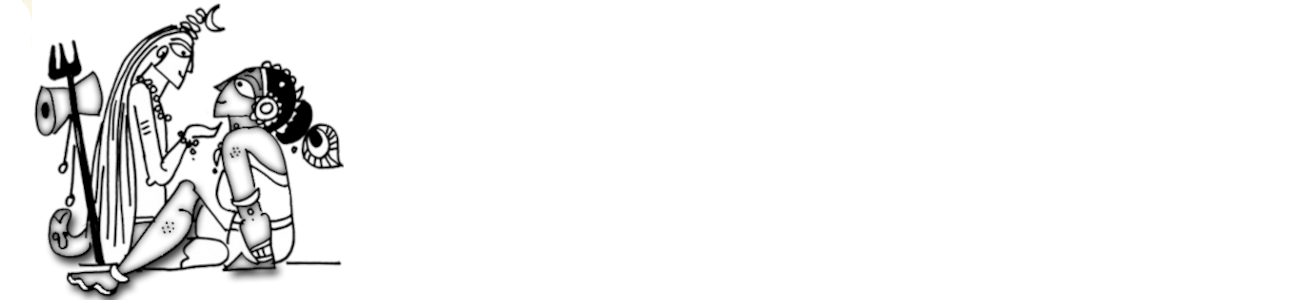
Krishna Kali Krishna Kali
Amma, Kali Kali, Krishna Krishna
Krishna Radha, Krishna Radha
Kali Kali, Krishna Kali
Kālī (काली, “the power of time”: The first of the ten Mahāvidyās. Kaali represents the power of time. She is the also the embodiment of all fear, while she herself is beyond fear and protects those from fear who invoke her. In Hindu iconology, she represents the supreme night, which devours all that exists. Kaali is depicted as a fearful goddess with four arms, standing over the corpse of Śiva. The ten Mahāvidyās are the emanations of Mahākālī, the Goddess of time and death.
There are several stories surrounding Krishna Kali, and how the two are as one.
The first states that during dwaparyug, Kaali took birth as masculine in the form of Krishna. "Krishna Kali" signifies the harmonious blending of the divine energies of Lord Krishna and Goddess Kali. It represents the union of divine love and fierce strength.
Another story tells In Vraja, every night Krishna would play his flute in the forests and Radharani would slip out of her house to meet Krishna. Radharani’s husband, Ayan, was unaware of this and Radharani’s sisters-in-law’s, Jatila and Kutila, informed her husband Ayan of what was happening.
This infuriated Ayan, and he went to catch Radharani red-handed. Krishna being aware of the future asked Radharani to collect wildflowers and fruits and sit down as if she was worshiping. Radharani did what Krishna asked her to do. Krishna then took the form of Kaali, the family goddess of Ayan.
When Ayan came to the woods and saw Radharani he saw her worshiping Kaali and was very pleased to see Radharani worship Kaali.
Yet another version is from the Brhadyoni Tantra, Krishna is said to be the manifestation of the goddess Kaali. She descended to Earth, placed her yoni (vulva) in the eye of the peacock’s tail feathers, and then incarnated in the womb of Devaki, Krishna ’s earthly mother. One day, when Krishna was in his divine play with the Gopis and Radha, he recognized the yoni in the peacock’s tail feathers, plucked one feather, and placed it on his head as a reminder of his divine femininity.
Krishna himself declares in the Bhagavad Gita that he is the Kaal. Bhagavad Gita (10.33) Krishna says ‘aham evākṣayaḥ kālo’ he is the Kaal. He repeats this in the (11.32) where he again confirms that he is Kaal the great destroyer of the worlds, kālo ’smi loka-kṣaya-kṛt pravṛddho lokān samāhartum iha pravrttaḥ.
Further more, the Tantrarājatantra, where it is said, that having already charmed the world of men as herself, Lalitā took a male form as Kṛṣṇa and then proceeded to enchant women. In this work, Krishna has six forms, identified with the six senses (including Mind). They are Kāmarāja Gopāla, Manmatha Gopāla, Kandarpa Gopāla, Makaraketana Gopāla and Manobhava Gopāla. Their meditation images (dhyāna according to the same work, describes them as being like dawn, with six arms, holding flute, noose, goad, sugar cane bow and a bowl of curds. These are the five arrows of Lalitā and the bow and here Kṛṣṇa is identified with Kameshvara, the Indian god of love, who is otherwise called Ananga, and, like Cupid, is armed with a bow.
The Kalivilasa Tantra states Kṛṣṇa was born as the son of Devi who was golden (Gauri) and turned black when he was excited by passion. In the Todala Tantra, each of the ten Mahavidyas, forms of the supreme Goddess, has her own male counterpart and Kṛiṣhṇa is said to be the spouse of Kālī.
Translations
| Sanskrit | English | Transliteration |
|---|---|---|
| कृष्ण | Krishna | Krishna |
| काली | Kali | Kali |
| कृष्ण | Krishna | Krishna |
| काली | Kali | Kali |
| अम्मा | Mother | Amma |
| काली | Kali | Kali |
| काली | Kali | Kali |
| कृष्ण | Krishna | Krishna |
| कृष्ण | Krishna | Krishna |
| कृष्ण | Krishna | Krishna |
| राधा | Radha | Radha |
| कृष्ण | Krishna | Krishna |
| राधा | Radha | Radha |
| काली | Kali | Kali |
| काली | Kali | Kali |
| कृष्ण | Krishna | Krishna |
| काली | Kali | Kali |