Jaya Radha Madhava
Krishna
Bhajan
Srila Bhaktivinoda Thakura
Sanskrit
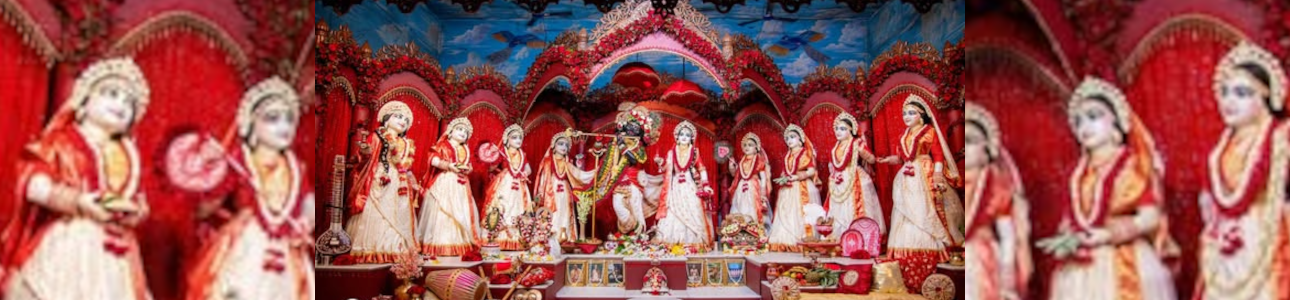
(Jaya) Radha-Madhava Kunja Bihari
Gopi-jana-vallabha Girivaradhari
Yashoda-nandana braja-jana-ranjana
Jamuna-tira-vana-cari
There are some... interesting translations of this bhajan, mostly citing Krishna(Madhava) as the lover of Radha.
he name Radha, in Sanskrit, means lustre, and is also the name of Krishnas eternal consort. In this instance, the etymology suggests this was originally meant as lustre, and not Radha, his favourite squeeze.
Because of changes in the language, "V" is often pronounced as "B".
Van Ke Vihari becomes Banke Bihari.
Ban/Van:Forest, Ke: (plural) Vihari:Dweller
One who dwells in the forests.
Bihari, in its original form means Supreme Enjoyer.
Jamuna/Yamuna in Sanskrit refers to a dwelling place, or resort, of celestial nymphs (apsaras), who live mainly on earth around rivers or on mountains, and in the courts of Gods.
Krishna was born to Devaki, but was given to Yashoda (Jasoda) and Nanda in Gokul, exchanging her daughter, Yogmaya, by Krishna's father(Vasudeva) on the night of His birth.
So, the translation of this will be:
Exhaltations to the lustrous person who likes to roam the bower, who is sweet like honey.
Exhaltations to the man who is lover of the Gopis.
Exhaltations to the lifting of the mountain (Govardan).
Exhaltations to the one who pleases and delights his mother Jasoda.
Exhaltations to the one who pleases a station of cowherds.
Exhaltations to the one who wanders the forests by the shores of the Jamuna River.
Translations
- [जय] Jaya: Victory
- [राधा] Radha: Radha
- [माधव] Madhava: Madhava (Krishna)
- [कुञ्ज] Kunja: Groves
- [बिहारी] Bihari: Wanderer
- [गोपि] Gopi: Gopi (cowherd girl)
- [जन] Jana: People
- [वल्लभ] Vallabha: Beloved
- [गिरिवर] Girivara: Govardhan Hill
- [धारी] Dhari: Holder
- [यशोदा] Yashoda: Yashoda
- [नन्दन] Nandana: Son
- [व्रज] Braja: Vraja (land of Krishna)
- [जन] Jana: People
- [रञ्जन] Ranjana: Delighter
- [यमुना] Jamuna: Yamuna (river)
- [तीर] Tira: Bank
- [वन] Vana: Forest
- [चारी] Cari: Wanderer
Music Notation
| 1 | & | 2 | & | 3 | & | 4 | & | 1 | & | 2 | & | 3 | & | 4 | & |
|---|---|---|---|---|---|---|---|---|---|---|---|---|---|---|---|
| Sa | - | Sa | Re | Ga | - | - | - | - | Pa | Ma | Ga | ReSa | Re | Ga | = |
| Ra | dha | Mad | ha | va |
| 1 | & | 2 | & | 3 | & | 4 | & | 1 | & | 2 | & | 3 | & | 4 | & |
|---|---|---|---|---|---|---|---|---|---|---|---|---|---|---|---|
| Ga | Re | Ma | Ga | Re | Sa | Ni | Sa | Ga | - | Re | Sa | NiPa | Ni | Sa | - |
| Kun | ja | Bi | - | ha | - | - | - | ri | - | - | - | - | - | - | Jai |
| 1 | & | 2 | & | 3 | & | 4 | & | 1 | & | 2 | & | 3 | & | 4 | & |
|---|---|---|---|---|---|---|---|---|---|---|---|---|---|---|---|
| Sa | - | Sa | Re | Ga | - | - | - | - | Pa | Ma | Ga | ReSa | Re | Ga | - |
| Go | pi | Ja | na | Val | - | ha | - | ba | - | - | - | - | - | - | - |
| 1 | & | 2 | & | 3 | & | 4 | & | 1 | & | 2 | & | 3 | & | 4 | & |
|---|---|---|---|---|---|---|---|---|---|---|---|---|---|---|---|
| Ga | Re | Ma | Ga | Re | Sa | Ni | Sa | Ga | - | Re | Sa | NiPa | Ni | Sa | - |
| Gi | ri | Va | ra | Dha | - | - | - | ri | - | - | - | - | - | - | - |
| 1 | & | 2 | & | 3 | & | 4 | & | 1 | & | 2 | & | 3 | & | 4 | & |
|---|---|---|---|---|---|---|---|---|---|---|---|---|---|---|---|
| Sa | - | Sa | Re | Ga | - | - | - | - | Pa | Ma | G | ReSa | Re | Ga | - |
| Yash | oda | Nan | - | da | na | Bra | ja | Ra | na | nan | da | na | aa | aa | - |
| 1 | & | 2 | & | 3 | & | 4 | & | 1 | & | 2 | & | 3 | & | 4 | & |
|---|---|---|---|---|---|---|---|---|---|---|---|---|---|---|---|
| Ga | Re | Ma | Ga | Re | Sa | Ni | Sa | Ga | - | Re | Sa | NiPa | Ni | Sa | - |
| Jam | una | Ti | ra | Va | na | Cha | - | ri | - | - | - | - | - | Jai |