Gayatri Mantra
Sāvitrī
Bhajan
Rig Veda
Sanskrit
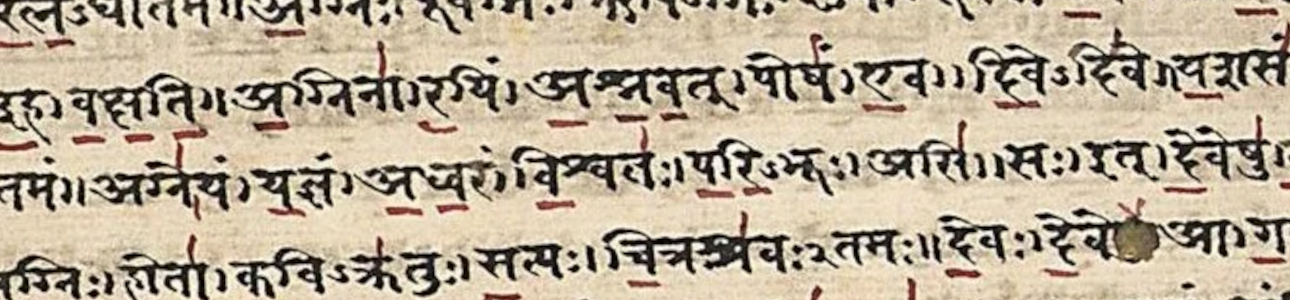
Aum Bhuur Bhuvah Svah
Tat Savitur Varennyam
Bhargo Devasya Dhiimahi
Dhiyo Yo Nah Pracodayaat
The mantra is dedicated to Savitṛ, the god of the rising sun (after rising, the sun is called Sūrya), and is therefore also known as the sāvitrī mantra.
The word gāyatrī has several meanings: it is the name of the famous vedic mantra, it is the poetic meter that the mantra is written in (consisting of 24 syllables, three lines of eight syllables each), and it is the name of the goddess who revealed the mantra to the sage Viśvāmitra. The word itself literally means “song of three” (gāya, “song” + tra, “three”), which itself has a double meaning: it can refer to the three lines of the mantra (and all mantras composed in the same meter), as well as to the goddess’s nature as being the combined essences of tridevī: Mahāsarasvatī, Mahālakṣmī, and Mahākālī (the respective consorts, or śaktis, of the Hindu trinity of Brahmā, Viṣṇu, and Śiva). Being the combination of these three śaktis, Gāyatrī is also considered Ādi Parāśakti, the supreme primordial energy.
The mantra is often preceded by the so called mahāvyāhṛti, the Great Declaration.
The mantra eminates from the Rig Veda (Mandala 3.62.10), dedicated to Savitr, the sun God.
The Taittiriya Aranyaka (2.11.1-8), states that this mantra should be prefixed with the syllable AUM and the three Vyahrtis (Bhu, Bhuvas, Svah).
To get a little deeper, in the Puranas, and Atharvaveda, there are fourteen worlds, seven higher worlds (Vyahrtis), and seven lower worlds (Patalas).
• Vyahrtis: Bhu, Bhuvas, Svar, Mahas, Janas, Tapas, and Satya.
• Patalas: Atala, Vitala, Sutala, Rasaataala, Talatala Mahaatala, Patala and Naraka.
The vyahritis also denote the seven planes of consciousness.
The mantras are prayers directed to the elemental forces on the seven planes.
These elemental forces are manifestations of the Parabrahman.
The seven worlds are embodied in the trinity of bhur, bhuvah, and svah.
• Bhur or bhu represents earth or the physical plane.
• Bhuvah represents the sky or astral plane.
• Svah represents heaven or the mental plane.
• Maharloka represents a higher plane.
• Janah represents the place of birth, a still higher plane.
• Tapah represents the mansion of the Blessed, an even higher plane.
• Satyam represents the abode of truth, the highest plane.
Now, things get a little trippy.
The book Tantrasara, Madhvacarya summarizes all this. There are twenty four syllables in gayatri (ta, tsa, vi, tuh, va, re, ni, yam, bha, rgo, de, va, sya, dhi, ma, hi, dhi, yo, yo, nah, pra, cho, da, yat).
These are called varnas, which are positioned by divine arrangement (see sacred geometry).
The twenty four varnas have corresponding governing forms of Vishnu/Krishna.
They are Keshava, Narayana, Madhava, Govinda, Vishnu, Madhusudana, Trivikrama, Vamana, Shridhara, Hrishikesha, Padmanabha, Damodara, Sankarshana, Vasudeva, Pradyumna, Aniruddha, Purushottama, Adhokshaja, Narasimha, Acyuta, Janardana, Upendra, Hari, and Shri Krishna respectively.
Translations
| Sanskrit | English | Transliteration |
|---|---|---|
| ॐ | The primeval sound | Aum |
| भूः | Earth | Bhuur |
| भुवः | Atmosphere | Bhuvah |
| स्वः | Heaven | Svah |
| तत् | That | Tat |
| सवितुः | Of the Sun | Savitur |
| वरेण्यम् | Most excellent | Varennyam |
| भर्गो | Radiance | Bhargo |
| देवस्य | Divine | Devasya |
| धीमहि | We meditate | Dhiimahi |
| धियो | Intellect | Dhiyo |
| यो | Who | Yo |
| नः | Our | Nah |
| प्रचोदयात् | May inspire | Pracodayaat |