AUM or OM
The Divine
Musings
Kevin Wild
Sanskrit
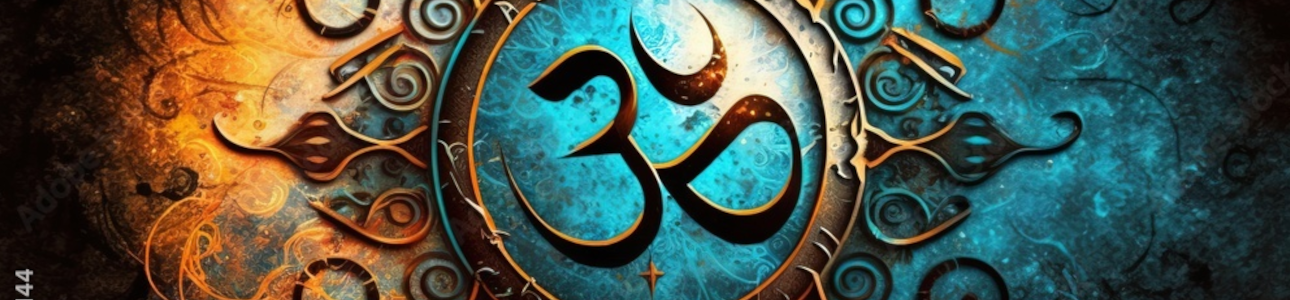
So, how did AUM become OM?Om:
Om (primordial sound) There is much confusion here. Firstly, many will call this Pranava Mantra. This is not quite correct, as only the M is Pranava. Secondly.. the spelling. How did AUM, a tri-sylabic mantra, be mono-sylabic? The answer lies in transliteration. The creating of english translations from sanskrit. The mantra is AA UU EEMM. and is written AUM, or, as most commonly seen, ॐAum:
Universal Vibration In the devanagari script, the A and U are combined, to create a single character, or a 'dipthong'. In this case, the letter O is a dipthong, a combination of two vowels into a single character. In english, we see this in with vowels, such as ou when used in the word 'sound', our 'hour'. As mentioned above, AUM is three syllables: A - as in far. U - as in moon. M - as in emma A (Akara), or अ when chanted, vibrates the navel and abdomen and is related to the waking state, and represents creation, or beginning. U (Ukara), or उ when chanted, vibrates the chest cavity and is related to dream states, and represents being. M (Makara), or म् when chanted, vibrates the throat and is related to a state of deep sleep. A quick note here, when the characters अ (A) and उ (U) are combined, they form औ (O), but still pronounced AA UU. The Mandukya Upanishad describes each of these syllables in detail, highlighting that the Atman or Self has four aspects, and is in truth Brahman, the Absolute Reality. Akara, the Self in the waking state, Vaishvanara. Consciousness is turned outward to the external world. Ukara, the Self in the Dreaming state, Taijasa. Consciousness is turned towards the inner world. Makara, the Self in the Deep Sleep state, Prajna. In this state, there is neither the desire for any gross or subtle object, nor any dreams. The forth state, is Turiya. Turiya is neither consciousness nor turned outward nor inward. Turiya beyond both cognition and the absence of cognition, and Pure Consciousness itself. This is why the Atman, and Brahman, are inseparable, and only through the illusion, do we see dualism. AUM namah Sivaya.
Om (primordial sound) There is much confusion here. Firstly, many will call this Pranava Mantra. This is not quite correct, as only the M is Pranava. Secondly.. the spelling. How did AUM, a tri-sylabic mantra, be mono-sylabic? The answer lies in transliteration. The creating of english translations from sanskrit. The mantra is AA UU EEMM. and is written AUM, or, as most commonly seen, ॐAum:
Universal Vibration In the devanagari script, the A and U are combined, to create a single character, or a 'dipthong'. In this case, the letter O is a dipthong, a combination of two vowels into a single character. In english, we see this in with vowels, such as ou when used in the word 'sound', our 'hour'. As mentioned above, AUM is three syllables: A - as in far. U - as in moon. M - as in emma A (Akara), or अ when chanted, vibrates the navel and abdomen and is related to the waking state, and represents creation, or beginning. U (Ukara), or उ when chanted, vibrates the chest cavity and is related to dream states, and represents being. M (Makara), or म् when chanted, vibrates the throat and is related to a state of deep sleep. A quick note here, when the characters अ (A) and उ (U) are combined, they form औ (O), but still pronounced AA UU. The Mandukya Upanishad describes each of these syllables in detail, highlighting that the Atman or Self has four aspects, and is in truth Brahman, the Absolute Reality. Akara, the Self in the waking state, Vaishvanara. Consciousness is turned outward to the external world. Ukara, the Self in the Dreaming state, Taijasa. Consciousness is turned towards the inner world. Makara, the Self in the Deep Sleep state, Prajna. In this state, there is neither the desire for any gross or subtle object, nor any dreams. The forth state, is Turiya. Turiya is neither consciousness nor turned outward nor inward. Turiya beyond both cognition and the absence of cognition, and Pure Consciousness itself. This is why the Atman, and Brahman, are inseparable, and only through the illusion, do we see dualism. AUM namah Sivaya.